RiseGuide Team
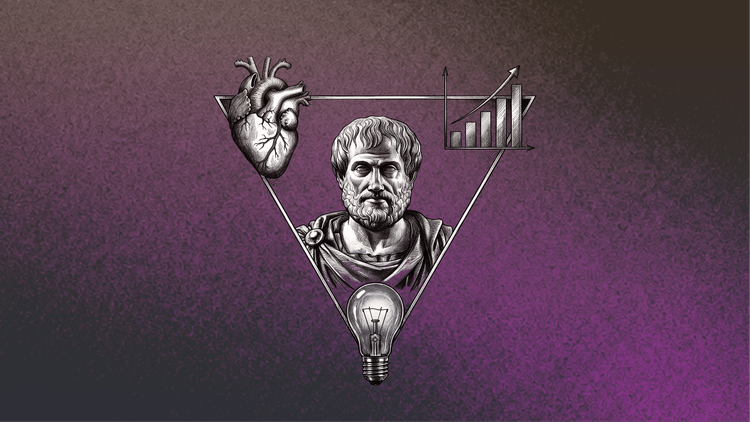
To use ethos, pathos, and logos, you earn trust (ethos), move people emotionally (pathos), and back your case with clear logic and evidence (logos), then combine all three and time them for the moment (kairos). Ethos is about who is speaking and why they are worth believing, pathos is about how the message makes people feel, and logos is the reasoning and proof behind it. The ads and speeches people remember, from Nike's athlete campaigns to Martin Luther King Jr.'s "I have a dream," use all three at once rather than leaning on any single one.
Someone is always trying to convince you of something, and you are usually trying to convince other people too, whether you are pitching an idea at work, writing a cover letter, or talking a friend into a weekend plan. Ethos, pathos, and logos are the three appeals Aristotle described more than two thousand years ago to explain how persuasion works, and they still shape the ads and speeches you come across every day. This guide covers what each appeal means, shows modern examples of all three, and explains how to use them together in your own talks and writing.
Ethos, pathos, and logos are the three ways a message can win over an audience. Aristotle set them out in his book Rhetoric, and they are still taught today as the three rhetorical appeals. Almost every piece of persuasion you meet uses some mix of them, even when no one planned it that way. As communication coach Carmine Gallo argues in Harvard Business Review, the appeals Aristotle named still sit underneath the way we persuade now.
Here is a short ethos pathos logos definition for each:
Put simply, the ethos pathos logos meaning comes down to three questions every audience asks:
A message that answers all three questions is more persuasive than one that covers only one of them.
"Ideas are the currency of the twenty-first century. The ability to persuade, to change hearts and minds, is perhaps the single greatest skill that will give you a competitive edge in the knowledge economy."
— Carmine Gallo
The clearest ethos pathos logos examples come from advertising and famous speeches, where persuading you is the entire job. Once you can spot the three appeals in someone else's message, they are much easier to use in your own. Here is how each one shows up.
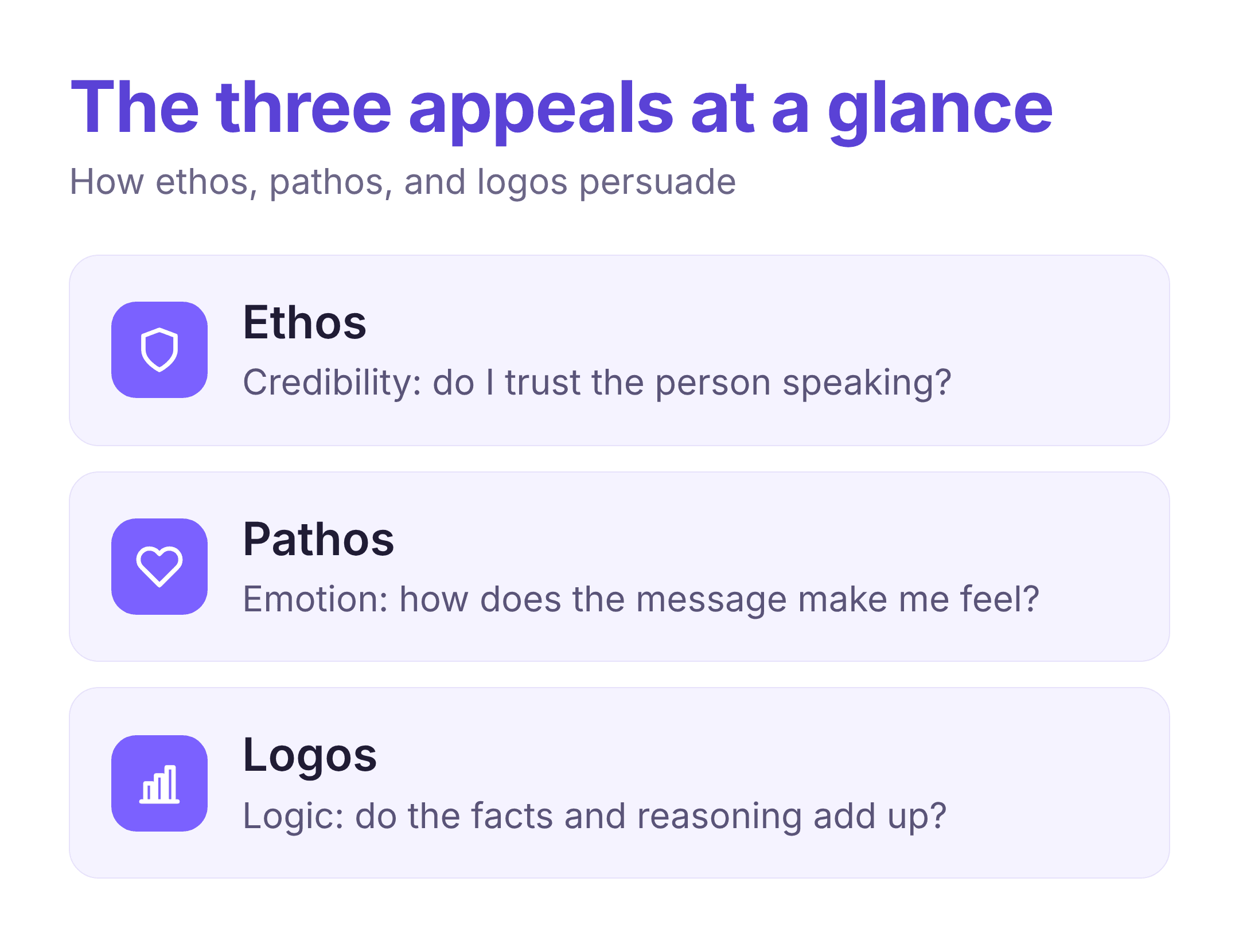
Ethos works by answering "why should I listen to you?" before the audience hears the rest of the message. Nike built much of its brand this way, pairing its products with the best athletes in the world so that their skill rubs off on the shoes. When a skincare ad puts a dermatologist on screen in a white coat, or a financial brand quotes its decades in business, that is ethos too. In a talk or a job application, your ethos comes from relevant experience, a track record, or simply showing you have done your homework on the topic. Presence helps as well, which is why the habits in our team's guide to being charismatic make a speaker easier to believe.
Pathos moves people by making them feel something, because most decisions are emotional before they are rational. Martin Luther King Jr.'s "I have a dream" is the classic example: it reaches for hope and justice rather than listing policy points. Brands lean on the same appeal when a commercial tells a small human story, a reunion or a first home, so the product rides along with the feeling. Pathos is powerful, but it has to be honest. Manufactured emotion reads as manipulation.
Logos persuades with reasoning and evidence: numbers, comparisons, and clear cause and effect. Geico's long-running line, "15 minutes could save you 15% or more on car insurance," is pure logos, a specific claim you can picture acting on. Phone makers do the same when they list battery life, camera specs, and prices side by side, and a charity does it when it shows you exactly how far a donation goes. Logos is what makes a case feel solid, but on its own it can be dry, which is why it works best alongside the other two appeals.
Aristotle described a fourth element that often gets left out, and it ties the others together. Kairos is timing: saying the right thing at the right moment, to the right audience. Together the four are sometimes called ethos pathos logos kairos. A strong argument delivered at the wrong time, or to people who are not ready to hear it, loses its force no matter how credible or well-reasoned it is. A weather app that reminds you to carry an umbrella is using kairos; so is a speaker who opens by naming exactly what the room is worried about that day. When you plan to persuade, kairos is the question of when and where, not just what.
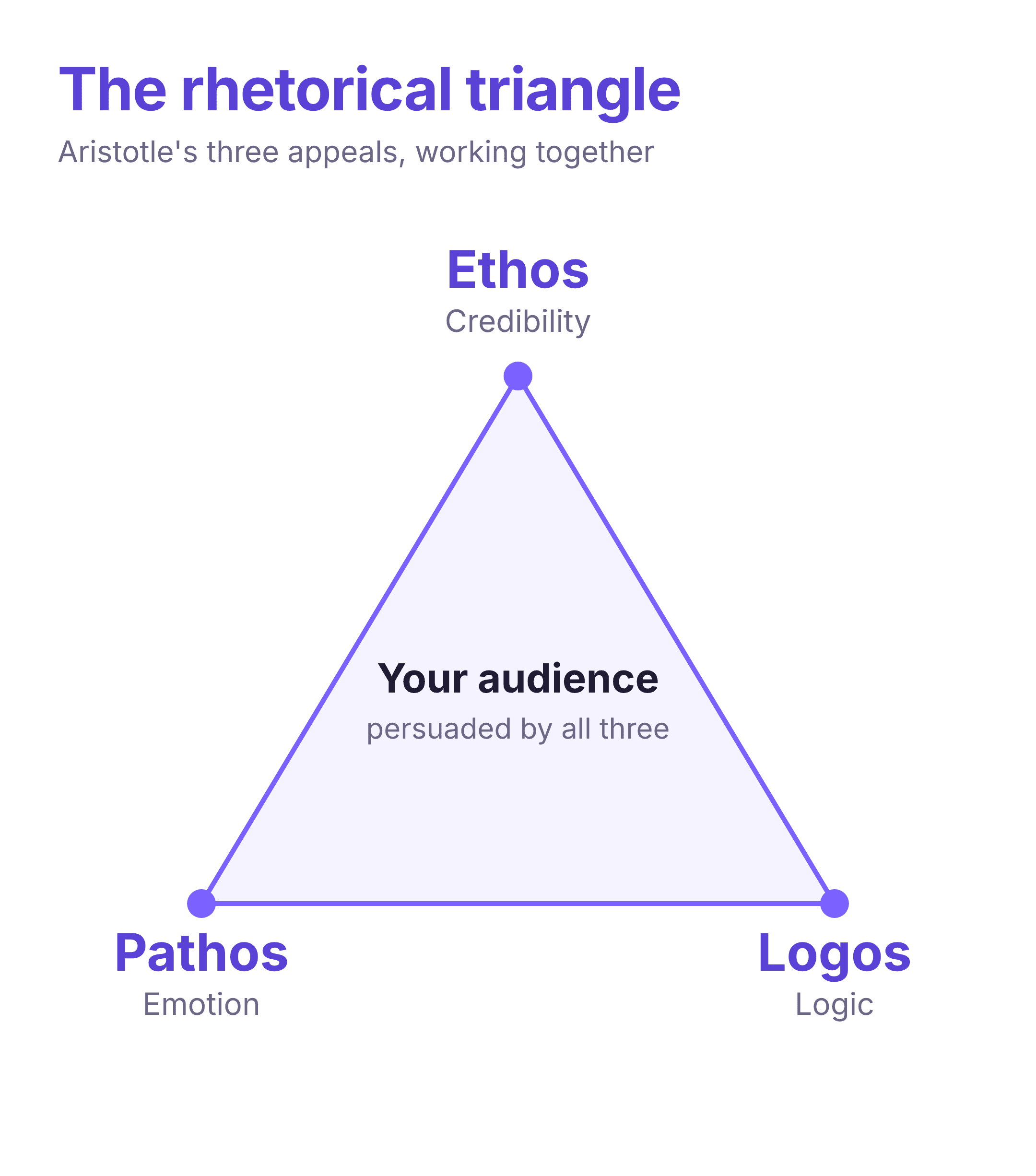
You do not need a stage to use ethos, pathos, and logos. The same three appeals work in a presentation, an email, a cover letter, or a conversation, and the strongest messages move through all of them rather than stopping at one.
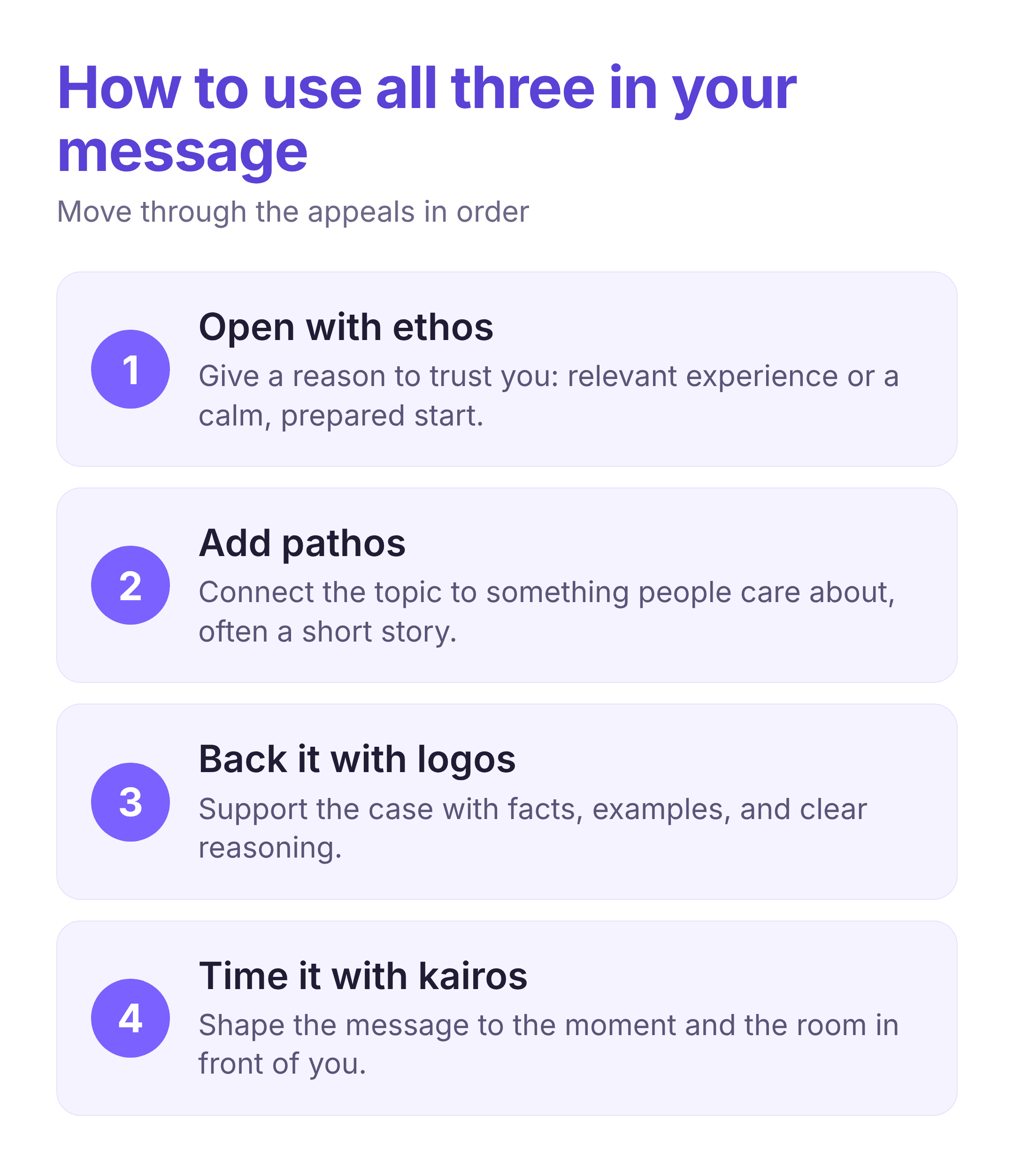
Start with ethos by giving the audience a reason to trust you early: a line about your experience, a sign you understand their situation, or just a calm, prepared delivery. Add pathos by connecting the topic to something people actually care about, often through a short, concrete story rather than a general appeal to "imagine." Support the case with logos, the facts, examples, and clear reasoning that let someone agree with you and defend the choice later. Then mind your kairos, shaping the message to the moment and the room in front of you.
The balance shifts with the setting. A wedding toast is mostly pathos; a research summary is mostly logos; a first meeting with a new client leans on ethos. If speaking is the skill you want to get stronger at, our team's guide to public speaking walks through how to practice, and our guide to workplace communication covers persuading colleagues day to day. If you would rather build the skill in short, structured lessons, RiseGuide's Communication Mastery journey breaks persuasion down into bite-size steps drawn from expert insights, so you can practice ethos, pathos, and logos in the gaps of a busy week.
Ethos, pathos, and logos are three questions every audience is already asking: can they trust you, do they feel it, and does it add up. The most convincing messages answer all three, then pick the right moment to make them. Watch for the appeals in the next ad or speech you find convincing, notice which one is doing the most, and use that same balance the next time you need to bring someone around.
Ethos appeals to credibility, pathos appeals to emotion, and logos appeals to logic. Ethos is about trusting the speaker, pathos is about how the message makes you feel, and logos is about whether the reasoning and evidence hold up. Most persuasive messages use all three.
A doctor recommending a treatment, a brand featuring a champion athlete, a speaker mentioning years of relevant experience, or a company pointing to its long track record. Each one builds trust before the main argument arrives.
Pathos is the emotional appeal, the part of a message that makes an audience feel something, while ethos is the credibility appeal and logos is the logical one. The three usually work together.
Ethos, pathos, and logos are the three classic rhetorical appeals, and kairos, the appeal to timing, is often added as a fourth. Together they describe who is speaking, how the message feels, what it argues, and when it is said.