RiseGuide Team

Improving at public speaking comes down to treating it as a skill you train rather than a talent you either have or don't. You build it by practicing in conditions close to the real thing, recording yourself and watching it back, asking a few trusted people for honest feedback, and repeating that loop often enough that the nerves stop running the show. Once that habit is in place, a handful of specific techniques — a strong opening, controlled pacing, real stories, warmth, and vocal variety — give you concrete things to practice each round.
You have probably read a list of speaking tips before, maybe several. And the next time you stood up to talk, most of what you read was gone.
That gap between knowing and doing is the real problem. Most advice hands you a list of things good speakers do and stops there, which leaves you with information you never turn into a habit. Reading about how to ride a bike has never taught anyone to ride one, and speaking works the same way. So before getting to the specific techniques, it helps to be clear on how the skill actually develops.
The honest answer is that you improve at public speaking the way you improve at anything physical and repeatable: through structured practice with feedback, repeated over time. Matt Abrahams, who lectures on communication at Stanford's Graduate School of Business, describes the process in three parts:
"We must take the time to dedicate to this improvement through repetition, reflection and feedback."
Those three parts give you a loop you can run again and again. The sections below break it into steps you can start this week.
Some people do seem to be born comfortable in front of a room, but comfort is not the same as competence, and competence is trainable. Psychologist Anders Ericsson's research on deliberate practice showed that expert performance across fields grows from focused, repeated effort aimed at specific weaknesses, not from raw talent or time served. For speaking, that means choosing one thing to work on at a time rather than trying to fix everything at once.
Rehearsing a talk silently in your head is the most common form of practice and one of the least useful. The skill you want is speaking out loud, on your feet, with something at stake, so your practice should look like that too. The effect is strong enough that even simulated audiences help: in a 2023 study, people who rehearsed public speaking in virtual reality improved their real-life performance, because the practice was close enough to the real situation to carry over. If you do not have access to a real audience, stand up, speak the whole thing aloud, and imagine the room.
Reflection is hard to do from memory, because how a talk felt rarely matches how it landed. Recording solves that. Film a few minutes on your phone and watch it once for content, then a second time with the sound off to see your body language, then a third time listening only to your voice. This is roughly the method Abrahams has his own students use, and it surfaces habits you would never catch in the moment.
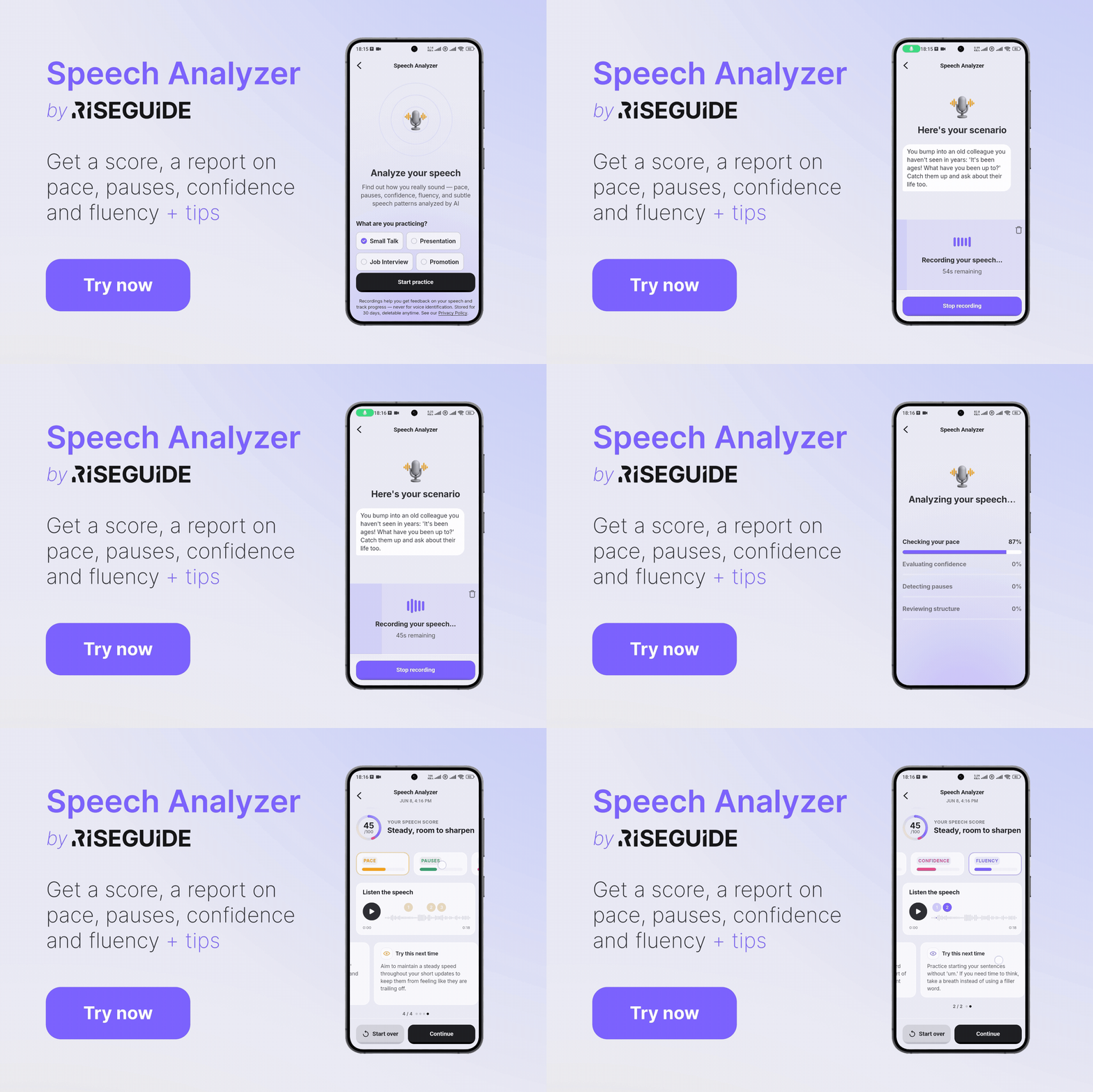
Watching yourself back works, but it is slow and easy to misjudge. RiseGuide's Speech Analyzer reviews a recording of you speaking and points out where your pacing, filler words, and clarity slip, so your practice time goes toward fixing the right things.
[speech analyzer banner]
Your own review only goes so far, since you cannot hear yourself the way an audience does. Ask one or two people you trust to watch you and tell you the single thing that would most improve the talk. A specific question gets you a useful answer, where "how was it?" tends to get you a polite one.
Each pass through practice, review, and feedback makes the next talk a little easier. The point is to keep the loop turning in settings that count, starting small and working up. A question raised in a meeting, a toast, a short update to your team - each one is a chance to run the cycle again.
Once you have a practice loop running, you need specific things to work on inside it. These are public speaking tips drawn from people who speak for a living, each with a reason it works and a way to rehearse it.
Many speakers spend their first thirty seconds clearing their throat: thanking the committee, apologizing for nerves, reading out the agenda. Attention drifts before the real content arrives. Strong speakers use the first sentence to give the audience a reason to listen. When Steve Jobs gave his 2005 Stanford commencement address, he opened without any preamble:
"Today I want to tell you three stories from my life. That's it. No big deal. Just three stories."
Chris Anderson, who has run TED for years, argues that the opening job of any talk is to make the audience care before you give them information. We pulled apart the rest of that talk in our breakdown of Steve Jobs's Stanford speech. To practice it, write your first line last, once you know what the talk is really about, and try a few openings out loud to hear which one makes someone lean in. It's also why the old advice to open with a joke is risky; speaking coach Ian Hawkins explains what great communicators do instead - walk on, own the space, and simply say hello.
Nerves make us speak faster, and a rushed delivery reads as anxiety to a listener. Slowing down and leaving deliberate silences does the opposite, signalling that you are in control and giving the audience time to absorb what you said. Winston Churchill marked pauses into his speaking notes the way a composer marks rests. A 2022 study on how pause duration shapes impressions of a speaker found that well-placed pauses raise how competent and trustworthy an audience judges you to be. Mark two or three spots in your notes where you will stop completely and count to two; it will feel far longer to you than to anyone listening.
Audiences forgive a lot when they can tell you mean what you say. Carmine Gallo, who studied dozens of the most-watched TED talks for his book Talk Like TED, found that real passion and a story to carry it were the traits the best speakers had in common. There is a reason a story outperforms a statistic, and it has a name in psychology: narrative transportation, the way a listener gets pulled into a narrative and processes it almost as lived experience. Brené Brown captured the same idea when she described her work as a researcher:
"Maybe stories are just data with a soul."
Find the one moment or example you would happily tell a friend over coffee, and build your point around that rather than around the bullet list. If lines like Brown's stay with you, we collected more of them in our roundup of communication quotes.
First impressions from a stage form fast, and they form in a particular order. Vanessa Van Edwards, who runs the behaviour-research lab Science of People, teaches that audiences read warmth before they read competence: they decide whether they like and trust you, and only then weigh whether you know your subject. A speaker who opens cold and impressive can lose the room before the content has had a chance. A smile, some eye contact, and a sentence that acknowledges the people in front of you settle an audience more than another credential does.
A flat, single-note delivery makes even strong material hard to follow. Speaking teacher Vinh Giang trains people to use the voice deliberately, working with pitch, pace and volume rather than leaving them on autopilot. Dropping your pitch slightly at the end of a sentence lands it as a statement instead of a question, and lowering your volume can draw an audience in more than raising it. To hear your own patterns, record two minutes of your talk and play it back with your eyes closed, listening for where the sound goes flat.
Think back to the talk where everything you knew disappeared the moment you stood up. More tips were never going to fix that on their own; what changes things is running the practice loop until the techniques hold up under pressure. Choose one technique, use it this week somewhere small, and watch what shifts.
Most people notice a difference within a few weeks of regular, deliberate practice. The pace depends far less on natural talent than on how often you practice in realistic conditions and review how it went.
Begin where the stakes are low: a comment in a meeting, a toast among friends, a short recording for your eyes only. Nerves ease through repeated exposure, which is why structured practice works better than waiting to feel ready.
No. Memorizing your opening line and main points, then speaking the rest in your own words, sounds more natural and lets you read the room. Full memorization often makes delivery stiffer.