
RiseGuide Team

To reach self-actualization, you work toward becoming the fullest version of yourself: using your talents, living by your own values, and growing into your potential instead of just getting by. It sits at the top of Maslow's hierarchy of needs, above food and safety, belonging, and esteem, and the idea is that once your more basic needs are reasonably met, you're freed up to pursue growth, meaning, and the work only you can do. Self-actualized people tend to share traits like self-acceptance, honesty, a clear sense of purpose, and the ability to enjoy the present. You move toward it in practice by meeting your foundational needs, getting to know yourself honestly, using your strengths on something that matters to you, and treating it as a direction you keep walking rather than a finish line you cross.
Most people spend their lives meeting needs: paying rent, staying safe, keeping relationships steady, earning some respect. Those matter, and they take up most of our attention. But underneath them sits a bigger question: are you actually becoming who you could be, or just getting by? That question is what the psychologist Abraham Maslow was pointing at with the term self-actualization, the idea at the top of his famous pyramid of human needs. It gets used loosely, so this guide lays out what it really means, where it fits in Maslow's hierarchy, what it looks like in real people, and, most usefully, how to actually move toward it.
Self-actualization is the process of becoming everything you're capable of becoming: realizing your potential, using your talents, and living in line with your own values rather than other people's expectations. Maslow put it simply when he wrote, "What a man can be, he must be." The drive he was describing is the pull to do the work you're suited for, to grow, and to express who you really are.
It helps to be clear about what it isn't. Self-actualization isn't the same as success, wealth, or status, and it isn't a fixed state you arrive at and keep. It's closer to a direction than a destination. Someone living it isn't necessarily famous or rich; they're using their abilities fully, acting from their own values, and continuing to grow. That's why self-actualization is harder to pin down with a single label than with a description of how a person lives.
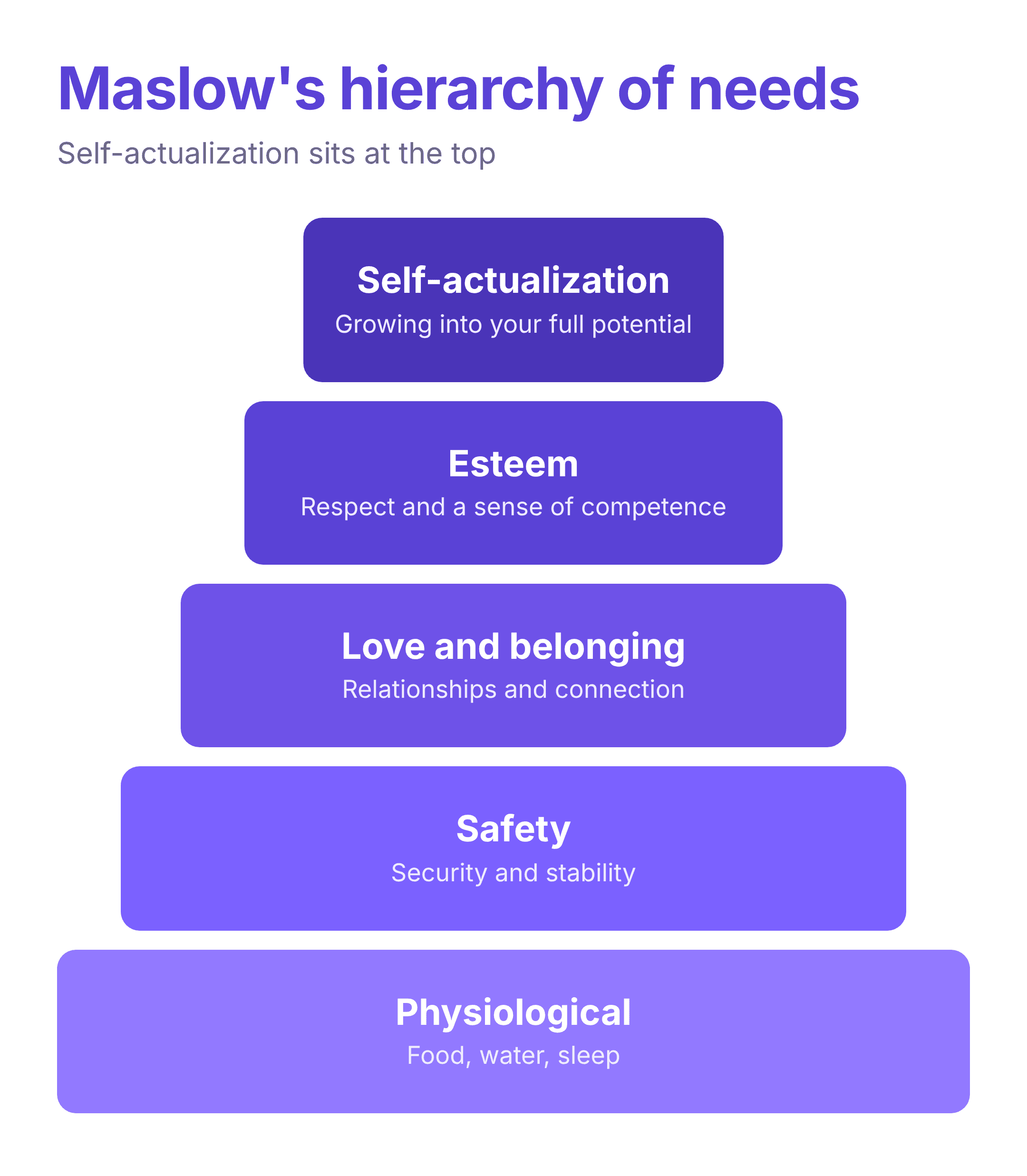
Maslow's hierarchy of needs is usually drawn as a pyramid with five levels. At the bottom are physiological needs (food, water, sleep), then safety (security, stability), then love and belonging (relationships, connection), then esteem (respect, recognition, a sense of competence). Self-actualization sits at the top. The self-actualization pyramid makes a simple claim: the lower, more basic needs tend to take priority, and once they're reasonably met, your attention is freed to pursue growth at the top.
In Maslow's model, self-actualization is the capstone, but it's worth knowing two things modern psychology has added. First, the levels aren't a rigid staircase. People pursue meaning and growth even while lower needs are unmet, and you don't have to "complete" belonging before you can create something. Second, Maslow later added the idea of self-transcendence, going beyond the self to connect with something larger, as a stage above self-actualization. The pyramid is a useful map, not a strict sequence.
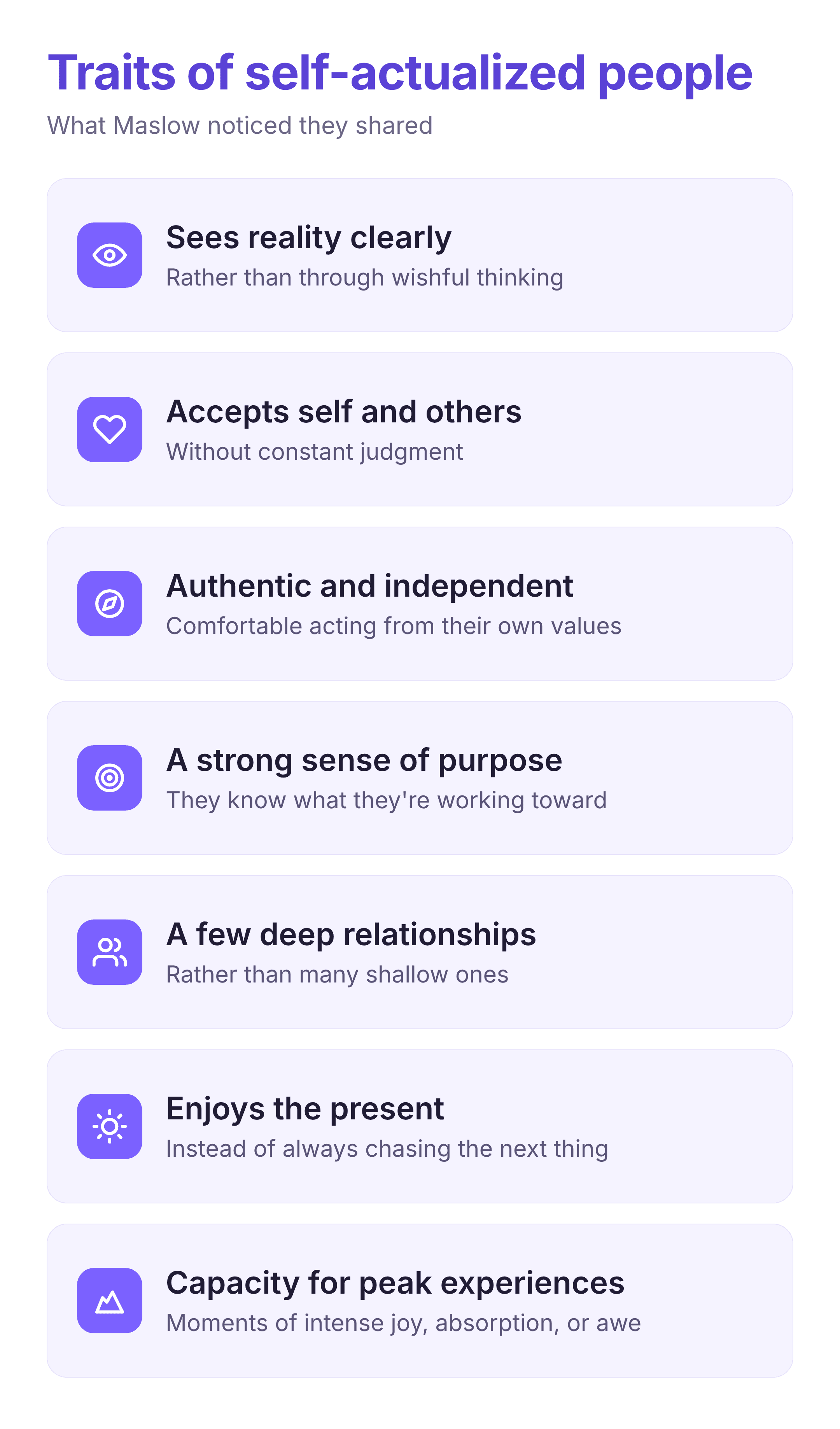
Maslow studied people he considered self-actualized and noticed they shared a set of traits. They saw reality clearly rather than through wishful thinking, accepted themselves and others without constant judgment, and were comfortable being independent. They had a strong sense of purpose, a few deep relationships rather than many shallow ones, and a capacity for what he called "peak experiences," moments of intense joy, absorption, or awe. They could also enjoy the present instead of always chasing the next thing.
Modern research has put numbers to this. The psychologist Scott Barry Kaufman built a measure of self-actualization from Maslow's writings and found that people who score higher on characteristics like authenticity, acceptance, purpose, good moral intuition, and a continued freshness of appreciation also report greater life satisfaction, stronger relationships, personal growth, and a clearer sense of meaning. The traits aren't just a philosophical ideal; they line up with measurable wellbeing.
Self-actualization examples are easier to recognize in how someone lives than in what they've achieved.
None of these require fame or money. What they share is a person using their abilities fully, acting from their own values, and growing, which is the real content of self-actualization.
This is where the concept becomes useful. You can't force self-actualization, but you can create the conditions for it and keep moving in its direction.
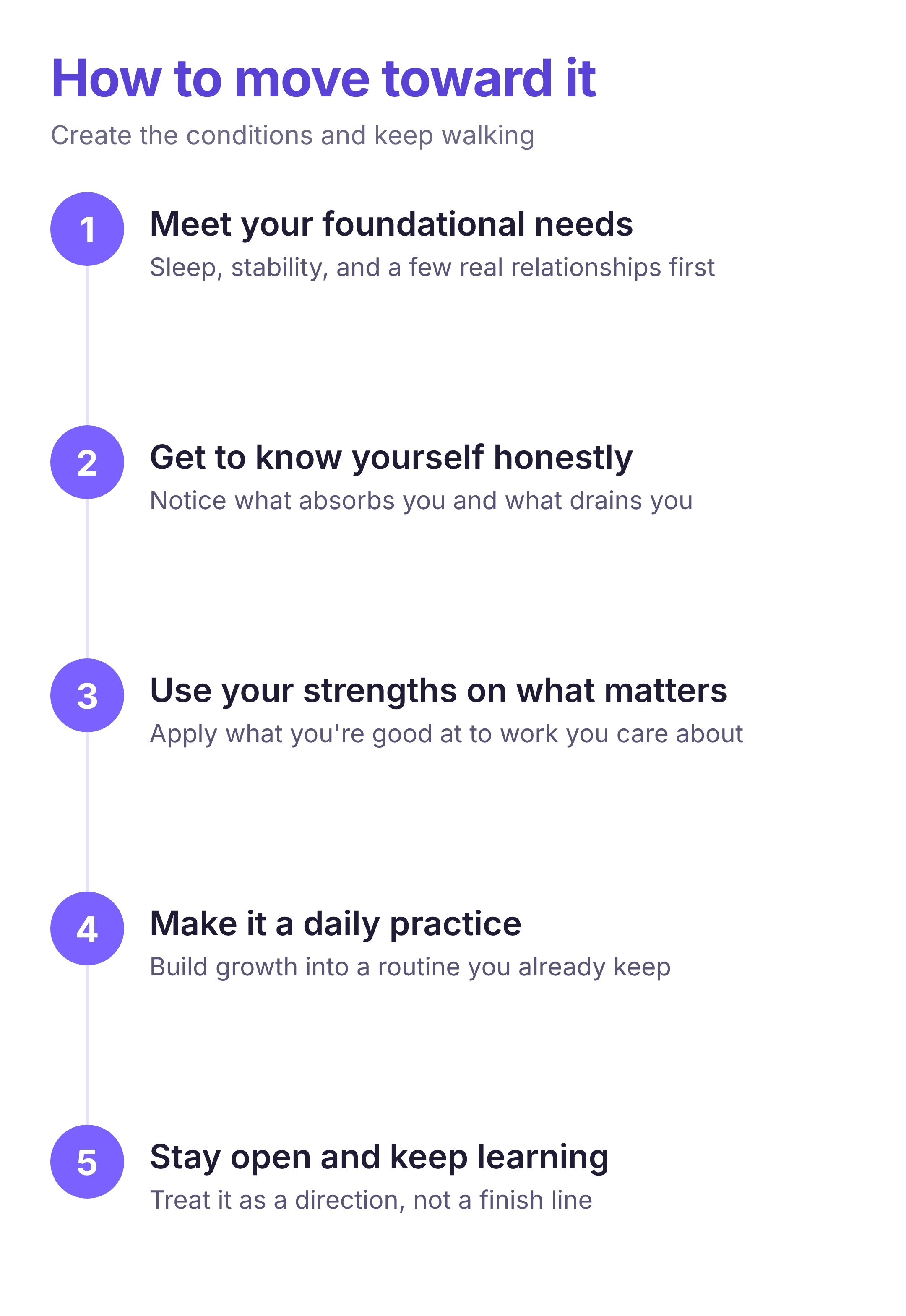
Meet your foundational needs first. It's hard to pursue growth when you're exhausted, unsafe, or isolated. Shoring up sleep, stability, and a few real relationships isn't a detour from self-actualization; it's the groundwork that frees your attention for it.
Get to know yourself honestly. You can't become your fullest self if you don't know what that self values, enjoys, and is good at. Pay attention to what absorbs you and what drains you. Reflection, journaling, and present-moment practices help here, which is part of why our roundup of mindfulness apps is a reasonable starting point for building that self-awareness.
Use your strengths on something that matters. Growth happens when you apply what you're good at to work you care about, and stretch a little past your current ability. Pointing that at a concrete aim helps, so setting goals you actually believe in, with the help of our goal-setting apps roundup if you want structure, turns a vague sense of potential into something you act on.
Make it a daily practice, not a someday project. Self-actualization is built in ordinary days, through steady habits rather than grand gestures, so attaching growth to a routine you already keep (even a simple morning routine like the one in our checklist) does more than waiting for a dramatic change.
Stay open and keep learning. The people Maslow studied kept a freshness of appreciation and a willingness to grow throughout their lives. Treat self-actualization as a direction you keep walking, not a box you check, and you're already doing it.
Self-actualization is a direction more than a finish line: becoming, over time, the fullest version of who you already are. Maslow placed it at the top of his hierarchy to show that growth is what we reach for once our more basic needs are steady, and modern research backs the idea that living this way goes with real wellbeing. You don't arrive at it in a single decision. You move toward it by meeting your needs, knowing yourself, using your strengths on something that matters, and treating growth as a daily habit rather than a far-off goal.
Being self-actualized means living close to your full potential: using your talents, acting from your own values, and continuing to grow, rather than simply meeting day-to-day needs. It's a way of living, not a status, and it looks different for each person.
A teacher who stays in a job that uses all her abilities and means something to her, rather than chasing a higher salary, is a common example of self-actualization. So is an artist who makes honest work, or anyone who feels most like themselves while doing something that fits their values.
Maslow thought relatively few people fully reach it, but that's partly because life keeps our basic needs in play. The more useful framing is that anyone can move toward it. It's a direction you walk rather than a finish line, and the steps above apply to almost anyone.
No. Success is usually measured from the outside, by money, status, or recognition. Self-actualization is measured from the inside, by whether you're using your abilities and living by your own values. You can have one without the other.