RiseGuide Team
To shift out of a scarcity mindset, start by noticing the thoughts that assume there is never enough, then question whether the limit is actually real, focus on what you already have instead of what is missing, make choices from your goals rather than from fear, and practice small acts of sharing or generosity that prove there is enough to go around. A scarcity mindset is the habit of seeing life as a shortage, of time, money, love, or opportunity, so you act to protect what you have instead of building more. The shift to an abundance mindset is a skill you build with practice, not a personality you are born with.
When you feel like there is never enough time, money, or opportunity to go around, small decisions start to feel high-stakes and other people's wins can feel like your losses. That pattern has a name, and it shapes more of our choices than we notice. Here is what a scarcity mindset is, how to spot it, what causes it, and how to shift toward abundance.
A scarcity mindset is the belief that there is never enough of something that matters to you, whether that is money, time, love, or chances to succeed. The scarcity mindset meaning goes beyond being careful with money. It is a lens that makes the world look like a fixed pie, where getting more means someone else gets less and holding on feels safer than reaching for more.
The scarcity mindset psychology is well studied. Research on the psychology of scarcity found that focusing on what you lack narrows your attention to the immediate shortage, a pattern the researchers call tunneling. It also taxes your mental bandwidth: in one study, the same farmers scored about 10 IQ points lower before harvest, when money was tight, than after it. Scarcity uses up the mental resources you need to think clearly and plan ahead.
The signs show up in how you think about having enough. You might recognize some of these scarcity mindset examples, and money is only one area where they appear.
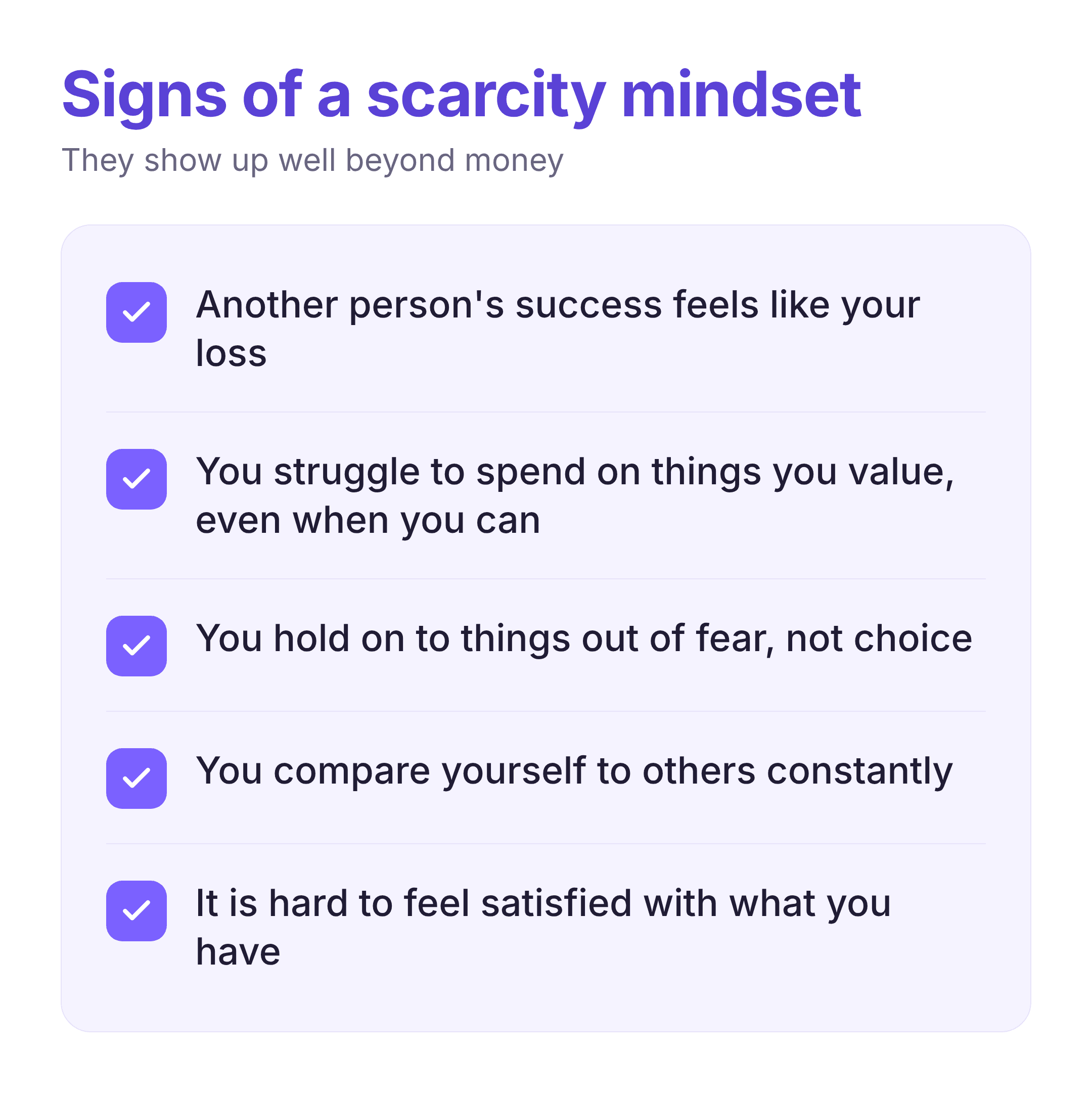
Common signs include feeling that another person's success takes something away from you, struggling to spend on things you value even when you can afford them, holding on to items, money, or relationships out of fear rather than choice, comparing yourself constantly to others, and finding it hard to feel satisfied because your attention stays on what is missing. A scarcity mindset about money might look like never feeling financially safe no matter the balance, while a scarcity mindset about time can make rest feel like something you have not earned.
A scarcity mindset usually comes from experience rather than character, and understanding the root helps you loosen its grip.
Real scarcity is the most direct cause. Living through a genuine shortage of money, food, or security teaches the brain to stay on guard, and that habit can linger long after things improve. Upbringing plays a part too, since growing up in a household where money or affection felt limited shapes what feels normal. Stress and uncertainty keep the pattern alive, because an unpredictable future makes holding on feel safer than sharing. And comparison feeds it, especially when a constant stream of other people's highlights makes your own share feel small. The way scarcity narrows your thinking also makes it self-reinforcing, since the same cognitive biases that focus you on the shortage make it harder to notice what you do have.
The opposite of a scarcity mindset is an abundance mindset, the belief that there is usually enough and more can be created. Understanding scarcity mindset vs abundance mindset is less about forced positivity and more about which assumption you bring to a situation.
| Scarcity mindset | Abundance mindset | |
|---|---|---|
| Core belief | There is never enough | There is usually enough, and more can be made |
| Other people | Their wins are my losses | Their wins do not shrink mine |
| Decisions | Made from fear of losing | Made from goals and values |
| Focus | What is missing | What is possible |
An abundance mindset does not mean ignoring real limits. Budgets and deadlines are real. It means not letting the feeling of shortage drive choices that a clear look at the facts would not support.
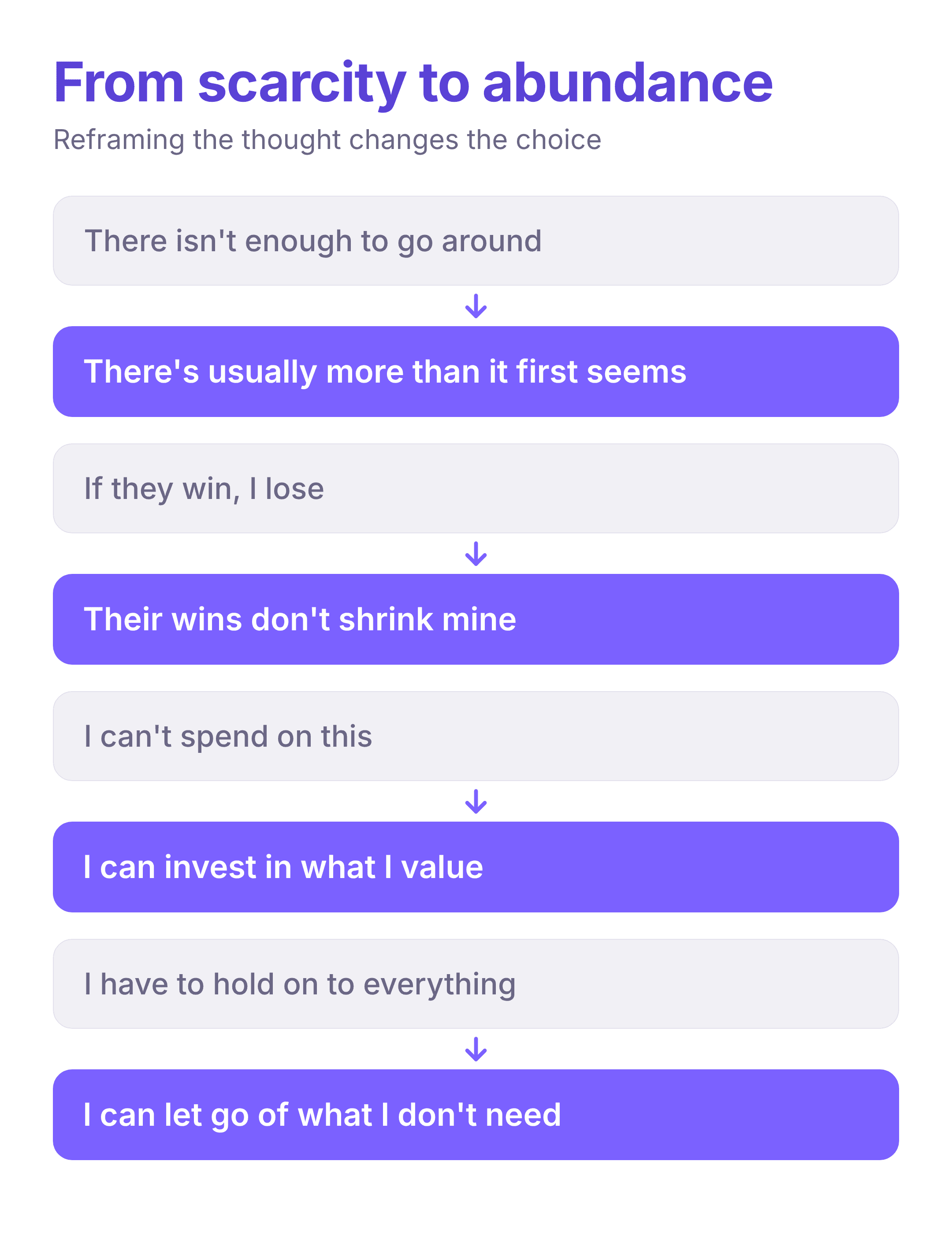
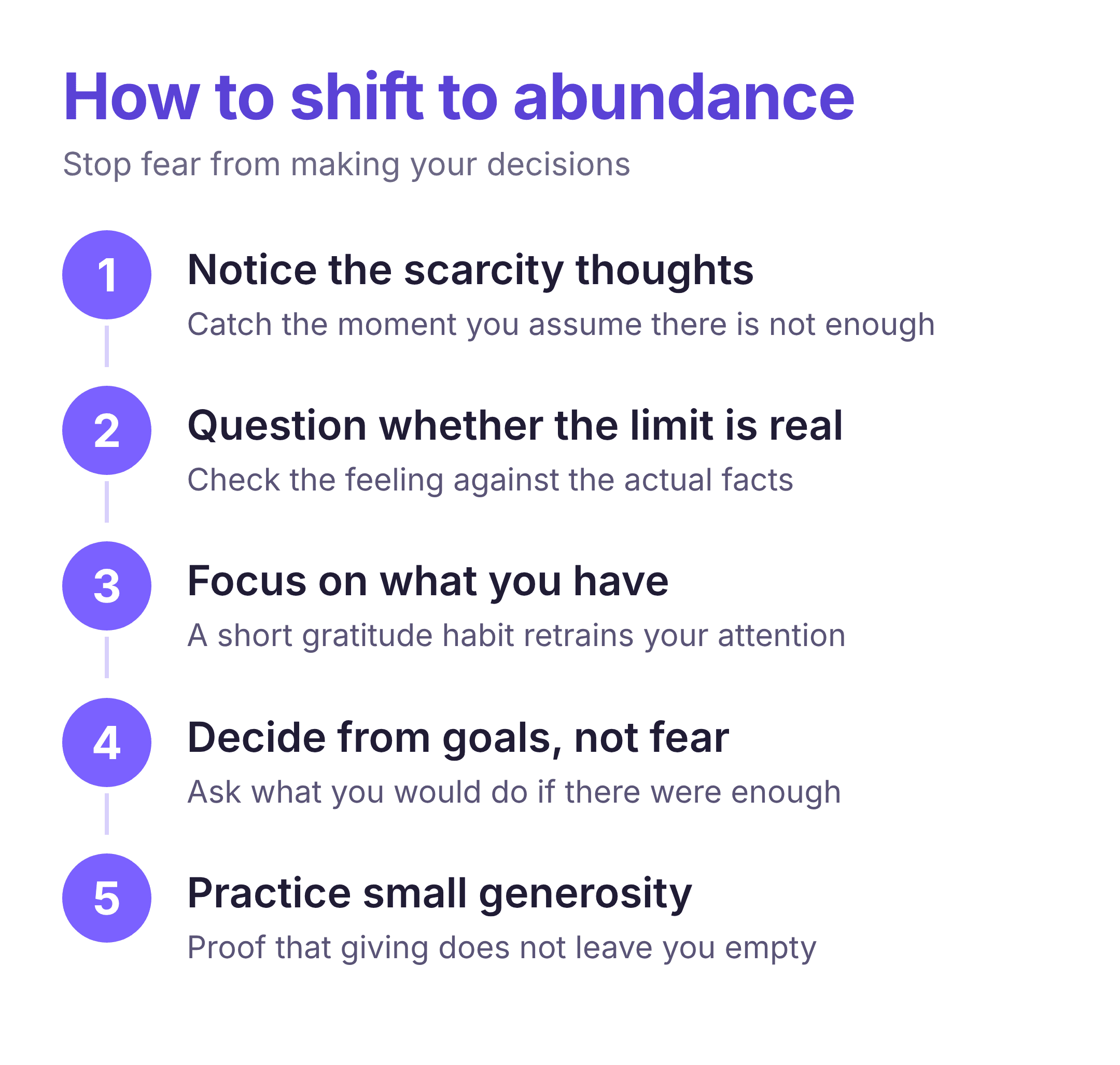
Here is how to overcome scarcity mindset in practice. The goal is to stop fear from making your decisions for you, while still respecting the limits that are real.
Start by noticing the scarcity thoughts. Catch the moment you think there is not enough, or that someone else's gain is your loss, and name it. Working through regular self-reflection makes these patterns easier to spot.
Then question whether the limit is real. Ask what evidence you actually have that there is not enough. Often the shortage is a feeling, not a fact, and checking it against reality loosens its hold.
Shift your focus to what you have. Scarcity keeps your attention on the gap, so deliberately noticing what is already enough, through a short gratitude habit or a simple daily list, retrains where your attention goes.
Make decisions from your goals, not your fear. Before a choice, ask what you would do if you trusted there was enough, then weigh that against the real facts. Treat yourself with self-compassion when old fears show up, since blame only deepens the sense of lack.
Practice small acts of generosity. Sharing time, help, or money in small, safe ways is direct evidence that giving does not leave you empty, which slowly rewires the belief underneath. Building these habits takes repetition, and short daily lessons in an app like RiseGuide can give you a steady way to practice the mindset and self-awareness skills behind the shift.
A scarcity mindset is a learned response to real experience, which means it can be unlearned. Changing it takes noticing the fear, checking it against the facts, and practicing small choices that prove there is enough. Over time, deciding from possibility instead of shortage becomes the more natural move.
A scarcity mindset is the belief that there is never enough of something important, like money, time, or opportunity. It makes you act to protect what you have rather than build more, and it can persist even when your situation is secure.
It usually comes from experience rather than personality. Living through real shortage, growing up where money or affection felt limited, ongoing stress, and constant comparison all teach the brain that resources are scarce and need guarding.
Notice the scarcity thoughts, question whether the limit is real, focus on what you already have, make decisions from your goals instead of fear, and practice small acts of generosity. It is a gradual shift built through repetition, not a single decision.
A scarcity mindset assumes there is never enough and treats others' gains as your losses. An abundance mindset assumes there is usually enough and that more can be created, so it makes room for other people to succeed too.