RiseGuide Team

To speak in public confidently, build the core presentation skills one at a time: shape the talk around a single clear message, plan an opening that steadies you, use your voice and eyes to hold the room, keep your posture open and calm, reset your nerves with a few simple habits, and watch the audience so you can adjust as you go. Confidence follows competence, so you practice each skill until it feels normal rather than waiting to feel ready.
Presentation skills are the specific things you do before and during a talk that decide how it lands: how you organize it, how you use your voice and body, how you manage nerves, and how you connect with the people in front of you. Speaking in public is not a fixed talent you either have or you don't. It is a set of skills, and skills can be learned with practice. This guide walks through the skills that matter most and how to build each one.
Standing up to talk triggers a real physical response. Your body reads a room full of eyes as a kind of risk, so your heart speeds up and your breathing goes shallow. That reaction is normal, and it fades once you have a few reps behind you, which is why the goal is steady practice rather than a one-time fix. You can improve public speaking the same way you build any physical skill, through repetition and feedback.
The second reason is a belief rather than a body signal. Many people assume a good talk has to be flawless, so every small stumble feels like proof they are failing. Audiences do not need perfect. They need to follow you and feel that you mean what you say, and that takes the pressure off far more than aiming for a spotless performance.
These skills build on each other, but you do not have to master them in order. Pick the one that would help your next talk the most, work on it until it feels natural, then add another.
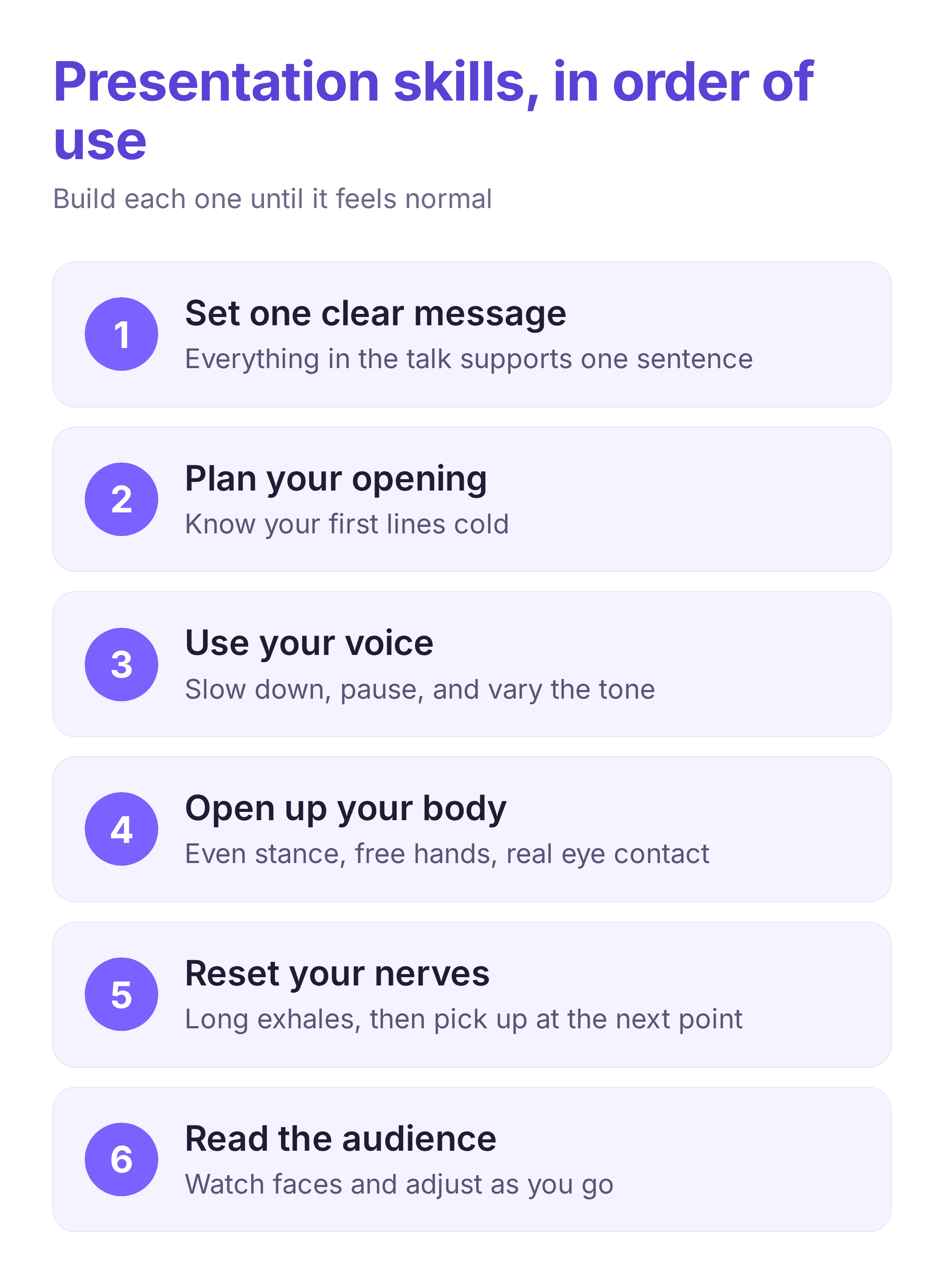
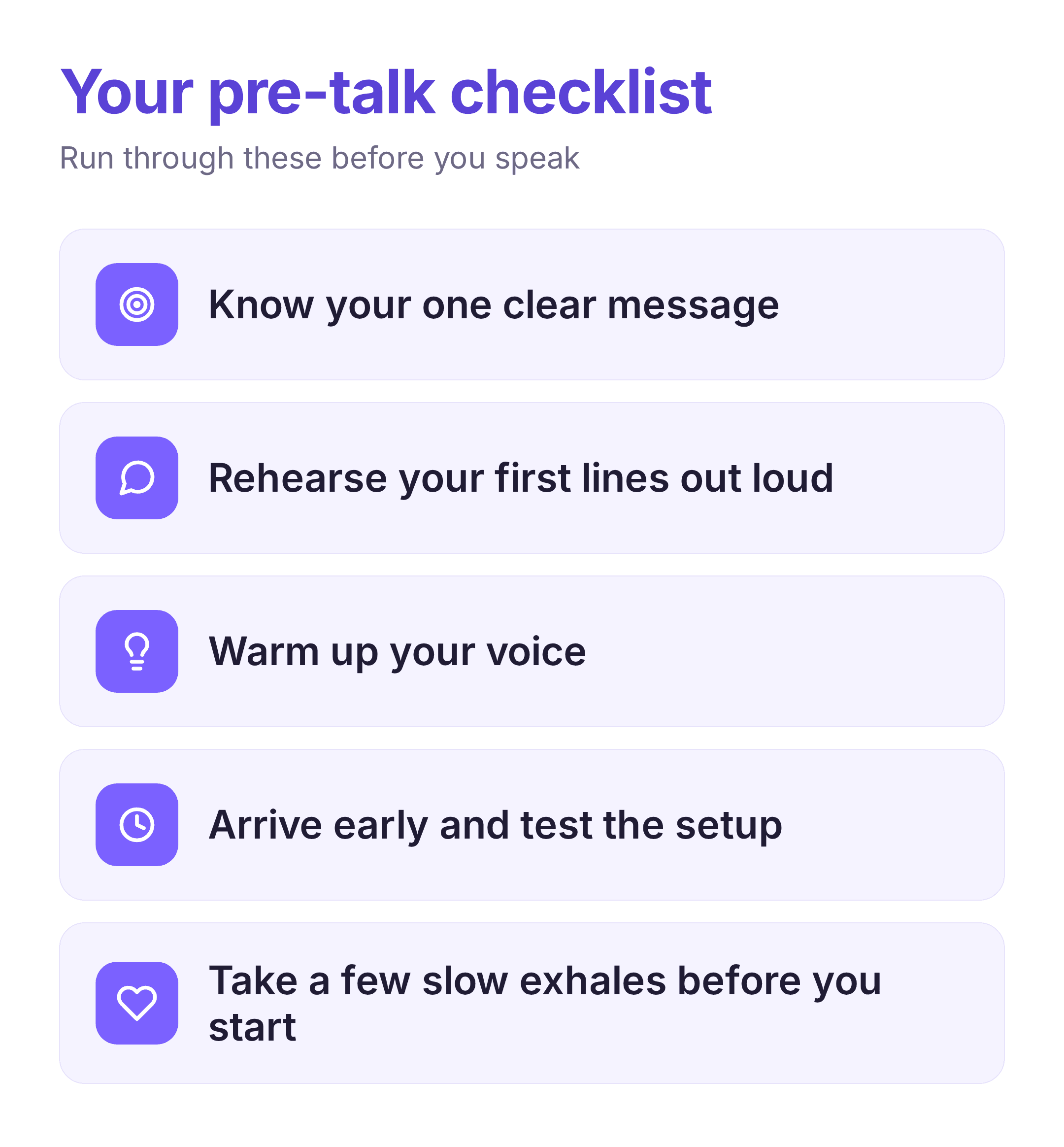
Before you think about delivery, get clear on the single thing you want people to remember. Write it in one sentence, then treat every section as support for that sentence. A talk built on one message is easier for the audience to follow and much easier for you to hold in your head, so you rely less on notes and feel steadier on your feet. When you know exactly where you are going, a lost word or a skipped point stops feeling like a disaster.
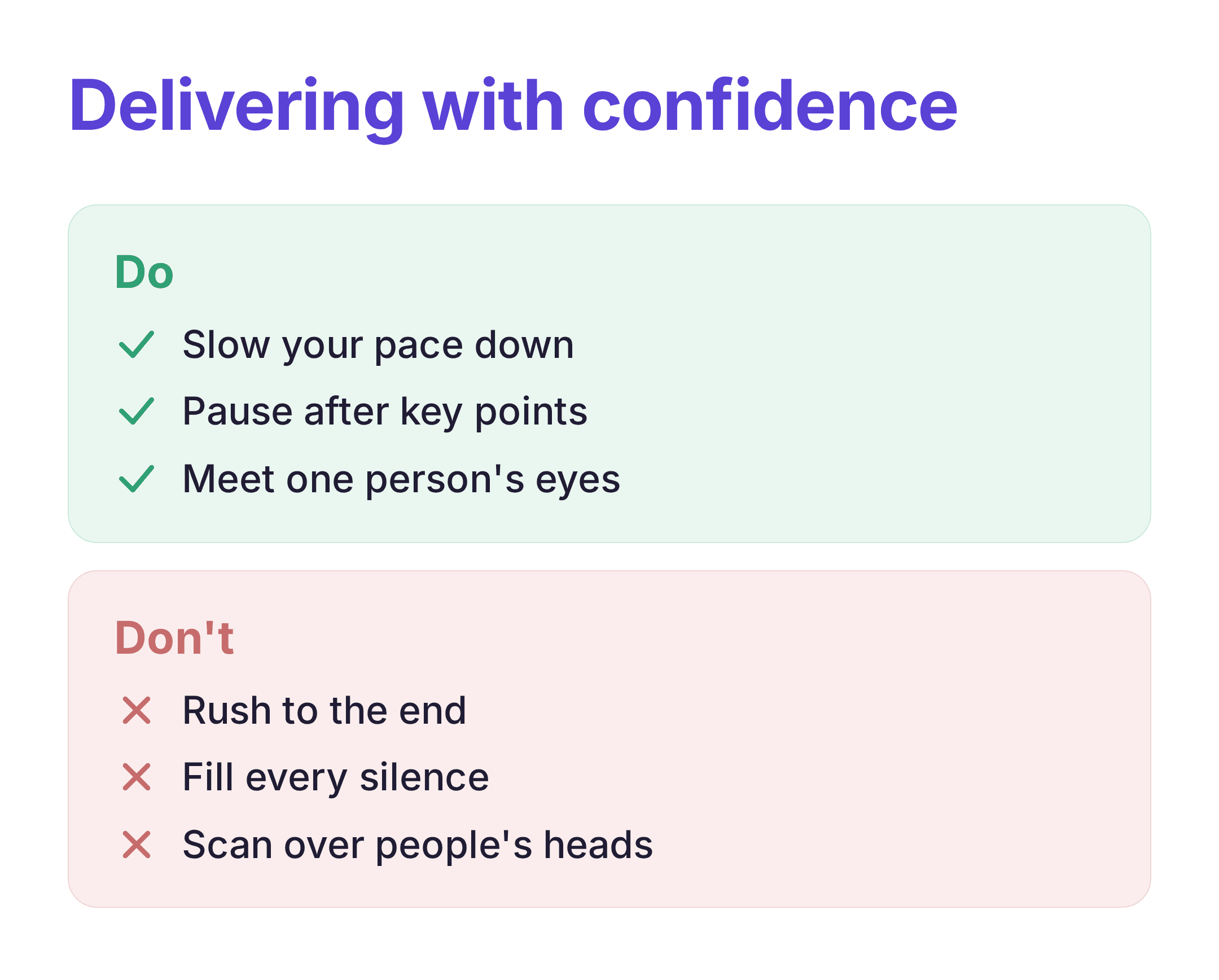
The first thirty seconds are where nerves peak, so decide in advance exactly how you will start. A specific plan, whether it is a short story, a plain statement of what you will cover, or a question you pose to the room, gives you a running start instead of a blank moment. Knowing your first lines cold means you begin on solid ground, and the calm you build in those opening seconds tends to carry into the rest of the talk.
How you say something carries as much as the words. Slow down more than feels natural, because most people speed up under nerves, and let yourself pause at the end of a key point rather than rushing to fill the silence. Vary your volume and pace so your voice does not flatten into a monotone. These are the parts of delivery you can rehearse out loud on your own, or with one of the public speaking apps built to give you feedback on pace and filler words.
Your body tells the room how you feel before you finish your first sentence. Stand with your weight even and your shoulders open, keep your hands free to gesture instead of gripping the podium, and hold eye contact with one person at a time rather than scanning over heads. These same signals help you look more confident even on a day when you do not feel it, and moving with a bit of purpose also burns off some of the nervous energy.
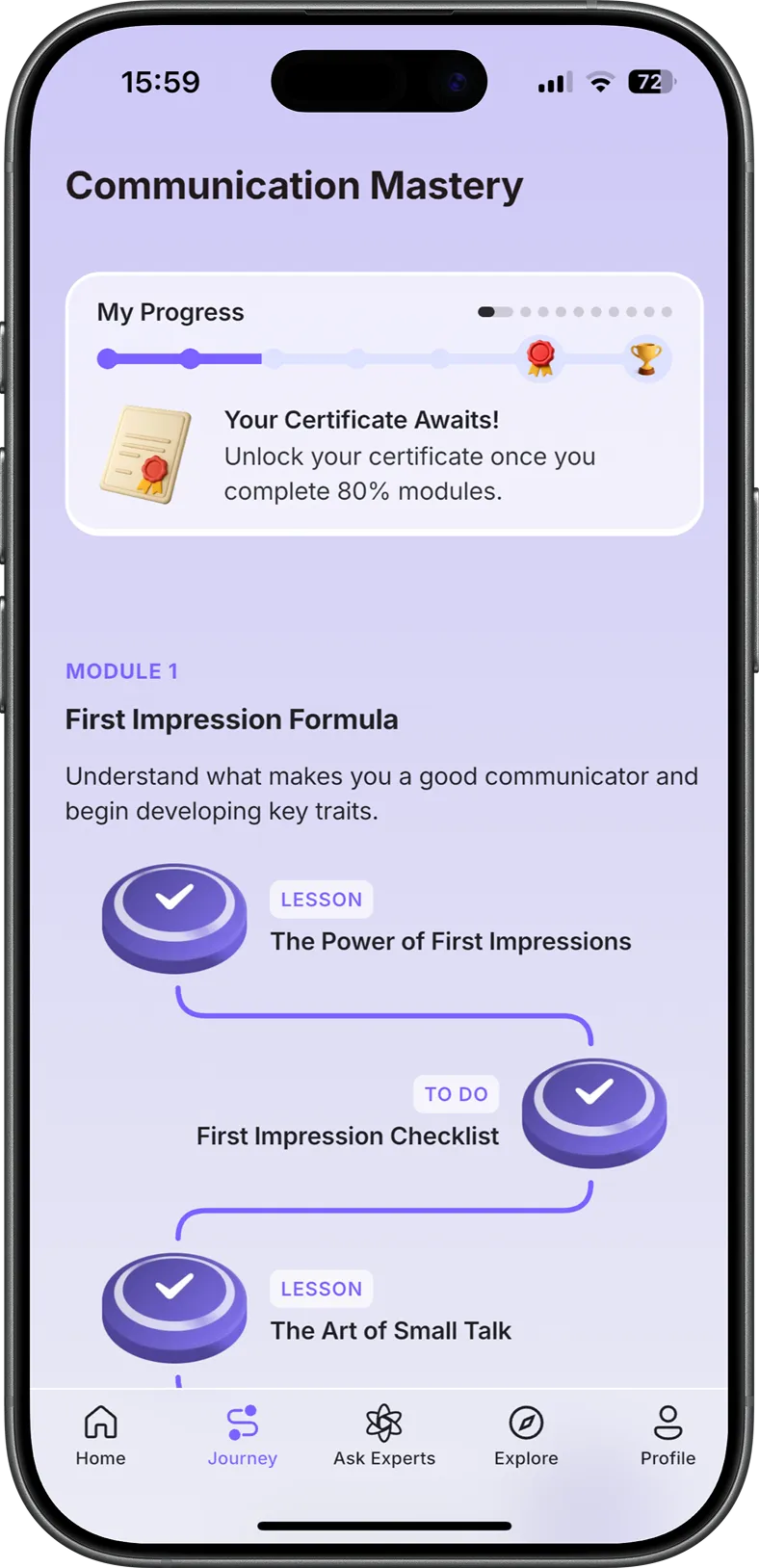
You cannot switch nerves off, but you can settle them. Before you start, take a few slow breaths out, which is the part that calms your system. If your mind races mid-talk, pause, look at your notes, and pick up at the next point rather than trying to rescue the last one. It helps to treat the physical buzz as readiness rather than fear, since the sensations are nearly the same and the label you give them changes how they feel. If communication is the area you want to train, the Communication Mastery journey in RiseGuide breaks these habits into interactive, expert-built micro-lessons of about fifteen minutes.
A talk is a conversation with a lot of people, not a recital. Watch faces as you speak: if people look lost, slow down or restate the point in plainer words; if they lean in, you are on the right track. Speaking to individuals one at a time, rather than to a blur, makes the room feel smaller and warmer, and it is a large part of what reads as charisma on a stage.
These skills grow through reps, so look for low-stakes chances to practice: speak up in meetings, offer the toast, record yourself on your phone and watch it back. Choose one skill to focus on each time instead of judging the whole performance at once, and ask a couple of people you trust for one specific piece of feedback. That steady loop of practice and feedback is what turns a set of techniques into the way you naturally present.
Speaking in public confidently comes down to a handful of learnable skills and enough practice that they stop feeling hard. Start with the one that would most help your next talk, work on it until it feels normal, and let your confidence grow out of the reps you put in.
The ones that shape how a talk lands: organizing it around a clear message, delivering it with a steady voice and open body language, managing nerves, and reading the audience so you can adjust. Preparation and delivery matter more than clever slides.
Being shy does not stop you from speaking well. Lean on preparation: know your message and your opening cold, practice out loud, and start with small, low-pressure chances to speak so each one makes the next feel easier.
Shaking usually comes from shallow, fast breathing. Slow your breathing before you start, focus on longer exhales, and slow your pace once you begin. Pausing on purpose also gives your voice a moment to settle.
Most people notice a difference within a few focused reps, not months. The change comes from practicing specific skills with feedback rather than from the number of talks alone.