
RiseGuide Team

To build a night routine that actually helps you sleep, keep the same bedtime every day, then give yourself the last 30 to 60 minutes to wind down: dim the lights and put screens away, cool down with a warm shower and a cooler bedroom, stop caffeine by mid-afternoon, do one calm thing like reading or stretching, and set up tomorrow so your mind can let the day go. Run the same short steps in the same order each night, and keep a simple checklist nearby so it becomes automatic.
Most of us don't decide how our evenings end. We mean to sleep, then the day spills over: one more episode, one more scroll, a slow drift to bed with a busy head. A night routine is the fix for that drift. It's a short, repeatable wind-down that tells your body the day is over and sleep is next, and it matters more than most people think. The CDC says adults need 7 or more hours of sleep a night, and the hour before bed is where a lot of that sleep is won or lost.
This is a practical wind down routine you can start tonight. It works as a bedtime routine for adults with real schedules and limited time, and it pairs with your morning routine so both ends of your day support each other. Below are the reasons a routine works, the steps in order, a copyable checklist, and answers to the questions people ask most.
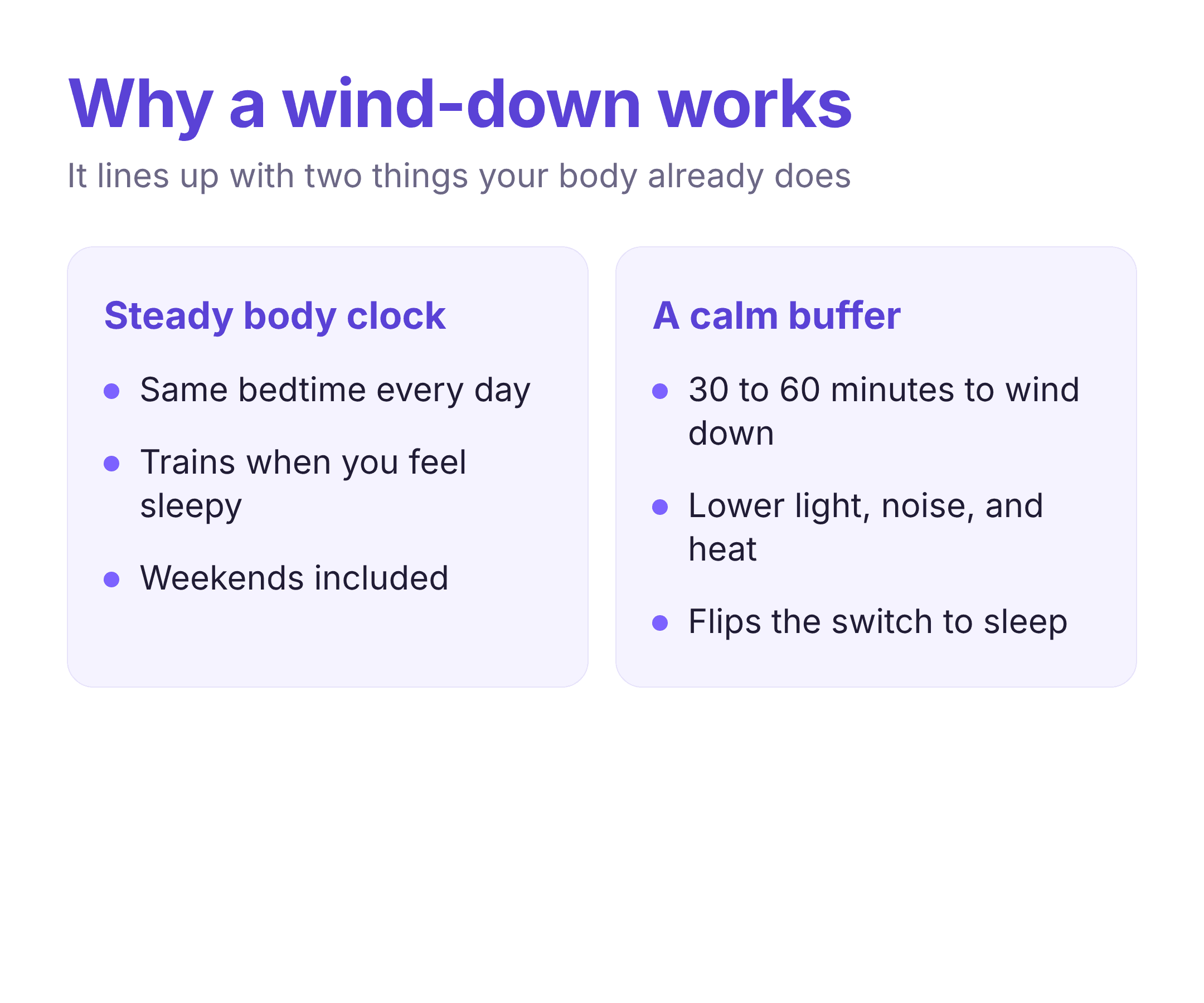
A good evening wind-down doesn't run on willpower. It works because of two simple things your body already does, and a routine lines up with both.
The first is your body clock. Sleep is easier when it arrives at the same time every day, because a steady schedule trains the internal timer that controls when you feel sleepy. The Sleep Foundation points to a consistent bedtime and a calming pre-sleep routine as two of the most effective habits for falling asleep faster. Sleep scientist Matthew Walker makes the same point plainly in Why We Sleep:
"Regularity is king, and will anchor your sleep and improve the quantity and quality of that sleep."
Walker lays out the broader case for protecting your sleep in his TED talk.
The second is the handoff from awake to asleep. You can't go from answering messages to deep sleep in one move. Your mind and body need a buffer — a stretch of lower light, lower stimulation, and lower temperature — so the switch has time to flip. That buffer is the whole job of a night time routine: it's the ramp down into sleep.
Order matters here, so treat these as steps rather than a loose list. You don't need all of them on night one. Pick the first two or three, run them for a week, then add more. The aim is a wind-down you can repeat without thinking.
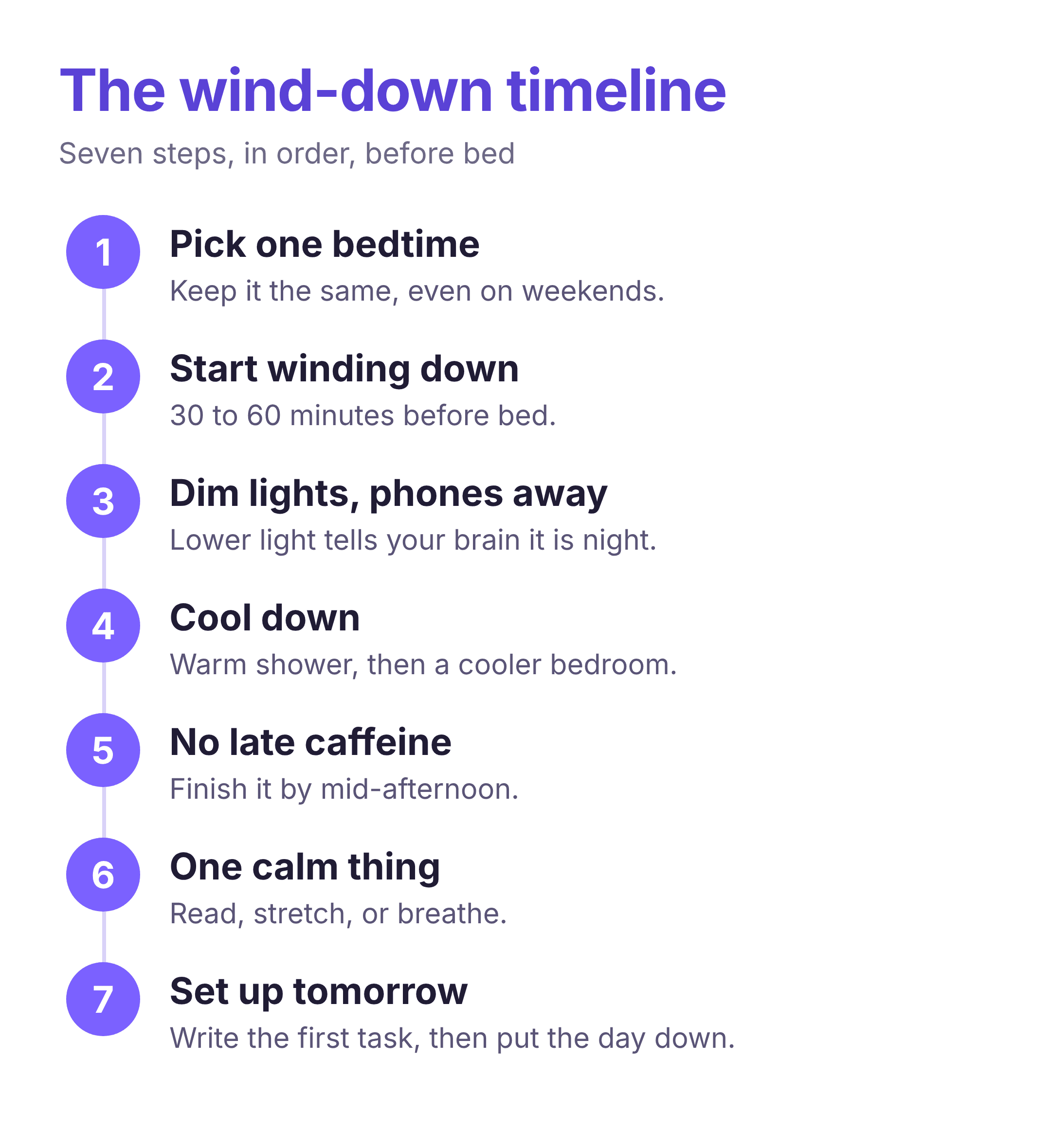
Choose a bedtime you can hit most nights, including weekends, and count back 7 to 8 hours from when you need to wake up. A steady bedtime is the single habit that makes everything else easier, because your body starts to expect sleep at that hour. If your current bedtime is all over the place, move it in small steps — 15 minutes earlier every few nights — rather than trying to jump an hour at once. Keeping a near-constant wake time matters just as much, and it's the thread that ties your evening and morning together.
Set an alarm — not for the morning, but for the start of your wind-down. When it goes off, the workday is over: no more email, no more chores that spin you up. This buffer is where a good night routine lives. Thirty minutes is plenty for most people; give yourself an hour if your days run hot and you need longer to come down.
Bright light late in the evening tells your brain it's still daytime. Blue light from phones, laptops, and overhead bulbs is the worst offender — Harvard Health notes it suppresses the sleep hormone melatonin more strongly than other light. Lower the lights an hour before bed, switch to a lamp, and put your phone somewhere you can't reach from the pillow. If late-night scrolling is your hardest habit to drop, it helps to treat it as its own project and break bad habits one at a time rather than relying on willpower in the moment.
Your body temperature naturally drops as you fall asleep, and you can help it along. A warm shower or bath about an hour before bed sounds backwards, but it works: warming up sends blood to your skin, and the drop afterward helps cue sleep. Keep the bedroom on the cool side — most people sleep best around 65°F (18°C) — with light bedding so you don't overheat in the night.
Caffeine lingers far longer than its lift. In one study published by the American Academy of Sleep Medicine, caffeine taken even 6 hours before bed cut total sleep time by more than an hour — and the people in it often didn't notice. A simple rule: finish coffee, strong tea, and energy drinks by mid-afternoon. If you want something warm in your wind-down, make it caffeine-free.
Give your wind-down a small, pleasant anchor — the part you look forward to. Reading a few pages, light stretching, a warm non-caffeinated drink, slow breathing, or writing down a few lines all work. This is the heart of an evening routine you'll actually keep, so pick what genuinely relaxes you, not what looks good. One calm activity, done most nights, beats an elaborate ritual you abandon in a week.
A racing mind is one of the most common reasons people lie awake. Head it off before you get in bed: lay out what you need for the morning, and write tomorrow's first task or two on paper so your brain can stop rehearsing them. A short "brain dump" of whatever's on your mind, or a line or two of journaling, helps close the day. Clearing tomorrow off your mind tonight also makes it easier to improve focus the next day, because you start it with a plan instead of a scramble.
The routine only works if you repeat it, and repetition is a skill of its own. Keep the steps few and the order fixed so the whole thing runs on autopilot, and attach it to something you already do every night, like brushing your teeth. For the deeper mechanics of why routines hold, see how to build good habits that last. Miss a night? Just start again the next evening — consistency over weeks is what counts, not a perfect streak.
Here's the whole wind-down as a copyable night routine checklist. Run it top to bottom and you've done the routine — no memory required.
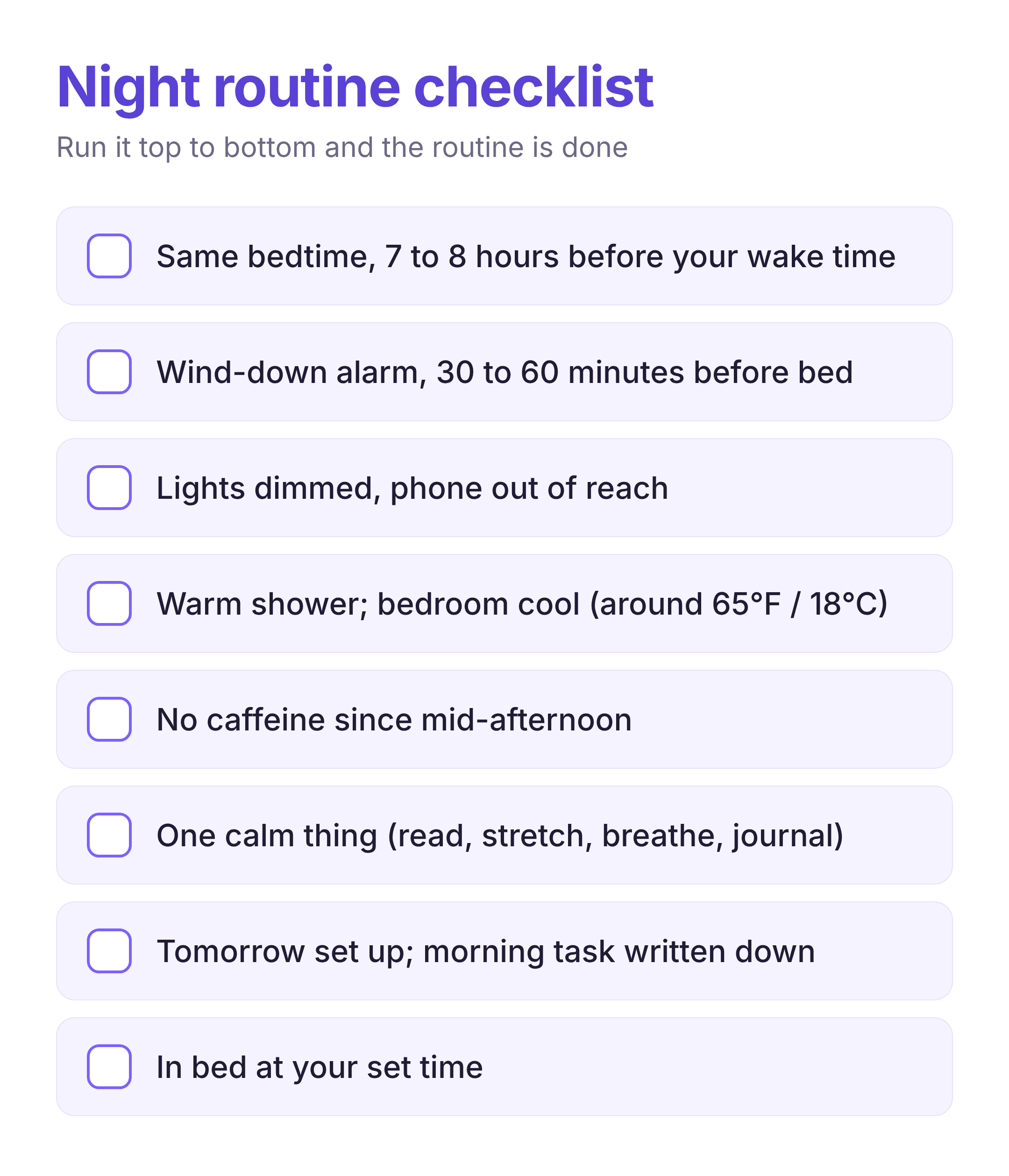
The steps above are the frame; the details should fit your life. A few night routine ideas to adapt it:
A good wind-down doesn't need to be long or perfect. Pick a steady bedtime, give yourself a short wind-down, lower the light and the temperature, keep caffeine to the first half of the day, and close the day down before you get in bed. Start with two or three steps this week, add the rest as they stick, and let the checklist carry the routine so you don't have to think about it. Keep it up most nights, and better sleep becomes the normal result of how you end your day.
A good night routine is a short, consistent wind-down before a fixed bedtime: dim the lights and put screens away, cool down, skip late caffeine, do one calm activity, and set up tomorrow so your mind can rest. The exact steps matter less than keeping them simple and doing them in the same order every night.
It's an easy countdown version of a bedtime routine: no food 3 hours before bed, no work 2 hours before, no screens 1 hour before, and 0 times you hit snooze in the morning. It's not a scientific rule, but it's a handy way to remember to stop eating, working, and scrolling in stages as bedtime approaches.
For most people, 30 to 60 minutes of wind-down is enough. If your days are high-stress, give yourself the full hour; if you're tight on time, even a 15-minute version — lights down, screens away, one calm thing — works, as long as you do it consistently.
Keep the same night time routine steps and the same order, just shifted to your schedule. Make your bedroom dark and cool whenever you sleep, protect a 30-minute wind-down, and avoid caffeine in the second half of your shift. Consistency of sequence matters more than the exact hour on the clock.
Give a new routine a couple of weeks before judging it, and check the usual culprits: late caffeine, bright screens, a warm room, or a busy mind. If you've been consistent for several weeks and still struggle most nights, it's worth talking to a doctor, since ongoing trouble sleeping can have medical causes a routine alone won't fix.