RiseGuide Team
 FREE GUIDE with any plan: the First Impression FormulaClaim the offer
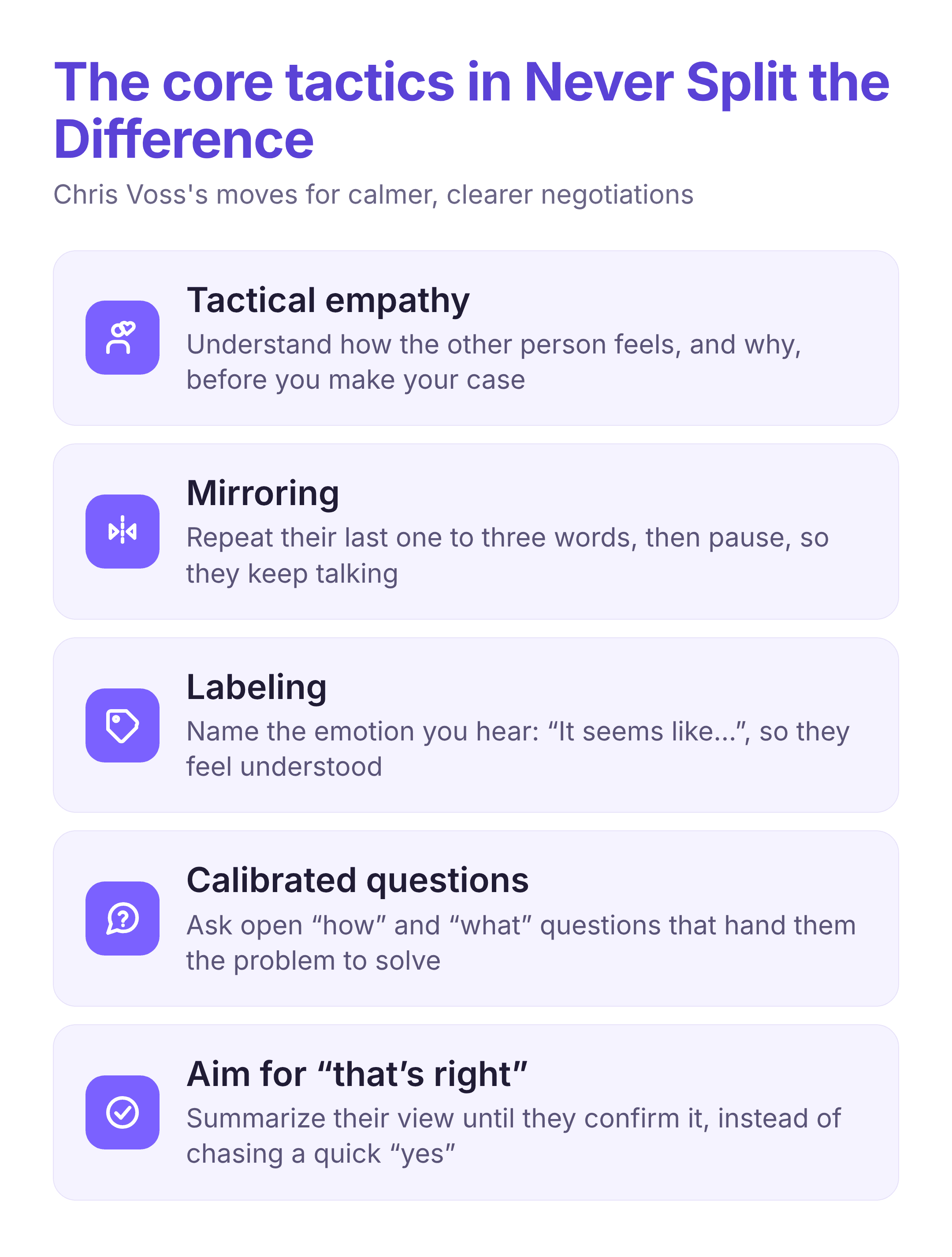
Never split the difference is the title of Chris Voss's negotiation book and his main rule: don't settle for a weak compromise where both sides lose. The tactics that make it work are tactical empathy (understanding how the other person feels before you push your case), mirroring (repeating their last few words so they keep talking), labeling (naming the emotion you hear so they feel understood), calibrated questions (open "how" and "what" questions that make the other person solve the problem with you), and aiming for "that's right" instead of a quick "yes". They apply to everyday situations like asking for a raise, lowering a bill, or a hard conversation at home. They work by getting the other person talking and feeling understood before you make your case.
You negotiate more often than you might think: a salary conversation, a disagreement over rent, a refund you feel you deserve, a tense talk with a partner who wants the opposite of what you want. Chris Voss spent twenty-four years at the FBI, much of it as the lead international kidnapping negotiator, and his book Never Split the Difference argues that the usual advice about staying rational and meeting in the middle is the wrong model for these moments. Below is what the phrase means and the tactics behind it, with how each one would sound in a real conversation rather than a hostage standoff.
"Never split the difference" means you should not reach for a quick compromise just to end the discomfort of a disagreement. Splitting the difference is the classic middle-ground move: you want $100, the other person offers $60, and you both "settle" on $80. It feels fair, but often neither side actually gets what they needed, and the real issue stays unsolved.
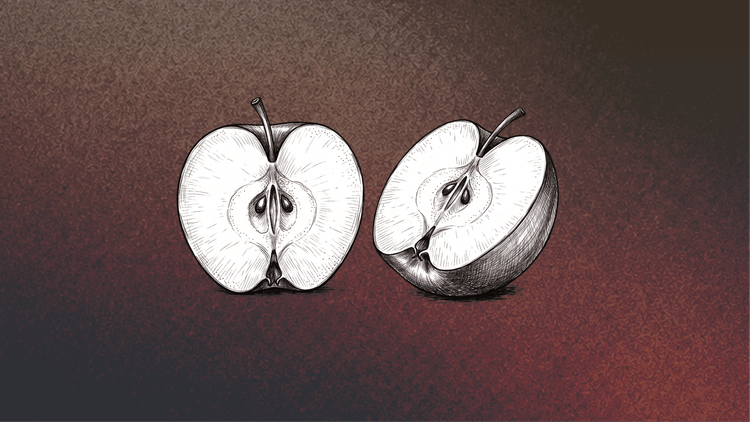
Voss makes the point with a plain image: "Splitting the difference is wearing one black and one brown shoe, so don't compromise." Two half-solutions do not add up to a good outcome, which is where the book's title and his rule come from: never split the difference. In his words, "Compromise is often a 'bad deal'," and "no deal is better than a bad deal."
That is the never split the difference summary in one line: stop treating the fast compromise as the goal, and instead slow down to understand what the other person actually needs, because that is where a good agreement comes from. Voss frames negotiation itself the same way: "Negotiation is not an act of battle; it's a process of discovery. The goal is to uncover as much information as possible." The tactics below are all ways to uncover that information.
Chris Voss is a former FBI negotiator who worked on more than 150 international kidnapping cases and served as the bureau's lead international kidnapping negotiator. After leaving the FBI he founded a negotiation training company and wrote Never Split the Difference with journalist Tahl Raz. His background matters here because the tactics were built for conversations where someone is frightened, defensive, or unwilling to talk, which is exactly the state people fall into during an ordinary argument too.
Voss lays out the full approach in his talk at Google, where he walks through why standard negotiation advice falls short and how these tactics work in practice:
Voss's method is built from a handful of specific moves. Each one works by getting the other person to feel safe enough to talk, so you learn what they really need. Here is each one, what it is, and how it sounds in a real conversation.
Tactical empathy is the foundation everything else sits on. Voss defines it as "understanding the feelings and mindset of another in the moment and also hearing what is behind those feelings so you increase your influence in all the moments that follow." In plain terms, it means you work out how the other person feels and why, and you show them you get it, before you make your case.
Tactical empathy does not mean you agree with the other person or go soft on what you need. It is about accuracy: the better you understand their position and the pressure they are under, the better you can find an answer that works for both of you. Everything below is a way to do tactical empathy out loud.
For example, before you ask your manager for a raise, tactical empathy means noticing that they may be worried about their budget and about setting a precedent with the rest of the team, and opening the conversation in a way that shows you understand those constraints rather than ignoring them.
The mirroring technique is the simplest move in the book. You repeat the last one to three words the other person said, with a slight upward, questioning tone, and then you stay quiet. Voss puts it plainly: "Mirrors work magic. Repeat the last three words (or the critical one to three words) of what someone has just said." The pause after the mirror does a lot of the work, because people tend to fill silence by explaining more.
It sounds almost too simple, but it keeps the other person talking and gives you information without turning the conversation into a back-and-forth argument. Mirroring is a listening move, and it pairs with the broader habit of paying close attention that we cover in our post on listening skills.
A quick script:
You said almost nothing, and they handed you a new option.
Labeling emotions means naming the feeling you sense and saying it back, usually starting with "It seems like," "It sounds like," or "It looks like." Voss describes it as a way "of validating someone's emotion by acknowledging it." You are simply showing them you noticed how they feel, which lowers the temperature.
There is research behind why this calms people down. In a 2007 UCLA study, researchers led by Matthew Lieberman found that putting a feeling into words lowered activity in the amygdala, the part of the brain tied to threat and distress. Naming an emotion, your own or someone else's, takes some of the heat out of it.
A quick script, used with a frustrated colleague:
Now you know the real problem, and they feel heard rather than cornered.
Calibrated questions are open questions that the other person can answer but that have no fixed answer, usually starting with "how" or "what." Voss calls them "queries that the other side can respond to but that have no fixed answers." Instead of pushing your solution, you hand them the problem and let them help solve it.
"How am I supposed to do that?" is the classic example. Said calmly, without sarcasm, it makes the other person consider your constraints and often walk back a hard position on their own. "What's the biggest challenge you're facing here?" opens up information you would never get from a yes-or-no question.
A quick script, in a refund conversation:
Most of us chase "yes," and Voss argues that is a mistake. A quick "yes" is often a way to end the conversation rather than a real commitment. He writes that "'No' starts conversations and creates safe havens to get to the final 'Yes' of commitment," and that good negotiators welcome a solid "no" to start, because it is a sign that the other party is engaged and thinking. Letting someone say no makes them feel in control, which is when they relax enough to talk honestly.
The words you actually want to hear are "that's right." Voss writes that "the sweetest two words in any negotiation are actually 'That's right,'" and that "'That's right' is better than 'yes.' Strive for it." When someone says "that's right," it means your summary of their situation was accurate and they feel understood. That is different from "you're right," which Voss warns is usually a polite way of ending the conversation: "Tell people 'you're right' and they get a happy smile on their face and leave you alone for at least twenty-four hours."
You get to "that's right" by summarizing their position so well that they confirm it. This is also the heart of staying calm with a tough counterpart, which we cover in our post on difficult people.
You do not need a hostage situation to use any of this. The same moves fit ordinary asks, and the order is usually the same: understand first with tactical empathy, keep them talking with mirroring and labeling, then guide the decision with a calibrated question.
These are skills you build with practice, and they have limits worth being honest about. Tactical empathy only works when it is real; people can tell when you are performing concern to get your way, and a fake label lands worse than none. The tactics help you understand the other person and lower the tension, but they do not guarantee you get everything you want, and they are not a way to pressure someone into a bad decision.
There are also moments when the right move is to hold firm or walk away rather than keep talking. Voss's own rule that "no deal is better than a bad deal" is a reminder that not every conversation should end in agreement. And since so much of this depends on reading tone and emotion, it works differently across cultures and over text, where those signals are harder to catch. Treat the tactics as a way to have a clearer, calmer conversation, not a script that always ends in your favor.
The real lesson of never split the difference is to understand what the other person needs before you accept a compromise, so you do not settle for a weak one out of discomfort. Tactical empathy, mirroring, labeling, and calibrated questions are all ways to slow a conversation down, keep the other person talking, and find an answer that holds up. You can practice them in low-stakes moments, a return at a store, a small disagreement at home, long before you need them for anything big.
The main point is that good negotiation comes from understanding the other person, not from pressure or clever arguments, and that a fast compromise is usually a bad outcome for both sides. Voss's tactics are built to get the other person talking and feeling understood so you can find a better answer together.
It means you should not settle for a middle-ground compromise just to end a disagreement. Splitting the difference often leaves both people with something that does not actually meet their needs, so Voss argues you should slow down and look for a real solution instead.
The core Chris Voss negotiation tips are to lead with tactical empathy, use mirroring to keep the other person talking, label the emotions you hear, ask calibrated "how" and "what" questions, and aim for "that's right" rather than a quick "yes."
If you negotiate at work, manage people, or just want calmer, clearer conversations at home, the book is a practical read because its tactics come from real high-stakes situations and translate well to everyday life. This article covers the main ideas, but the book has far more examples and detail.
Mirroring works because repeating someone's last few words, then pausing, prompts them to keep explaining, which gives you information without arguing. It is a small habit, and like any conversation skill it works best when it is subtle rather than mechanical.