RiseGuide Team

To deal with difficult people, start by staying calm instead of matching their energy, since your reaction is the one part of the situation you control. Remember that most difficult behavior is more about them than about you, so try not to take it personally. Listen and acknowledge what they've said before you respond, keep your own words short and steady, and set a clear limit when a line gets crossed. Choose which conflicts are actually worth your time, protect the space and attention you give the person, and know when the right move is to step back or walk away. The point is to stay steady enough that a hard person can't pull you off balance, which matters more than winning any single exchange.
Almost everyone has a difficult person in their life: the relative who criticizes everything, the friend who turns every chat into a complaint, the neighbor who won't take no for an answer. You can't change how they act, but you can change how much they get to you and how you respond, and that's usually enough to make the relationship livable.
This guide looks at why some people are so hard to be around, the common types you'll run into, and practical ways to handle difficult people without losing your temper or your peace of mind.
Most difficult behavior isn't really aimed at you, even when it lands on you. People act out when they feel stressed, insecure, unheard, or out of control, and being critical, pushy, or negative is often a clumsy way of managing feelings they can't name. That doesn't excuse it, but it does explain it, and understanding it makes the behavior easier to handle calmly.
There's also a quirk in how we judge each other. Psychologists call it the attribution error: we tend to blame other people's behavior on their character ("he's just rude") while explaining the same behavior in ourselves by our circumstances ("I was having a rough day"). So we're quick to file someone as a difficult person, when a lot of the time they're a normal person having a hard week. Keeping that in mind won't fix them, but it lowers the heat on your side, which is where you have any say at all.
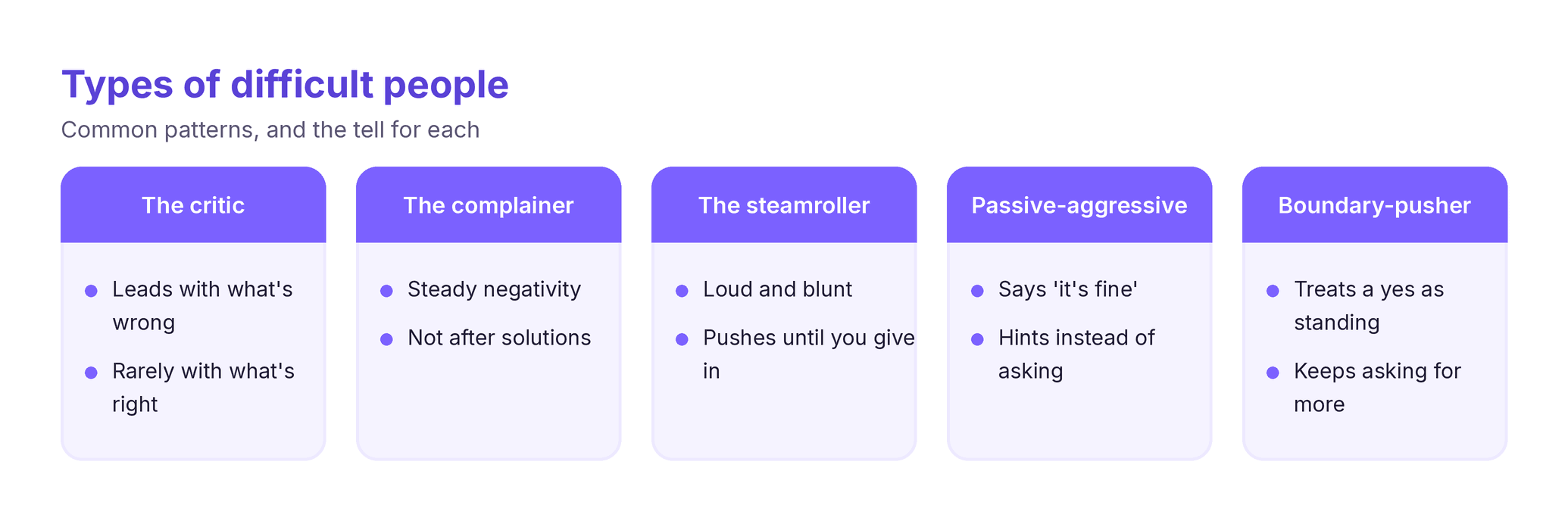
Difficult people aren't all the same, and the way you respond changes with the pattern in front of you. These aren't fixed labels, just common shapes the behavior takes.
The critic leads with what's wrong and rarely with what's right, so time with them can feel like a running performance review. The complainer keeps up a steady negative commentary but isn't actually looking for solutions, which is why advice bounces off them. The steamroller is loud, blunt, and used to getting their way by pushing until people give in. The passive-aggressive one says "it's fine" while making very sure it isn't, hinting at problems instead of naming them. And the boundary-pusher treats your time, help, or a single yes as a standing invitation and keeps asking for more.
Spotting which one you're dealing with helps because each needs a slightly different response: the complainer needs you to stop feeding the loop, the steamroller needs a firm limit, and the passive-aggressive one needs you to gently name what's really going on.
Dealing with difficult people is a set of habits you can build, and knowing how to handle difficult people in the moment comes down to a handful of them, not a single trick. You won't need all of these every time; pick the ones that fit the person and the moment.
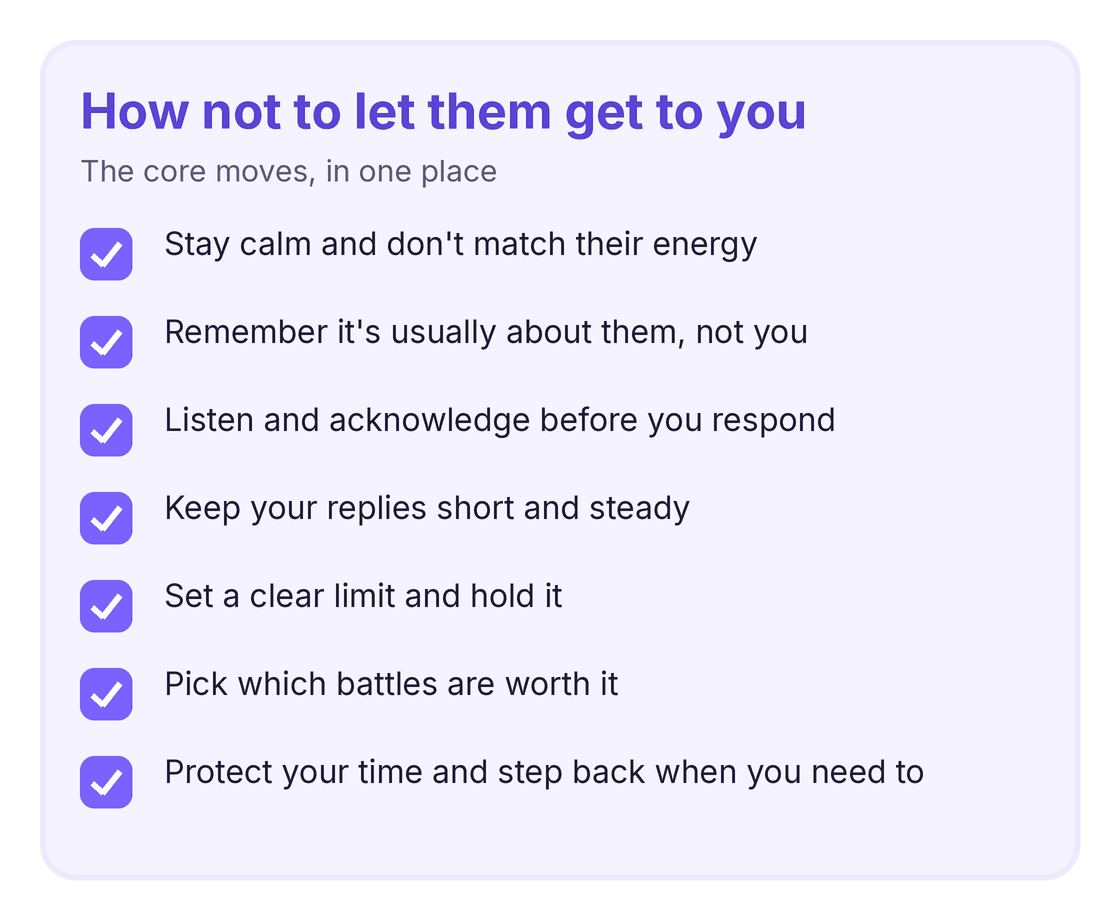
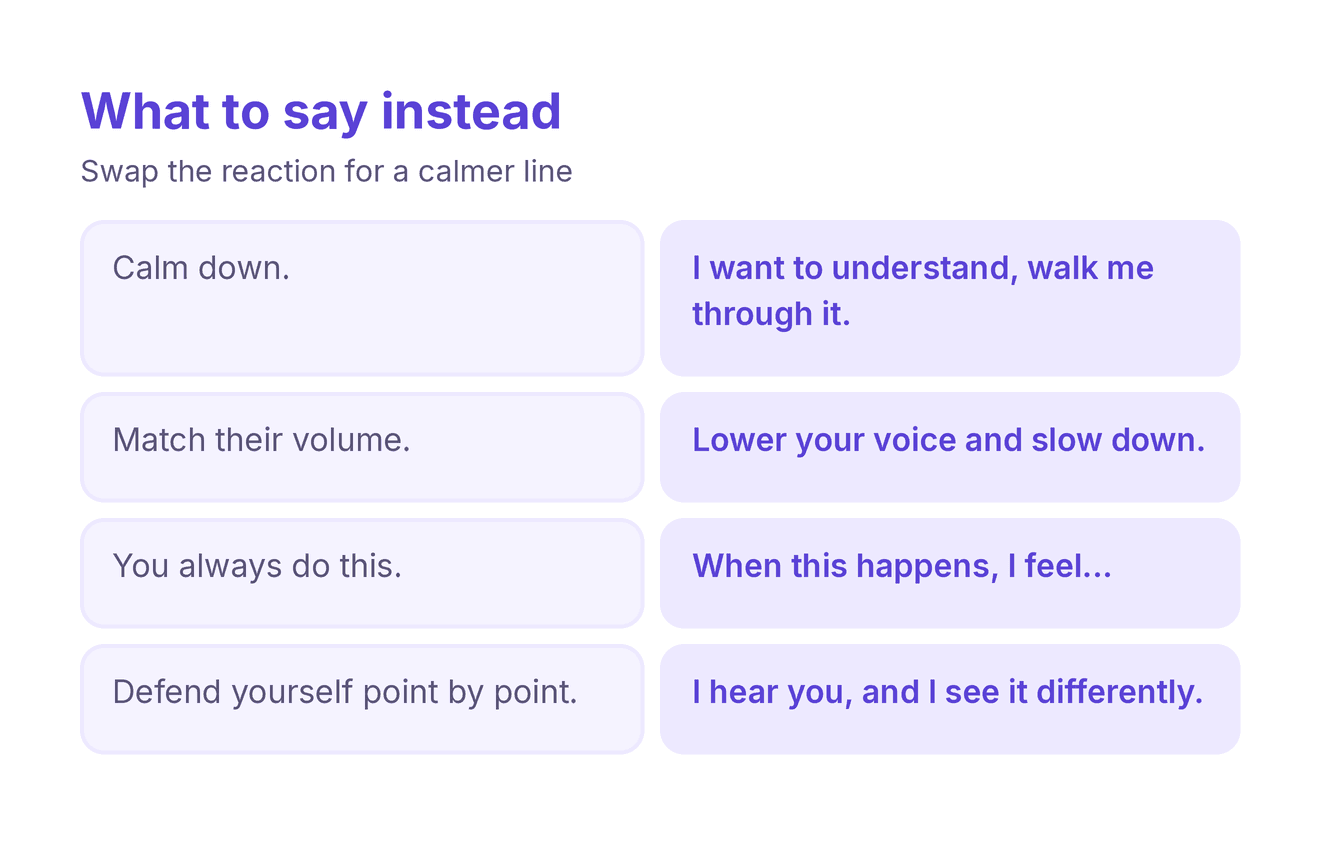
The fastest way to make a tense moment worse is to meet heat with heat. When someone gets loud, sharp, or dramatic, the instinct is to rise to it, and two escalated people rarely solve anything. Calm is contagious in the same way tension is, so lowering your voice and slowing down often pulls the whole exchange down a notch. This isn't about being a pushover; a steady, unbothered response is one of the strongest positions you can hold.
When someone is difficult, it's easy to feel like the target, but their behavior usually says more about their day than about your worth. Reminding yourself of that in the moment keeps you from getting hooked, and a person who can't provoke a reaction loses a lot of their power. Save your energy for what they're actually asking for underneath the tone, which is often just to feel heard.
A lot of difficult behavior gets louder because the person feels unheard. Letting them finish, then reflecting back what you heard ("so you're frustrated that the plan changed at the last minute"), can defuse more than any clever comeback. Acknowledging how someone feels isn't the same as agreeing with them, and it often takes the charge out of the conversation so you can talk about the actual problem.
You don't have to fill every silence or answer every jab. Short, steady replies give a difficult person less to push against, and a calm phrase you can reach for takes the pressure off inventing one mid-argument. Lines like "I hear you, and I see it differently," "let's come back to this when we're both calmer," or "I'm not able to do that" end a lot of standoffs without a fight.
Some people keep going until they meet a limit, so calmly stating one is a kindness to both of you. A boundary is just a plain statement of what you will and won't do: "I'm happy to help on weekdays, but not on weekends," or "if the shouting continues, I'm going to leave." Say it once, without a long justification, and then follow through, because a boundary you don't hold teaches people to ignore it. Doing this without turning it into a confrontation takes practice, and learning to be more assertive makes it easier to hold your ground and stay warm at the same time.
Not every difficult comment needs a response, and trying to correct everything is exhausting and rarely works. Ask yourself whether this particular thing actually matters or whether you can let it pass. Spending your energy on the few things that genuinely affect you, and letting the rest pass, keeps you from being dragged into every small skirmish a difficult person offers.
You get to decide how much access a difficult person has to your time and attention. That might mean shorter visits, fewer one-on-one situations, or a break from someone whose behavior crosses into cruelty. Stepping back isn't failure, and with some people it's the only thing that works. If a relationship is consistently harmful rather than just annoying, giving yourself distance is a reasonable choice, not a last resort.
Work is where a lot of us meet the most difficult people, and it comes with its own rules because you can't always walk away. The same calm, boundary-setting approach applies, but the stakes and the audience are different. For that setting, handling a toxic coworker and apologizing well after a clash both go deeper than a general piece can.
You can't control a difficult person, and trying to is the fastest way to let them run your day. What you can control is your own calm, your boundaries, and how much room you give them. Start with staying steady in one hard conversation this week, and notice how differently it goes when you're the one setting the tone.
Stay calm, listen and acknowledge what they've said, and keep your own reply short and steady. Respond to the need under the tone rather than the tone itself, and set a clear limit if a line gets crossed. Matching their energy almost always makes it worse.
Remember that their behavior is usually about them, not you, which takes away a lot of its sting. Decide in advance which comments you'll let pass, limit how much time and attention you give the person, and step back when you need to. Learning how to get along with difficult people is mostly about protecting your own calm rather than changing theirs.
Steady, low-key phrases work best: "I hear you, and I see it differently," "let's come back to this when we're both calmer," or "I'm happy to help, but not like this." Short lines that acknowledge them without escalating give them less to push against.
Use the same calm, boundary-setting approach, but keep it professional and, where it matters, documented. Because you often can't avoid the person, focus on clear limits and steady responses rather than trying to win. Dealing with a toxic coworker has enough workplace specifics that it's worth a closer look on its own.