RiseGuide Team

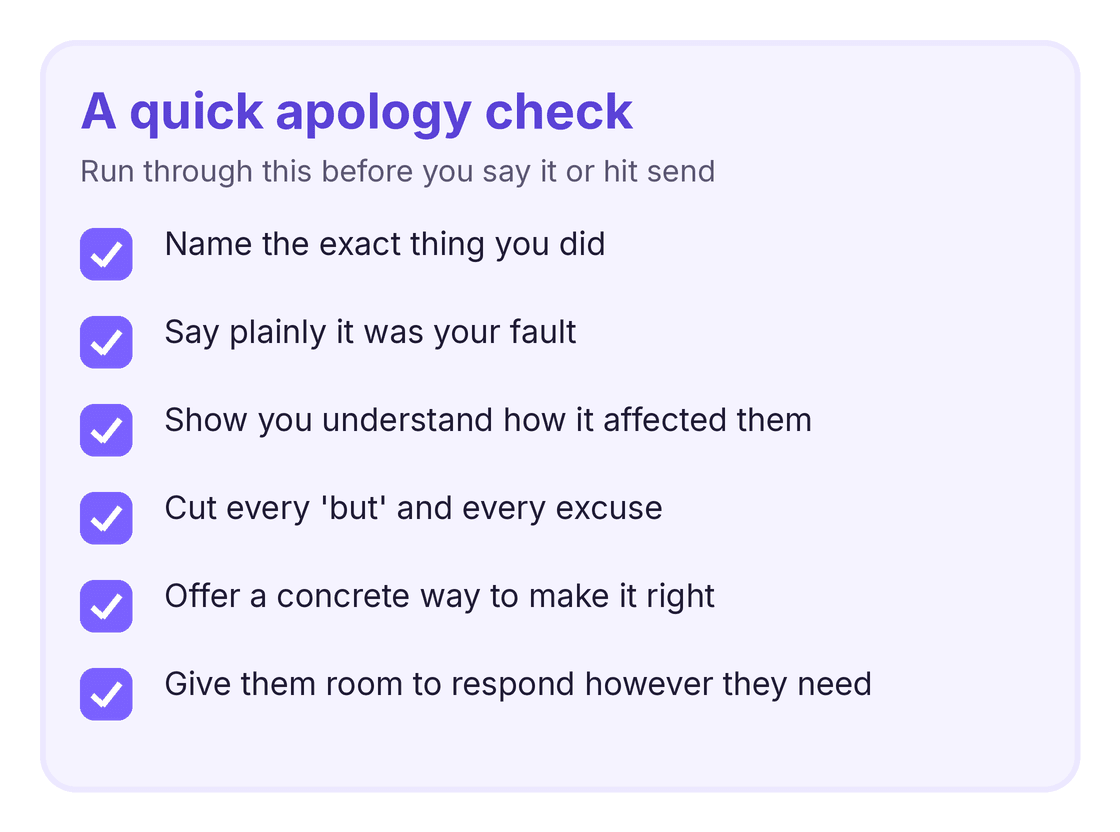
To apologize, name exactly what you did, say plainly that it was your fault, and show you understand how it affected the other person. Skip the excuses and the word "but." Say what you'll do to make it right and what you'll do differently, then give the person room to respond however they need to. Research on effective apologies found that taking responsibility matters most and offering to repair the damage comes second, so those are the two parts to prioritize. What you do after the apology — actually changing — is what makes it believable.
Most of us learned to say "sorry" as kids and never got taught much beyond that. So when something real goes wrong — you snapped at your partner, missed a deadline, hurt a friend without meaning to — the words come out clumsy, or defensive, or so fast they don't land. A good apology is a skill, and like any skill you can learn the parts and practice them.
This guide covers how to apologize in a way that actually repairs things: what a sincere apology is made of, words you can adapt, the mistakes that make people trust you less, and how to handle the situations people struggle with most — a partner, someone you hurt badly, a slip at work, and apologies you have to send over text. The core of how to apologize sincerely stays the same across all of them.
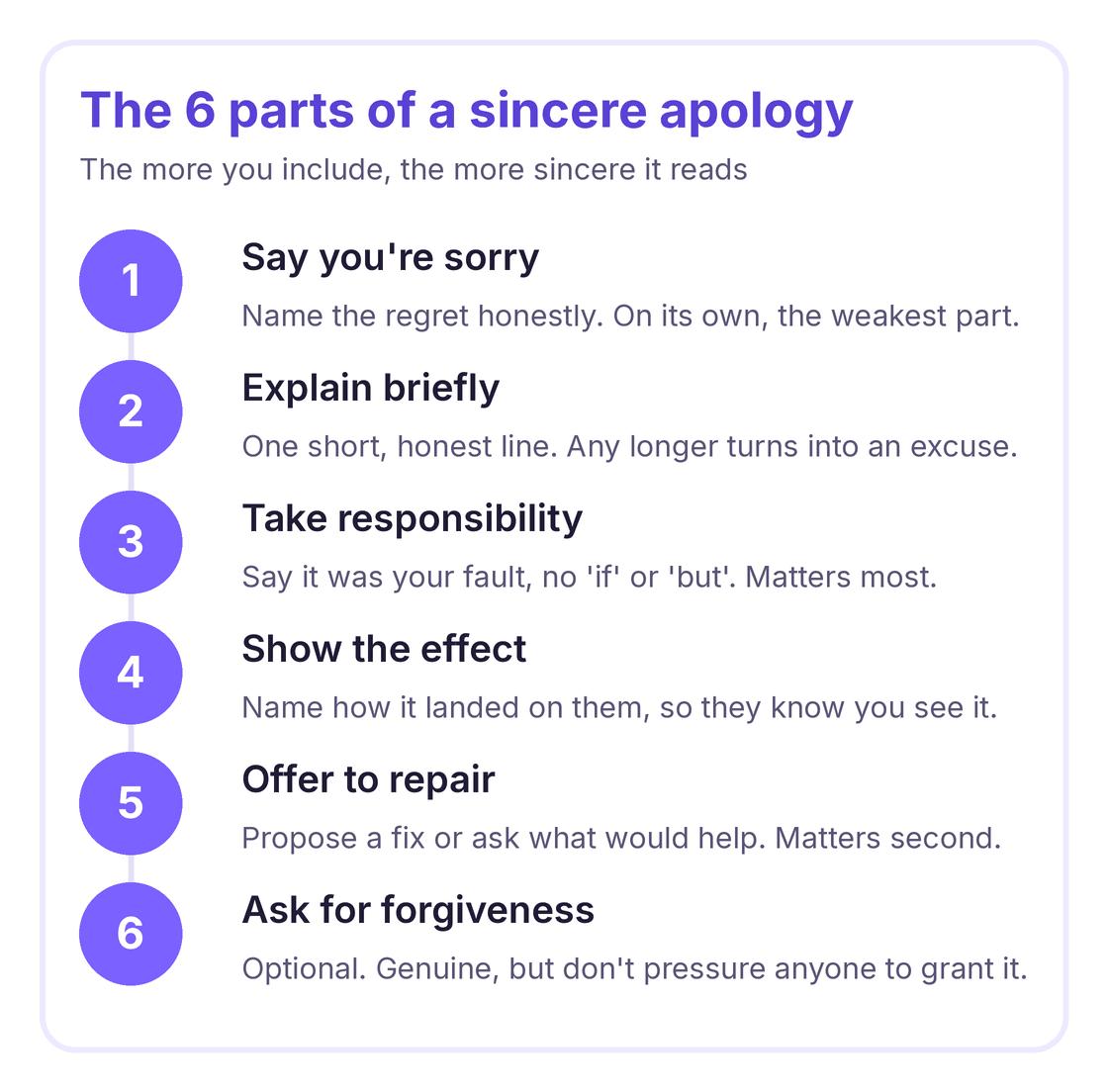
Learning how to apologize properly starts with knowing what a full apology contains. A research team led by Roy Lewicki at Ohio State University tested apologies and found six components that make one work: an expression of regret, an explanation of what went wrong, an acknowledgment of responsibility, a declaration that you're sorry, an offer to repair the damage, and a request for forgiveness. You don't always need all six, but the more you include, the more sincere it reads.
The same study found the parts are not equal. Acknowledging responsibility mattered most, and offering to repair the damage came second. As Lewicki put it:
"Our findings showed that the most important component is an acknowledgement of responsibility. Say it is your fault, that you made a mistake."
Requesting forgiveness mattered least, so that's the part you can drop if the moment is tense. Here is what each part sounds like in practice.
When you're working out how to apologize to someone, it helps to have a simple shape to fill in rather than a script to memorize. Here is one you can adapt to almost any situation:
"I'm sorry for [the specific thing you did]. It was my fault, and I understand it [the effect it had on them]. I should have [what you'd do differently]. To make it right, I'll [your repair]. I understand if you need time."
Filled in, it might sound like: "I'm sorry I canceled on you last minute again. That was my fault, and I know it left you sitting at the restaurant alone and feeling like I don't value your time. To make it right, I'd like to plan something this week and actually show up. I understand if you're still frustrated."
Notice there is no "but" anywhere in it, and it never explains the behavior away. That is what makes it read as a real apology instead of a defense.
A bad apology can leave the other person angrier than no apology at all, because it adds a second insult on top of the first. These are the patterns to watch for.
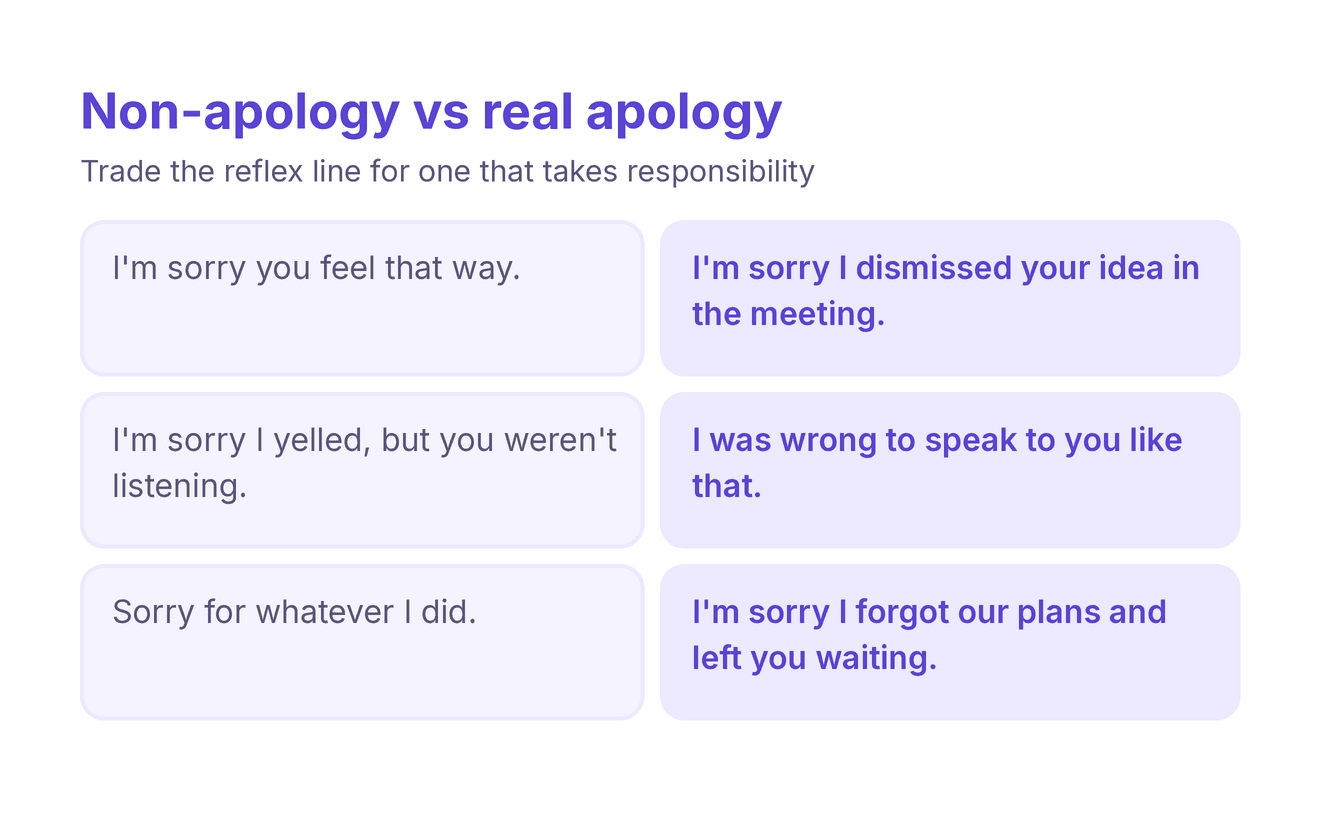
The non-apology. "I'm sorry you feel that way" or "I'm sorry if anyone was offended" sounds like an apology but takes no responsibility — it makes the other person's reaction the problem. Replace it with a line that names your own action: "I'm sorry I dismissed your idea in the meeting."
The "but" that erases it. "I'm sorry I yelled, but you weren't listening" cancels the first half with the second. The moment you add "but," the person hears the excuse and forgets the apology. If you need to raise your own concern, do it in a separate conversation later.
Over-explaining. Piling on reasons you were tired, busy, or provoked turns an apology into a defense. One short explanation is plenty; anything more sounds like you're arguing your way out.
Over-apologizing. Saying "sorry" ten times, or apologizing for things that aren't your fault, shifts the focus onto managing your guilt instead of repairing the harm. One clear apology carries more weight than a flood of them. If you tend to over-apologize as a reflex, working on being more assertive can help you tell a real apology apart from an anxious one.
Sometimes "sorry" is the wrong word — because you've overused it, because the setting is formal, or because you want to lead with accountability instead of regret. Learning how to apologize without saying sorry is really about taking responsibility in plainer language.
At work especially, "I'm so sorry, I'm so sorry" can read as flustered. Try leading with the fix instead: "Thank you for flagging that. I sent the wrong file — here's the correct one, and I've added a check so it doesn't happen again." You've owned the mistake and offered a repair without a single "sorry."
You can also apologize through action. Redoing the work, replacing what you broke, or simply changing the behavior often says more than the words do. The apology still needs to be spoken at some point, but the action is what proves you meant it.
The six parts stay the same, but the emphasis shifts depending on who you hurt and how badly.
When you're working out how to apologize sincerely in a relationship, focus on showing you understand the hurt. The exact words matter much less than that. Pick a calm moment, not the middle of the argument. Lead with responsibility and the effect: "I'm sorry I brought up your family like that. It was a low blow and I know it hurt." Avoid relitigating who started it. If there's something you also need to raise, save it for later so this moment stays about your part.
When the harm is serious — a betrayal, a broken trust, a real loss — how to apologize to someone you hurt deeply comes down to patience. Don't expect the apology to fix things in one conversation. Say your piece fully, take complete responsibility without any defense, and then stop talking and listen. Let them be angry. Ask what would help rather than deciding for them, and be ready to apologize more than once over time. If they can't accept it yet, that's part of the cost. Juliann Wiese, our expert, writes about handling rejection in a way that keeps you from getting defensive, so their pain doesn't become about you.
Knowing how to apologize for a mistake professionally is mostly about being brief, factual, and forward-looking. Own the error, state the impact, and move straight to the fix — at work, people mostly want to see the recovery, so keep the focus there. "I missed the client deadline. That put the team in a tough spot. I've spoken to the client, here's the new timeline, and I'll flag risks earlier next time." Skip the drama and the ten apologies. If the mistake involved friction with a difficult coworker, keep your apology strictly to your own part and don't use it to reopen the conflict.
An in-person apology is almost always better, because tone carries so much of the meaning. But when distance or timing makes text the only option, keep it simple and sincere, and don't hide behind emojis or jokes. Write the same thing you'd say out loud: name what you did, take responsibility, and offer to talk properly when you can. "I've been thinking about last night. I was out of line and I'm sorry. Can I call you later so I can say this properly?" A text is a good way to start, but finish the apology in person or by call when you get the chance.
The words are only the beginning. An apology asks the other person to trust you again, and that trust is rebuilt by what you do next. If you promised a fix, do it. If you promised to change, change in a way they can see. Give the person time, and don't demand that things go back to normal on your schedule. When your actions match your apology over the following days and weeks, people come to believe it.
If communication is the area you keep tripping on — apologies, hard conversations, saying what you mean without heat — it can help to practice it deliberately. RiseGuide's Communication Mastery journey breaks skills like this into short lessons built on expert insights, and tools like the Speech Analyzer let you hear how your tone actually comes across before an important conversation. For deeper reading, a few communication books cover repair and conflict in more detail.
Expressing regret, explaining what went wrong, taking responsibility, saying you're sorry, offering to repair the damage, and asking for forgiveness. Research from Ohio State found taking responsibility and offering repair matter most, so prioritize those two.
In their book on the subject, Gary Chapman and Jennifer Thomas describe five ways people express and hear apologies: expressing regret, accepting responsibility, making restitution, genuinely repenting, and requesting forgiveness. The idea is that people feel most apologized-to in different "languages," so it helps to know which one matters to the person you're apologizing to.
Write plainly and sincerely: name what you did, take responsibility, and offer to talk in person or by call when you can. Don't soften it with jokes or emojis, and don't send a wall of text — a short, honest message that opens the door works better than a long one that explains everything.
Usually not. A late apology can still mean a lot, as long as you don't use the delay as an excuse. Acknowledge the time that's passed ("I should have said this a long time ago"), take responsibility, and don't expect the wait to be forgiven instantly.
Give one short explanation at most, and never follow "I'm sorry" with "but." If you notice yourself justifying what you did, stop and return to the plain statement: what you did, that it was your fault, and how you'll make it right.