RiseGuide Team

To communicate your needs in a relationship, first get clear on what you actually need, then bring it up at a calm moment with a soft opening rather than a complaint. Use "I" statements to name what you feel and what you need, be specific instead of hinting, and ask for it directly. Listen to your partner's needs with the same attention, treat a need as a request rather than a demand, and check back later, since needs change over time. When a need keeps going unmet, stay calm, name the pattern, and decide together what to adjust.
Most people expect a partner to notice what they need without being told, and feel let down when it doesn't happen. The problem is rarely a lack of caring. Needs stay in your head, where no one else can act on them. Learning how to communicate your needs in a relationship is the skill that turns unspoken frustration into something your partner can actually respond to, and it is something you can practice rather than a trait you either have or don't.
Naming a need out loud can feel risky, so people avoid it. Understanding why makes it easier to push past.
One reason is fear of the reaction. Asking for something can feel like you are starting a fight or being needy, so it feels safer to stay quiet and hope things change on their own. Another is the belief that a partner who loves you should already know. That expectation sets both of you up to fail, because no one reads minds reliably, even in a close relationship. A third reason is that you may not be clear on the need yourself. "I feel off lately" is hard to act on until you translate it into something specific, like more time together or a word of reassurance.
Leaving needs unspoken has a downside worth taking seriously. Emotional needs in a relationship that go unmet tend to build into resentment, and resentment is much harder to talk through than the original request would have been.
The moves below are ways to make a need clear and easy to respond to. They do not have to happen in a fixed order, though the first two set up the rest. Together they turn a vague feeling into a specific request your partner can meet.
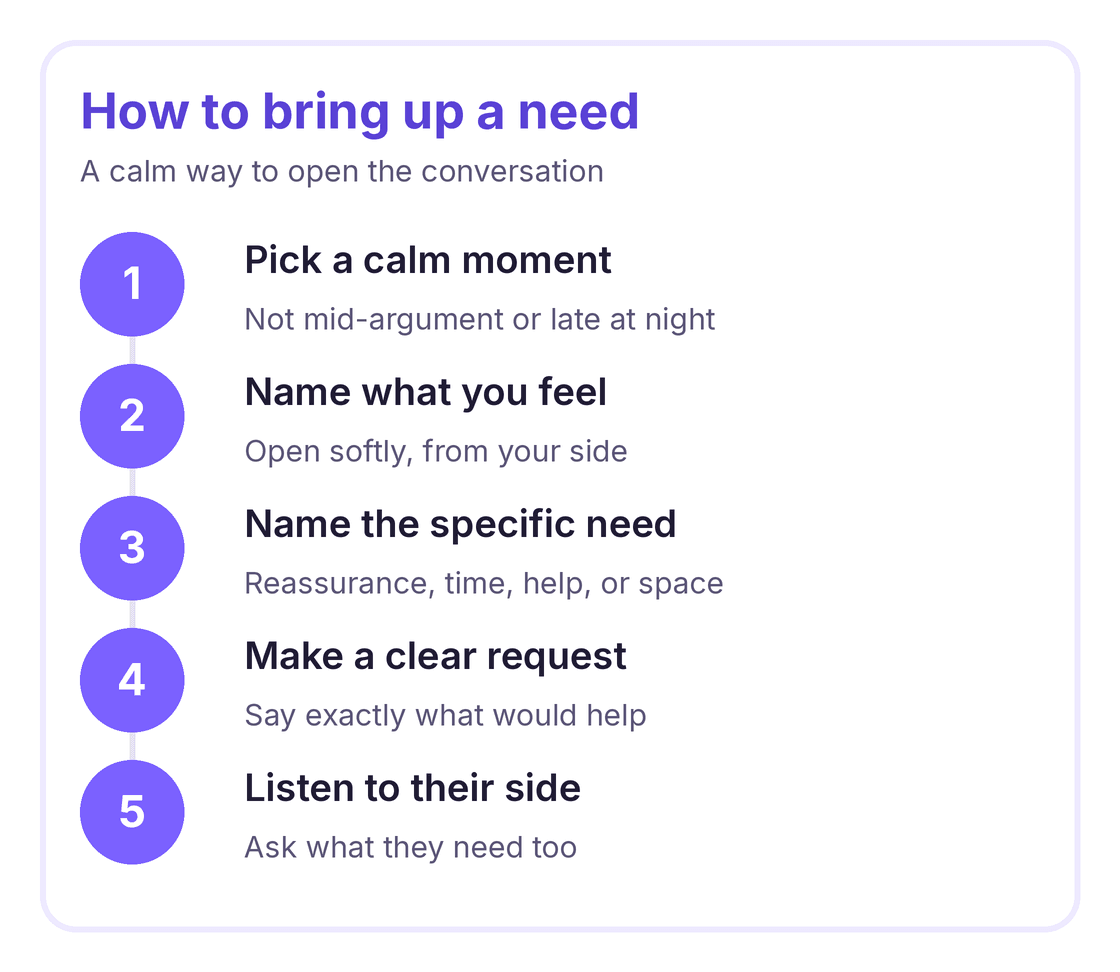
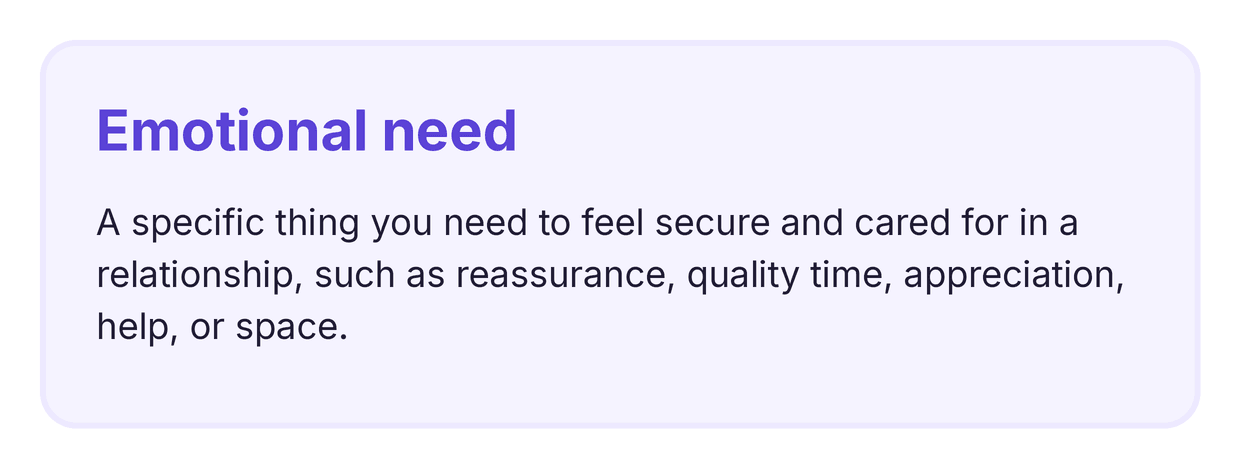
Before you can ask for something, you have to know what it is. When you feel unsettled, sit with it long enough to name the underlying need: reassurance, time together, help with a task, space, appreciation, or something else. Getting from a mood to a concrete need is most of the work, because a specific request is easy to act on while a general complaint is not.
Timing shapes how a conversation goes. Raising a need in the middle of an argument, late at night, or as your partner walks in the door rarely lands well. Pick a calm moment, and open softly rather than with blame. Research from the Gottman Institute found that observing just the first three minutes of a conflict conversation was enough to predict how it would turn out, which is why a gentle opening matters so much. Start with what you feel and what you would like, rather than what your partner did wrong.
The way you phrase a need decides whether your partner listens or gets defensive. "I" statements keep the focus on your experience instead of an accusation. A simple pattern helps: name the feeling, the situation, and the need, as in "I feel disconnected when we spend evenings on our phones, and I'd like one night a week that's just us." Compare that to "you never pay attention to me," which invites an argument. Used well, "I" statements make a request easy to hear.
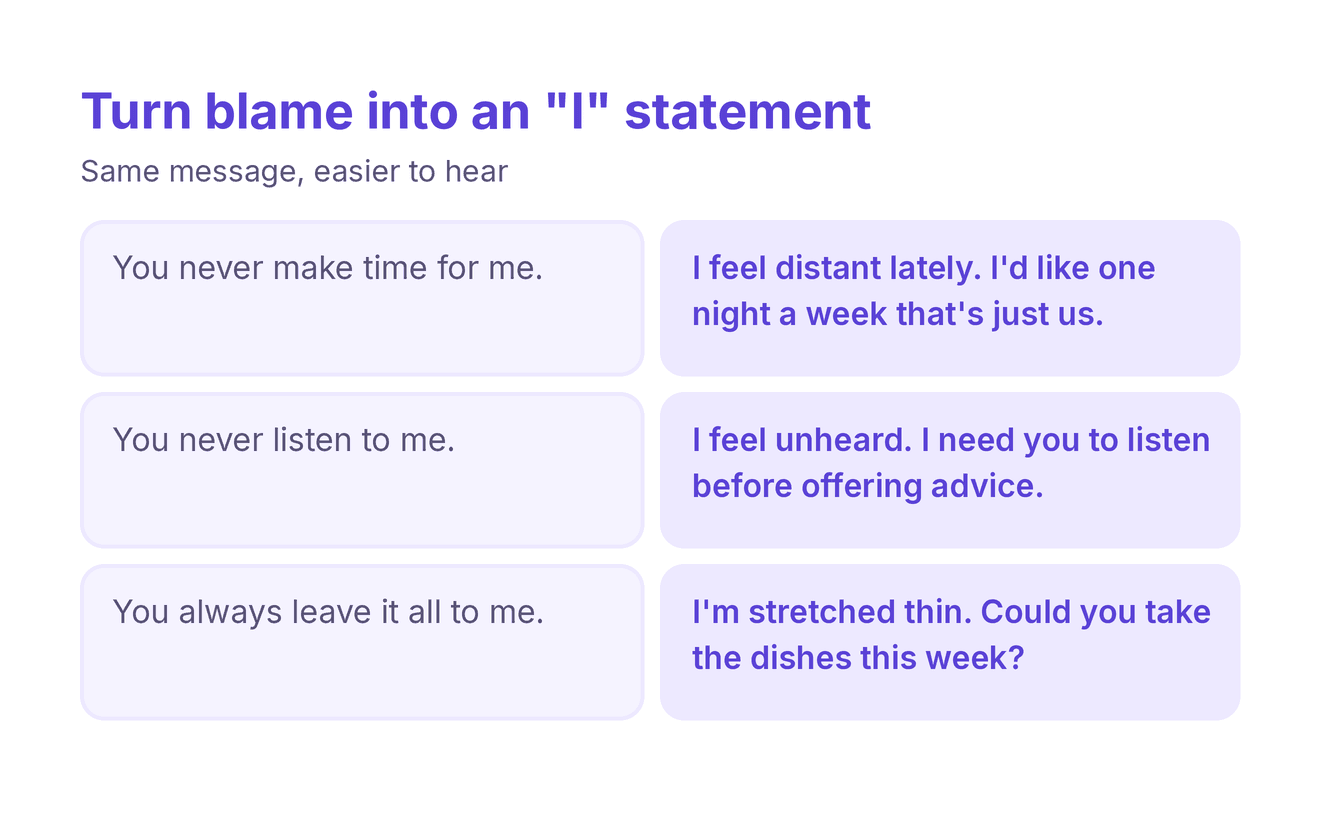
A complaint describes what is wrong; a request describes what would help. "You're always busy" tells your partner there's a problem but not what to do about it. "Could we set aside Sunday mornings together?" gives them a clear action. The more concrete the ask, the easier it is for your partner to say yes and follow through.
Hinting, going quiet, or hoping your partner guesses puts the burden on them and usually leaves you disappointed. Asking plainly for what you want is clearer and kinder to both of you. If saying it outright feels uncomfortable, that is a skill worth building on its own — learning to be more assertive helps you state a need without softening it into something your partner can miss.
Communicating your needs works best as a two-way exchange. When your partner responds, give them real attention rather than waiting for your turn to talk, and notice the difference between active and passive listening in your own reactions. Ask what they need as well, so the conversation is about both of you rather than a list of demands.
If communication is the part of your relationship you most want to strengthen, it is something you can practice deliberately. RiseGuide is an expert-powered micro-learning app whose flagship Communication Mastery journey turns short, ~15-minute lessons into practice at naming feelings, listening well, and asking for what you need.
There is a difference between asking for something and insisting on it. A request leaves room for your partner's own limits and for a conversation about what you can both do. Keeping that spirit also means respecting the line where a need becomes a demand, which is where healthy boundaries come in for both of you. You are far more likely to get a need met when your partner does not feel cornered.
Needs are not fixed. What you needed last year may not be what you need now, and the same is true for your partner. A short check-in from time to time — asking how you are both doing and whether anything feels off — keeps small needs from turning into big ones. This is also how you keep learning how to communicate better in a relationship over the long run.
Even a clear request sometimes goes unanswered. When that happens, resist the urge to store it up or to assume the worst. Name the pattern plainly, without blame: describe what you have been needing, what you have noticed, and how it has been affecting you. Dealing with unmet needs in a relationship is about staying specific and calm rather than letting the frustration speak for you.
If the same need keeps going unmet after you have raised it clearly more than once, that is worth a longer conversation about why, and sometimes worth support from a couples counselor. Repeated unmet needs are usually a signal about the relationship's patterns, not proof that you asked wrong.
Communicating your needs comes down to knowing what you need, choosing a good moment, and asking for it plainly while leaving room for your partner to do the same. None of it requires perfect wording. It asks for the willingness to say what you need out loud and to listen when your partner does the same. Do that regularly and most needs get met long before they turn into resentment.
Pick a calm moment and open softly, then name the need and its effect using an "I" statement, such as "I've been feeling distant lately, and I need more time where it's just us." Describe the pattern rather than accusing, and say what specifically would help.
The 5-5-5 rule is one approach to conflict where each partner speaks for five minutes about how they feel while the other listens, then they switch, then they spend five minutes discussing it together. It is meant to slow a heated conversation down and make sure both people feel heard.
Notice when you feel unsettled, hurt, or resentful, and trace it back to what is missing, whether that is reassurance, time, help, appreciation, or space. Naming the specific need behind the feeling is what makes it possible to ask for it.
There are many reasons, from stress and conflict avoidance to not feeling safe to open up. Rather than guessing, ask directly and gently, make it easy for them to talk without judgment, and give them time. If the silence is a long-term pattern, it may be worth working through together or with help.