RiseGuide Team

To develop willpower, you rely on it less and set up your life so the good choice needs less effort. Build one small habit at a time so the behavior runs on autopilot, write if-then plans that decide your response ahead of time, and shape your environment to keep temptations out of reach. Protect the basics that wear self-control down — sleep, food, and stress — and treat willpower as something you can train rather than a tank that empties each day. The old idea that willpower is a fixed resource you use up has not held up well in research, so the reliable path is habits and systems, with raw self-control as backup.
Most people treat willpower as something they either have or they don't. You start the week set on eating better, focusing more, or scrolling less, and by Thursday evening the plan falls apart. Learning how to develop willpower comes down to understanding what self-control actually is, why it seems to fade as the day goes on, and how to build a routine that doesn't depend on you being at your best. Here is what the research shows, and the practical ways to strengthen self-control you can start using today.
What is willpower, exactly? It's your ability to hold back an impulse and keep acting toward a goal even when part of you wants the easier option. Psychologists usually call it self-control: choosing the harder-but-better thing over the easy short-term one. It shows up in small moments — closing a distracting tab, going for the walk, saying no to the second drink — and those small choices add up over months.
It helps to separate two things that often get blurred together. One is the in-the-moment effort of resisting a temptation. The other is the quieter system of habits and routines that means the temptation never really comes up. Both count, and most of the advice below is about shifting weight from the first to the second.
The most famous explanation comes from a 1998 study by Roy Baumeister and colleagues. People asked to resist a plate of fresh cookies and eat radishes instead later gave up on a hard puzzle much sooner than those who had been allowed to eat the cookies — 8.35 minutes versus almost 19. The researchers called this "ego depletion" and described willpower as a limited resource, like a muscle that tires with use.
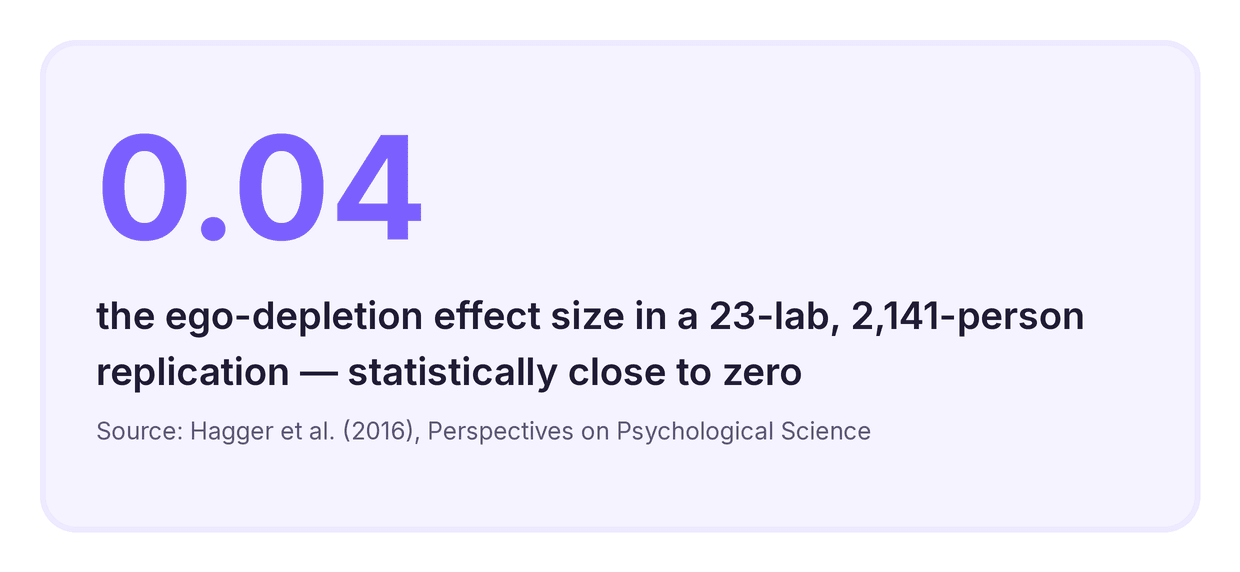
That muscle idea shaped years of self-help advice. The trouble is that it has not held up well. In 2016, a 23-lab replication of more than 2,000 people found the ego-depletion effect was tiny and not clearly different from zero. Willpower may not be a simple fuel tank that drains with every hard choice.
What does seem to matter is what you believe about it. In one study, people who saw self-control as unlimited didn't show the usual drop after a tiring task, while those who thought it was easily used up did. How run-down you feel is shaped partly by the story you tell yourself about running down.
Self-control does get genuinely harder under some conditions, though. Poor sleep, high stress, and hunger all make it tougher to hold a plan, and a long day of back-to-back decisions leaves most people more likely to take the easy option by evening. So willpower doesn't empty on a fixed schedule, but real things wear it down — and most of them are physical and situational, not a sign of weak character. That points to a practical answer for how to increase willpower: rely on it less.
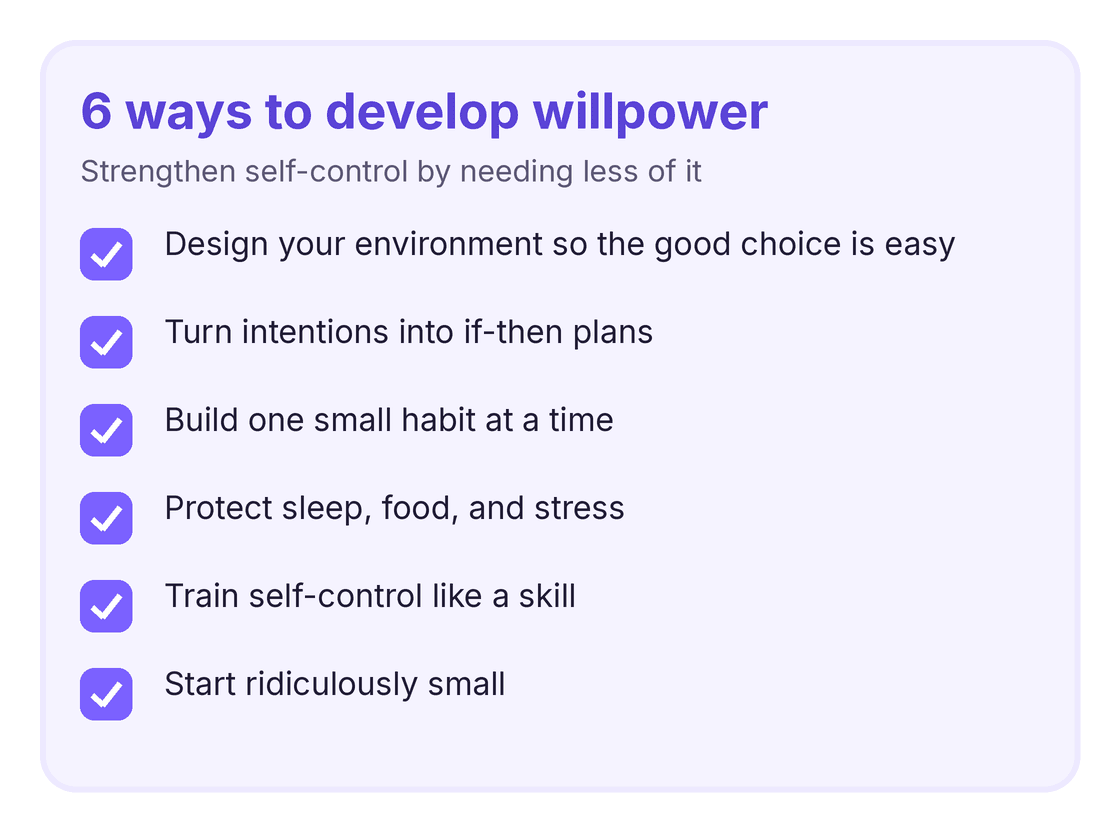
Since raw resistance is unreliable, the useful goal is to need less of it. The techniques below are the practical side of how to build willpower that holds up on a bad day — they strengthen self-control by building habits, planning ahead, and changing your surroundings so the right choice is the easy one. They work together, so you don't have to do them in order. Start with whichever fits the problem in front of you.
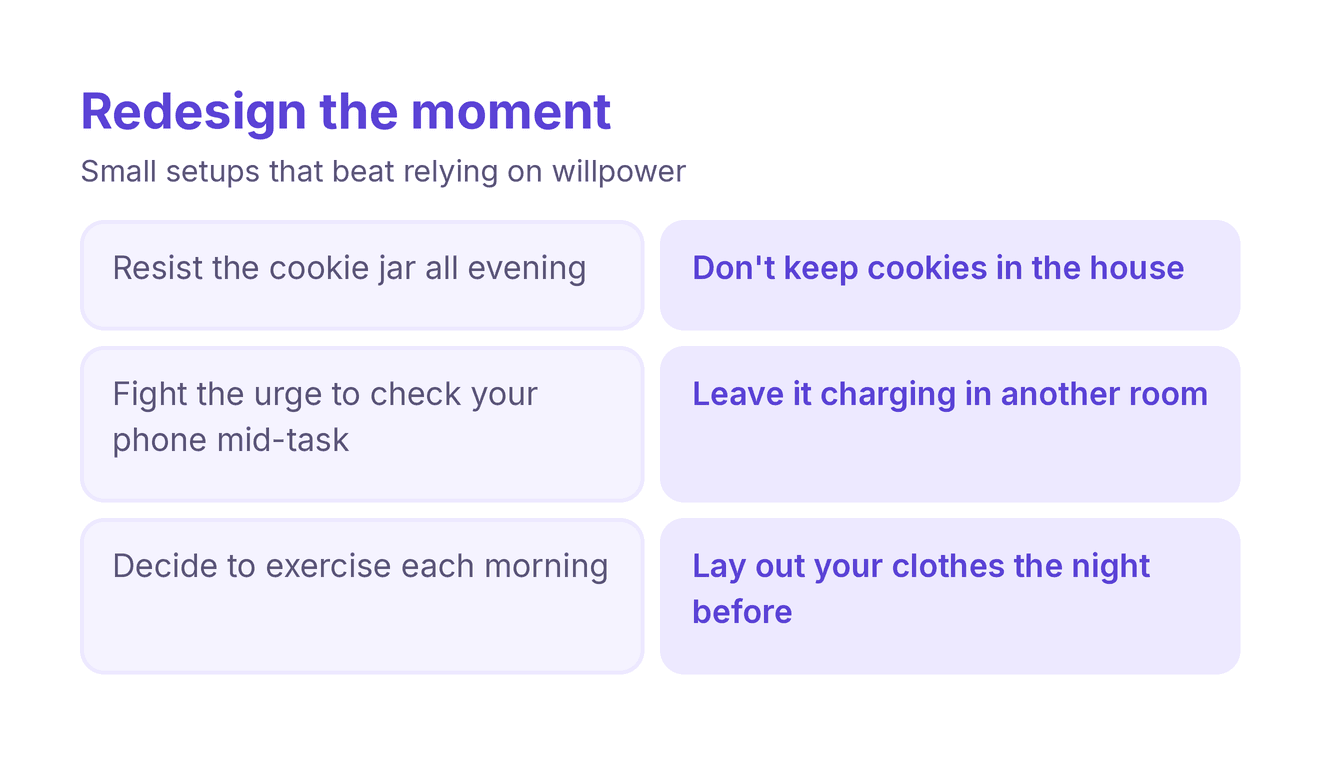
The people who look most disciplined usually aren't out-muscling temptation all day. A large meta-analysis of trait self-control found it was tied more to good automatic habits than to constantly fighting urges. In plain terms, they've arranged life so the tempting option isn't in front of them. Keep the snacks out of the house, put your phone in another room while you work, lay out your gym clothes the night before. Every bit of friction you take off the good choice, and add to the bad one, is willpower you never have to spend.
A goal like "I'll focus more" gives your brain nothing to act on. An if-then plan does: "If it's 9 a.m., then I close email and write for 30 minutes." Deciding your response in advance means you don't have to make the call in the moment, when you're most likely to cave. A review of 94 studies found these plans, called implementation intentions, had a medium-to-large effect on actually reaching goals. Write the trigger and the action together, and be specific about both.
A habit is self-control that has gone on autopilot, so it costs almost nothing to run. The catch is that building one takes real attention, so trying to start five new habits at once tends to collapse. Pick one, attach it to something you already do every day, and keep it small enough that you'll do it even on a bad day. A steady morning routine is a good place to start, since a few early wins set the tone before the day's decisions pile up.
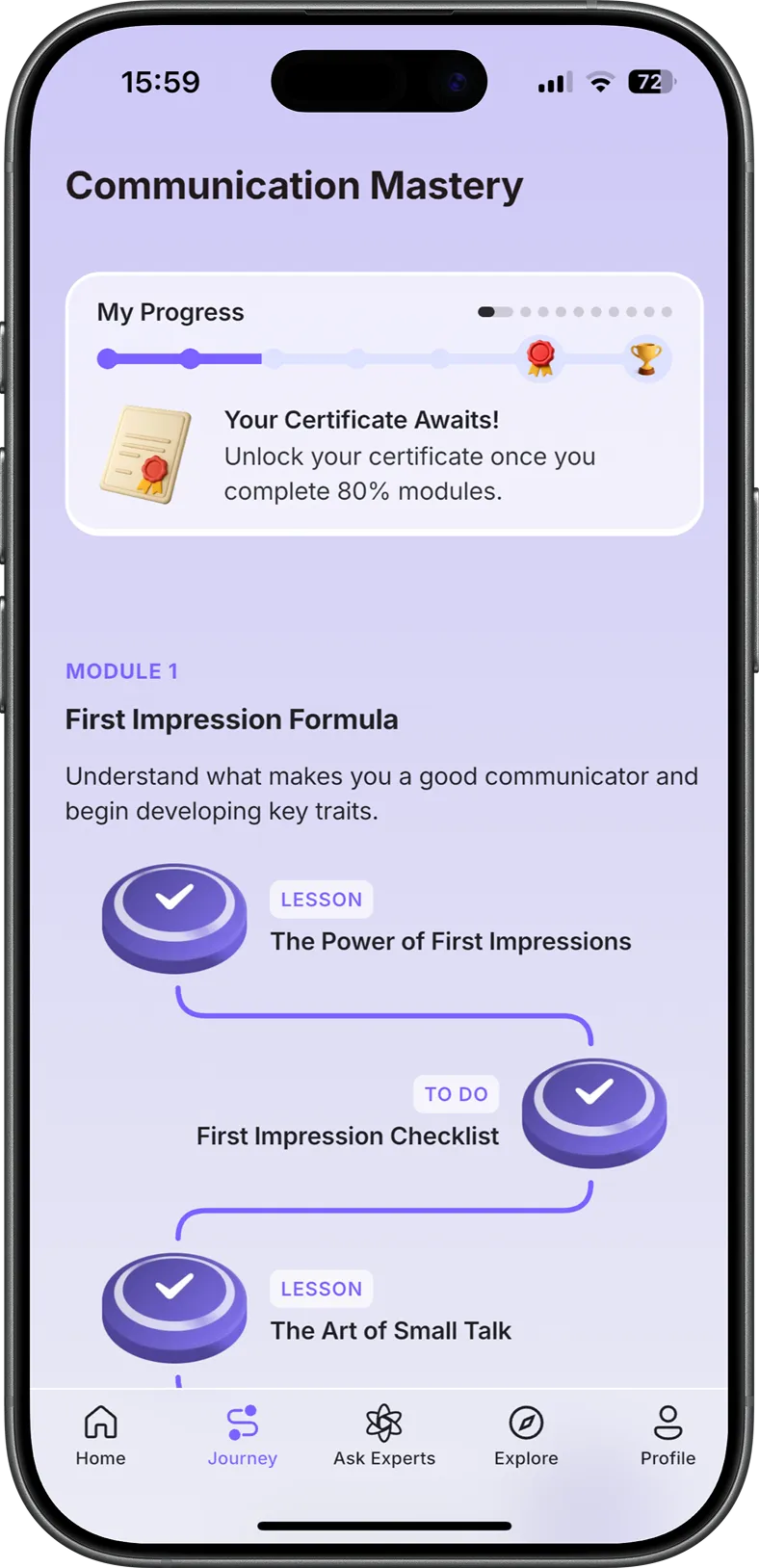
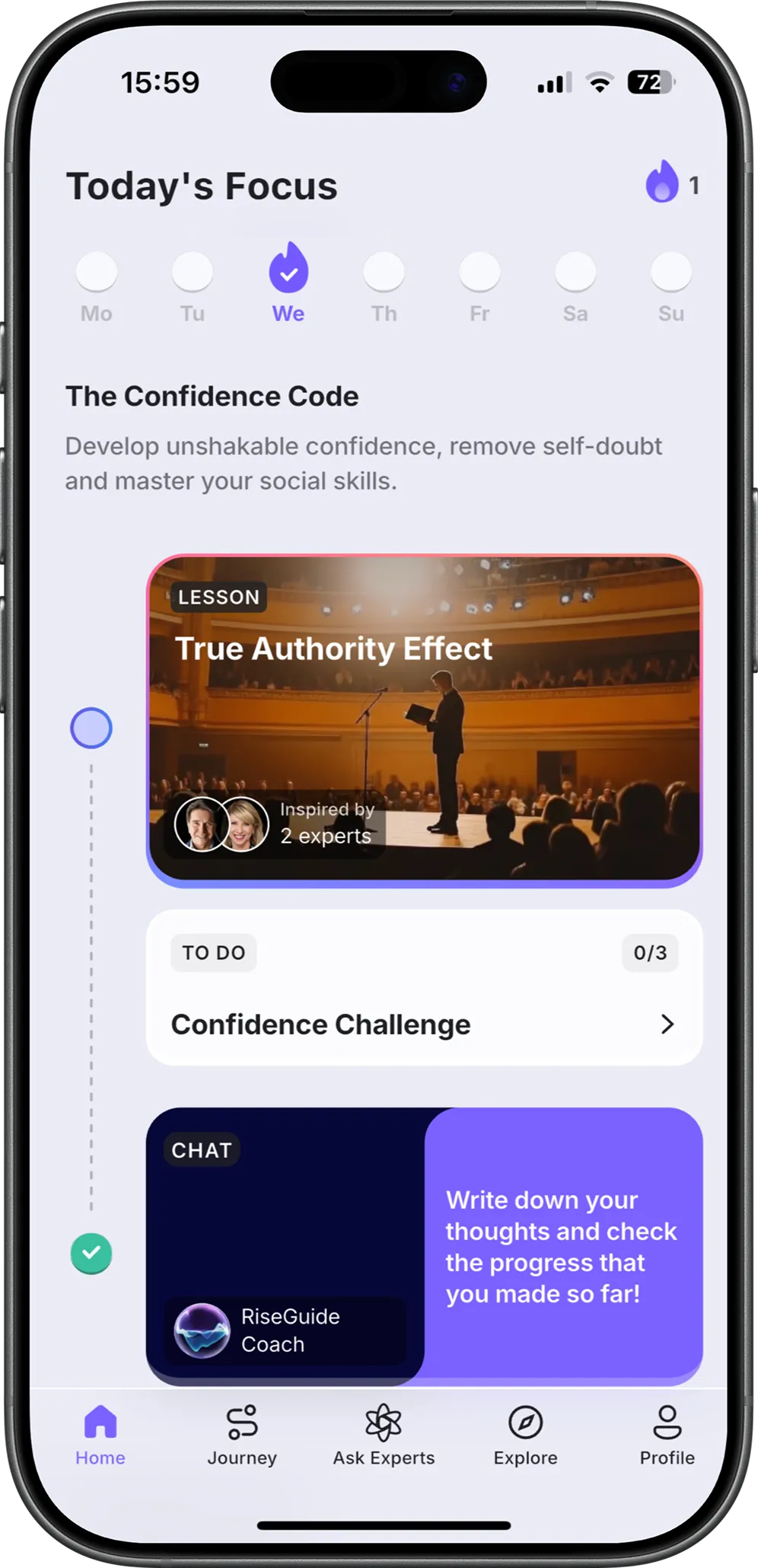
If you'd rather not build the practice from scratch, RiseGuide turns spare phone time into short, interactive lessons built on expert insights — around 10 to 15 minutes at a time, led by its Communication Mastery journey with other skill journeys alongside it — so your daily habit has a set place to happen. It's one option among many self-improvement apps that can hold the structure for you.
Self-control is a physical state as much as a mental one. When you're short on sleep, running on an empty stomach, or stretched thin by stress, holding any plan gets harder. Treating rest and regular meals as part of your discipline plan, rather than something separate from it, removes a lot of the "willpower failures" that were really just fatigue. On a low-sleep day, expect a little less of yourself and lean harder on your habits and your if-then plans.
Willpower responds to practice. Small, repeated acts of follow-through — finishing the set, keeping the one promise you made yourself that morning — build the sense that you're someone who does what they planned. Because belief plays a real role, dropping the idea that you get a fixed daily ration helps too: treat a slip as information about what to change, rather than proof that your tank is empty. That is how to strengthen willpower over weeks — steady reps and a workable story about your own capacity, rather than one heroic push. If you want to point this at studying or a new skill, the same small-steps idea shapes a study routine that helps you learn faster.
When you want to build up to a bigger goal, shrink the first step until it's almost too easy — two minutes of reading, one page of writing, a five-minute walk. Small steps get past the resistance that stops you starting, and starting is usually the hardest part. Once you're moving, keeping going is easier, and the streak itself becomes motivating. Pairing this with a few personal growth exercises gives you low-stakes reps while the habit takes hold.
Developing willpower is mostly about needing less of it. Build habits, plan your responses ahead of time, and set up your surroundings so the good choice is the easy one, and self-control has far less to do. Start with one small change this week and protect your sleep, so your systems carry the load that raw willpower can't.
Usually a mix of physical and situational things rather than a character flaw: poor sleep, stress, hunger, and a long run of decisions all make self-control harder, and an environment full of easy temptations makes it harder still. Believing you have no willpower can become self-fulfilling, too.
Yes. Self-control responds to practice, and it grows most when you build habits, plan your responses in advance, and set up your surroundings so you lean on raw willpower less often.
The reliable drains are lack of sleep, high stress, hunger, and decision overload. The classic idea that any single act of self-control drains a shared tank for the rest has largely not held up in newer research.
To increase willpower, start with your environment and your habits before your effort: remove temptations, write if-then plans, build one small habit at a time, and protect sleep and regular meals so you're not fighting fatigue on top of everything else.
The 1998 "ego depletion" research suggested it was, but a large 2016 replication found little evidence for a simple daily limit. Self-control clearly gets harder when you're tired or stressed, so it's better understood as a state you can support than a fuel gauge that empties on schedule.