RiseGuide Team
To beat decision fatigue, make your most important decisions early in the day, cut the number of small choices with defaults and routines, batch similar decisions together, take real breaks between hard calls, and protect your sleep and meals so your brain has fuel. Decision fatigue is the drop in the quality of your choices after you have already made a lot of them. The signs are avoiding decisions, going with the default, getting irritable, and making impulsive calls. You beat it by making fewer, better-timed decisions.
By the end of a long day, even a simple choice like what to have for dinner can feel like too much. That is not a lack of willpower, it is your decision-making running low after a day of choices. Here is what decision fatigue is, how to spot it, why it happens, and the simple changes that help you beat it.
Any mention of ADHD or other conditions in this article is for general and educational information only. It is not medical or mental health advice, and nothing here is a diagnosis. If these patterns affect your daily life, consider speaking with a qualified professional.
Decision fatigue is the drop in your ability to make good decisions after you have made many of them. A peer-reviewed analysis describes it as the impaired ability to make decisions and control behavior as a consequence of repeated acts of decision-making. In plain terms, every choice you make draws down a shared pool of mental energy, and when that pool runs low your later choices get worse.
So if you have wondered what is decision fatigue in everyday language, it is the reason a decision that would be easy in the morning feels heavy at night. The decision fatigue psychology is tied to self-control: deciding and resisting both pull from the same limited resource, so a day full of choices and willpower leaves less for whatever comes next.
The clearest decision fatigue symptoms show up in how you handle choices late in the day. You might notice some decision fatigue examples in your own routine: putting off a decision you could easily make, or snapping at a small question because it feels like one thing too many.
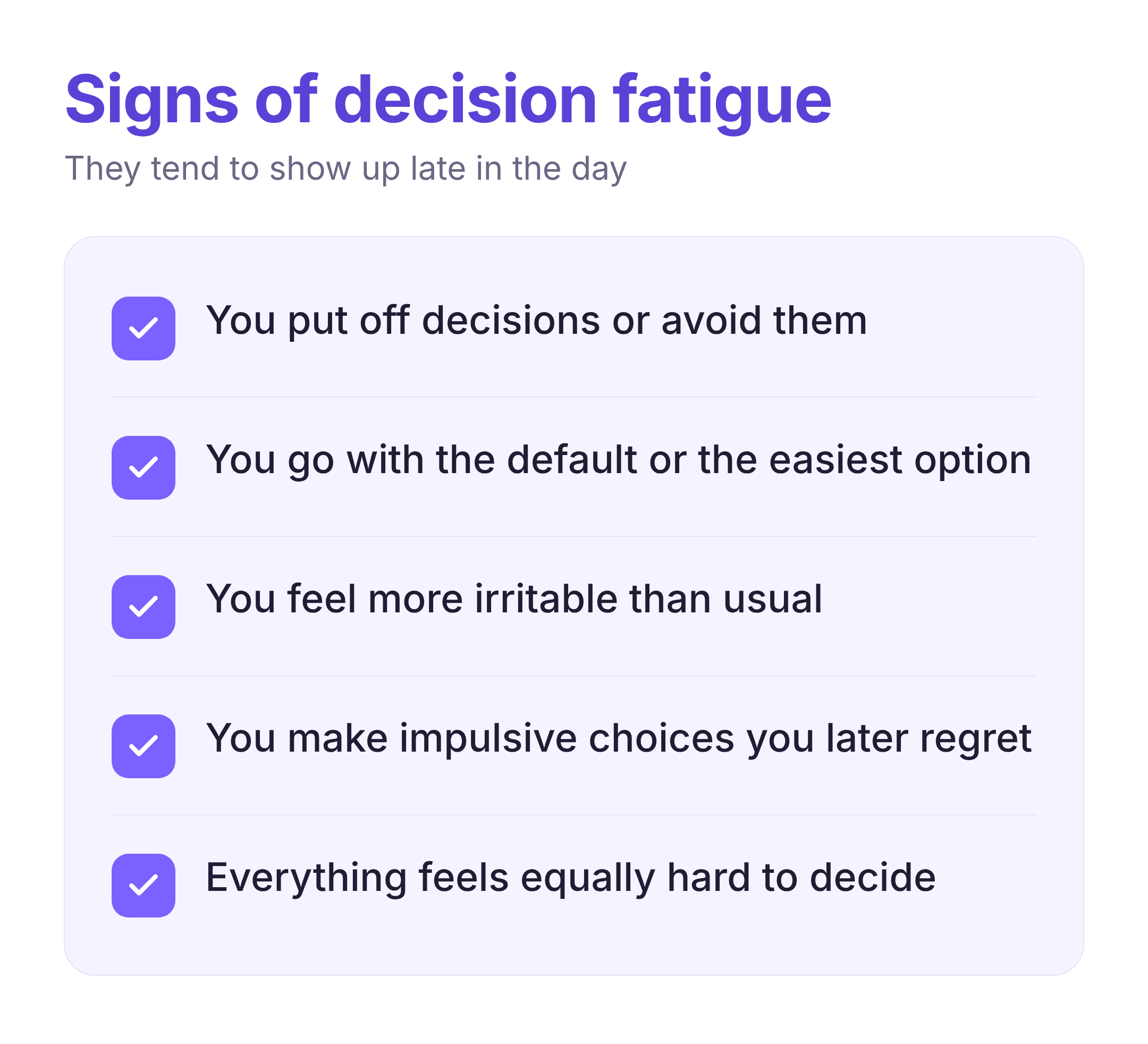
Common signs include avoiding or delaying decisions, going with whatever is easiest or the default option, feeling more irritable than usual, making impulsive choices you later regret, and finding that everything starts to feel equally hard to decide. One or two of these on a busy day is normal. A regular pattern is a sign your decision load is too high.
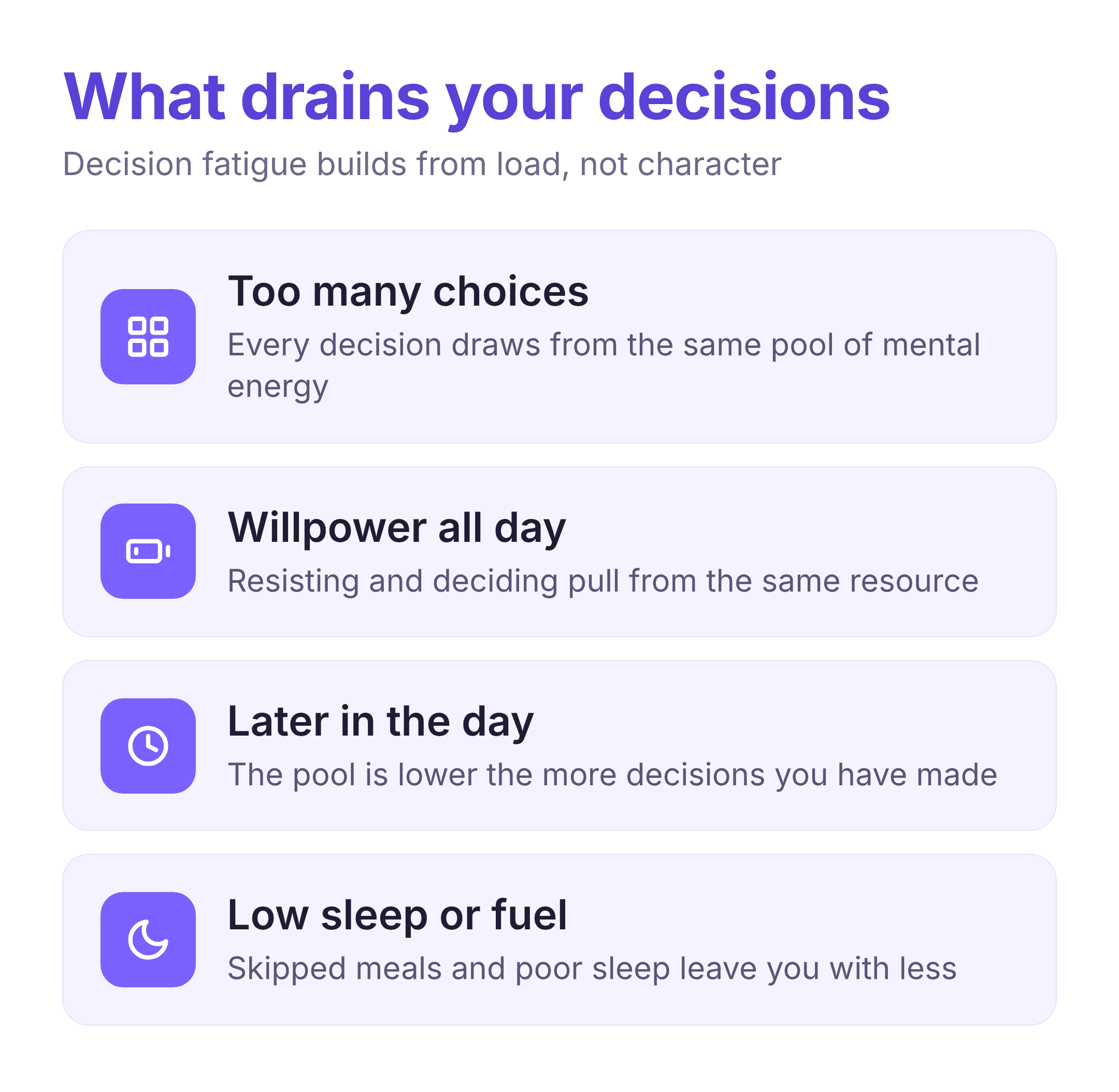
Decision fatigue builds up from a few things working together, and most of them are about load rather than character.
The main driver is sheer volume: the more decisions you make, the more your mental resources drain. Self-control adds to it, because resisting a snack or staying patient pulls from the same pool as deciding does. Timing matters too, since the pool is lower later in the day. And physical fuel plays a part, so skipped meals and poor sleep leave you with less to work with. When your brain is running low, it leans harder on mental shortcuts, which can make choices quicker but also more error-prone.
Decision fatigue is easy to confuse with analysis paralysis, but they are different. Analysis paralysis is getting stuck before a single decision because you are overthinking it. Decision fatigue is what happens after many decisions, when your judgment is worn down and later choices suffer. One is about overthinking one choice, the other is about running out of steam across many. The fixes differ too: analysis paralysis calls for narrowing the choice, while decision fatigue calls for making fewer choices in the first place.
Here is how to beat decision fatigue in practice. The theme is simple: make fewer decisions, and make the ones that matter when you are fresh.
Make important decisions early. Your decision-making is strongest earlier in the day, so schedule the big calls for the morning rather than the end of a long afternoon.
Cut small choices with defaults and routines. Decide once and reuse it: a standard breakfast, a few go-to outfits, a set grocery list. Building a simple morning routine removes a cluster of tiny decisions before the day even starts.
Batch similar decisions. Handle all your email replies, or plan all your meals, in one sitting instead of scattered through the day. Deciding in batches is lighter than switching back and forth.
Focus on what actually matters. Not every decision deserves the same effort, so spend your energy on the few that count and let the rest be quick, which is the idea behind the 80/20 rule. Noticing when your judgment is slipping, a skill called metacognition, helps you catch yourself and step back before you decide something important while depleted.
Take breaks and protect your fuel. A short walk, a meal, or a real pause resets you more than pushing through. Steady sleep and regular meals give your brain the resources to decide well. Building these habits is easier with a little structure, and short daily lessons in an app like RiseGuide can help you practice the thinking and self-management skills behind better decisions.
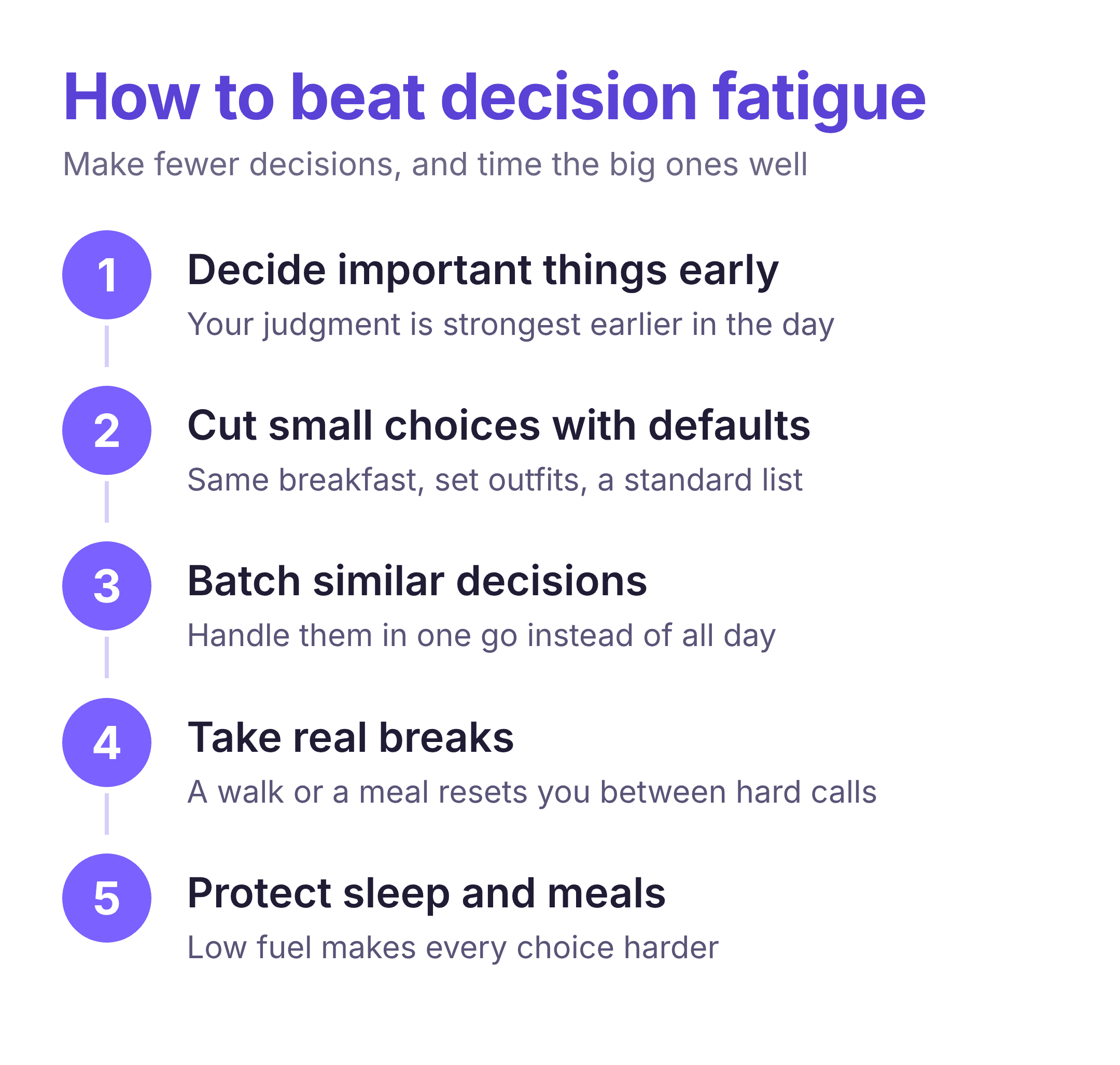
Decision fatigue is not a flaw in you, it is the predictable result of asking your brain to decide too much. Once you see it, you can design around it: make the big calls early, turn small choices into defaults, batch what you can, and give yourself real rest. Fewer, better-timed decisions leave you with more energy for the ones that matter.
Reduce the number of decisions you face and time the important ones well. Make big calls early in the day, turn small repeated choices into defaults and routines, batch similar decisions, take breaks, and protect your sleep and meals.
Decision fatigue happens to everyone, not only people with ADHD. That said, people with ADHD can find decisions more draining because planning and self-control already take extra effort, so the pool may run down faster. It is a load problem, not a personal failing.
With decision fatigue specifically, the signs are avoiding or delaying choices, defaulting to the easiest option, irritability, impulsive decisions, and feeling that every choice is equally hard. Broader mental exhaustion can also include trouble focusing and low motivation.
Decision fatigue is worn-down judgment after making many decisions. Analysis paralysis is getting stuck overthinking one decision before you make it. Decision fatigue is about volume, analysis paralysis is about a single choice.