RiseGuide Team

Communication apprehension is the fear or anxiety you feel about talking with others, whether the conversation is happening now or you're only picturing it. It shows up in four forms: as a general trait, tied to a context like public speaking, tied to a particular person or audience, or tied to one specific moment. It comes from past experiences, thin practice, high stakes, and your own temperament, and you feel it as a racing heart, dry mouth, a shaky voice, or going blank. To ease it, name the nerves instead of fighting them, prepare and rehearse what you want to say, start in low-stakes settings like small talk, slow your breathing to settle your body, watch how you talk to yourself, and build the skill with steady practice until speaking up feels ordinary.
Most of us know the feeling. The meeting is on the calendar, someone will turn to you for your take, and the moment you imagine answering, your chest tightens and your mind starts rehearsing everything that could go wrong. For some people it passes in a breath. For others it sits there for days before a presentation, or it quietly shapes which jobs they apply for and which rooms they stay quiet in.
That reaction has a name, and understanding it is the first thing that makes it smaller. Below is what communication apprehension actually is, where it comes from, how it feels, and the ways you can work through it.
Communication apprehension is the anxiety or fear tied to real or anticipated communication with another person or group. The term comes from communication scholar James McCroskey, who used it to describe a reaction that can be triggered by talking to one person, speaking in a meeting, or standing in front of an audience.
The word "anticipated" matters here. You don't need to be mid-conversation to feel it. Dreading a phone call you haven't made yet, or losing sleep over a wedding toast that's still a week away, is the same response at work. Some everyday examples: staying silent in a class or meeting even when you have something to add, letting a call go to voicemail so you can reply by text instead, or rehearsing a simple request over and over before you say it out loud.
Feeling some of this is normal, and a bit of nervous energy can even sharpen you. It becomes worth addressing when it holds you back from things you want to do.
Not all of this anxiety works the same way. Researchers usually sort it into four types, and knowing which one you're dealing with points you toward the right fix.
Most people recognize themselves in more than one of these, and that's expected.
The fear rarely comes from nowhere. A few common roots tend to be behind it.
Past experience is a big one. A moment that went badly, like being laughed at, corrected harshly, or blanking in front of a class, can leave a mark that flares up whenever a similar situation appears. Thin practice adds to it: talking in high-pressure settings is a skill, and skills you rarely use feel shaky when you finally need them.
High stakes matter too. When you sense you're being judged, or that a lot rides on how you come across, your body treats it as a threat and reacts accordingly. And some of it is simply temperament. People differ in how strongly they react to social pressure, and part of that sensitivity appears to be wired in from birth rather than learned. That doesn't mean you're stuck with it; it means the goal is to manage the reaction, not to blame yourself for having it.
The clearest communication apprehension symptoms are physical, because the body reads social pressure as a kind of danger and shifts into fight-or-flight. That can show up as physical symptoms like a pounding heart, shaking, a dry mouth, sweaty palms, stomach butterflies, and suddenly forgetting what you meant to say. Your voice may go thin or unsteady while it happens.
There's a quieter behavioral side too, and it often does more damage over time. This is the avoidance: skipping the meeting where you'd have to present, keeping your idea to yourself, choosing an email over a call, or over-preparing so heavily that ordinary conversations start to feel like exams. The physical symptoms pass in minutes. The avoidance can slowly shrink the situations you're willing to enter, which is why working on it is worth the effort.
You don't get past this by waiting to feel confident first. Confidence tends to follow action rather than arrive before it, so most of what helps is about acting while the nerves are still there. These are ways to make that easier, and you can start with whichever fits your situation.
Start by naming the nerves instead of trying to delete them. Ian Hawkins, a speaking and storytelling coach and one of our experts, makes the case for reframing the nerves — treating that jittery feeling as useful information, a sign the moment matters rather than proof you'll fail. That shift takes a surprising amount of pressure off.
Prepare and rehearse what you want to say. Much situational anxiety comes from uncertainty, so knowing your opening line, your main points, and how you'll close gives your brain something solid to hold onto. Saying it out loud beforehand, even once, helps far more than reading it silently.
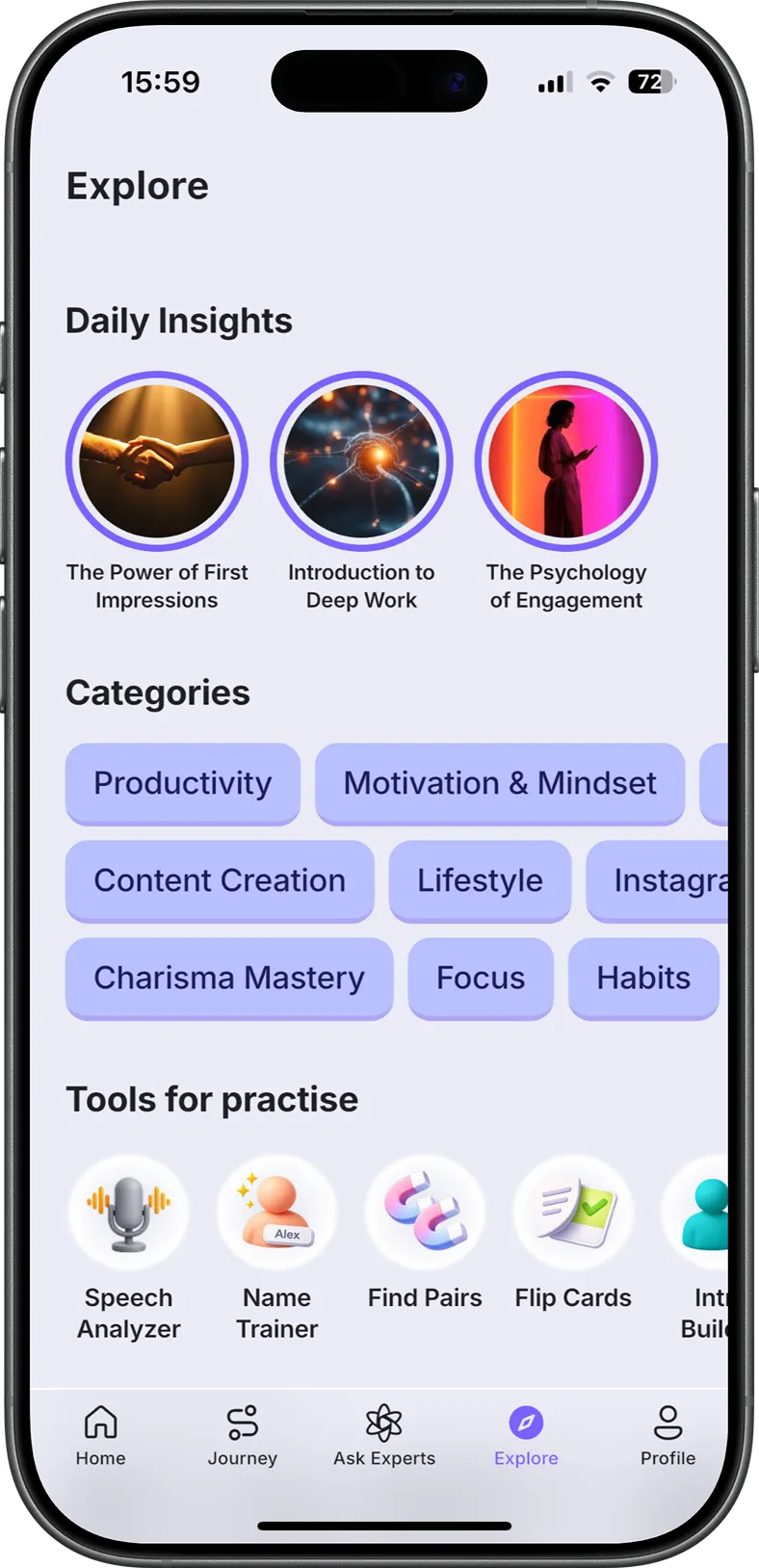
Practice where the stakes are low. You don't have to start with a keynote. Everyday small talk is a genuine training ground, and low-pressure communication games let you rehearse listening, tone, and quick thinking without an audience that matters. Each small rep makes the bigger moments feel less foreign.
Settle your body in the moment. Slow, steady breathing before and during a tense conversation tells your nervous system the threat isn't real, which softens the racing heart and shaky voice. A few deliberate breaths before you speak is one of the fastest things that works.
Watch how you talk to yourself. Silent predictions like "I'm going to embarrass myself" tend to become self-fulfilling, so swapping them for something plainer and truer ("I know this, and I can get through it") changes how the moment lands. Notice the harsh line, then answer it.
Build the skill on purpose over time. Some people practice with a friend or a coach; others use apps to rehearse between real conversations, and we've rounded up several in our post on communication apps.
None of these erase the nerves overnight. Used together and repeated, they steadily lower how loud the fear gets and how much say it has over what you do.
Communication apprehension is common, and it's something you can work on rather than a fixed part of who you are. The most useful first move is to notice which version you're dealing with, whether it's a general unease, a specific setting like presenting, a particular person, or a one-off moment, and what tends to set it off. From there you can match a technique to it instead of trying to fix everything at once.
Progress comes from small, repeated reps in low-stakes moments more than from one big push, so the nerves rarely disappear, but over time they stop running the show. And if the fear is heavy enough to affect your everyday life, that may be closer to social anxiety, and talking it through with a professional is the right next step. Wherever you're starting from, the next quiet conversation is a fine place to practice.
Trait (a general tendency across situations), context-based (tied to a setting like public speaking), audience-based (tied to a specific person or group), and situational (tied to one specific moment).
No. Communication apprehension is the fear tied to communicating, and it's a normal reaction most people feel. Social anxiety is a broader, more intense fear of being judged in social situations that, in its stronger form, is a diagnosable condition. They overlap, but you can have one without the other.
Not quite. Glossophobia is the fear of public speaking specifically. Communication apprehension is broader and covers anxiety about all kinds of communication, including one-on-one talks, group discussions, and phone calls, with public speaking being one part of it.
For most people the aim is to manage it, not erase it. A small amount of nervous energy is normal and even helpful. With practice and the right techniques, you can bring it down to a level where it no longer decides what you will and won't do.