RiseGuide Team
To break analysis paralysis, name what the decision actually costs you, cut your options down to two or three, give yourself a deadline, decide in advance what a good enough choice looks like, and take one small step you can adjust later. Analysis paralysis is overthinking a decision so much that you never make it. It usually comes from having too many options, fearing the wrong choice, chasing a perfect answer, and treating small decisions as if they were huge. You get past it by shrinking the choice and acting before you feel completely certain.
Most of us know the feeling of looking at a choice and going in circles. You open ten tabs, read every review, ask a few friends, and hours later nothing is decided. That stuck, spinning state has a name, and it happens to careful, capable people all the time. Here is what analysis paralysis is, why your brain does it, and the simple ways to start moving again.
Any mention of ADHD or other conditions in this article is for general and educational information only. It is not medical or mental health advice, and nothing here is a diagnosis. If these patterns affect your daily life, consider speaking with a qualified professional.
Analysis paralysis, sometimes called paralysis by analysis, is when overthinking a decision stops you from actually making it. The analysis paralysis meaning sits right in the phrase: you analyze so much that you freeze. You keep gathering information, weighing options, and running through what-ifs, and the more you do it, the harder choosing feels.
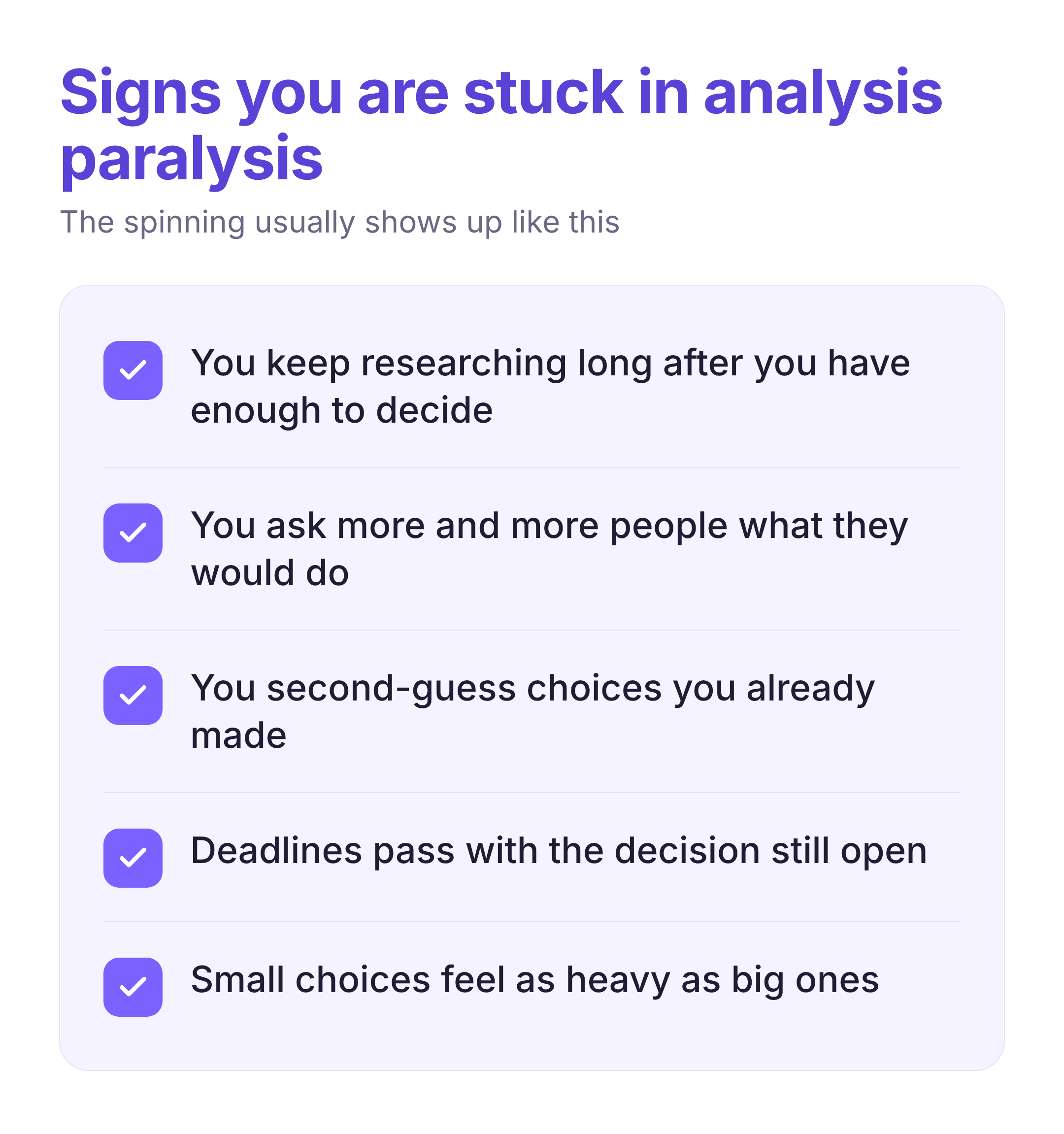
It is not laziness or a lack of willpower. Usually it is the opposite. The people who get stuck are often the ones who care most about getting it right, so they keep researching long past the point where more information helps. The spinning feels productive, which is part of why it is so easy to stay in it.
You can usually spot analysis paralysis by the gap between how much you are thinking and how little you are deciding. A few everyday examples of analysis paralysis: spending a whole evening comparing laptops and closing the tab without buying one, rewriting the same email five times, or standing in a store unable to pick between two near-identical options.
Left alone, this often slides into procrastination, where the decision keeps getting pushed to tomorrow. It is also a close cousin of everyday overthinking, the kind of mental looping where the same thoughts circle without going anywhere.
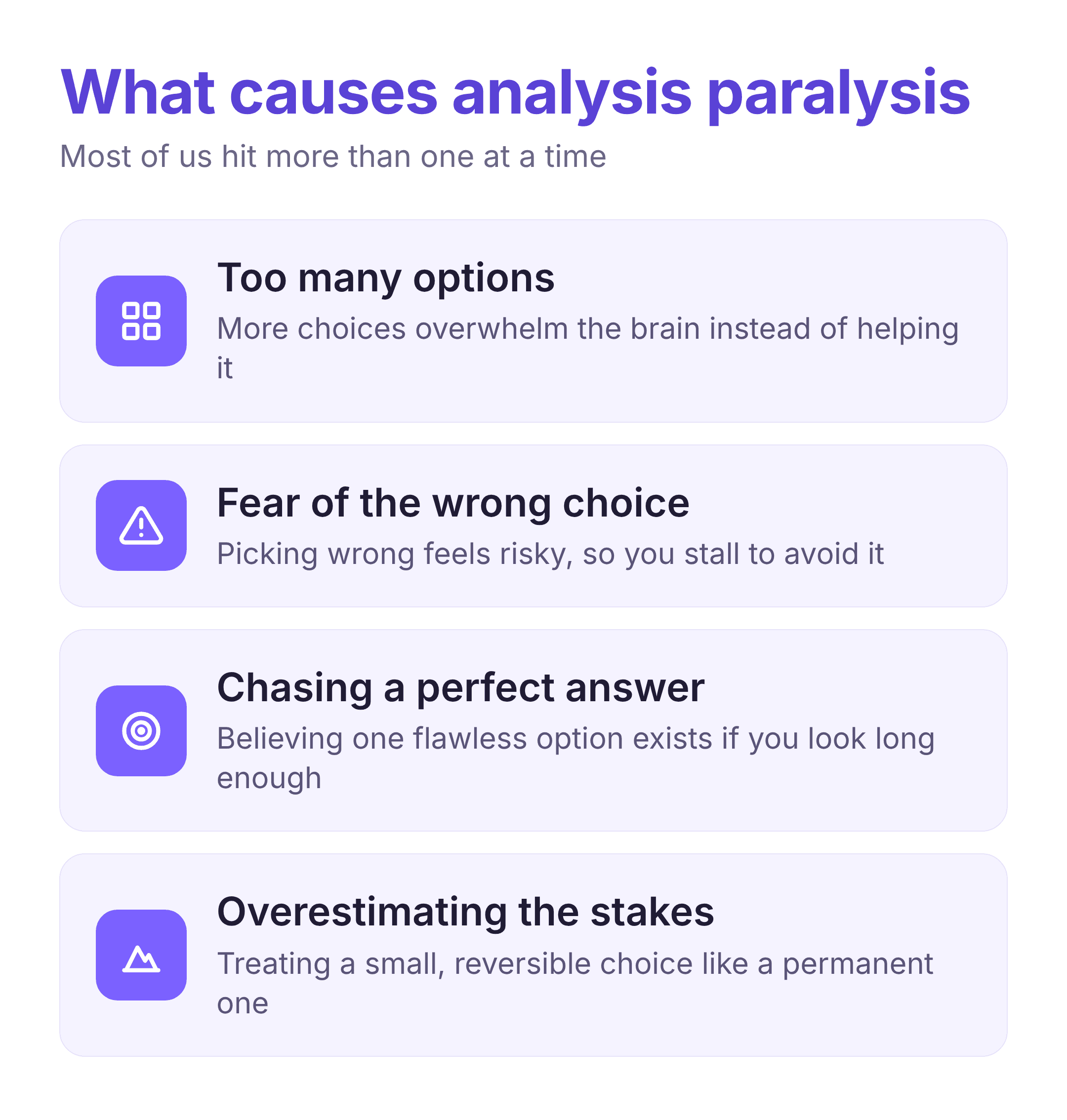
The psychology of analysis paralysis comes down to a few overlapping causes, and most of us hit more than one at a time.
The first is simply too many options. When a choice has dozens of possibilities, comparing them all overwhelms the brain instead of helping it. In a well-known 2000 study, shoppers offered 24 jams were far less likely to buy than shoppers offered just 6, even though the big display drew more interest. More choice looked appealing and made deciding harder.
The second is fear of the wrong choice. When picking wrong feels costly or embarrassing, the brain treats the decision as a threat and stalls to avoid the risk. The third is perfectionism, the belief that there is one correct answer out there if you just research long enough. The fourth is overestimating the stakes, where a reversible, low-cost choice gets treated like a permanent one. Overthinking is also fed by a handful of cognitive biases we cover in a separate post, which make options look riskier and more final than they really are.
For some people the freeze is tied to how their brain manages tasks. Deciding well leans on executive function, the mental skills that hold details in mind, compare options, and weigh outcomes. People with ADHD often find that harder, and many also deal with anxiety, so worry about choosing wrong piles on top. As the nonprofit Understood explains in its guide to ADHD and overthinking, people with ADHD "can have an especially tough time weighing options and choosing," and may get stuck in anxious thoughts and struggle to move on. None of this is about intelligence, and the ways out below still help.
People sometimes mix up analysis paralysis with decision fatigue, or call the freeze decision paralysis, but they are different problems with different fixes. Analysis paralysis happens before you decide: you overthink a single choice and never land on it. Decision fatigue happens after you have made many choices: your mental energy runs down, and later decisions get rushed, careless, or avoided.
| Analysis paralysis | Decision fatigue | |
|---|---|---|
| When it hits | Before you make a choice | After making many choices |
| Main cause | Too many options and fear of a wrong choice | Mental energy worn down by repeated deciding |
| What it feels like | Stuck, looping, unable to pick | Rushed, careless, or avoiding the choice |
| What helps | Narrow the options and set a deadline | Rest, routines, and fewer choices early in the day |
Knowing which one you are in tells you what to do. If you are frozen on one decision, the problem is the choice in front of you. If you are making bad calls late in the day, the problem is that you are worn out.
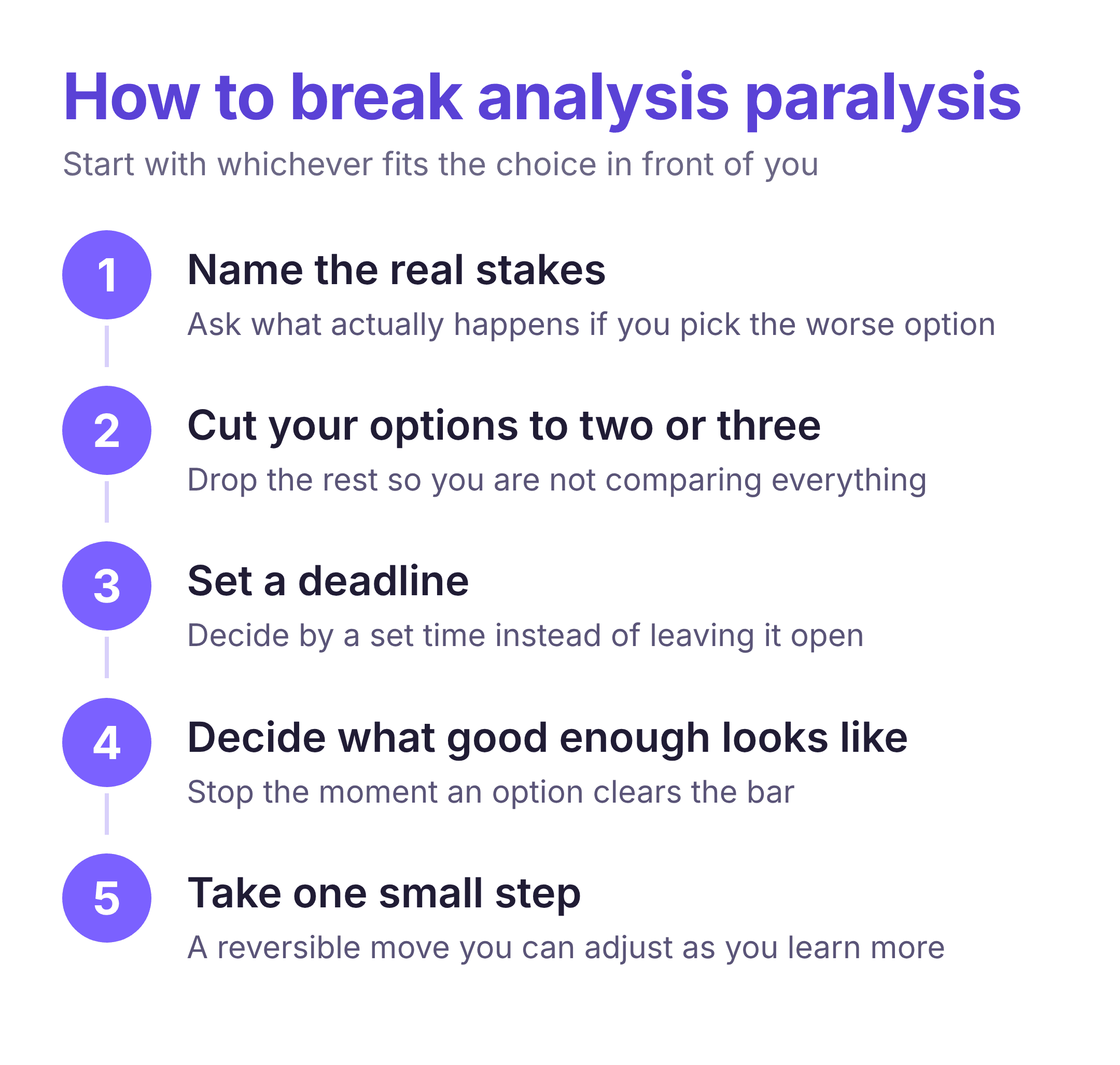
Here is how to overcome analysis paralysis in practice. These are not strict steps in order, so start with whichever fits the choice you are stuck on.
Start by naming the real stakes. Ask what actually happens if you pick the worse option. Most everyday choices are reversible and low-cost, and saying that out loud shrinks the fear that keeps you stuck.
Next, cut your options to a short list of two or three. More than that and you are back in the jam display. Focus on the few factors that genuinely matter to you and ignore the rest, which is the idea behind the 80/20 rule: a small number of things drive most of the outcome.
Give yourself a deadline. Open-ended decisions expand to fill all the time you give them, so set a timer or a date and decide when it runs out. Alongside that, decide in advance what a good enough choice looks like. If you know the three things the option needs to do, you can stop the moment one clears the bar instead of hunting for a perfect answer that does not exist.
It also helps to notice how you are thinking while you are stuck. Stepping back to watch your own thought process, a skill called metacognition, lets you catch the spiral and name it, which makes it easier to break. And when you do choose, treat an imperfect decision with self-compassion rather than blame, so the fear of getting it wrong has less power next time.
Finally, take one small step you can adjust later. You rarely need to solve the whole decision at once. A reversible first move gives you real information and breaks the freeze, and you can correct course as you learn more. Building the habit of deciding this way is something you can practice, and short daily lessons in an app like RiseGuide can help if clearer thinking and steadier decisions are what you want to work on.
Analysis paralysis is not a character flaw, and you do not beat it by thinking harder. You beat it by making the choice smaller and acting before you feel sure. Shrink the options, set a limit, define what good enough means, and take one step you can change later. The more you practice deciding this way, the less often a choice can trap you.
It is usually a mix of having too many options, fearing the wrong choice, chasing a perfect answer, and treating small decisions as high-stakes. Each one pushes you to keep gathering information instead of deciding.
Narrow your options to two or three, set a deadline, decide what a good enough choice looks like, and take one small step you can adjust later. Acting before you feel completely certain is the part that breaks the freeze.
Not on its own. Everyone freezes on hard choices sometimes. That said, people with ADHD or anxiety often find deciding harder, because it leans on executive function and because worry about choosing wrong adds pressure. If it regularly affects your life, it is worth talking to a professional.
Analysis paralysis is overthinking one choice before you make it. Decision fatigue is the drop in judgment that comes after you have made many choices and your mental energy is low.