RiseGuide Team
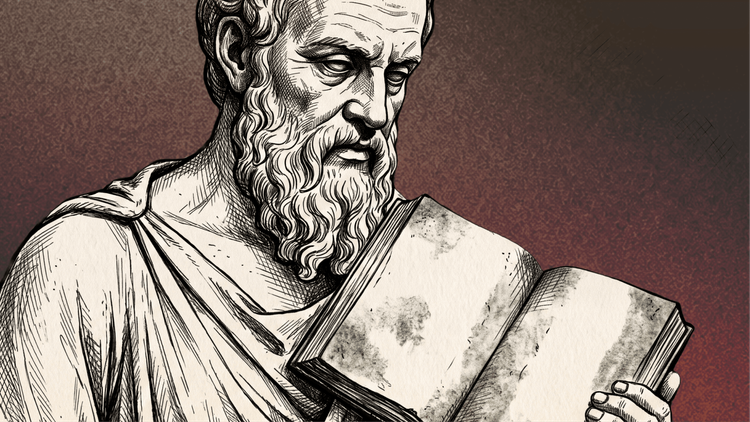
To practice stoicism, put your energy into what you control — your judgments, choices, and actions — and let go of what you don't. Stoicism is an ancient Greek philosophy that says a good life comes from your own character, built on four virtues (wisdom, courage, justice, and temperance), rather than from money, status, or comfort. You can start today with a few small habits: plan your day each morning, notice the judgment behind each reaction, expect a few things to go wrong so they sting less, and review how you handled the day each night.
Marcus Aurelius ran the Roman Empire while writing private notes to himself about staying patient with difficult people and keeping his temper. Those notes survived as one of the most-read books on stoicism ever written, and they show the philosophy at work in an ordinary, pressured life. This guide covers what stoicism is, the core beliefs behind it, and the daily practices that make it useful.
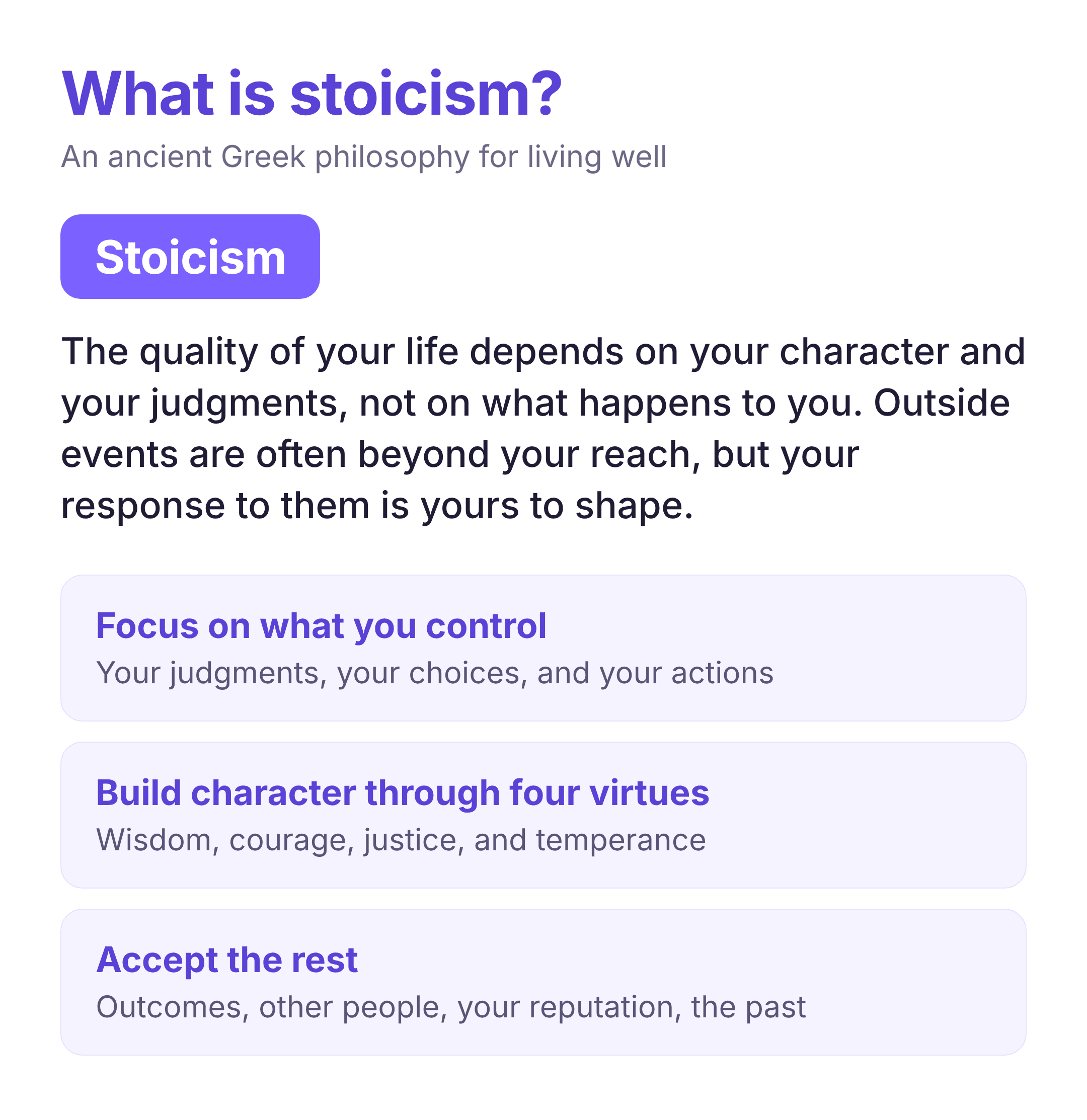
Stoicism is a practical philosophy for living well, founded in Athens around 300 BCE. The stoicism meaning comes down to one idea: the quality of your life depends on the quality of your thinking and your character, not on what happens to you. Outside events are often beyond your reach, but your response to them is yours to shape.
If you have ever wondered what is stoicism in a single sentence, this is it — a method for staying calm, reasonable, and decent while the world does whatever it is going to do.
The philosophy began with a merchant named Zeno of Citium, who started teaching in Athens after losing his cargo in a shipwreck. He gave his lessons on a public porch called the Stoa Poikile, the "painted porch," and that porch is where the word "stoicism" comes from. Over the next few centuries, stoic philosophy spread through the Greek and Roman world.
Three Stoics left writings that still survive and still read clearly today: Seneca, a Roman statesman and playwright; Epictetus, a former slave who became a respected teacher; and Marcus Aurelius, a Roman emperor. Their range — a politician, a freed slave, and an emperor — shows the philosophy was meant to work at every station in life.
Stoicism is not a religion, and it asks for no particular faith. Its influence reaches into modern psychology: Albert Ellis, who created an early form of talk therapy that shaped today's cognitive behavioral therapy (CBT), built his method on the Stoic idea that we are disturbed not by events but by our judgments about them.
A few stoicism beliefs sit underneath everything else. Understanding them makes the daily practices later feel obvious rather than arbitrary.
The first belief is that virtue is the only true good. For the Stoics, a good character — acting wisely, bravely, fairly, and with self-control — is worth more than health, wealth, or reputation. Those outside things are not evil, but they are not what makes a life good either. The Stoics called them "indifferents": fine to prefer, but never the foundation you build on.
The second belief is that your emotions follow your judgments. You feel anxious or angry because of the view you take of a situation, not because of the situation by itself. Change the judgment and the feeling shifts with it. As Epictetus put it, "Men are disturbed not by the things which happen, but by their opinions about the things."
The third belief is that living well means living by reason and in line with nature — using your capacity to think clearly, and accepting that you are one small part of a larger world you did not design. Taken together, these beliefs point your attention away from circumstances and toward the one thing you can always work on: how you think and act.
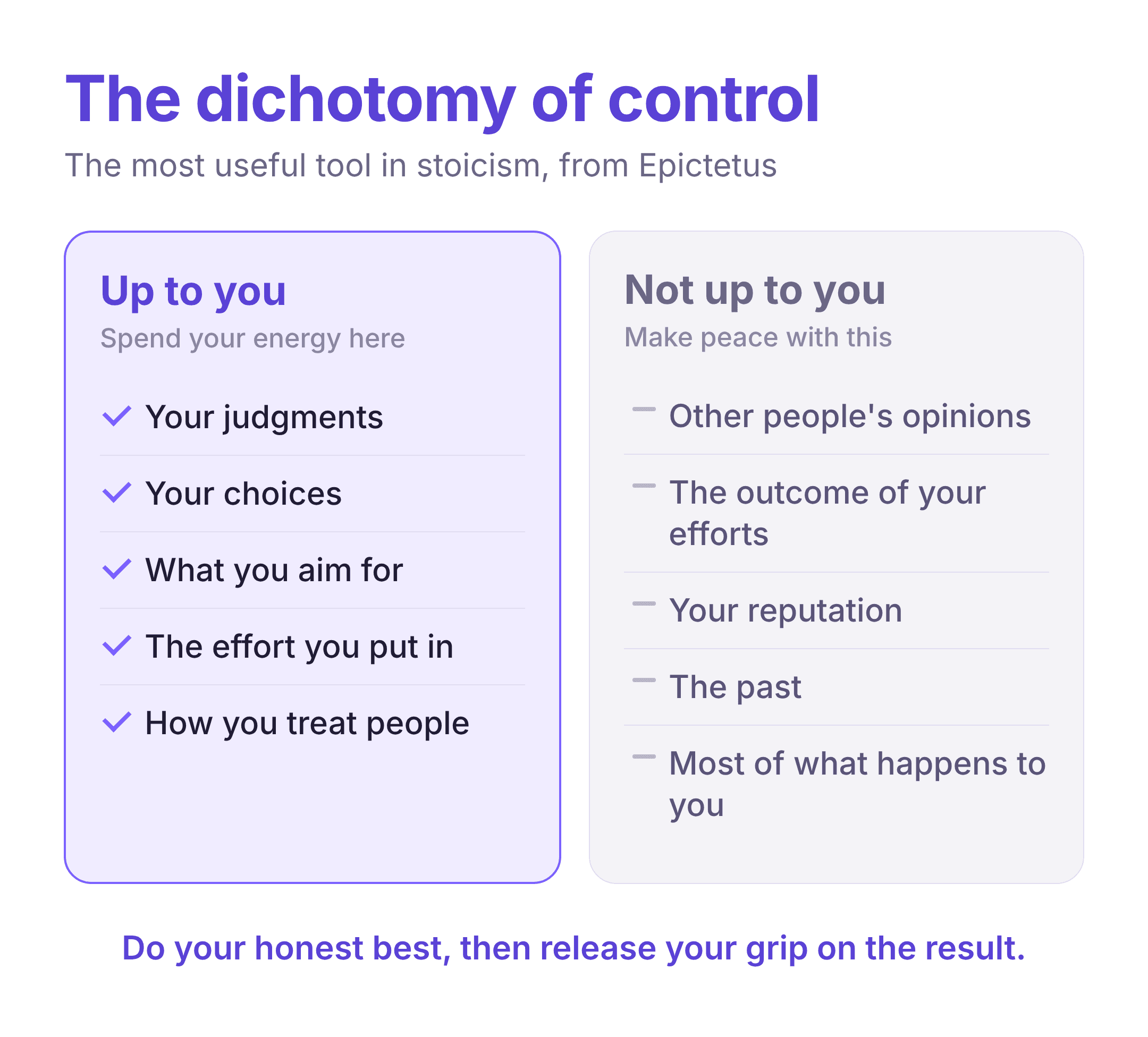
The most useful tool in stoicism is the dichotomy of control, and it comes straight from Epictetus. He opens his handbook with it: "Some things are in our control and others are not."
In our control are our judgments, our choices, what we aim for, and the effort we put in. Not in our control are other people's actions and opinions, the outcome of our efforts, our reputation, the past, and most of what happens to our bodies and circumstances. A stoic mindset means spending your energy on the first list and making peace with the second.
This sounds simple, and it is, but it is also where most of our stress comes from. We try to control how others see us, whether a plan works out, or what someone else decides — none of which is actually up to us. Chronic people-pleasing, for example, is an attempt to control other people's approval, which no amount of effort can guarantee. The Stoic move is to do your honest best and then release your grip on the result.
If virtue is the only true good, it helps to know what the Stoics meant by it. They named four stoic virtues, and every Stoic practice is really about strengthening one of them.
Wisdom is seeing situations clearly and knowing the right thing to do — telling what is in your control from what is not, and what matters from what only seems to. Courage is doing that right thing even when it is hard, frightening, or unpopular, whether the challenge is physical or moral. Justice is treating other people fairly and honestly, which the Stoics considered the most important virtue because so much of life is lived with others. Temperance is self-control and moderation: knowing how much is enough and not being ruled by appetite, anger, or impulse.
You do not practice the virtues one at a time. A hard conversation might call for wisdom to see it clearly, courage to have it, justice to be fair in it, and temperance to stay measured throughout.
Stoicism was always meant to be used, not just studied. Here is how to practice stoicism as a set of everyday habits. You do not need all of them; pick one or two and build from there.
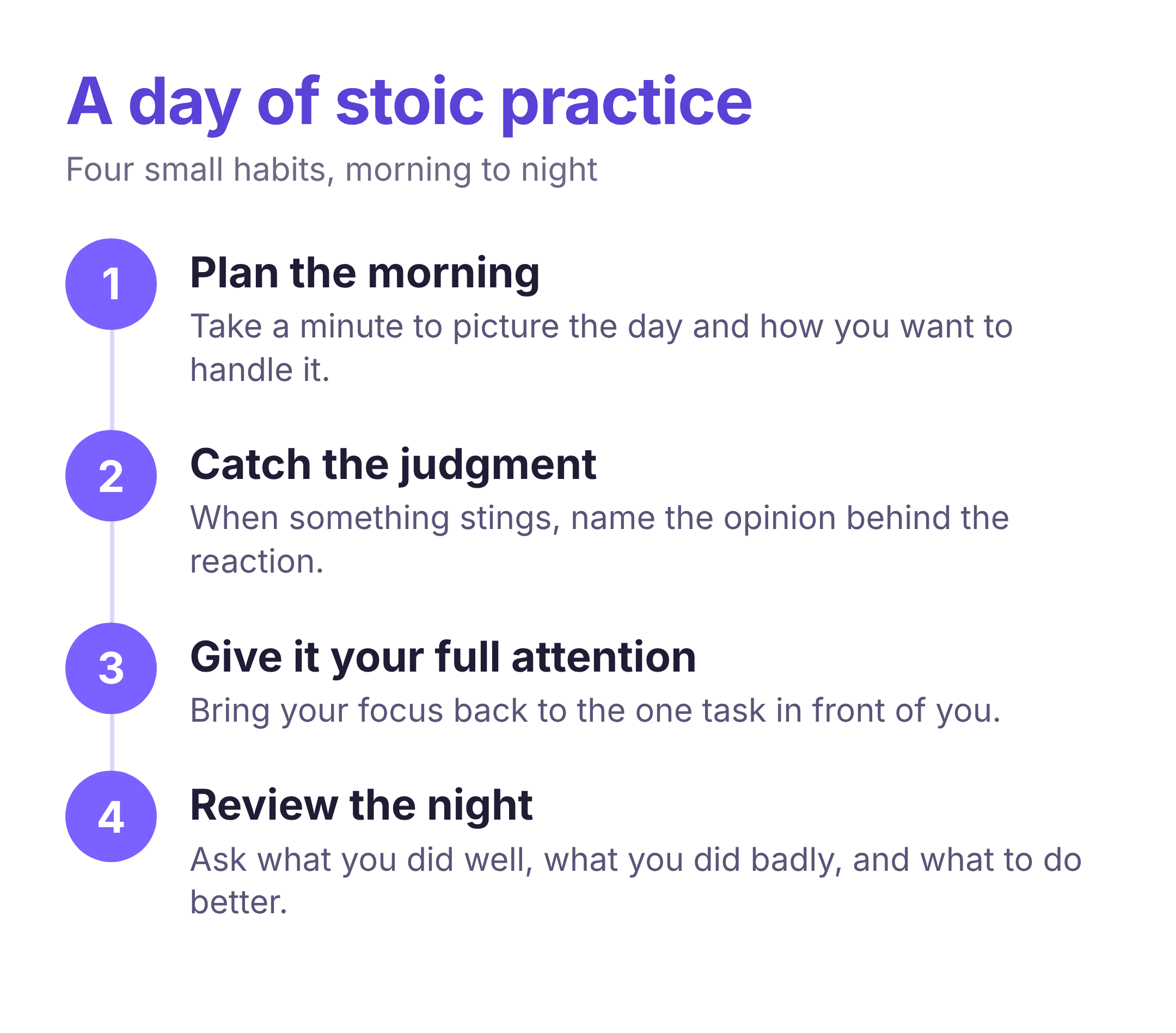
Plan the day in the morning. Before the day gets going, take a minute to picture what is ahead and how you want to handle it. Marcus Aurelius began his notes by reminding himself he would meet difficult people that day and deciding in advance not to let them disturb him. Folding this into an existing morning routine makes it stick.
Expect a few things to go wrong. The Stoics practiced imagining setbacks in advance — a delayed train, a tense meeting, a plan that falls through — so the real thing lands softer. Seneca put it plainly: "We suffer more often in imagination than in reality." Picturing a problem calmly beforehand takes much of its sting away when it arrives.
Catch the judgment behind the reaction. When something irritates or worries you, pause and name the judgment you are making about it. Often the event is neutral and the judgment is doing all the work. This is the dichotomy of control applied in real time, and it is the same move modern therapists teach.
Give your full attention to the task in front of you. Stoics treated the present action as the only place they could actually live and act well. Bringing your attention back to one thing, rather than scattering it, is a practice in itself — and a skill you can improve focus on deliberately.
Review the day at night. Seneca ended each day by asking himself what he did well, what he did badly, and what he could do better. A short, honest evening review turns ordinary days into practice and keeps you from repeating the same mistakes.
Keep perspective. Reminding yourself that your time is limited, and that your problem is small against the scale of the world, is not meant to depress you. The point is to help you care about the right things and let the small stuff go.
Because "stoic" with a lowercase "s" means unemotional in everyday English, stoicism gets misread in a few predictable ways.
It is not about suppressing or hiding your feelings. Stoics did not try to feel nothing. The aim was to examine a feeling and decide whether to act on it, rather than be ruled by it. Noticing anger and choosing not to act on it is Stoic. Pretending you feel fine while seething inside is not.
It is not passivity or a sign of not caring. Accepting what you cannot control frees up energy for what you can, so you put more into the things that matter. Marcus Aurelius governed an empire and fought wars, and Seneca advised emperors. These were engaged, active people.
It is not being cold or detached from others. Justice — treating people well — is one of the four virtues, and the Stoics saw caring for other people as a basic duty. The calm the philosophy builds is meant to make you steadier for the people around you, not distant from them.
There is also a simple spelling point worth clearing up: a capital-S "Stoic" follows the philosophy, while a lowercase-s "stoic" person just hides emotion. They are not the same thing.
Stoicism lasts because it is useful. It gives you a clear place to put your attention — what you control — and a clear standard for a life well lived in the four virtues. You do not have to read every ancient text or adopt all of it at once. Pick one practice, such as planning your morning or reviewing your night, and notice what changes. The philosophy was written by people with hard, busy lives, for people with hard, busy lives, and it still helps with the same problems today.
That a good life comes from your own character and judgment, not from outside things. The Stoics believed virtue — acting wisely, bravely, fairly, and with self-control — is the only true good, and that we should focus on what we control and accept what we don't.
In the philosophical sense, a Stoic is someone who tries to live by the four virtues and the dichotomy of control: doing their best at what is up to them and staying calm about the rest. This is different from the everyday word "stoic," which just means someone who hides their emotions.
No. Stoicism is a philosophy of how to live, and it asks for no particular faith or worship. People of any religion, or none, practice it.
The main risk is misusing it to suppress emotions or excuse not caring. Real stoicism asks you to examine your feelings, not bury them, and to act fairly toward others rather than withdraw from them. Used that way, it supports your well-being rather than numbing it.
Pick one small habit. The easiest place to start is the dichotomy of control: when something upsets you, ask whether it is actually up to you. From there, add a one-minute morning plan and a short evening review. That is enough to learn how to be stoic in a practical, everyday sense.