RiseGuide Team
To build a calmer day, work through these 15 mindfulness exercises across five groups: breathing exercises, body-based practices, grounding techniques for anxious moments, everyday mindfulness activities, and quick exercises for a busy schedule. Start with one that fits your situation: box breathing to settle nerves, the 5-4-3-2-1 grounding method when your mind races, or a one-minute body scan to reconnect. Add more as they become habit. Most take five minutes or less.
Mindfulness is a skill, and like any skill it grows with small, regular reps rather than one long session. The exercises below are those reps. According to the U.S. National Center for Complementary and Integrative Health, regular mindfulness practice is linked to less anxiety and better sleep, and none of these mindfulness exercises for adults needs special equipment or more than a few minutes. Pick one group to start with, and treat the rest as a menu you return to.
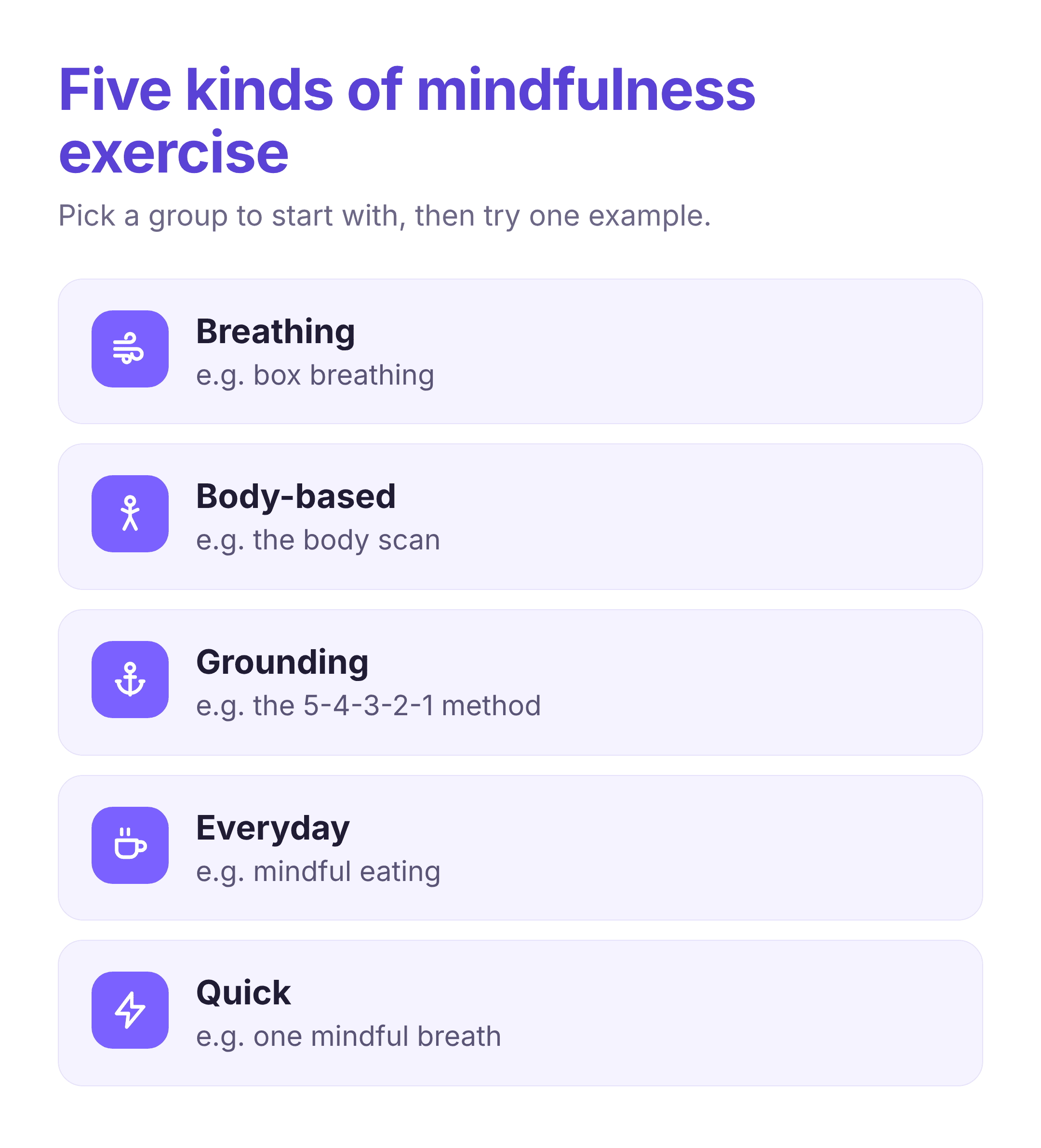
Breath is the easiest anchor for attention because it is always with you. These breathing exercises for anxiety also work as everyday resets.
1. Box breathing. Breathe in for a count of four, hold for four, breathe out for four, and hold for four. Repeat for a minute or two. The even rhythm slows a racing heart and is used by everyone from nurses to soldiers to steady themselves.
2. 4-7-8 breathing. Breathe in through your nose for four counts, hold for seven, and breathe out slowly through your mouth for eight. The long exhale is the active part; it signals your body to relax. Three or four rounds is enough.
3. Slow coherent breathing. Aim for about six breaths a minute, roughly a five-second inhale and a five-second exhale, for a few minutes. There is nothing to count sharply; the goal is a smooth, even pace that calms the nervous system.
These move your attention out of your head and into physical sensation, which is often where mindfulness feels most concrete.
4. The body scan. Bring your attention slowly from the top of your head to your toes, noticing sensations in each area without trying to change them. Even a one-minute version helps you reconnect with the present. A longer body scan is a staple of formal mindfulness meditation.
5. Mindful stretching. Do a few gentle stretches while paying full attention to how each one feels — the pull, the release, the breath that goes with it. This pairs movement with attention and suits people who find sitting still difficult.
6. Mindful walking. Walk a little slower than usual and notice the feeling of each foot meeting the ground, the rhythm of your steps, and the air on your skin. You can do it on a short indoor loop or any walk you already take.
When anxiety spikes, grounding techniques pull your attention back to the present and out of a spiral of thoughts. These grounding exercises are the ones to reach for in a hard moment.
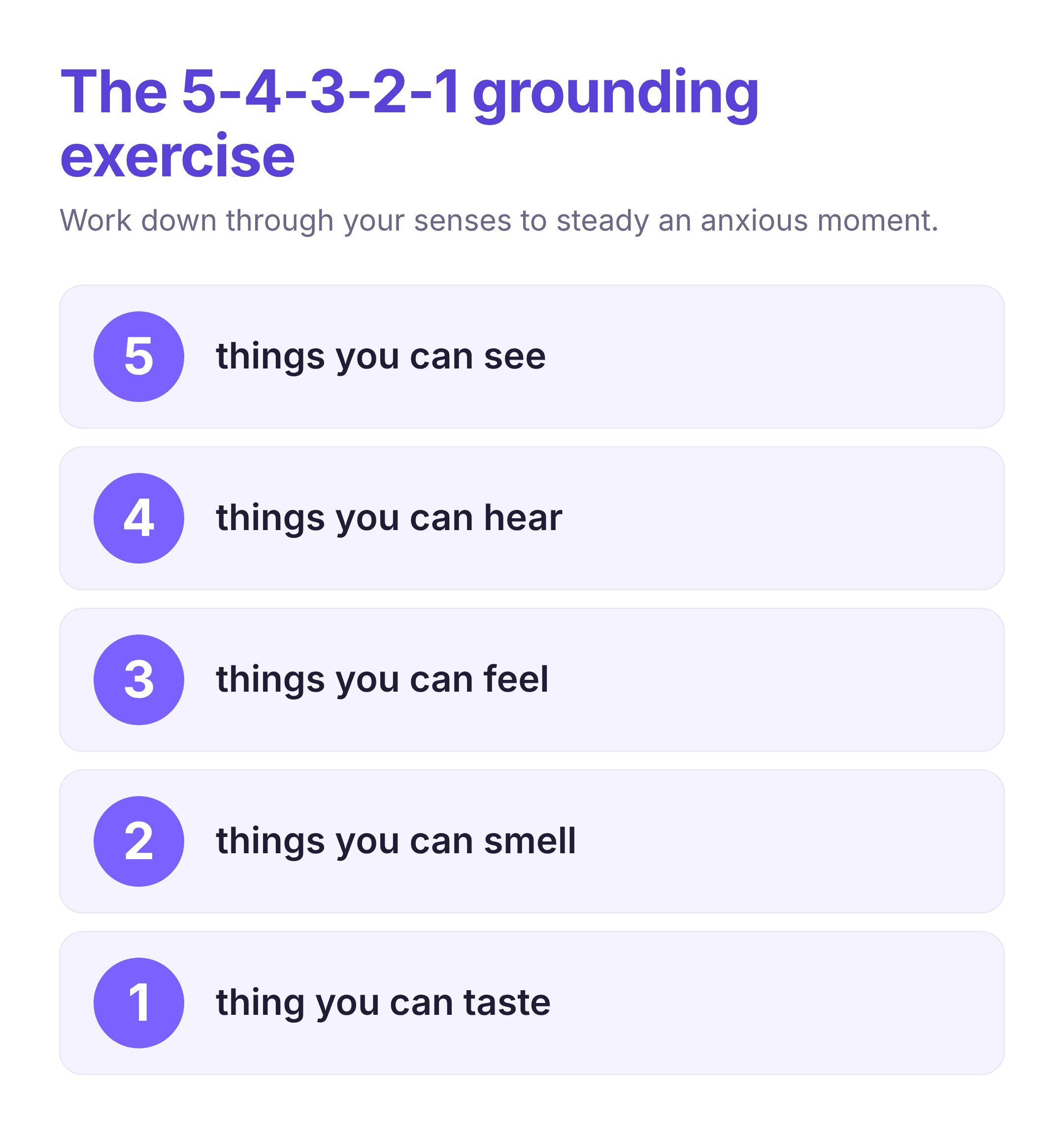
7. The 5-4-3-2-1 method. Name five things you can see, four you can hear, three you can feel, two you can smell, and one you can taste. Working through the senses interrupts anxious thinking and anchors you in the room.
8. Feet on the floor. Press both feet flat into the ground and notice the support underneath you. Feel the contact, the weight, and the stability. It is small, quiet, and works even in a meeting.
9. Hold and describe an object. Pick up something nearby, like a pen, a key, or a warm mug, and describe it to yourself in detail: its weight, texture, temperature, and color. Giving your mind a concrete task steadies it. These mindfulness exercises for anxiety work because they give attention somewhere specific to go.
You do not need extra time for these mindfulness activities — you attach them to things you already do.
10. Mindful eating. For one meal, or even the first few bites, put your phone away and notice taste, texture, temperature, and smell. Eating is one of the easiest everyday actions to do with full attention.
11. Mindful listening. In your next conversation, give the other person your whole attention instead of planning your reply. Notice their words, tone, and pauses. The same works with a piece of music, listened to without doing anything else.
12. Single-task a chore. Pick one routine task, like washing the dishes, and do only that — feel the water, the weight of each dish, the movement of your hands. Turning a chore into a practice is a classic way to fold mindfulness into a busy life.
When five minutes feels like too much, these take under a minute and still build the skill.
13. One mindful breath. Before you start a task, take one slow, fully attended breath. One breath, done with real attention, resets more than you would expect.
14. The mindful transition. Between two tasks, pause for ten seconds and notice that you are switching. This small gap keeps the stress of one task from bleeding into the next and makes it easier to improve focus on what is next.
15. The gratitude pause. Stop and notice three things that are going fine right now. This is present-moment attention pointed at the good parts of an ordinary moment, and it is an easy one to add to an existing morning routine.
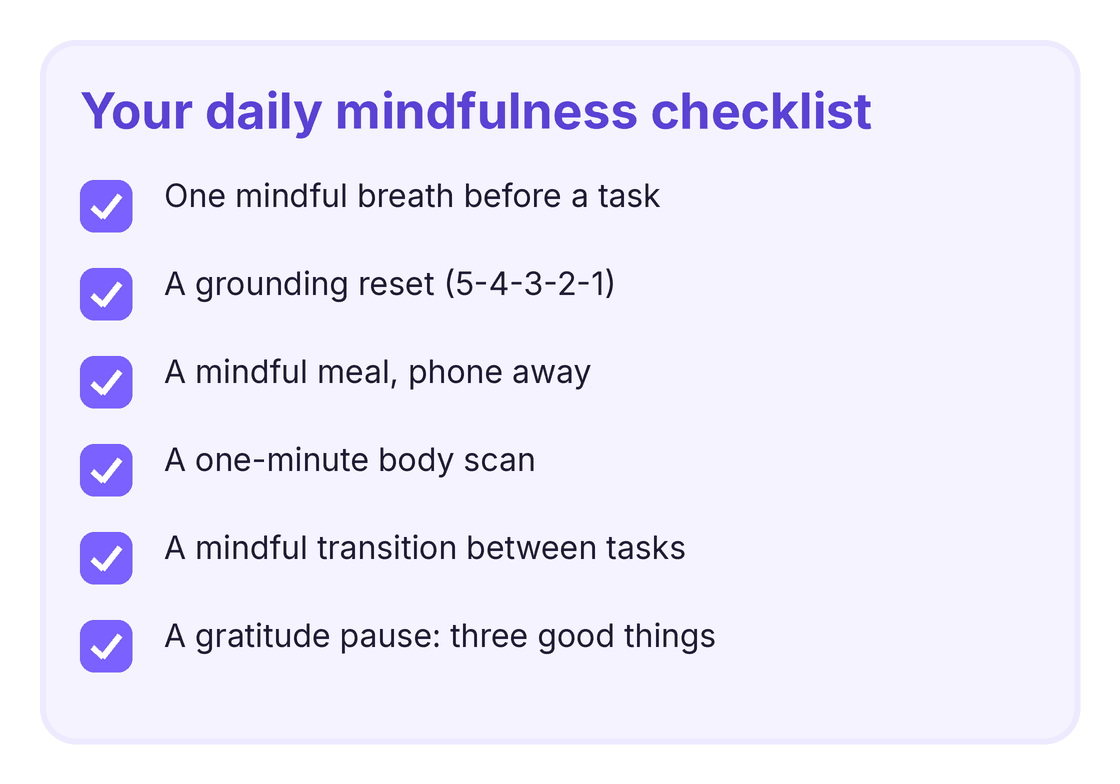
A one-page checklist of these exercises is easier to keep on a desk or phone than a whole article. The free mindfulness checklist is available to download so you can tick off a few each day while the habit forms. Practicing the same small exercises on a schedule is also how you stop old habits of reacting on autopilot, including the urge toward people-pleasing, before it takes over.
You do not need all fifteen of these at once. Pick one breathing exercise, one grounding technique, and one everyday activity, and run them for a week. The point of mindfulness exercises is repetition rather than perfection, and a few minutes most days will do more than a long session once in a while. Keep the checklist nearby, start small, and let the habit grow from there.
A simple daily set is one breathing exercise (box breathing or 4-7-8), one grounding technique (the 5-4-3-2-1 method), and one everyday practice (a mindful meal or a mindful walk). Together they take under ten minutes and cover calm, focus, and present-moment attention.
One mindful breath before a task, box breathing, the 5-4-3-2-1 grounding method, a one-minute body scan, and a mindful transition between tasks. Each takes a minute or two.
A five-minute body scan, five minutes of slow breathing, a short mindful walk, or a mindful meal all work. These mindfulness activities for adults fit into a lunch break or the start of the day.
The 5 R's of mindfulness are taught in a few slightly different versions. A widely shared one is recognize, relax, review, respond, and return: notice what you are feeling, relax your body, look at the moment without judgment, choose your response on purpose, and return your attention to the present. Because the wording varies by source, treat it as a simple loop to follow rather than a fixed checklist.
Yes, for many people. Grounding techniques and slow breathing calm the body's stress response in the moment, and regular practice is linked to lower anxiety over time. They are a helpful tool alongside, not a replacement for, professional care when anxiety is severe.