RiseGuide Team
 Free with any plan: the First Impression Formula guideClaim the free guideGet the guide

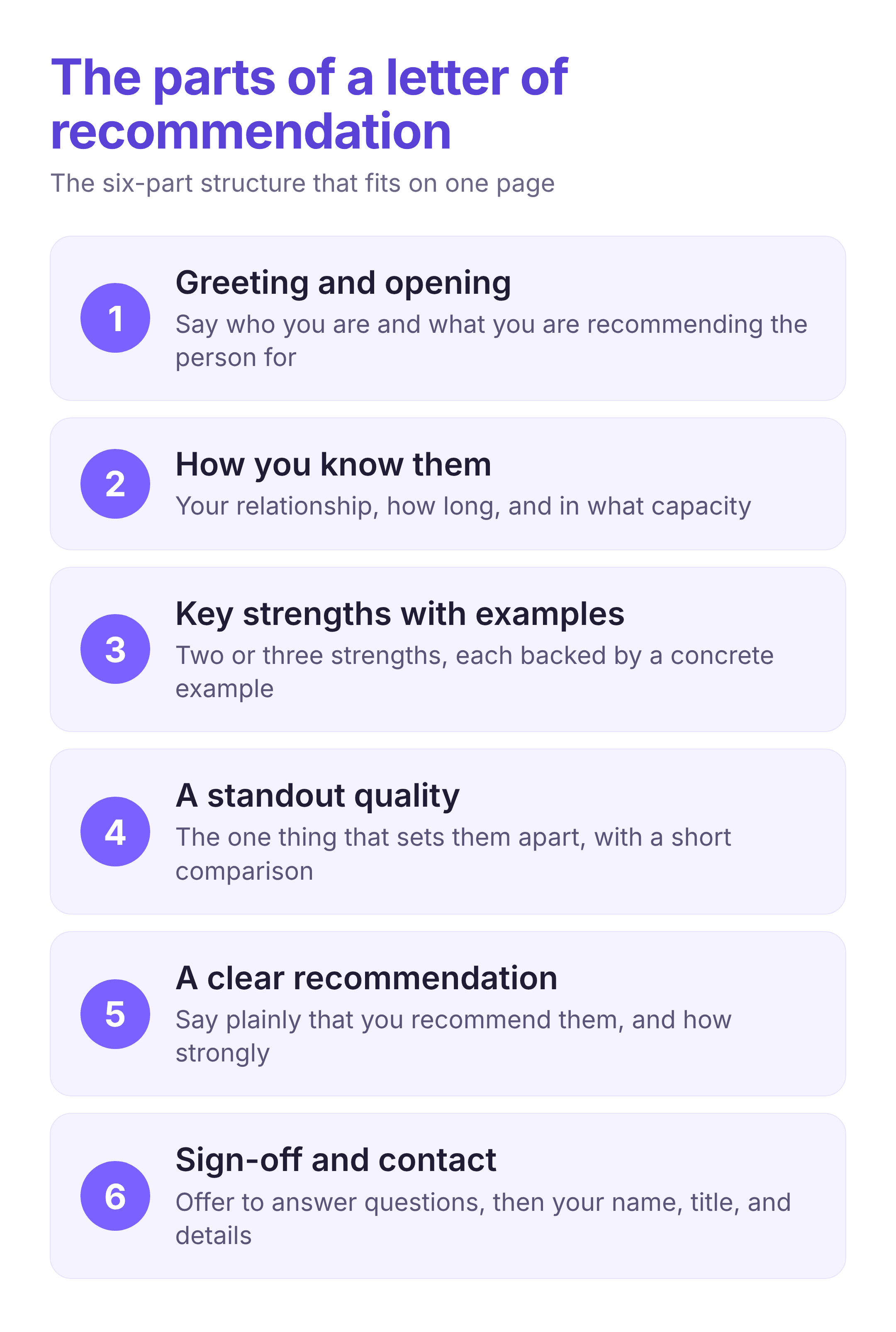
A letter of recommendation follows a simple structure you can reuse: an opening that says who you are and how you know the person, a paragraph on how long and in what capacity you have known them, one or two paragraphs with specific strengths backed by real examples, a clear line that you recommend them, and a sign-off with your contact details.
Being asked to write a letter of recommendation is a small kind of pressure. Someone trusts you enough to vouch for them, you want to do right by them, and then you face a blank page and a deadline. The good news is that a strong letter of recommendation is mostly structure. Once you know the parts and have a couple of real examples to work from, the writing goes quickly. This guide gives you the format, a template you can copy, full examples for the most common situations, and the one habit that separates a letter that helps from one that gets skimmed: using specific, true details instead of general praise.
A letter of recommendation is a letter written by someone who knows a person's work or character, addressed to an employer, a school, or a committee, that supports that person's application. You are, in effect, lending your own credibility to someone else. Teachers write them for students applying to college, managers write them for employees moving on or up, and colleagues write them for peers.
It is worth clearing up two terms people mix up. A letter of recommendation is usually detailed and tied to a specific opportunity, like a particular job or degree program. A professional reference letter is often more general, a shorter confirmation of someone's skills and conduct that can be reused for several applications. Both are different from a cover letter, which a candidate writes about themselves to sell their own fit for a role. If you are the one applying rather than the one writing, our post on cover letter examples covers that side.
Most recommendation letters share the same shape, which is why a template works so well. A standard letter of recommendation has six parts, and it fits on a single page.
Here is a letter of recommendation template you can copy and fill in. Replace everything in brackets, and cut any line that does not fit.
[Date]

Dear [Reader's name, or "To whom it may concern"],

I am pleased to recommend [Name] for [the role, program, or opportunity]. My name is [Your name], and I am [your title] at [organization], where I have worked with [Name] for [length of time] as their [manager / teacher / colleague].

In that time, [Name] has stood out for [first strength]. For example, [specific example with a number or result]. They are also [second strength]: [specific example].

What sets [Name] apart is [standout quality]. [Short comparison or concrete evidence that backs it up.]

I recommend [Name] without reservation for [the opportunity], and I am confident they will [the result the reader cares about]. Please feel free to contact me at [email or phone] if I can share anything more.

Sincerely,
[Your name]
[Your title, organization]
[Contact details]
Knowing how to write a letter of recommendation comes down to a few steps that keep it specific and honest.
The difference between a forgettable letter and a strong one is almost always specifics. Vague praise reads as a favor; concrete examples read as evidence.
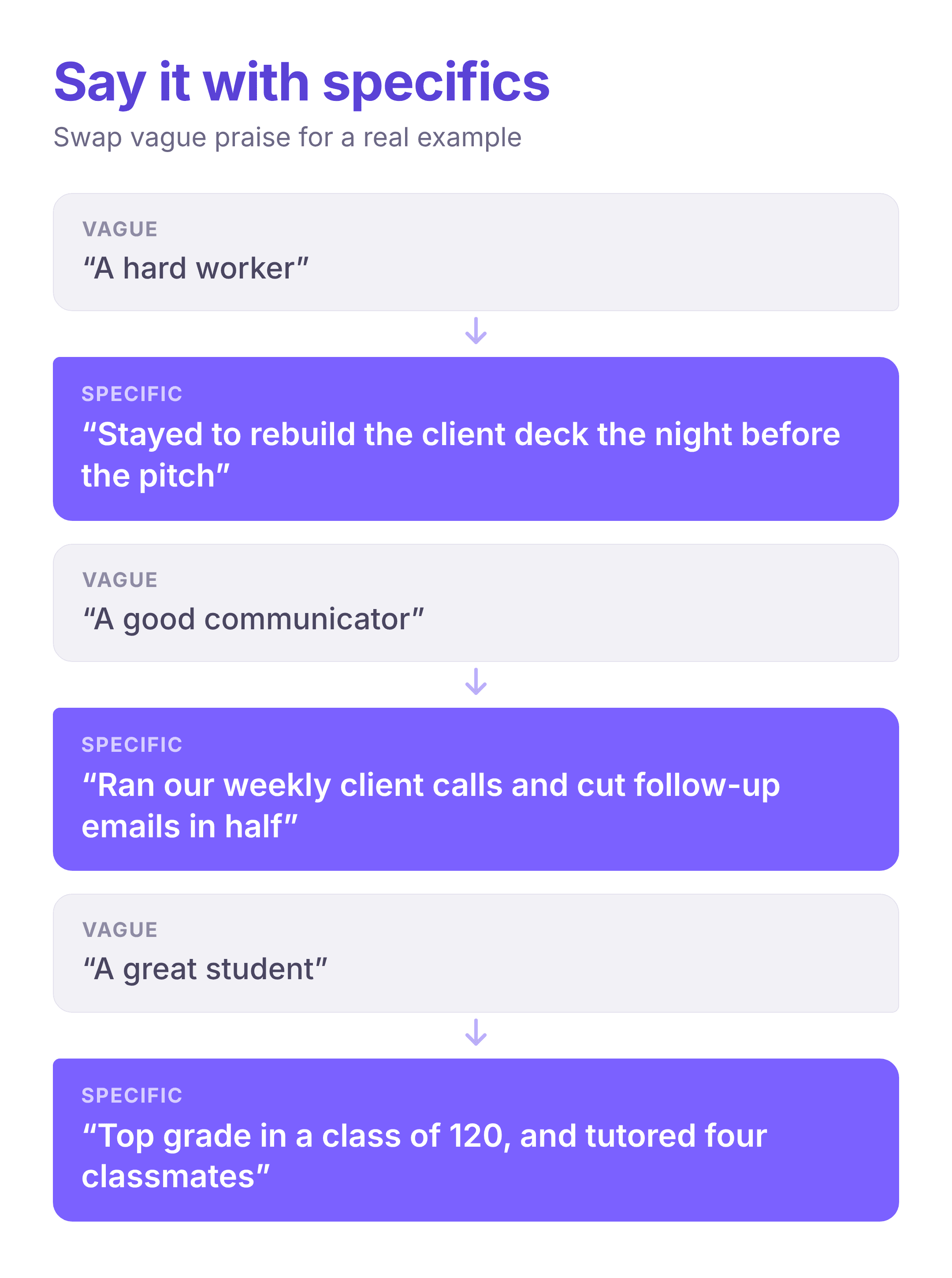
The structure is the same, but the voice and the details change with who you are and who you are writing for. Here are three letter of recommendation examples you can adapt.
Use this when you are a manager and need a letter of recommendation for employee applications, written for someone moving to a new job.
Dear Ms. Alvarez,

I am glad to recommend Daniel Okafor for the Operations Manager role at Brightline Logistics. I am Priya Shah, Director of Operations at Meridian Freight, where I managed Daniel directly for four years.

Daniel joined us as a coordinator and was promoted twice on the strength of his results. He redesigned our dispatch process and cut average delivery delays by 22 percent in a single quarter, and he did it while training two new coordinators who are now among our strongest.

What sets Daniel apart is how calm he stays under pressure. During a warehouse system outage last year, he kept our largest accounts informed hour by hour and we did not lose a single one. In ten years of managing operations teams, he is one of the two best people I have worked with.

I recommend Daniel without reservation. He will raise the standard of any team he joins. Please reach me at [email protected] if I can tell you more.

Sincerely,
Priya Shah
Director of Operations, Meridian Freight
Use this when you are a teacher or professor and need a letter of recommendation for student applications to a program or scholarship.
To whom it may concern,

I am pleased to recommend Mei Tan for admission to your undergraduate engineering program. I am Robert Ellis, and I taught Mei in AP Physics and supervised her robotics team for two years at Lincoln High School.

Mei is one of the most capable students I have taught in fifteen years. She earned the highest grade in a class of 120 and, more tellingly, spent her own lunch periods tutoring four classmates who went on to pass the course. On the robotics team she led the design that placed second at the state championship.

What stands out about Mei is her curiosity. She asks the question the rest of the class has not thought of yet, and she follows it until she understands. That instinct is exactly what strong engineering students are made of.

I recommend Mei with my full confidence. She will make the most of the opportunity you offer her. I am happy to answer any questions at [email protected].

Sincerely,
Robert Ellis
Physics Teacher, Lincoln High School
Use this when a coworker at your own level asks you to vouch for them and you cannot speak as their manager.
To whom it may concern,

I am happy to recommend Jordan Fields for the Senior Designer position at Northwind Studio. Jordan and I worked side by side as product designers at Cloudbank for three years, so I can speak to their work from up close rather than from above.

Jordan is the person our team turned to when a project was stuck. When our checkout redesign stalled, they ran a two-day working session that got the whole team aligned, and the new flow lifted completed purchases by 15 percent. They are also generous with feedback, which quietly made everyone around them better.

What I value most about Jordan is their reliability. If they say a piece of work will be ready, it is ready, and it is good. That is rarer than it should be.

I recommend Jordan wholeheartedly and would gladly work with them again. Feel free to contact me at [email protected].

Sincerely,
Sam Reyes
Product Designer
If you are on the other side and need someone to write one for you, make it easy for them. Ask in good time, pick someone who knows your work well, and give them your resume, the job or program details, and a short note on what you would like them to highlight. The more specific material you hand over, the stronger and faster the letter. While you are preparing applications, it also helps to have the rest of your materials ready: our posts on how to make a resume stand out and the questions to ask in an interview cover the steps around the letter.
A template gets you started, but a letter that sounds copied from a template will not help anyone. Before you send it, adapt it in two ways.
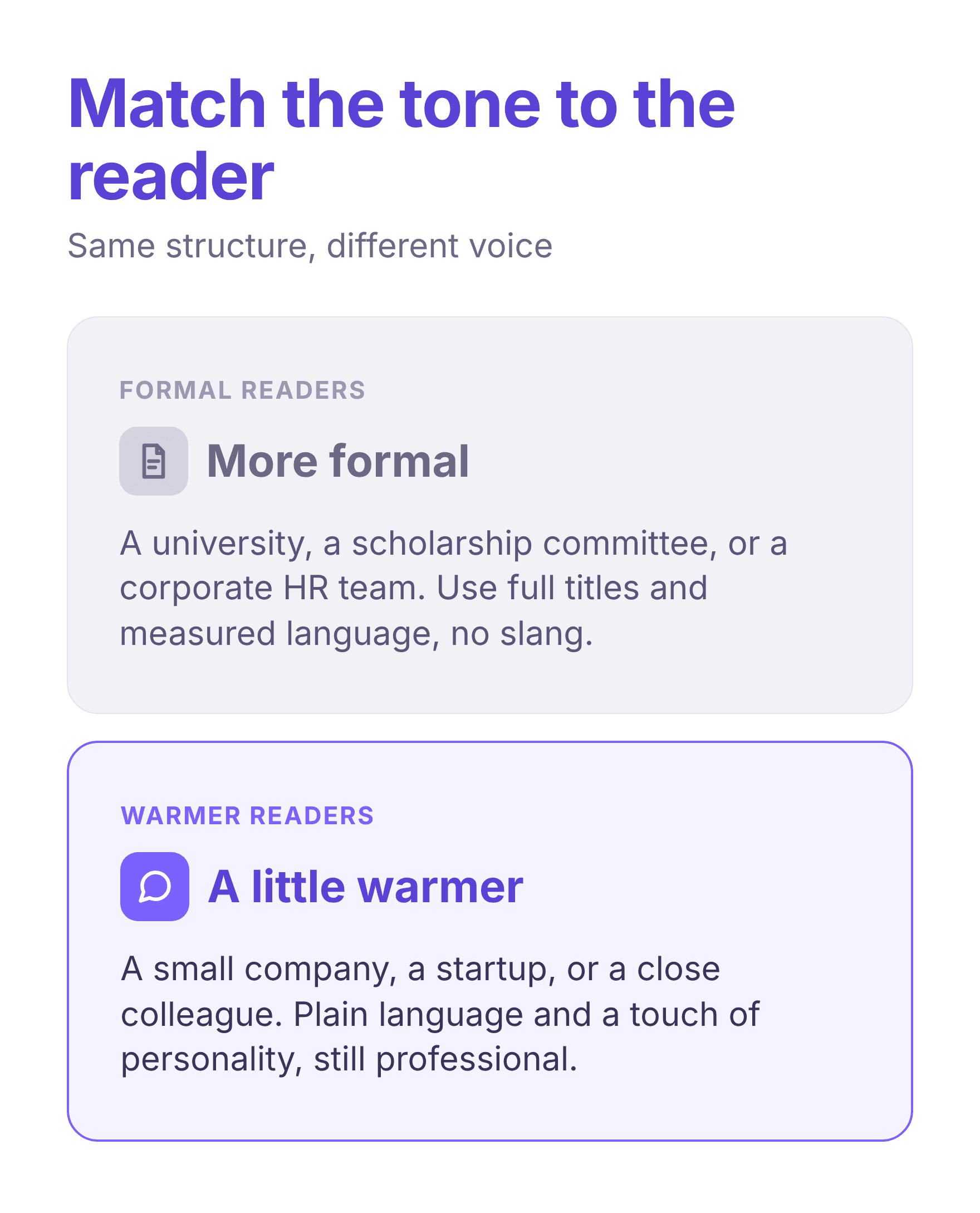
First, match the tone to the reader. A scholarship committee or a large company's HR team expects a formal letter with full titles and measured language. A small company or a startup usually reads warmer, plainer writing as a better fit, so you can let a little personality through while staying professional. If you can, look at the organization's website or social media to get a feel for how they talk, and write toward that.
Second, make the examples true and specific to this person. The strength of a recommendation comes from details only you could know, so swap every placeholder for a real moment, a real number, or a real result. A letter built from your own observations will always beat a polished template filled with generic lines.
A letter of recommendation is easier to write than it feels, because the structure does most of the work. Start from the letter of recommendation template, follow the six parts, and spend your effort on specific, honest examples rather than on finding bigger adjectives. Match the tone to whoever will read it, keep it to a page, and you will hand the person a letter that actually helps them.
Follow the six-part structure: open with who you are and the opportunity, say how you know the person, give two or three strengths with real examples, name one standout quality, state clearly that you recommend them, and close with your contact details. Keep it to one page and swap general praise for specific results.
The standard format is a one-page business letter: a dated greeting, an opening that introduces you and the recommendation, a paragraph on your relationship, one or two paragraphs of strengths backed by examples, a clear endorsement, and a sign-off with your name, title, and contact information.
Strong, specific words help, for example dependable, resourceful, thorough, collaborative, and principled. But a single concrete example does more than any adjective, so use these words as labels for real behavior rather than as a substitute for it.
An AI tool can help you draft a structure or tidy your wording, but the value of a recommendation is the specific, true detail that only you know about the person. Use it as a starting point if you like, then replace the generic lines with your own observations and check every fact before you sign it.
One page, usually three to four short paragraphs. Readers often have many letters to get through, so a focused page with concrete examples lands better than a long letter padded with general praise.