RiseGuide Team

For strong cover letter examples, match the example to your situation, then make it yours: open by naming the job and why you want it, spend the middle connecting two or three of your results to what the role needs, and close with a clear thank-you and next step. A good cover letter is about half a page, never repeats your resume word for word, and speaks to one specific job. Below you will find examples for a first job, a career change, no experience, a recent graduate, and a short email version, plus a free template you can download.
A blank page is the hardest part of any job application, and the cover letter is often where people get stuck. It helps to start from a real example that fits your situation and adjust it, rather than inventing the whole thing from scratch. This guide gives you cover letter examples for the most common situations, a simple format that works for almost any role, and a free template you can download and fill in with your own details.
A cover letter is a short, one-page note you send with your resume to introduce yourself and explain why you are a good fit for one specific job. Where the resume lists what you have done, the cover letter connects those facts to the role in front of you and adds the context a bullet point cannot: why you want this job, why this company, and what you would bring to it.
You do not always need one, but it rarely hurts to include it, and for a career change or a first job it can help by filling in the context your resume leaves out. The goal is to give a hiring manager a reason to read on, using the space to explain why a few things on your resume matter for this job.
Almost every effective cover letter follows the same basic cover letter format. Keep it to a single page, use the same font and header as your resume, and work through these parts in order.
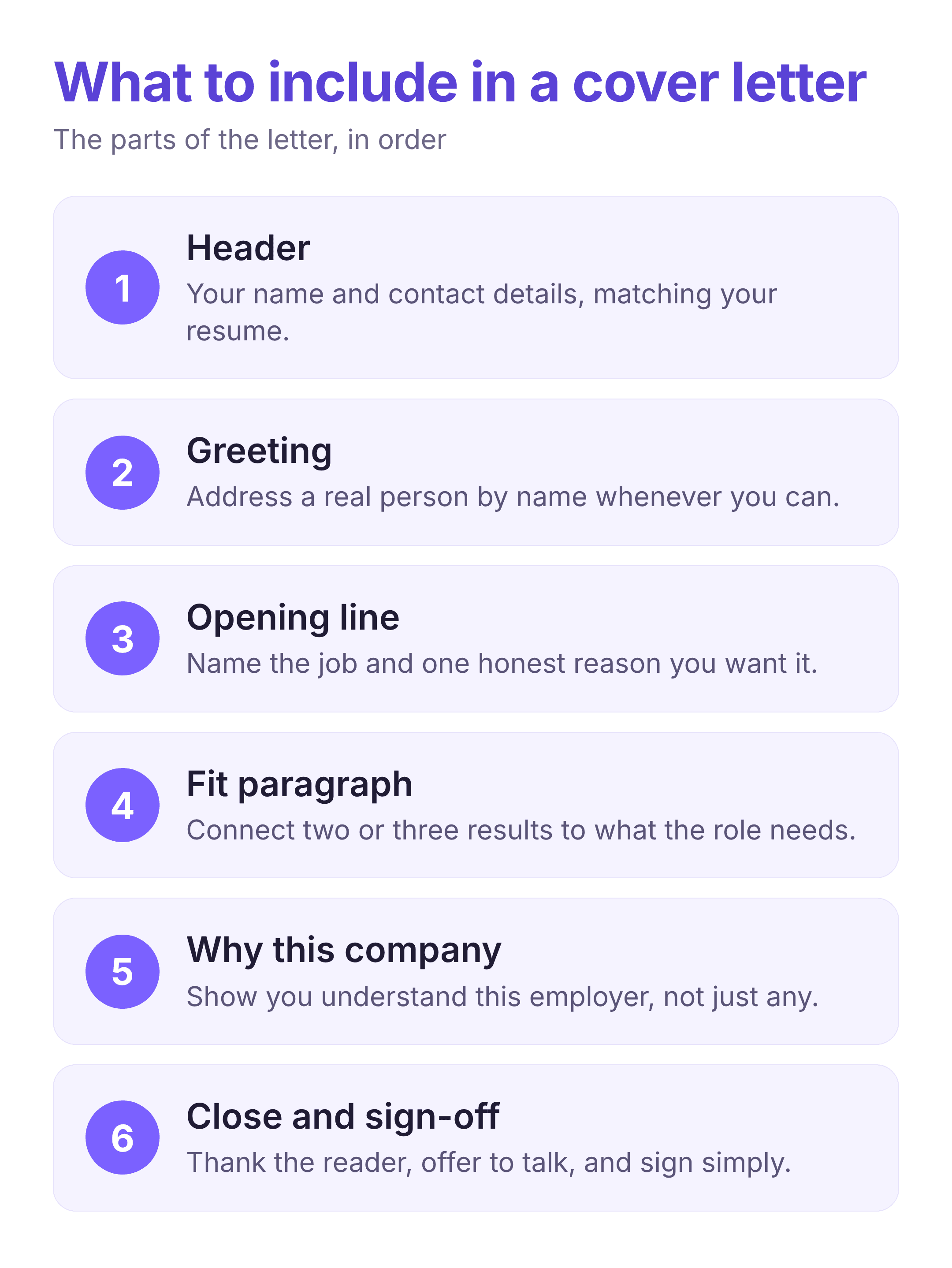
Your header comes first: your name and contact details at the top, matching your resume, with the date and the company's details below. Then a greeting, addressed to a person by name wherever you can find it, and to the team or hiring manager when you cannot. The opening line names the job you are applying for and gives one genuine reason you want it. The middle is the main part, usually one or two short paragraphs that connect your most relevant results to what the role asks for. A separate line or short paragraph shows you understand this specific company and want to work there, not just anywhere. The close thanks the reader, says you would welcome the chance to talk, and signs off simply.
Once you know the parts, writing the letter is a matter of working through them in order. These steps run in sequence because each one feeds the next.
First, read the job post twice and pull out the three or four things it clearly cares about most. Second, open with the job title and a specific, honest reason you want it, not "I am writing to apply for." Third, pick two or three of your achievements that match what the post asked for and explain the result, not just the task. Fourth, add a line that shows you know this company, from its product, mission, or recent work. Fifth, close with a short thank-you and an offer to talk, then read the whole thing out loud to catch anything stiff.
Keep the letter working alongside your resume rather than echoing it. If your resume needs the same attention, our team's guide to making your resume stand out covers the other half of the application. And if putting your strengths into words is the part you find hardest, RiseGuide's Communication Mastery journey breaks that skill into short lessons drawn from expert insights, so you can practice writing and speaking about your work in the gaps of a busy week.
The fastest way to write yours is to start from the example closest to your situation and swap in your own details. Each one below follows the same shape: an opening that names the job, a middle led by a concrete result, a line on why this company, and a short close. Here are cover letter examples for the five situations people ask about most.
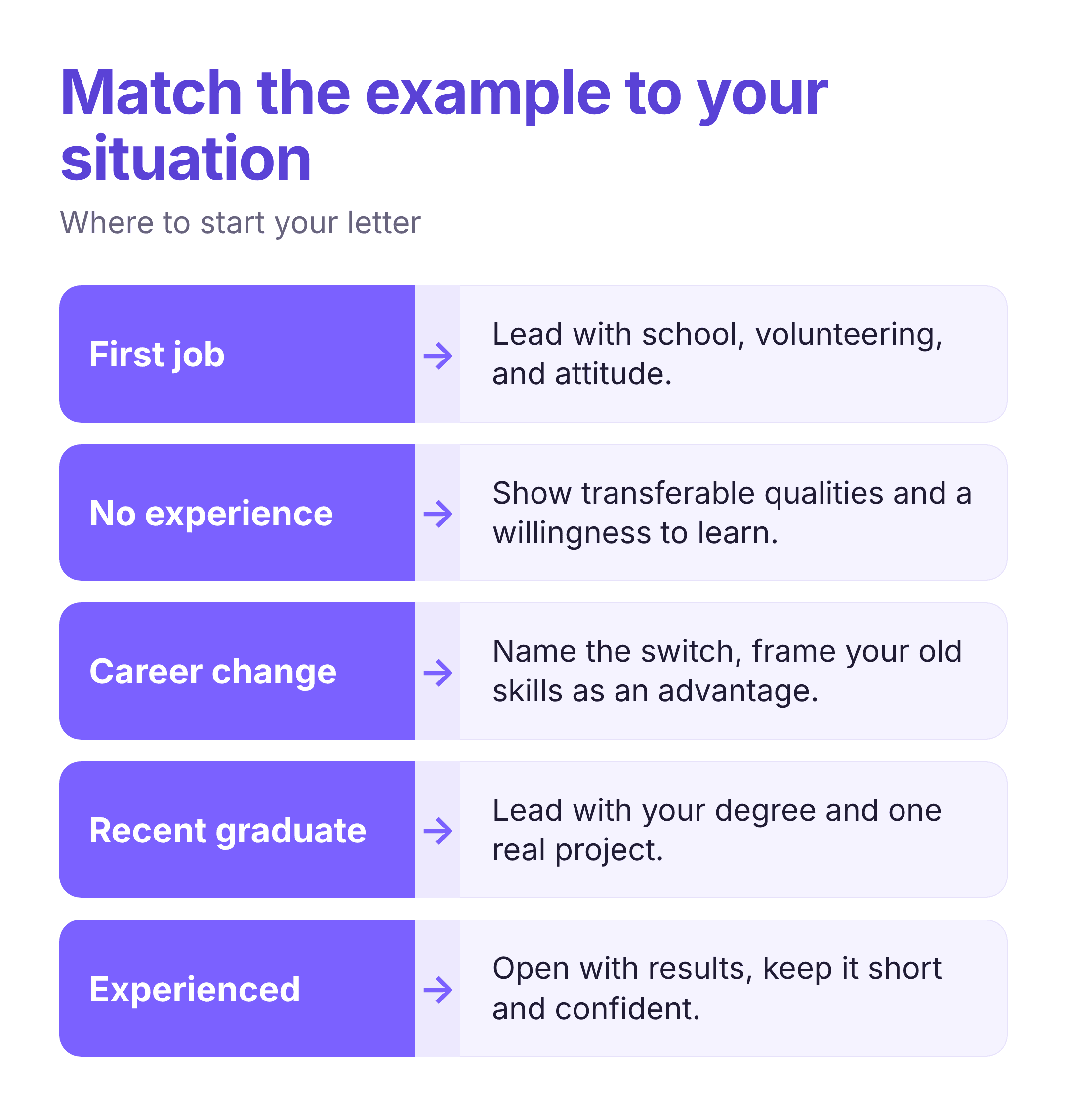
When you have no formal work history, lead with real things you have done at school, volunteering, or a side project, and show the qualities the role needs.
Dear Ms. Harper,<br /><br />I am applying for the Sales Assistant role at Brightway Books. For the past two years I have run a weekly secondhand book stall at my school, where I set up the stock, ran the till, and served customers at our busiest times. Last year the stall raised $1,200, our highest total yet, after I started asking buyers what they liked and walking them to two or three other books.<br /><br />I am dependable, I learn new systems quickly, and I am genuinely good with people during a busy shift. I would bring that reliability and a real interest in books to your team at Brightway.<br /><br />Thank you for considering my application. I would welcome the chance to meet and show you how I work.<br /><br />Best regards,<br />Sam Carter
When you are switching fields, name the change in the first line and frame your old experience as proof you can do the new work.
Dear Ms. Reyes,<br /><br />I am applying for the Project Coordinator role at Lumen Studio. After six years teaching high school English, I am moving into project work, and the day-to-day is closer than it sounds: I planned a year of lessons against fixed deadlines, coordinated students, parents, and staff, and kept every plan documented and on schedule.<br /><br />Last spring I ran our school's arts week from start to finish. I booked three outside venues, managed a $4,000 budget, and coordinated 15 volunteers across five days, and every event started on time. I am now formalizing the skill set with a Google Project Management certificate, which I finish in May. I would bring that same planning, and the calm it takes to keep a full classroom on track, to your team.<br /><br />Thank you for your time. I would be glad to walk you through how my experience maps to this role.<br /><br />Sincerely,<br />Jordan Blake
A new graduate can lead with the degree, then point to one real project that looks like the job.
Dear Mr. Lind,<br /><br />I am applying for the Junior Analyst role at Northwind Data. I graduated in May with a degree in economics, and what I enjoy most is exactly what this role involves: finding the story in a company's numbers and explaining it in plain terms.<br /><br />Last summer I interned at Brightline, a small online clothing retailer, where I analyzed a year of their returns data. Almost half of all returns came from a single jacket, and most buyers who sent it back said it ran small. I recommended rewriting the size guide and adding exact measurements to the product page, and the quarter after the change the return rate on that jacket fell from 38 percent to 22 percent. I work confidently in Excel and SQL, and I am keen to learn from a team that handles data at a larger scale.<br /><br />Thank you for considering my application. I would welcome the chance to discuss how I could contribute.<br /><br />Best regards,<br />Maya Okafor
With a track record, lead with numbers and keep it confident and brief.
Dear Mr. Olsen,<br /><br />I am applying for the Operations Manager role at Harbor Logistics. For the last eight years I have run warehouse operations for a mid-sized retailer, most recently a team of 24 across two shifts. I cut average order-processing time from 48 hours to 16, and raised picking accuracy to 99.4 percent through two back-to-back holiday peaks.<br /><br />What draws me to Harbor is your move into same-day delivery. When my current company launched next-day shipping, I built the overnight dispatch process from scratch, so I know the staffing and routing problems that come with tighter windows. I would bring that experience, a close watch on throughput and error rates, and a management style built on clear targets and weekly one-to-ones.<br /><br />Thank you for your time. I would welcome a conversation about how I can help Harbor scale without losing accuracy.<br /><br />Sincerely,<br />Dana Whitfield
When you are pasting a note into an email or an application box, a short cover letter sample like this one does the job.
Dear Ms. Grant,<br /><br />I am applying for the Content Writer role at Fernlea Media. I write for B2B software brands, and over the past year I grew one client's blog from 3,000 to 11,000 monthly readers by rebuilding their SEO calendar and tightening the editing.<br /><br />I can turn around clean, well-researched drafts quickly, and I already read and recommend your newsletter. My resume is attached, and I am happy to share samples or do a short paid test. Thank you for your time.<br /><br />Best regards,<br />Noah Bennett
Before you send anything, spend two minutes reading how the company talks about itself. The job post, the About page, and the company's social media tell you whether to lean formal or casual, and matching that is part of what makes a letter feel written for them.
Formal signals look like full sentences, titles and surnames, and careful, measured language with no slang or emoji. Law, finance, government, and large corporates usually sit here. If that is how they write, address a real person as "Dear Ms. Lee," keep your sentences complete, and let your results speak without hype.
Casual signals look like a first-person "we," a conversational blog, the odd joke, and first names on the team page. Startups, creative studios, and small brands often sit here. If that is their style, "Hi Maria" is fine, contractions are welcome, and a warmer, more direct opening will fit. You are still professional, just less buttoned-up.
When you cannot tell, lean slightly formal. A copy-paste letter in the wrong register is easy for a hiring manager to spot.
Everything here comes together in our free, printable cover letter kit. It has mix-and-match openings, middles, and closings in both a formal and a casual version, two full example letters, and a blank template to fill in, so you can put a letter together in a few minutes and adapt it to the company's tone. This free cover letter template works for almost any role.
Download the free cover letter kit
A template gets you started, and the details are what you adapt for each job. Change the opening line for every application, and if you are reaching out through someone you know, a short, warm note works better than a formal one. Our guide to networking covers how to find the right person to address and how to follow up after you apply.
A cover letter is easier when you stop trying to write it from nothing. Pick the example that matches where you are, keep the structure simple, and spend your effort on the two or three details that connect you to this one job. Download the template, fill in the brackets, read it out loud once, and send it.
About half a page, and never more than one. Three or four short paragraphs, roughly 250 to 400 words, is enough to make your case without losing the reader. If you are writing in the body of an email, shorter is better.
Match the company. Read their website, the job post, and their social media: careful, measured language means a formal letter, while a conversational brand is fine with a warmer, more direct note. When you cannot tell, lean slightly formal.
When a cover letter is optional, including a strong one rarely hurts and often helps, especially for a career change, a first job, or a role you really want. If you only have time to send a generic one, it is better to skip it and put that effort into tailoring your resume.
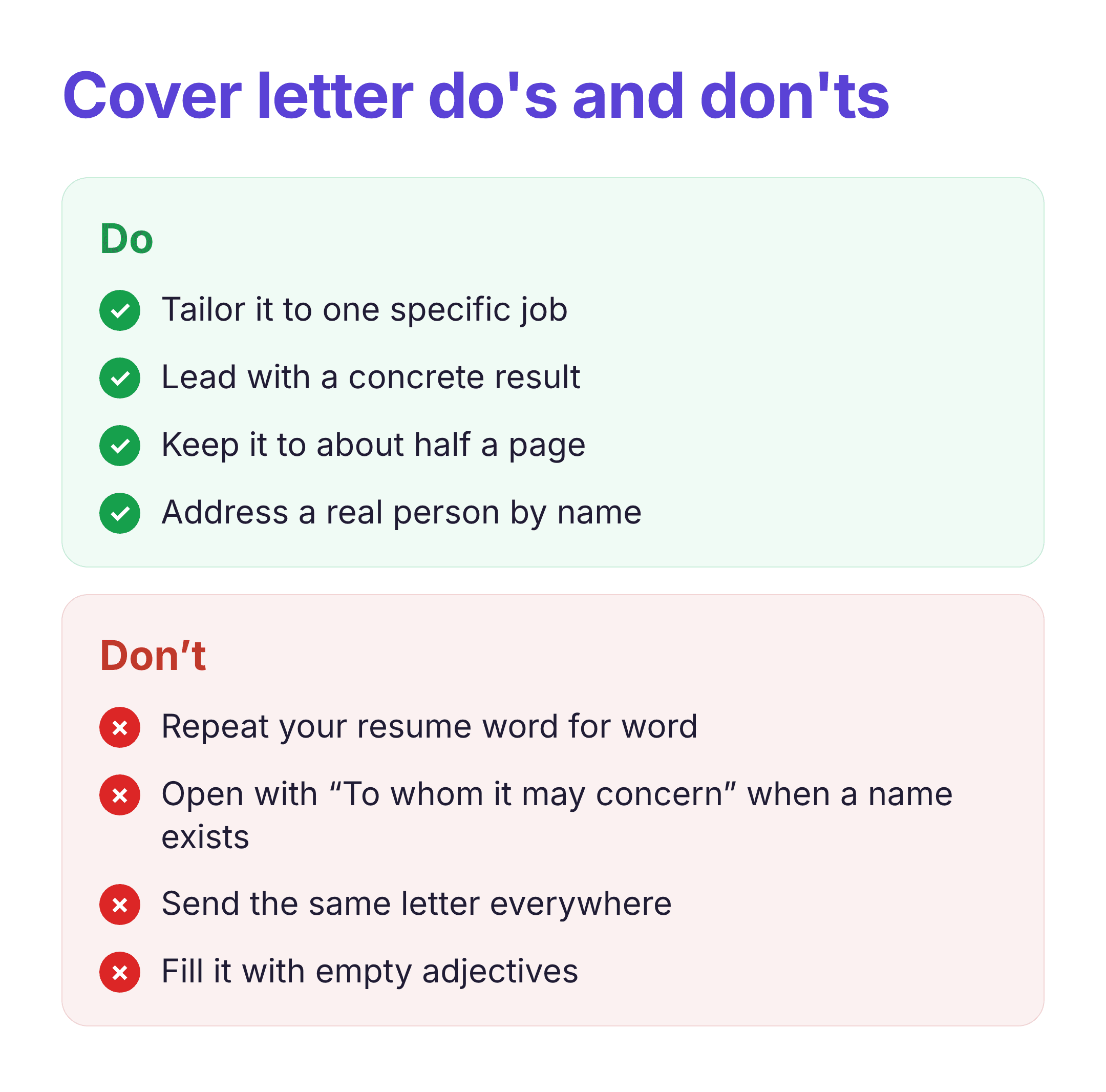
Name the job and give one specific, honest reason you want it. Skip "I am writing to apply for the position of," which wastes your strongest line. Address a real person by name whenever you can find one.
No. The resume lists what you have done; the cover letter explains why a few of those things matter for this job, and adds the context and motivation a resume cannot show.