RiseGuide Team
 FREE GUIDE with any plan: the First Impression FormulaClaim the offer
Audible is worth it if you listen to audiobooks often, want new releases as soon as they come out, and like having a monthly credit plus a catalog you can stream. Across reviews, people praise the size of the library, the convenience of listening while they commute or do chores, and the fact that books you buy stay yours after you cancel. The same reviews point out that you are licensing books rather than owning the files, that unused credits disappear if you cancel, and that it is poor value if you only finish a few books a year. Membership runs from about $8 to $15 a month depending on the plan. If you read only now and then, happily wait for library holds, or want to own your files outright, a free app like Libby or a different service may suit you better.
Audible is the first name most people think of for audiobooks, and for good reason: it has the biggest catalog, the newest releases, and deep ties to Amazon and Kindle. It also runs on a credit system that can be confusing until you have used it for a while, which is part of why so many people want a clear answer on whether Audible is worth it before they commit. As with most subscriptions, the honest answer depends on how you listen. Here is how Audible works, what people say after living with it, what it costs, and the kind of listener who tends to love it or feel like they are overpaying.
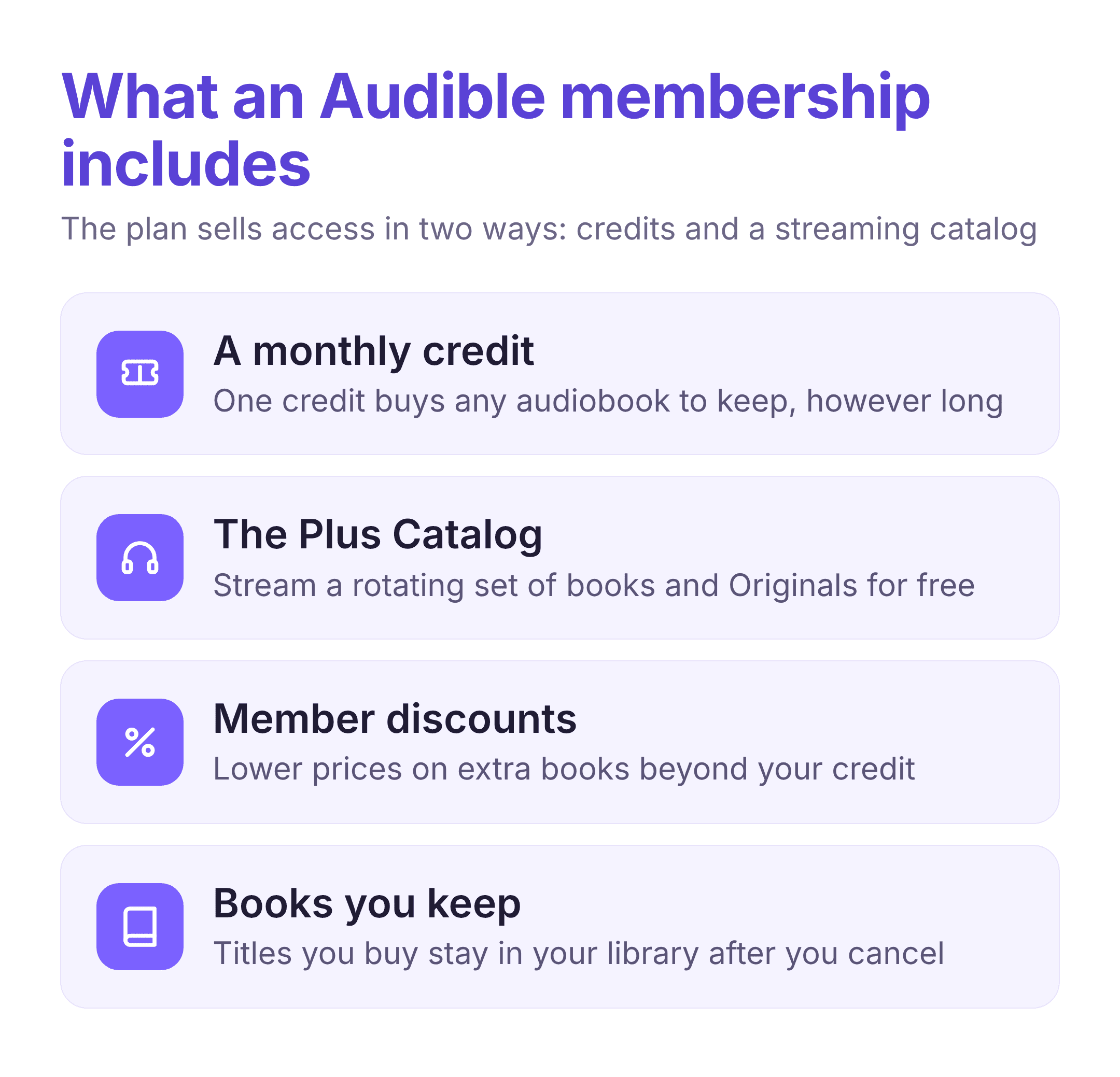
Audible is Amazon's audiobook service, and it sells access in two ways that are easy to mix up.
The first is a streaming catalog. Both plans include the Audible Plus Catalog, a rotating set of audiobooks, podcasts, and Audible Originals you can listen to as much as you want while you are a member, at no extra cost. The second is credits. On the Premium Plus plan you get one credit each month, and one credit buys any single audiobook, no matter how long or how expensive, which is yours to keep. The catch is that the biggest new releases and most bestsellers usually sit outside the free Plus Catalog, so you use a credit or pay for them.
That split is the whole key to whether Audible is worth it for you. If you mostly want to browse and stream, the cheaper plan covers it. If you want to own specific new books, the credit plan is built for that. Books you buy with a credit stay in your library even after you cancel, but unused credits do not, so it pays to spend them before you leave.
Read through a range of Audible reviews and the picture is consistent, and worth taking on its own terms rather than as a simple yes or no.
The praise is steady. In an avid listener's review, the strongest points were that a credit works out cheaper than buying full-price audiobooks for people who listen a lot, that new releases are available right away instead of behind a library hold, and that Whispersync lets you move between the Kindle and Audible versions of a book without losing your place. A detailed review adds the breadth of the catalog and the Audible Originals as reasons regular listeners stay. On Reddit, the most common advice from members is to be honest about how many books you actually finish, since a credit only pays off if you use it.
The limitations come up just as often. Reviewers note that you license books rather than own the files, that the credit you do not use is lost when you cancel, and that Audible is not included with Amazon Prime, which surprises a lot of people. Some find the app slow or cluttered, and some simply would rather not add another Amazon subscription. A few reviewers also point to free or cheaper options they use alongside or instead of Audible, which is a fair thing to weigh before you subscribe.
None of this makes Audible a bad service. It is the most complete audiobook platform available. The question is whether the way it charges matches how much you listen.
Audible has a couple of plans, and the difference between them is credits. Current plans look like this, though prices change, so it is worth checking Audible's site before you subscribe.
| Plan | Price | What you get |
|---|---|---|
| Audible Plus | $7.95 / month | Stream the Plus Catalog, no monthly credit |
| Premium Plus | $14.95 / month | 1 credit a month, the Plus Catalog, member discounts |
| Premium Plus (2 credits) | $22.95 / month | 2 credits a month, the Plus Catalog, member discounts |
A few things are useful to know. Audible offers a 30-day free trial that includes a free audiobook, and you can prepay for a year to save roughly two months. Credits build up to a cap if you do not use them, you can cancel any time, and the books you have already claimed stay in your library after you cancel. Audible is a separate subscription from Amazon Prime, so Prime does not include it.
Audible tends to be well worth it for a specific kind of listener. If this sounds like you, the membership usually pays for itself.
For this listener, a credit usually costs less than buying the same audiobook outright, and the convenience is the real draw.
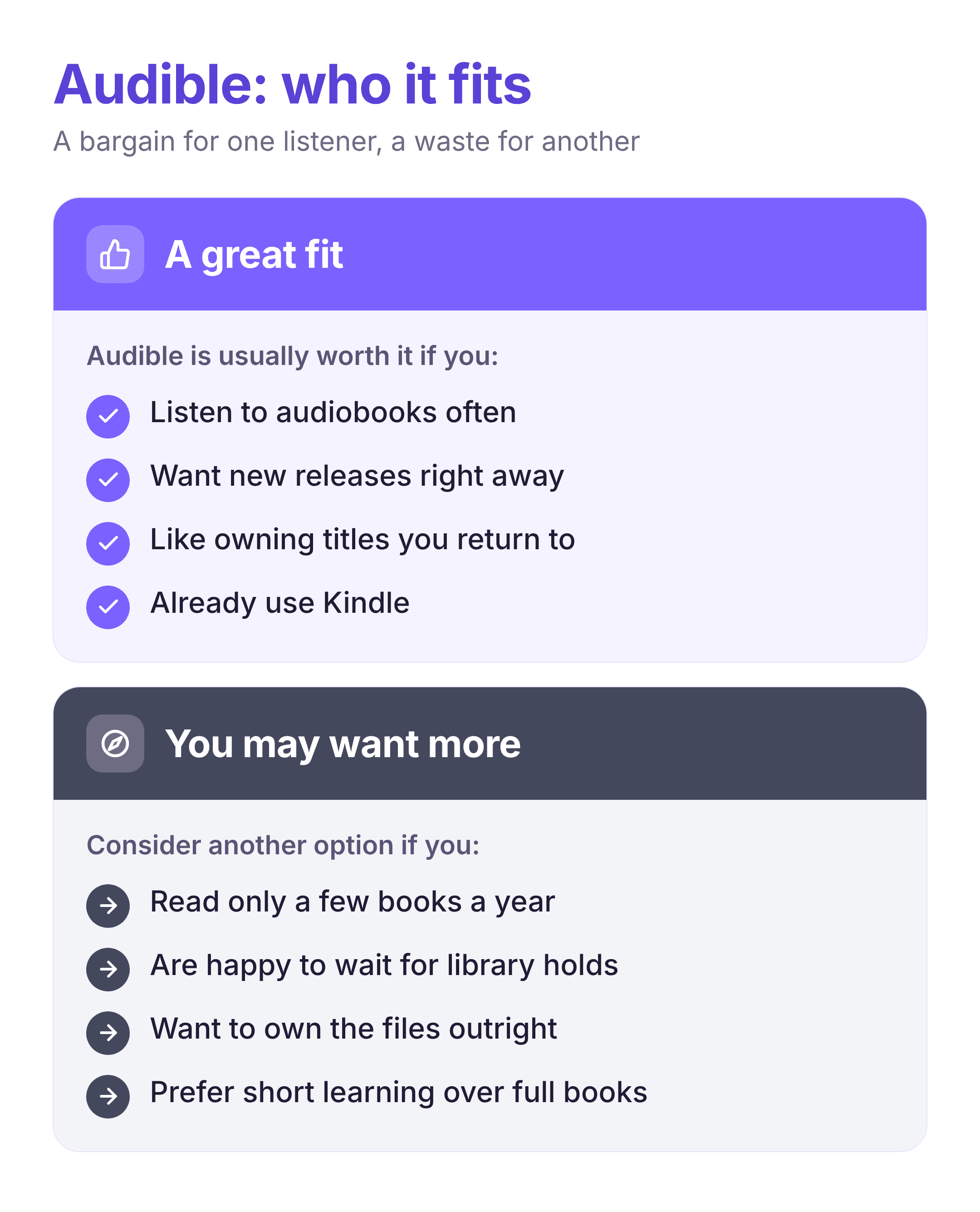
Audible is a wonderful service for a heavy listener, and it is just as fair to say that some people will do better elsewhere. That takes nothing away from Audible. It comes down to matching the tool to how you actually read and learn.
If you finish only a handful of books a year, a monthly credit can sit unused, and the membership may cost more than the books would. In that case a free library app like Libby, which lets you borrow audiobooks through your local library, is often all you need. If owning your files matters to you, services like LibroFM sell downloadable audiobooks without Amazon's restrictions and share proceeds with independent bookshops. And services like Spotify have added some audiobook listening to their premium plans, which can be enough for lighter listeners. For a fuller look at the options, our team compared the best audiobook apps.
There is also a different question worth asking: what are you hoping to get out of all that listening time? For many people, audiobooks are really about learning and growing in the gaps of the day. If that is your goal, a full-length book is not the only way to use a commute. A micro-learning app is built around short, practical lessons you can finish in the same spare minutes. One option in that group is RiseGuide, a self-improvement app built from the insights of experts, which gives you short, interactive journeys, around fifteen minutes each, on skills like communication, mindset, and focus. Our team's list of the best microlearning apps covers more of these, and our team's guide to learning faster is a good read if you want your listening time to stick. If you are weighing full learning platforms rather than audiobooks, our team also put RiseGuide, MasterClass, and Mindvalley in a side-by-side comparison.
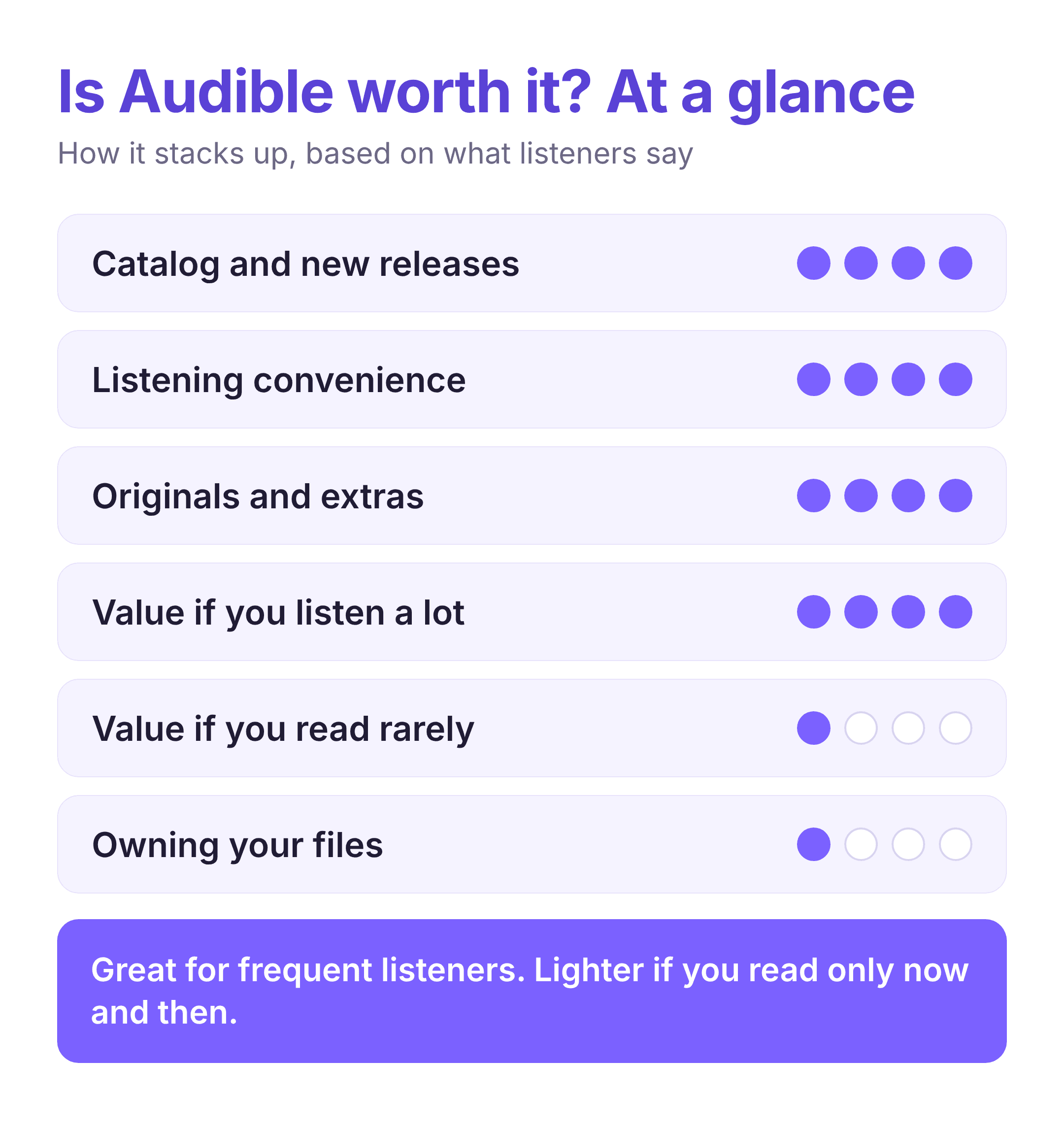
Is Audible worth it? For a regular listener, usually yes. If you go through audiobooks often, want new releases right away, and listen enough that a monthly credit gets used, Audible is the most complete option out there, and a credit tends to cost less than buying the book on its own. If you only read a few books a year, are happy to wait for a free library copy, or want to own your files, you can get most of the same listening for less, and Audible may feel like more than you need. The service is a strong one. The real question is how much you listen, and that is something only you can answer honestly.
A membership gets you a monthly credit that buys any audiobook to keep, plus a catalog you can stream at no extra cost and member discounts on other titles. For people who listen a lot, that usually costs less than buying audiobooks one at a time.
No. Titles in the Audible Plus Catalog are included with your membership and cost nothing extra to stream. For books outside the catalog, you use your monthly credit or pay the member price, so you are not paying full price for everything.
No. Audible is a separate subscription from Amazon Prime, and Prime does not include an Audible membership. Prime members sometimes get extra perks on an Audible trial, but the plans are billed on their own.
You can stream as much as you want from the Audible Plus Catalog while you are a member. Books outside that catalog, including most big new releases, still need a credit or a purchase, so it is not unlimited across the whole library.
Audible Plus is $7.95 a month for the streaming catalog with no credits. Premium Plus is $14.95 a month for one credit plus the catalog and member discounts, and a two-credit plan is $22.95 a month. There is a 30-day free trial, and you can prepay for a year to save a little.
Audible has the deeper catalog, the newest releases, and a credit system built for owning specific books, which suits heavy listeners. Spotify bundles some audiobook listening into its premium plan, which can be enough if you listen only occasionally and already pay for music. The better choice comes down to how much you listen and whether you want to keep the books.