RiseGuide Team

How to Win Friends and Influence People is Dale Carnegie's 1936 book on getting along with other people and gently changing their minds. It is organized into four parts: how to handle people without making them defensive, six ways to make people like you, how to win people to your way of thinking, and how to lead and correct people without causing resentment. Across its 30 principles, the main ideas are to stop criticizing and complaining, give honest appreciation, take a real interest in other people, listen more than you talk, avoid arguments, and let people keep their dignity when you disagree with them or correct them. Carnegie's argument throughout is that these only work when your interest in people is sincere. The same ideas still apply today, in person and over email, messages, and video calls.
Dale Carnegie published How to Win Friends and Influence People in 1936, and it has sold over 30 million copies worldwide since. People keep picking it up because the problem it set out to solve hasn't changed: most of us want to get along with the people around us, be listened to, and change someone's mind without starting a fight. Carnegie's answer was a set of small, practical habits for how you treat people day to day. The rest of this article explains what each of the four parts covers, which principles are most useful, and how they apply to the way people communicate today.
This is an independent summary of Dale Carnegie's book How to Win Friends and Influence People, written to explain its main ideas. RiseGuide isn't affiliated with or endorsed by Dale Carnegie or Dale Carnegie & Associates, and it's no substitute for reading the book itself.
The book is a self-help guide to getting along with others and gently moving them toward your point of view. In the editions most people read today, it's organized into four parts, with 30 short principles in total. Each principle is a single instruction — "become genuinely interested in other people," "remember names," "don't criticize" — followed by stories showing it at work.
One idea runs through the whole book: people respond well when they feel understood and valued, and they resist when they feel judged or pushed. So the most reliable way to influence someone is usually to stop arguing, pay real attention to them, and make it easier for them to agree. That idea sits under all four parts of a How to Win Friends and Influence People summary, which the rest of this article explains.
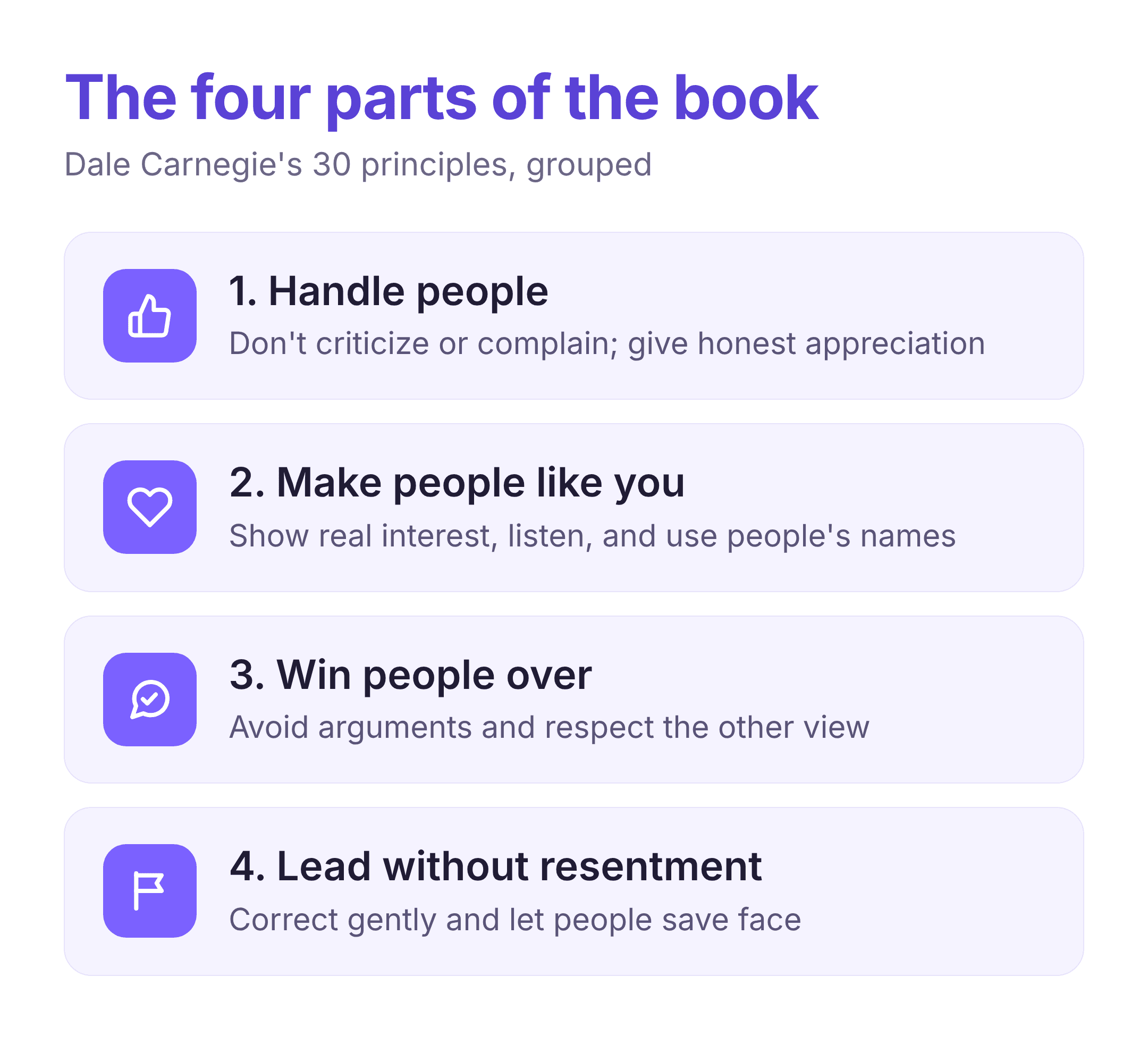
The four parts move from the basics of how you treat anyone, to building rapport, to changing minds, to leading. Here are the How to Win Friends and Influence People principles that matter most in each, in plain terms.
The first part is the groundwork under every interaction. It has three principles:
The second part is where the question of how to make people like you gets a concrete answer. Carnegie lists six habits:

The third part is Carnegie's take on how to influence people once there is a disagreement. It has 12 principles:
The last part is about correcting and leading people without breeding resentment. Its nine principles work by softening feedback so the person stays open rather than shutting down:
It's a fair question, and the book has always had critics. The novelist Sinclair Lewis mocked Carnegie's method as teaching people to "smile and bob and pretend to be interested in other people's hobbies precisely so that you may screw things out of them," and later reviewers have criticized it as insincere or manipulative. Some of the examples feel dated, and the salesman's framing won't suit everyone.
The defense is the one Carnegie made himself: the habits only work when the care behind them is genuine, and used that way they're hard to argue with. Being interested in people, listening, and handling disagreement without contempt are useful habits in any decade. Read as a reminder to treat people with more attention and respect, most of the book still holds up.
The book has lasted because it rests on a simple observation: people open up when they feel understood and close off when they feel judged. Carnegie's 30 principles are specific ways to act on that, from not criticizing, to paying attention, to making it easier for people to agree, to correcting gently. You do not need to read all 30 to begin. Pick one, such as taking a real interest in the next person you talk to, and try it this week.
The book's main points come down to four parts: handle people without criticizing them, make people like you by showing real interest, win people to your way of thinking by avoiding arguments and respecting their view, and lead or correct people without causing resentment. Underneath all of them is one idea — people respond to feeling valued and understood.
The three C's are don't criticize, condemn, or complain. It's the first principle in the book, and Carnegie's argument is that criticism puts people on the defensive and rarely changes behavior, so it usually costs you more than it's worth.
In the four-part editions read today, there are 30 principles: three on handling people, six on making people like you, twelve on winning people to your way of thinking, and nine on leading and changing people without resentment.
It can be used that way, and critics have said so, but Carnegie's own position is that the principles only work when your interest in people is genuine. Hollow flattery and tactics for "screwing things out of" people tend to backfire; the book works best as a push to treat people with real attention.