RiseGuide Team

To stop being lazy, treat it as a signal rather than a character flaw and remove whatever is blocking you. Rule out low energy from poor sleep or skipped meals, shrink the task until starting takes two minutes, set up your space so the easy option is the useful one, pair a dull chore with something you enjoy, pick one specific next action instead of the whole project, turn the task into a small routine, let the first attempt be rough, and check whether what feels like laziness is really burnout or low mood. Keep the two or three fixes that match your situation and leave the rest.
Most people who call themselves lazy are not sitting still because they enjoy doing nothing. They are tired, unsure where to begin, or dreading a task that feels too big to face. Social psychologist Devon Price argues that what we label laziness usually hides unseen barriers like exhaustion, fear, or a goal that was never broken into steps. That reframe helps, because a barrier can be removed in a way a character flaw cannot. Knowing how to stop being lazy starts with the physical and practical causes, then moves to motivation, and ends at the point where "lazy" is the wrong word for what is happening.
If you keep asking why am I so lazy, it helps to look at the specific cause instead of the label. Laziness is a feeling with several different sources, and the right fix depends on which one you are dealing with. Naming the cause turns a vague sense of failure into a problem you can solve.
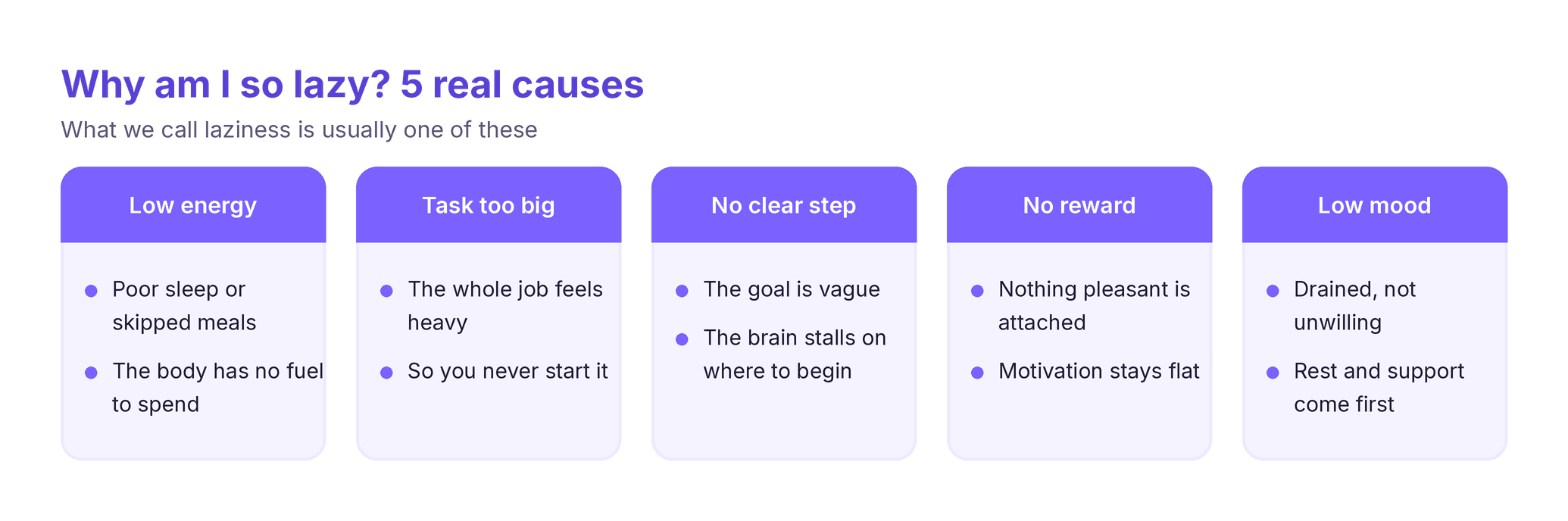
When you are short on sleep, running on caffeine, or eating little, your body has less to spend, and optional effort is the first thing it drops. From the outside that reads as laziness, but the tank is low. This is also why so many people feel unmotivated and flat at the same time: no energy and no drive tend to arrive together, and pushing harder rarely refills either one.
The second common cause sits in the task, not in you. "Clean the house" or "write the report" is not one action; it is dozens, and the mind stalls when the next move is unclear. What looks like laziness is often procrastination, which comes from wanting to avoid an uncomfortable feeling rather than from a missing work ethic. Once you see that, the fix stops being "try harder" and becomes "make the task smaller and clearer."
Before you try to force motivation, handle the physical and practical basics. The first three fixes clear the causes that no amount of willpower can override, so the later fixes have something to work with.
Ask what your body has had before you decide you are lazy. A late night, a skipped lunch, too little water, or hours without moving will flatten your drive on their own. Give yourself the obvious inputs first: a real meal, a glass of water, a short walk, and a proper night's sleep. Often the effort that felt impossible in the afternoon comes back on its own once the basics are covered, and you save your willpower for the tasks that truly need it.
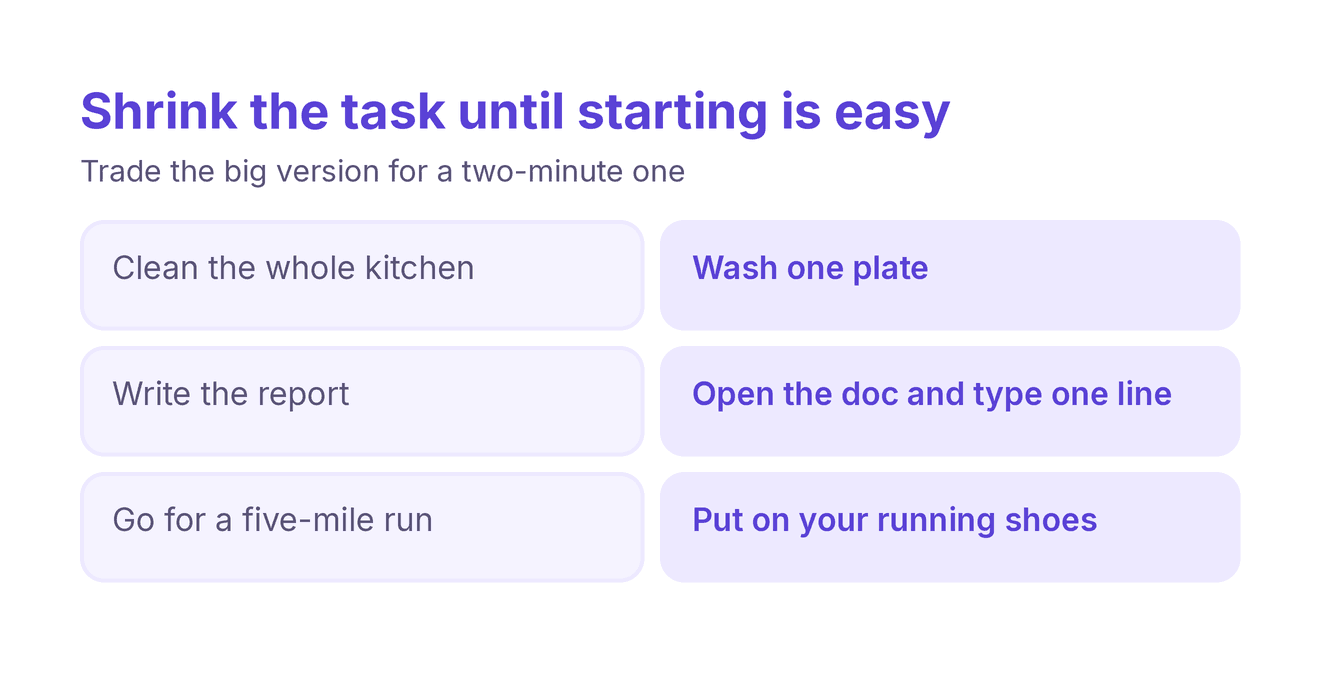
The most reliable way to beat a task that feels too big is to make the first step almost too small to refuse. James Clear calls this the two-minute rule: scale the task down to something you can finish in two minutes, so "write the report" becomes "open the document and type one sentence." Behavior scientist BJ Fogg built his Tiny Habits method on the same idea, starting people with something as small as flossing one tooth. Starting is the hard part; once you are in motion, continuing feels far easier than beginning did.
Your environment decides a lot of what you do. If your phone is in your hand, you will scroll; if your running shoes are by the door and your kit is laid out, a run is a smaller decision. Put the thing you want to do in your path and the thing you want to avoid out of reach: leave the book on your pillow, keep the guitar on a stand, charge the phone in another room. Instead of relying on discipline in the moment, you set up the moment so less discipline is needed.
With the basics handled, the next three fixes work on motivation itself. Each one gives the task something it was missing: a reward, a clear entry point, or a fixed place in your day.
A dull task gets easier when you attach something pleasant to it. Researchers call this temptation bundling: you only let yourself have the thing you like while doing the thing you avoid. In one study, gym members who could listen to a gripping audiobook only at the gym showed up 51% more often than a comparison group. Save a podcast for the dishes, a favorite playlist for the inbox, or a good coffee for the spreadsheet, and the chore stops being pure cost.

A project is heavy; a single action is light. Instead of "do my taxes," the next action is "find last year's return in my email." Instead of "get fit," it is "fill the water bottle." Naming the one specific, physical thing you would do first removes the stall that comes from not knowing where to begin. If the thing you keep avoiding is studying, a few study techniques cut the friction by telling you exactly what to do first. This is also the honest answer to how to stop being lazy and procrastinating on the same task: pick the single next move and start there, before the dread has time to build.
Every task you have to decide on fresh each day costs a little willpower, and some days you lose that fight. A routine spends the decision once. If you always read after brushing your teeth or always tidy for ten minutes before dinner, the choice is already made and the task rides along with a habit you keep anyway. Folding a task into a morning routine or a fixed slot later in the day is how it moves from "if I feel like it" to something that happens on its own.
Sometimes "lazy" points at something that needs care rather than a push. The last two fixes cover the mental side, and the second one matters more than any productivity tip.
A surprising amount of "laziness" is perfectionism in disguise. If the only acceptable outcome is a perfect one, starting feels dangerous, so you put it off. Give yourself permission to do a rough version: a messy first draft, a quick sketch, a workout that is shorter than planned. A poor start you can improve beats a perfect plan you never begin, and the pressure usually drops once real work exists on the page.
If you have lost interest in most things, feel tired no matter how much you rest, or cannot concentrate on anything, it is worth asking am I lazy or depressed rather than how to push harder. Ongoing exhaustion, low mood, and a flat, joyless feeling are signs of burnout or depression, not weak character, and no two-minute rule fixes them. Thyroid problems, anemia, and poor sleep can drain energy the same way. If this sounds like you, treat it as a health question and talk to a doctor rather than blaming yourself.
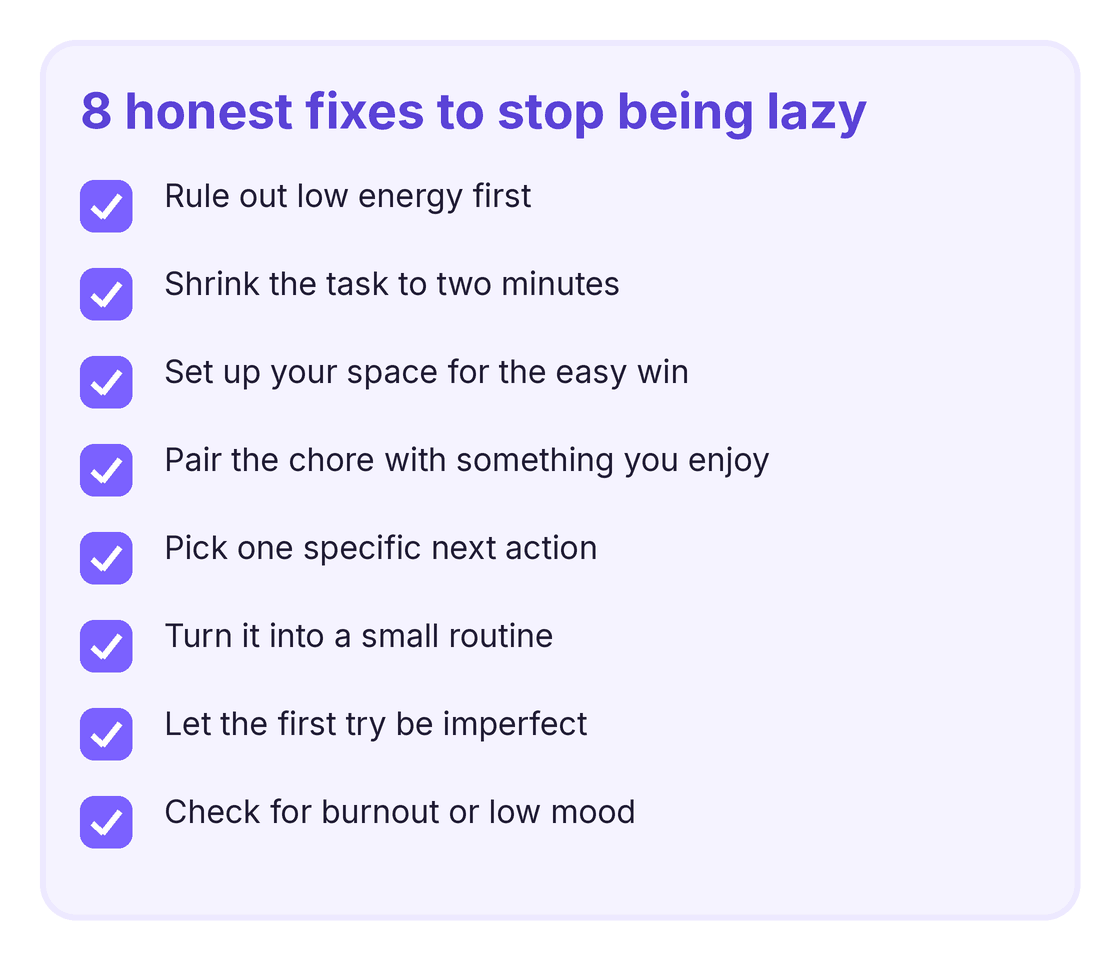
There is no shortcut to how to not be lazy that skips food, sleep, and a task small enough to start. Pick the two or three fixes that match your reason: if you are drained, start with energy; if the task feels huge, shrink it; if nothing is rewarding, bundle in something you like; and if the flat feeling never lifts, treat it as your health, not your worth. Laziness is usually a message about what is in your way, and once you clear the barrier, the effort tends to follow.
Low energy and low motivation usually share a cause: poor sleep, skipped meals, a task that feels too big, or a stretch of stress that has worn you down. Start by covering the basics — food, water, movement, and rest — then shrink whatever you are avoiding to a two-minute first step. If the flat feeling lasts for weeks and touches most of your life, it is worth checking for burnout or depression rather than assuming it is a motivation problem.
Laziness tends to be task-specific and lifts once you start or once the pressure passes. Depression is broader and more constant: little interest in things you used to enjoy, tiredness that rest does not fix, trouble concentrating, and low mood most of the day for two weeks or more. If that pattern fits, it is not laziness, and a doctor or therapist is the right next step.
The fix for how to stop being lazy and procrastinating is to name the single next physical action and make it tiny, so starting takes about two minutes. Remove the friction around it, attach a small reward, and let the first attempt be imperfect. The same approach works for how to stop being lazy and unmotivated: handle your energy first, then make the task small enough that beginning feels easy.
Trouble starting boring tasks happens to everyone, but ADHD is a consistent, lifelong pattern that shows up across school, work, and home — not only when a task is dull. If you regularly struggle with focus, follow-through, time, and organization in ways that affect your daily life, that is worth raising with a professional, since laziness is a habit you can adjust while ADHD is a condition that benefits from proper support.