RiseGuide Team
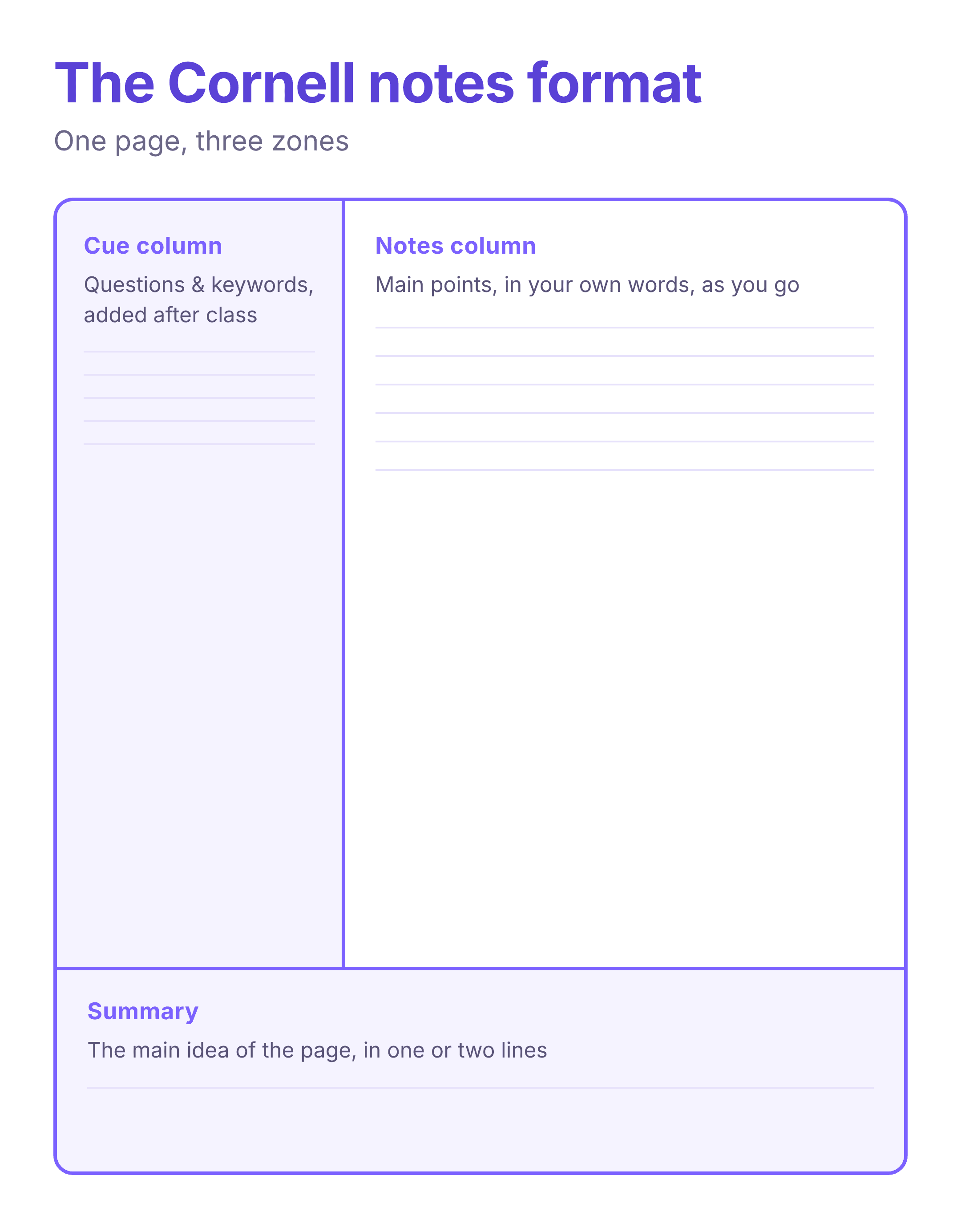
To take Cornell notes, split your page into three parts: a wide notes column on the right, a narrow cue column on the left, and a summary bar along the bottom. As you listen or read, write the main points in the notes column. Soon after, add questions and keywords in the cue column, then write a short summary at the bottom. To study, cover the notes and answer the cue questions from memory. The method comes from Walter Pauk's five R's: record, reduce, recite, reflect, and review.
Good note-taking does more than copy down what you hear. The goal is to capture the right points in a form you can study later, and the Cornell method is one of the most reliable ways to do that. An education professor named Walter Pauk created it at Cornell University in the 1950s, and students have used it ever since. This guide covers what Cornell notes are, the format, how to take them step by step, why they work, a filled-in example, and a free template you can download.
This article mentions ADHD in passing. Any mention of a condition here is for general educational purposes only, not medical advice or a diagnosis. If it affects you, talk with a qualified professional about your own situation.
Cornell notes are a note-taking system that splits each page into three areas: a main notes column, a cue column for questions and keywords, and a summary section at the bottom. You fill them in at different times, which is what makes the system useful. First you record the notes, then you turn them into cues, then you use the same page to test yourself.
Walter Pauk laid out the system in his book How to Study in College, and Cornell's Learning Strategies Center still teaches it today. So when people ask what are Cornell notes, the short answer is a page built to be studied from.
The Cornell notes format is simple enough to draw on any sheet of paper. You make three zones:
That's the whole layout. You can rule it up by hand, set it up once in a note-taking app, or print a ready-made sheet.
Pauk described the Cornell notes method as five R's. Here is how to take Cornell notes using them, in order.
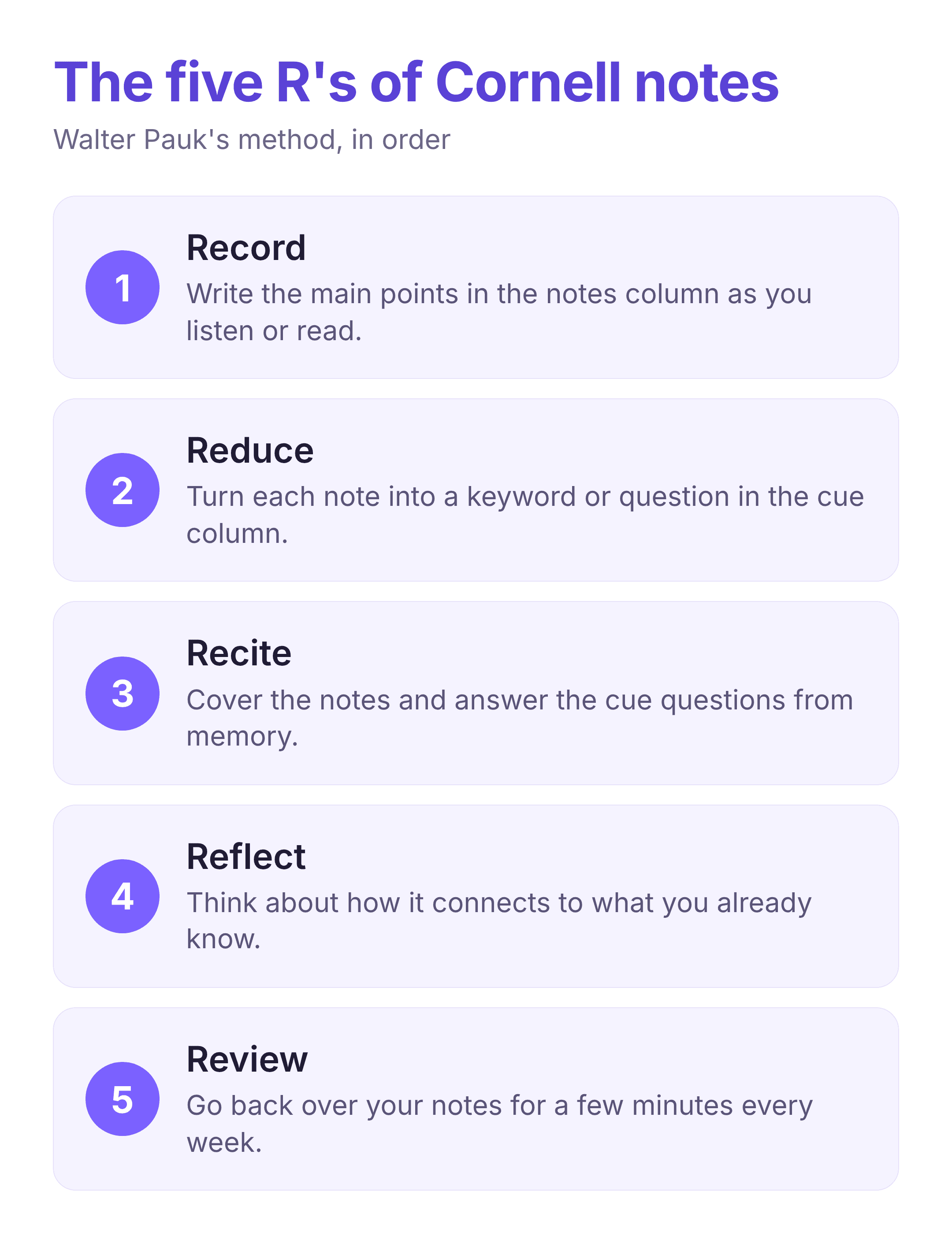
During the lecture or while you read, write the main ideas and facts in the notes column on the right. Keep each note short, use your own words, and start a new line for each new point. Don't try to write down everything, just the things worth keeping.
Soon after, go back over your notes and boil each one down to a keyword or a question in the cue column on the left. "The water cycle has four stages" becomes the question "What are the four stages of the water cycle?" This is the step that turns a page of notes into a study tool.
Cover the notes column so you can only see the cue column. Working from each question or keyword, say the answer out loud in your own words, then uncover the notes to check. This is where the learning happens, because you are pulling the answer from memory rather than rereading it.
Spend a minute thinking about how the material fits with what you already know. Ask why it matters, how it connects to other topics, and where you might use it. Reflection is what moves a fact from something you memorized to something you understand.
Go back over your notes for a few minutes regularly, not only the night before a test. A quick weekly pass over the cue questions keeps the material fresh and shows you what you have forgotten while there is still time to relearn it.
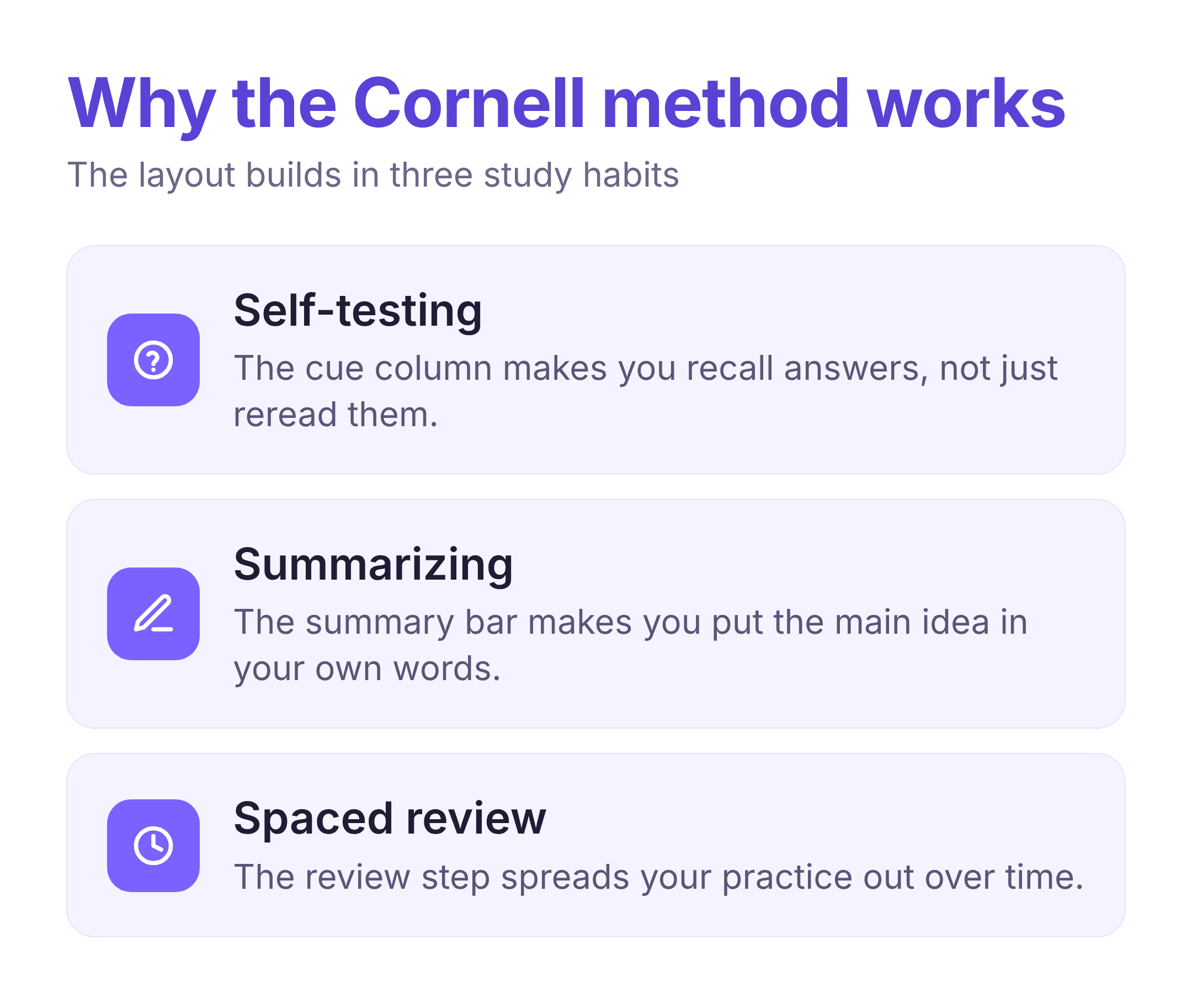
The Cornell method works because of what the layout makes you do, not because of the lines on the page. Three things stand out.
The cue column turns your notes into a set of questions, so studying becomes active recall instead of rereading. In one study, students who tested themselves on a passage recalled about 56% of it a week later, while students who simply reread it recalled about 42%. The summary bar forces you to put the main idea in your own words, which quickly shows you whether you actually followed the material. And the review step spreads your practice out over time, the idea behind spaced repetition, which our post on spaced repetition covers in more depth.
None of this is unique to Cornell notes, but the format bakes these habits into one page, which is why it holds up. For more on the habits behind it, our team's guide to studying effectively is a good companion read.
It's easier to see the system than to describe it. Here is a short Cornell notes example from a lesson on photosynthesis, with the cue column already filled in from the notes.
| Cue column (questions & keywords) | Notes column |
|---|---|
| What is photosynthesis? | How plants turn light, water, and carbon dioxide into glucose and oxygen. |
| Where does it happen? | In chloroplasts, mostly in the leaves. The green pigment chlorophyll absorbs the light. |
| Two main stages? | Light-dependent reactions capture light energy; the Calvin cycle uses it to build sugar. |
| Why does it matter? | It makes the oxygen we breathe and forms the base of most food chains. |
| Summary | Photosynthesis is how plants turn light, water, and carbon dioxide into glucose and oxygen, in two stages inside chloroplasts. It produces the oxygen we breathe and feeds most food chains. |
To study from this, you would cover the notes column and answer each cue question from memory, then read the summary to check the main idea stuck.
If you don't want to rule up the layout yourself, use our free Cornell notes template. The kit has a blank template, a lined version, a few tips and the filled-in example so you can see how a finished page looks.
Download Cornell notes template kit
A few small habits make the system work better. Write the cue questions the same day you take the notes, while the lecture is still fresh, rather than leaving it for exam week. Keep your notes short so the recite step is quick. And treat the template as a starting point: some people add a date and topic line at the top, or a star in the margin for anything they got wrong during review.
The method also pairs well with a steady routine. Our team's guide to building study habits can help you make the weekly review stick, and our post on how to remember more from what you read goes further on turning notes into lasting memory.
Cornell notes work because the page itself nudges you to do the right things: capture the main points, turn them into questions, test yourself, and review over time. Set up the three zones, fill them in at the right moments, and use the cue column to quiz yourself instead of rereading. Download the template below, try it on your next lecture or book chapter, and adjust the layout until it fits how you study.
Divide your page into a narrow cue column on the left, a wide notes column on the right, and a summary bar at the bottom. Take your notes in the right column, then write questions and keywords in the left column soon after, and a short summary at the bottom. To study, cover the notes and answer the cue questions from memory.
Record, reduce, recite, reflect, and review. You record notes during the lecture, reduce them to cues and questions afterward, recite the answers from memory, reflect on how the material connects, and review your notes regularly over time.
Some people who struggle with focus find the structure helpful, because the fixed layout gives notes a clear place to go and the cue column breaks studying into short, active bursts. It works differently for everyone, so treat this as general information rather than advice for a specific condition, and see what fits you.
They help most when you use the cue column to test yourself, not just to store tidy notes. The self-quizzing and regular review are the parts that research links to better memory. Written out neatly but never revisited, any notes do little.