RiseGuide Team
To find public speaking classes worth your time, choose the format before you choose the provider: a one- or two-day intensive if you have a talk coming up, a weekly Toastmasters club if you want practice that compounds over months, a university continuing-education course if you want structure and something to put on a résumé, or an improv or storytelling class if the part that scares you is being watched. Here is what is available in eight major US cities:
If none of those are within reach, the online section covers courses from the University of Washington, Dale Carnegie, TED, and Toastmasters' remote-friendly clubs. Go in person if your problem is a live audience. Go online if your problem is that nobody ever taught you how a talk is built.
The phrase "public speaking class" covers a wide range of things. It can mean a single Saturday in a rented Midtown studio with six other people, a weekly club that has met in the same room since the 1950s, four Monday evenings at a business school, or an eight-week improv course at a comedy theater. Those produce different results, and the one that works tends to be the one that matches what actually goes wrong when you stand up.
About a third of Americans — 33.7% — say they are afraid or very afraid of public speaking, according to the 2025 Chapman University Survey of American Fears, up from 29% the year before. The same survey ranks it 46th out of more than 65 fears, well below corrupt officials, serious illness, and financial collapse, so the familiar line about people fearing the podium more than the grave does not survive contact with the data. It remains, for a lot of people, the single thing they would most like to change about how they come across at work.
Most classes fall into four families, and they are not interchangeable.
Dedicated speaking workshops are short, small, and built around delivery. You get a room of six to ten people, a camera or an audience, and a full day or two of standing up and being corrected. They work well when you have a specific talk coming and need to fix something fast.
Toastmasters clubs run on a different logic. Instead of a course with an end date, you get a meeting every week or two where members give prepared speeches, take impromptu questions, and evaluate each other out loud. Toastmasters International counts more than 265,000 members across 13,800 clubs in nearly 150 countries, and the Pathways curriculum organizes the work into six learning paths of five levels each. The feedback comes from fellow amateurs rather than professional coaches, so quality varies a great deal from club to club - visit two or three before settling.
University continuing education gives you a syllabus, an instructor with credentials, and usually a certificate. The framing is professional: managing speech anxiety, structuring a persuasive case, presenting to a leadership team. Sessions are fixed, so it suits people who need a calendar entry to make them show up.
Improv and storytelling theaters come at the problem sideways. You are not rehearsing a speech; you are learning to keep talking when you have no script and a room is watching. For people whose real fear is being seen rather than being unprepared, that transfers surprisingly well.
Whichever you pick, check one thing above all: how much of the class you spend on your feet. A course that is mostly lecture will teach you what good speaking looks like without moving you any closer to doing it. That gap is the whole reason improving at public speaking depends on deliberate practice rather than talent - reps in realistic conditions, watched back, corrected, repeated.
Group size is the second thing to check. A cap of eight means you speak several times; a room of thirty means you might speak once.
The options below are all currently running and open to adults with no experience. Schedules shift, so confirm dates on the provider's page before committing. Where a public rating exists, it is noted with its source.
New York has the deepest bench of the eight cities, with a dedicated speaking school, one of the oldest clubs in the country, and a large improv scene.
Public Speaking Classes NYC runs a single-day intensive, 10am to 5pm, capped at seven participants, at Ripley-Grier Studios on 8th Avenue in Midtown. Instructor Herman Otten trained at the Utrecht School of Performing Arts and has taught the class since 2020. A Level Two follow-up exists for people who want a second pass. Best for a fast, concentrated reset before a specific event.
New York Toastmasters meets Mondays from 6:30 to 8:30pm at 145 West 46th Street, with three in-person meetings a month and one online. The club was founded in 1956, which makes it one of the oldest continuously running clubs in the city. Guests can attend and watch without speaking, which matters if the idea of a first speech is what is stopping you.
Magnet Theater's Improv Level One is an eight- to nine-week beginner course, two hours a week, at 254 West 29th Street in Chelsea. Sections run mornings, afternoons, and evenings seven days a week, so shift workers can find a slot. The theater holds a 4.7 Google rating from 414 reviews. Best for building comfort with a room's attention on you.
If you want something between an intensive and a semester, NYC Career Centers runs a six-hour Intro to Public Speaking on Madison Avenue, also offered live online.
Los Angeles leans performance-heavy, which suits some readers and not others, so the list below covers both ends.
The Groundlings School on Melrose Avenue offers a three-hour Improv for Beginners class as a single-day entry point, and Improv Workshop A as a six-session course. Both are open to non-actors with no audition. The school holds a 4.7 Google rating from 317 reviews, and beginner sections regularly sell out.
Westside Toastmasters meets Wednesdays from 7:15 to 9pm in the Joslyn Park craft room in Santa Monica, in person and on Zoom simultaneously. The club was chartered in September 1952. Visitors can walk in without arranging anything in advance.
Fearless Presentations, run by The Leaders Institute, is a two-day seminar at the Howard Hughes Center near LAX, 9am to 4pm both days, built specifically around stage fright rather than general delivery. The company has operated since 2001 and runs the Los Angeles session roughly every four months, so dates are limited.
Chicago is the one city on this list where a major comedy institution teaches public speaking as its own subject, separate from improv.
The Second City's Public Speaking course runs four weeks, three hours a class, at 230 W. North Avenue in Old Town. The course page opens by naming exactly who it is for: people who feel nervous, unsure, or dread presenting. If you would rather work the improv track instead, Improv 1 at the same address runs seven to nine weeks.
DePaul's Effective Presentation and Communication Skills Certificate is four Monday evenings, 6 to 8:30pm, at the Loop campus on East Jackson. It is taught by Charles Drehmer, PhD, of DePaul's Driehaus College of Business, and the curriculum covers speech anxiety, speaking up in difficult situations, and packaging a message for an audience. The next cohort runs October 26 to November 16, 2026.
Pathfinders Toastmasters meets the first and third Tuesdays, 7 to 9pm, at University Church on South University Avenue in Hyde Park. Chartered in 1958. Worth knowing: many downtown Chicago clubs have moved to Zoom permanently, so if you specifically want a room, verify the format before you go.
Houston's strongest options sit at opposite ends - a low-commitment improv door and a corporate on-camera workshop.
Station Theater teaches a nine-week beginner long-form improv course at 2000 Nance Street in the Fifth Ward arts district, and runs a 30-minute drop-in intro on Friday evenings for anyone who wants to test the water first. That half-hour is the lowest-risk way into any class on this page if speaking anxiety is severe. The theater holds a 4.7 Google rating from 145 reviews. Class start dates are handled through its registration portal rather than the class page.
UH Bauer's Presentation Skills Training is a single eight-hour day on the University of Houston campus in Melcher Hall, taught by business communication coach Marianne Gooch. It is heavily on-camera and covers audience analysis alongside informative and persuasive structure. The next session is November 4, 2026.
Heights Toastmasters meets Tuesdays from 6 to 7pm at the TALC Building at All Saints in the Houston Heights. The one-hour format is unusually short for a Toastmasters club, which makes it easier to sustain than a two-hour evening commitment. Chartered in 1992.
Atlanta's list splits cleanly between an anxiety-focused intensive and two long-running community options.
Fearless Presentations Atlanta runs two full days, 9am to 4pm, at the WeWork on West Peachtree Street in Midtown. Groups stay small - recent sessions have run with six participants - and the entire curriculum is pointed at nervousness rather than polish. The next session is September 17 and 18, 2026.
Dad's Garage teaches an eight-week adult Improv Level 1, two hours a session, at 569 Ezzard Street SE in Old Fourth Ward, with a free preview class offered separately and a progression through Level 5, sketch, and stand-up. The theater holds a 4.7 TripAdvisor rating from 58 reviews. Whole World Improv Theatre in Midtown is a solid alternative with a ten-week beginner course.
Buckhead Toastmasters meets Thursdays at 6:45pm. Despite the name, it currently meets at Central Congregational Church on Clairmont Road in the North Druid Hills area. The club was chartered in October 1954 and guests attend with no obligation to speak.
Boston lost ImprovBoston when it closed in 2023, but the city still has both a dedicated speaking workshop and a long-standing adult-education course.
BostonSpeaks runs a four-hour workshop at 50 Milk Street in the Financial District, in morning or afternoon slots, capped at eight people. The structure moves from one-on-one to small-group to full-room speaking across the session, so you are on your feet repeatedly rather than once at the end. Aimed at professionals, senior leaders, and founders pitching.
The Cambridge Center for Adult Education teaches its Public Speaking Workshop in person at 42 Brattle Street in Harvard Square. Students deliver both impromptu and prepared speeches with feedback, and the syllabus covers body language, speech structure, and classical persuasion. It is taught by Dr. Adam Tomasi, who comes from a competitive debate background. CCAE dates to 1871 and currently runs more than 470 offerings; call ahead for session counts, which are not listed online.
Improv Asylum runs an eight-week Improv Level 1, two hours a session, at Asylum CoLab on Causeway Street, with additional Somerville and Hingham locations. Founded in 1998, it holds a 4.4 TripAdvisor rating from 259 reviews, and the school explicitly markets the classes to people who want to become more confident speakers.
DC's two strongest options are both performance-based, which fits a city where the skill in demand is holding a room without notes.
Washington Improv Theater's Level 1: Foundations of Improv is eight weekly sessions of two and a half hours, ending in a student showcase. Classes rotate across metro-accessible venues including Sitar Arts Center in Kalorama, the Latin American Youth Center in Columbia Heights, and the Farragut Center downtown. No prerequisites.
Story District's Storytelling Foundations runs four weeks, one two-hour session a week, at Industrious on Union Street NE in NoMa. You workshop one true personal story toward live performance with real-time coaching. The organization was founded in 1997 and has performed at the Kennedy Center. Better suited to talks and personal narrative than to slide-deck presenting.
Speakeasy in Downtown DC Toastmasters meets the second and fourth Mondays at 7pm at 1899 L Street NW in the Golden Triangle, and formally supports remote attendance alongside the in-person meeting - one of relatively few central DC clubs that does.
Dallas has the oldest club on this list and a practice-heavy corporate workshop, plus a Deep Ellum improv school that puts students on a real stage.
Effective Presentations runs "Presenting with Impact" over two days, 8:30am to 4:30pm, capped at ten participants, with a follow-up one-on-one session for individual enrollees. The company has operated for over 20 years and also offers a live-virtual version. The next Dallas session is October 1 and 2, 2026.
Big "D" Toastmasters meets Thursdays from 6:30 to 8:30pm at the Hampton Inn on North Central Expressway. Chartered in March 1949, it describes itself as the oldest Toastmasters club in Dallas, typically hosts two or three visitors a meeting, and encourages attending more than once before joining.
Dallas Comedy Club's Training Center teaches an eight-week Improv Level 1, three hours a week, at 3036 Elm Street in Deep Ellum, capped at ten. Every core class ends in a graduation show on the club's actual stage, which is a meaningfully different endpoint from a classroom exercise.
If you are not in one of those eight cities, or you want structure more than you want a room, the online field is stronger than the local one in one specific way: the best courses are taught by people who have thought carefully about how a talk is built. What they cannot give you is a live audience, so most readers are best served by pairing one of these with somewhere to actually speak.
Introduction to Public Speaking from the University of Washington, taught by Dr. Matt McGarrity, is the reference point for online public speaking classes. It holds a 4.7 rating from 2,325 reviews with 394,327 learners enrolled, runs about ten hours across five modules, and is self-paced. It includes 14 graded assignments built around video speech uploads - an introduction speech, a key-point speech, an elevator pitch - so you do have to record yourself, though the grading is automated rather than human. McGarrity's Dynamic Public Speaking Specialization extends this to four courses and roughly 59 hours, with peer-reviewed speeches, which means real people watch your recordings.
Toastmasters' online and hybrid clubs are the one remote option with a live audience every week. The club finder has a meeting-format filter with an "online attendance accepted" checkbox - note that fully online clubs are listed separately and are not searchable through that tool, a quirk that trips up most people on their first try. Clubs also run Speechcraft, a four- to eight-week program open to non-members, if a full membership feels like too much.
Dale Carnegie's live online courses are instructor-led cohorts rather than videos: eight sessions totaling 24 instructional hours, delivered by certified trainers with a group of other participants. The NCCRS credit review recommends it for three semester hours in interpersonal communication. The program traces back more than a century, and the framing is workplace influence rather than performance, so public speaking is one strand of a broader course. There is also a dedicated High Impact Presentations course. Fixed session times are the trade-off, though for most people that is the feature, not the bug.
TED Masterclass is TED's own course - not MasterClass.com - hosted by TED head Chris Anderson across three sections and 11 lessons of roughly an hour each. It is the strongest option on this list for the part most people skip: finding the idea and shaping the narrative before worrying about delivery. It runs on TED's app and web player, with the course also now distributed through YouTube Courses in the US. Nobody watches you speak, so treat it as the blueprint rather than the practice.
Sophia's Public Speaking course is the one that carries transferable college credit - three semester credits, recommended by both ACE and DEAC, with more than 105 partner institutions. It is fully self-paced, structured as 14 challenges, five milestones, and five touchstone projects, with learning coaches available by phone or chat rather than a live instructor. Confirm transferability with your own school before starting, because acceptance is not automatic.
TJ Walker's Complete Public Speaking Masterclass on Udemy is the sprawling reference library of the group: 4.6 stars from 10,332 ratings, 111,718 students, and about 38 hours of video across 735 lectures, last updated in May 2026. Its 76 sections cover panels, media interviews, toasts, virtual meetings, and executive settings, which makes it more useful to dip into by situation than to work through front to back.
LinkedIn Learning's Public Speaking Skills Professional Certificate by Toastmasters International packages Toastmasters' curriculum as an on-demand video path with a certificate that posts to your profile. It is video-only with no practice component, so it earns its place as a credential and a primer rather than as training.
The Second City's virtual Intro to Improv runs four weeks and combines live Zoom sessions with self-paced work between them, for adults 19 and up. It is improv rather than public speaking instruction, so it will not teach you to structure a talk. What it does teach is how to keep going when you lose your place, which is the specific fear that a script cannot fix.
One honest note on a name you will see recommended often: Harvard's dedicated public speaking courses through the Extension School and Professional Development are currently archived and not enrollable. What remains open is adjacent - Presenting with Confidence, Public Narrative, and an edX rhetoric course that focuses on persuasive writing and speech analysis rather than delivery.
Every option above shares one weakness: a class meets on a schedule, and speaking improves on repetition. The days between sessions are where the skill is actually made or lost, and most people have nowhere to put that practice.
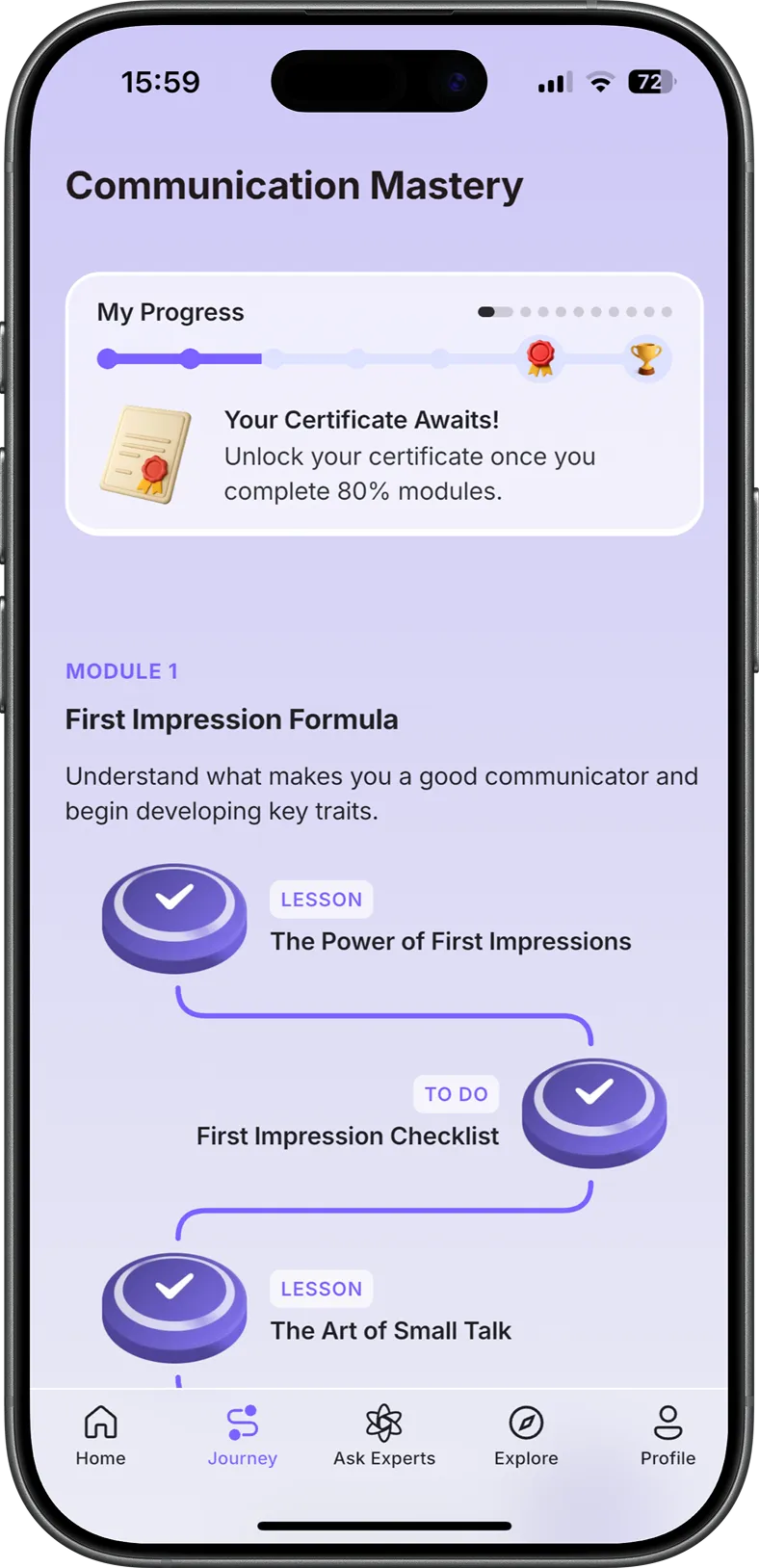
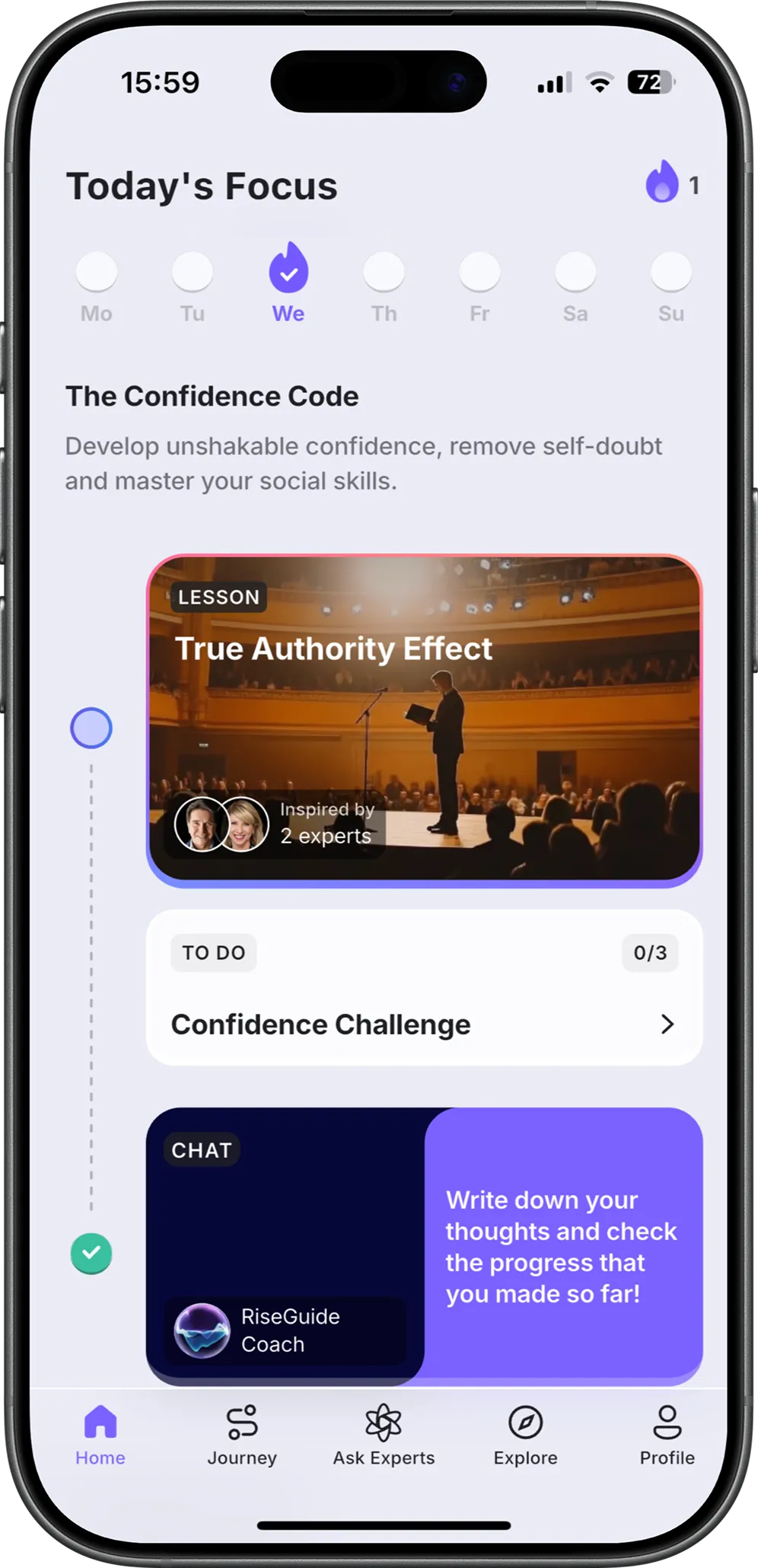
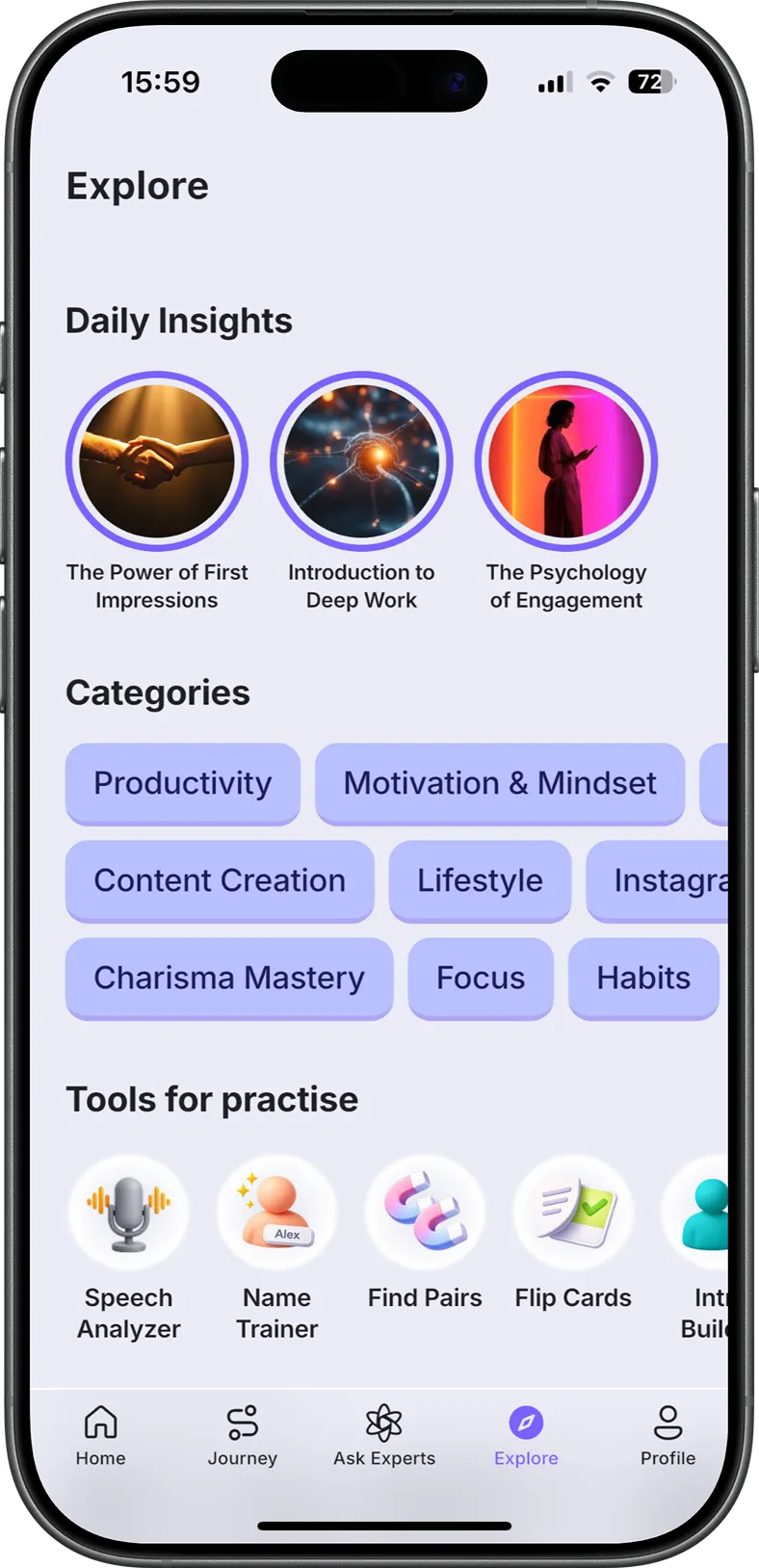
RiseGuide's Communication Mastery journey is built for those days. It moves through speaking, body language, voice, storytelling, and first impressions in short daily lessons of about 15 minutes, drawn from the work of experts in each field, so the technique arrives in a sensible order. Around the lessons sit tools for applying it: Speech Analyzer records up to a minute of you talking and reports back on pace, confidence, pauses, and structure with notes on what to adjust; a small talk simulator, an intro builder, and a thoughts organizer help you shape what you want to say before you say it. SEEK, the search engine for expert knowledge, answers a specific question from a curated library and links back to the original sources.
If you would rather compare tools than courses, we have covered the five apps worth trying for speaking practice separately.
Start from what happens to you when you stand up, because that points at a format more reliably than any ranking does.
If your voice shakes and your mind empties, the problem is exposure, and exposure is fixed by frequency. A weekly Toastmasters club or an eight-week improv course gets you in front of people over and over until the alarm response quiets down. A single intensive will not do that, however well taught.
If you know your material and still lose the room, the problem is craft — structure, pacing, where the emphasis lands. That is what a dedicated workshop like BostonSpeaks or Fearless Presentations, or a course like TED Masterclass, is built to fix, and a couple of days can genuinely change how a talk lands.
If you have a specific event in three weeks, take the shortest thing with the most stage time. A one-day intensive with a cap of seven will do more for you than a 38-hour video library you will not finish.
And if you are somewhere without a good local option, pair a structured course with a live audience of some kind. The University of Washington course teaches you how a speech is built; a hybrid Toastmasters club gives you somewhere to test it. Neither half works nearly as well alone.
A public speaking class is structured instruction in preparing and delivering a talk to an audience. Depending on the provider, that means anything from a one-day workshop focused on nerves and delivery, to a multi-week university course covering speech structure and persuasion, to a peer club where members speak and evaluate each other every week. Most include time on your feet in front of other people, which is the part that separates a class from a book.
You speak, and someone tells you what to change. Typically that means short prepared speeches, impromptu speaking exercises, and structured feedback from an instructor or the group. Many classes record you and play it back. Alongside that, you cover the mechanics: how to open, how to structure an argument, how to use pauses and vocal variation, and how to handle questions.
You can learn the craft online — structure, delivery technique, how to build an argument — and courses from the University of Washington, TED, and Dale Carnegie teach it well. What is harder to replicate is a live audience, since the physiological response to being watched is the specific thing most people are trying to train. Live online formats such as Dale Carnegie's cohorts and Toastmasters' hybrid clubs come closest.
For a foundation, Introduction to Public Speaking from the University of Washington, because it combines a coherent framework with assignments that require you to record actual speeches. For live coaching and accountability, Dale Carnegie's eight-session online course. For ongoing practice with a real audience, a Toastmasters club. The best choice depends on whether you need to learn the skill or rehearse it.
Often, yes. Many US degree programs include an oral communication requirement, usually satisfied by an introductory public speaking or speech course. Requirements vary by institution and major, so check your own program. If you want to satisfy it outside a classroom, Sophia's ACE-recommended course is accepted by more than 105 partner institutions, though you should confirm with your school first.
Repetition in low-stakes settings, mostly. The fear responds to evidence rather than argument, and each time you speak without disaster the response gets a little quieter. Choosing a format where you speak often, in a small group, matters more than choosing a prestigious one. It is also worth separating fear of speaking from a broader discomfort with being noticed — the second is closer to what charisma actually is and whether it can be learned, and it responds to different work.