RiseGuide Team

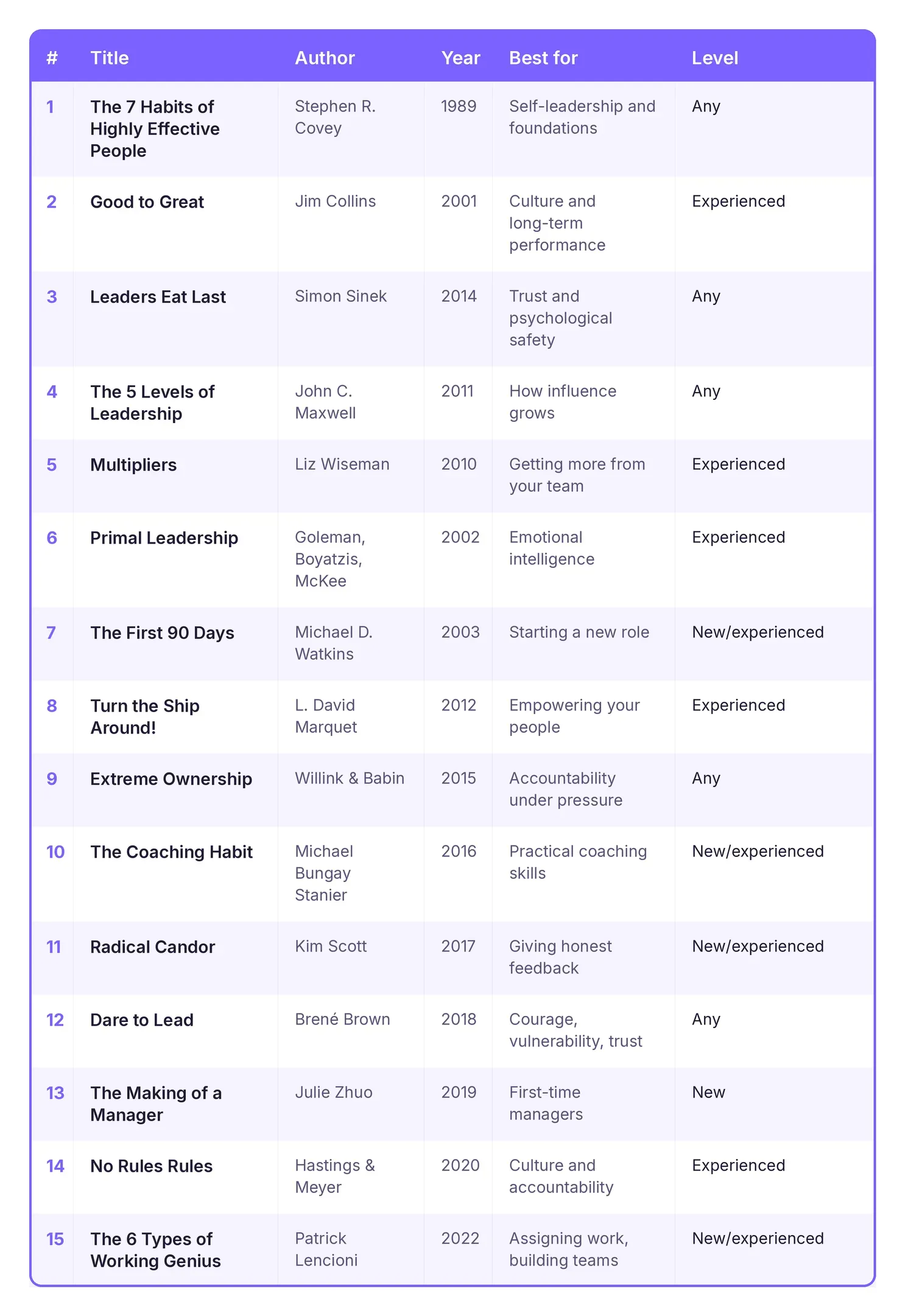
To choose the right leadership book, match it to where you are and what you want to build: your level (new manager or seasoned leader), the skill you're working on, and whether you learn best from a framework, a story, or a set of tactics. These 15 cover that range. Start with the foundations in The 7 Habits of Highly Effective People (Stephen R. Covey) and Good to Great (Jim Collins). Build trust and emotional awareness with Leaders Eat Last (Simon Sinek), Primal Leadership (Daniel Goleman and co-authors), and Dare to Lead (Brené Brown). Understand how influence grows with The 5 Levels of Leadership (John C. Maxwell) and Multipliers (Liz Wiseman). Get practical with feedback and coaching through Radical Candor (Kim Scott) and The Coaching Habit (Michael Bungay Stanier). Step into a new role with The First 90 Days (Michael D. Watkins) and The Making of a Manager (Julie Zhuo). And rethink how you run a team with Turn the Ship Around! (L. David Marquet), Extreme Ownership (Jocko Willink and Leif Babin), No Rules Rules (Reed Hastings and Erin Meyer), and The 6 Types of Working Genius (Patrick Lencioni).
Few skills reward reading as directly as leading people does. A strong leadership book hands you years of someone else's experience for the price of a few evenings, and the ideas in the best ones stay with you long after you finish. The hard part is choosing. There are thousands of titles, and the book that helps a brand-new manager is often the wrong first read for someone running a large team.
So each entry below names who it's written for, what it argues, and where it falls short. Some are decades-old classics that shaped how we think about management; others were written in the last few years for the way teams work now. Find the one that matches where you are, and a single careful read will do more for you than skimming ten.
The best books on leadership aren't the ones with the most citations or the biggest name on the cover. They're the ones that fit your situation, so it's worth being honest about four things before you pick.
Your level comes first. A first-time manager needs different help than a director who already runs managers. If you were promoted last month, start with a book about the actual job of managing rather than a treatise on visionary leadership.
Then there's the skill you want to build. Leadership isn't one skill; it's a stack of them: giving feedback, building trust, making decisions, running a team, communicating clearly. Pick the book that targets the gap you feel most. If that gap is communication, our roundup of the best books for communication skills is a better shelf to start from than a general leadership list.
Classic or current matters too. Older books like The 7 Habits carry ideas that have held up for decades, but their examples can feel dated. Newer books speak to remote work, psychological safety, and flatter teams, though they've had less time to prove themselves. A good reading list mixes both.
Finally, notice how you learn. Some people absorb a clean framework; others need a story they can picture, or a short list of things to try on Monday. The entries below are tagged so you can tell which is which. And a book is only one route: coaching, practice, and feedback from people you trust all move you faster, which is part of why our piece on leadership coaching is worth reading alongside any book here.
[banner]
Best for: self-leadership, before you try to lead anyone else.
Covey's argument is that lasting effectiveness grows out of character and principles, not clever tactics. The seven habits move outward in order — be proactive, begin with the end in mind, put first things first, and so on — from managing yourself to working well with others. It remains one of the most widely read books in the category for a reason: the core ideas hold up.
Worth knowing: it's dense, and the examples show their age. If you want quick, modern tactics, this will feel like a long climb.
Best for: leaders thinking about culture, discipline, and long-term performance.
Collins studied companies that jumped from ordinary to exceptional results and found a pattern: humble but determined "Level 5" leaders who got the right people in place before setting direction. The ideas about discipline and getting "the right people on the bus" have shaped how a generation of executives thinks about building teams.
Worth knowing: it's research-heavy and corporate, and several of the companies Collins praised later struggled, so treat the case studies as illustrations rather than proof.
Best for: building trust and psychological safety on a team.
Sinek's central idea is that leaders who put their people's wellbeing first create what he calls a "Circle of Safety," and that safety is what frees a team to cooperate instead of competing with each other. It's a warm, persuasive case for a more protective style of leadership.
Worth knowing: it leans heavily on biology and anecdote and is light on step-by-step implementation, so you'll finish inspired but may need another book for the how.
Best for: a clear map of how influence grows over a career.
Maxwell lays out five levels, from position (people follow because they have to) up to pinnacle (people follow because of who you've become). It's a tidy way to locate where your authority actually comes from right now and what earning the next level would take.
Worth knowing: the framework can feel repetitive, and the lens is firmly US corporate. You may get the value from the model itself without needing every chapter.
Best for: managers who want their team to do its best thinking.
Wiseman divides leaders into "Multipliers," who make everyone around them smarter by asking and stretching, and "Diminishers," who unintentionally shut capability down. The value is in recognizing the diminishing habits you didn't know you had.
Worth knowing: the two-camp framing can feel binary, and the examples skew toward tech and large corporations.
Best for: understanding emotional intelligence in leadership.
The authors argue that a leader's mood is contagious and sets the emotional tone of the whole team, so managing your own emotions is part of the job. They map six leadership styles and when each one works.
Worth knowing: the tone is academic, and the emotional-intelligence research it draws on has been debated since it came out. Read it for the framework, not as settled science.
Best for: anyone starting a new role or stepping up after a promotion.
Watkins gives a structured plan for a transition: secure early wins, match your strategy to the situation you've inherited, and build the relationships you'll depend on. It's the book people press into your hands when you get promoted, and the advice earns that reputation.
Worth knowing: it was written with senior corporate moves in mind, so a first-time team lead may find parts heavier than their situation calls for.
Best for: shifting from command-and-control to giving people real ownership.
Marquet, a submarine captain, describes how he stopped giving orders and instead pushed decision-making down to the people closest to the work — a "leader-leader" model rather than leader-follower. The turnaround in his crew's performance is the whole argument.
Worth knowing: it's a single extended military story, so you have to do the work of translating it to your own team.
Best for: accountability and decisiveness under pressure.
Two former Navy SEALs make the case that leaders own everything in their world, with no excuses, and that this mindset is what drives a team to perform. The chapters pair a combat story with a business lesson.
Worth knowing: the military framing and hard-charging tone won't suit every culture, and "own everything" can tip into taking on more blame than is useful if you read it too literally.
Best for: managers who want practical coaching skills quickly.
The book teaches seven simple questions — starting with "What's on your mind?" — and one core discipline: stay curious a little longer before jumping in with advice. It's short, and you can use it the same week you read it.
Worth knowing: it's deliberately narrow. This is a technique book about better conversations, not a full philosophy of leadership.
Best for: managers who find honest feedback hard to give.
Scott's framework is to "care personally" and "challenge directly" at the same time, so your guidance is both kind and clear. For anyone who softens feedback until it disappears, it's a useful correction.
Worth knowing: it's heavily flavored by Silicon Valley, and "radical candor" is easy to misread as a license to be blunt. The care half of the idea is the part people skip.
Best for: leaders working on courage, vulnerability, and trust.
Brown argues that brave leadership is a set of learnable skills built on vulnerability, clear values, and trust, rather than armor and certainty. Her research on what makes people willing to take risks at work is the backbone.
Worth knowing: the research-and-story style can feel abstract if you're after a concrete playbook you can follow step by step.
Best for: brand-new and first-time managers.
Zhuo became a manager at 25 and writes plainly about what the job actually involves day to day — running one-on-ones, giving feedback, hiring, and the shift from doing the work to leading people who do it. It reads like advice from a slightly-further-along peer.
Worth knowing: it draws mostly from her experience in tech and design organizations and is lighter on the challenges of senior leadership.
Best for: leaders rethinking culture, freedom, and accountability.
Netflix's co-founder and a culture researcher explain how the company traded rules and controls for "freedom and responsibility": hire exceptional people, pay them well, be candid, and then get out of their way. It's a genuinely different model of how a company can run.
Worth knowing: it describes one unusual company. The low-rules approach depends on very high talent density and doesn't transfer cleanly to most organizations.
Best for: leaders assigning work and building complementary teams.
Lencioni's model says each of us has two kinds of work that energize us and two that drain us, and that matching people to the right stage of a project cuts frustration and burnout. It's a practical lens for dividing up work and understanding why some tasks exhaust certain people.
Worth knowing: it's built around the author's own assessment, and being newer, it has less independent, long-term validation than the classics on this list.