RiseGuide Team

To choose the right language app for you, match it to how you want to practice. Pick Duolingo for a daily habit, Babbel for practical conversation, Pimsleur for learning by ear, Busuu for corrections from native speakers, Rosetta Stone for full immersion, Memrise for real native-speaker video, Mondly for quick everyday phrases, Drops for building vocabulary in short bursts, LingQ for learning through reading and listening, and HelloTalk for chatting with real partners. Most people do best starting with one app that fits their main goal, then adding a second for whatever it misses, usually speaking practice.
Learning a new language has never had more options, and that is part of the problem. The app stores are full of products that all promise fluency, and it is hard to tell from the outside which one suits the way you learn, the language you want, or the time you can give it. The best language learning apps are not all trying to do the same thing: some are built to get you talking from day one, others to drill vocabulary, others to keep you coming back every day.
This roundup looks at ten apps that are genuinely worth your time in 2026 and what each one is good at, so you can pick the right starting point instead of downloading five and finishing none. If you want tools for learning beyond languages, we cover those separately in our roundup of the best apps for learning.
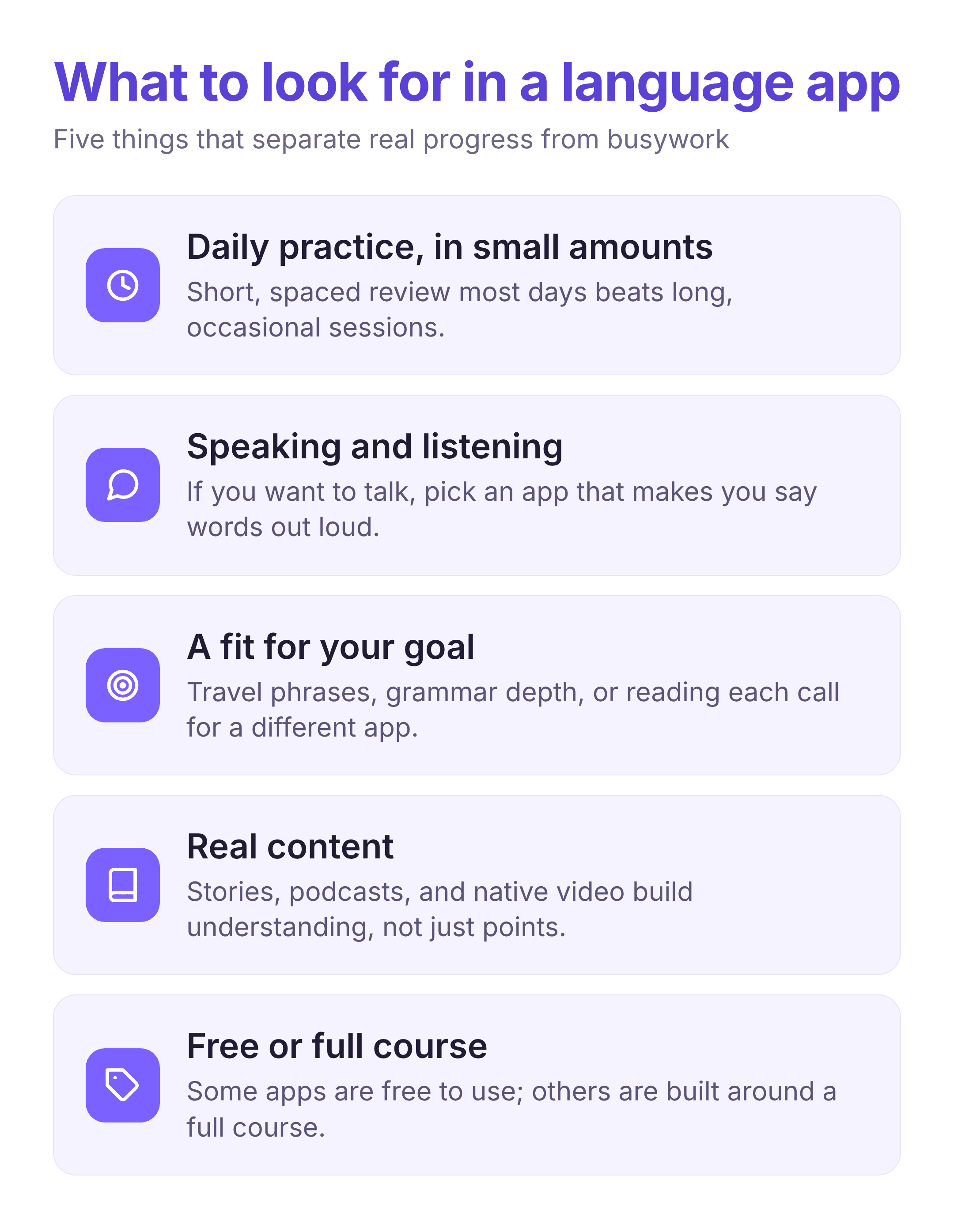
The right app depends on your goal, but a few things separate the ones that build real skill from the ones that just feel productive.
Look for daily practice in small amounts rather than long, occasional sessions. Short, spaced review is one of the most reliable findings in learning research: in a double-blind study, students who spent about three minutes a day on spaced vocabulary review remembered roughly three times as much over the long term as those who did not. An app that brings you back each day, and reshows a word just before you would forget it, is doing the kind of steady review that builds lasting memory.
Beyond that, match the app to your goal. If you want to hold a conversation, you need an app that makes you speak and listen, not only tap translations. If you are learning for travel, quick practical phrases matter more than grammar depth. If you want to read books or watch shows in the language, you need something built around real content. Free matters too: some of the best apps are free to use, while others are built around a full course, so it is worth knowing which is which before you commit.
Duolingo is the app most people try first, and for good reason. It turns lessons into short, game-like exercises with streaks, points, and reminders that make it easy to practice a little every day. You tap, type, and speak your way through bite-size lessons that get harder as you go, across more than forty languages.
What Duolingo does better than almost anyone is keep you coming back. The streak counter and daily goals are genuinely motivating, and the free version gives you the full course, which is rare. Newer features add an AI chat and video-call style speaking practice for learners who want to talk more.
Best for: building and keeping a daily learning habit.
Strengths:
Limitations:
Available on: iOS, Android, and web.
Babbel is built around the kind of language you actually use: ordering food, introducing yourself, making plans. Its lessons are short, around ten to fifteen minutes, and designed by language teachers rather than generated automatically, so there is a clear logic to how grammar and vocabulary build.
Using Babbel feels more like a structured course than a game. Dialogues are practical, the speech recognition helps you practice saying phrases out loud, and review sessions bring back what you have learned. It covers fourteen languages and is especially strong for European ones.
Best for: learning practical, everyday conversation in a structured way.
Strengths:
Limitations:
Available on: iOS, Android, and web.
Pimsleur is almost entirely audio, and that is the point. Each lesson is a roughly thirty-minute spoken session that prompts you to listen, then speak, long before you start reading. It is built on a method that spaces out when you recall each word, so phrases move into memory without flashcard drilling.
Because it is audio-first, Pimsleur fits naturally into a commute, a walk, or time in the kitchen. You finish lessons able to say things out loud with decent pronunciation, which is where many app learners struggle. It suits people who want to speak and understand more than they want to read or write.
Best for: learning to speak and understand through listening.
Strengths:
Limitations:
Available on: iOS, Android, and web.
Busuu combines structured lessons with something most apps lack: real people. After a writing or speaking exercise, you can submit it to the community of native speakers, who correct it, and you return the favor for people learning your language. That feedback loop is what sets it apart.
The courses are organized around the CEFR levels used in formal language learning, so you always know roughly where you stand. Lessons cover vocabulary, grammar, and conversation, and a study plan keeps you on track toward a goal.
Best for: getting your writing and speaking corrected by native speakers.
Strengths:
Limitations:
Available on: iOS, Android, and web.
Rosetta Stone takes a different path: no translations. From the first lesson, you match words and phrases to images and sound, the way a child picks up a first language. The idea is to get you thinking in the new language instead of translating in your head.
Its standout tool is speech recognition that compares your pronunciation to native speakers and gives instant feedback. Immersion takes patience, and the lack of explanation frustrates some beginners, but for people who want to absorb a language naturally, it is one of the most established options around.
Best for: learning through immersion, without translating.
Strengths:
Limitations:
Available on: iOS, Android, and web.
Memrise leans on short clips of real native speakers saying words and phrases in everyday settings, so you hear how a language actually sounds rather than a studio recording. It pairs those clips with spaced repetition that brings vocabulary back at the right moment to help it stick.
More recent versions add an AI chat partner you can practice conversations with, which gives beginners a low-pressure way to try out what they have learned. It is strongest as a vocabulary and listening tool, and many people use it alongside a more structured course.
Best for: picking up real, spoken vocabulary from native speakers.
Strengths:
Limitations:
Available on: iOS, Android, and web.
Mondly focuses on the practical phrases you need fast, which makes it a favorite for travelers. Daily lessons are short and themed, a chatbot lets you rehearse simple conversations, and the whole thing is designed to get useful language into your head quickly.
It covers a wide range of languages and, unusually, lets you learn from many native languages rather than only English. The experience is light and approachable, which is great for getting started, though serious learners will outgrow it.
Best for: picking up practical phrases quickly, especially for travel.
Strengths:
Limitations:
Available on: iOS, Android, and web.
Drops is vocabulary learning stripped down to something you can do in five minutes. You match words to clean illustrations in fast, swipe-based sessions, with no translating sentences or grammar drills. It is the app to reach for when you want to grow your word bank without much effort.
The visual, time-boxed design makes it genuinely fun, and the short sessions are easy to keep up daily. It will not teach you to build sentences or hold a conversation on its own, so most people use it as a companion to a fuller course.
Best for: growing vocabulary in quick, daily bursts.
Strengths:
Limitations:
Available on: iOS and Android.
LingQ is built around a simple idea: you learn a language by understanding lots of real content in it. You read and listen to articles, stories, podcasts, and even your own imported material, tapping any unknown word to see its meaning and save it for review. Over time, the app tracks how many words you know.
It suits intermediate learners who are ready to move beyond beginner lessons and want to spend time with real language. The interface is less polished than the big consumer apps, but few tools make it this easy to learn from content you actually enjoy.
Best for: learning from real reading and listening material.
Strengths:
Limitations:
Available on: iOS, Android, and web.
HelloTalk is more a place to use the language with people than a course in itself. It connects you with native speakers who are learning your language, so you can text, send voice messages, and call to practice, correcting each other as you go. Built-in translation and correction tools make the exchange less intimidating.
It is the natural companion to any structured app: once you have some basics, HelloTalk is where you put them to work with real humans. The quality of a given exchange depends on who you meet, but for low-cost speaking practice, little else compares.
Best for: practicing real conversation with native speakers.
Strengths:
Limitations:
Available on: iOS and Android.
| App | Best for | Pricing | App Store | Google Play |
|---|---|---|---|---|
| Duolingo | Building a daily habit | Free; Super from ~$7/mo (annual) | 4.7 | 4.7 |
| Babbel | Practical conversation | From ~$15.99/mo (less annually) | 4.6 | 4.6 |
| Pimsleur | Learning by ear | From ~$20.99/mo | 4.7 | 4.2 |
| Busuu | Native-speaker feedback | Free tier; Premium from ~$6.67/mo (annual) | 4.7 | 4.7 |
| Rosetta Stone | Full immersion | From ~$13/mo (annual); lifetime option | 4.8 | 4.6 |
| Memrise | Real native speech | Free tier; Pro from ~$5/mo (annual) | 4.8 | 4.5 |
| Mondly | Everyday phrases | Free daily lesson; from ~$6.24/mo (annual) | 4.7 | 4.6 |
| Drops | Vocabulary bursts | Free (5 min/day); Premium ~$5.83/mo (annual) | 4.7 | 4.5 |
| LingQ | Reading and listening | Free tier; Premium from ~$10/mo (annual) | 4.7 | 4.6 |
| HelloTalk | Real conversation | Free; VIP from ~$6.67/mo (annual) | 4.6 | 3.9 |
Ratings are from the App Store and Google Play, and prices are a snapshot for October 2026. Prices vary by plan length and region and change often, so check the current figures before you settle on one.
Start from your main goal rather than the app's reputation. If you mostly want the pull to practice every day, Duolingo is hard to beat, and it is also the obvious place to look if you are after Duolingo alternatives that keep the same habit-building feel, like Memrise or Mondly. If your aim is to talk, the best language learning apps for speaking are the ones that make you say things out loud: Pimsleur for guided audio, Babbel for structured dialogue, and HelloTalk for real conversation partners.
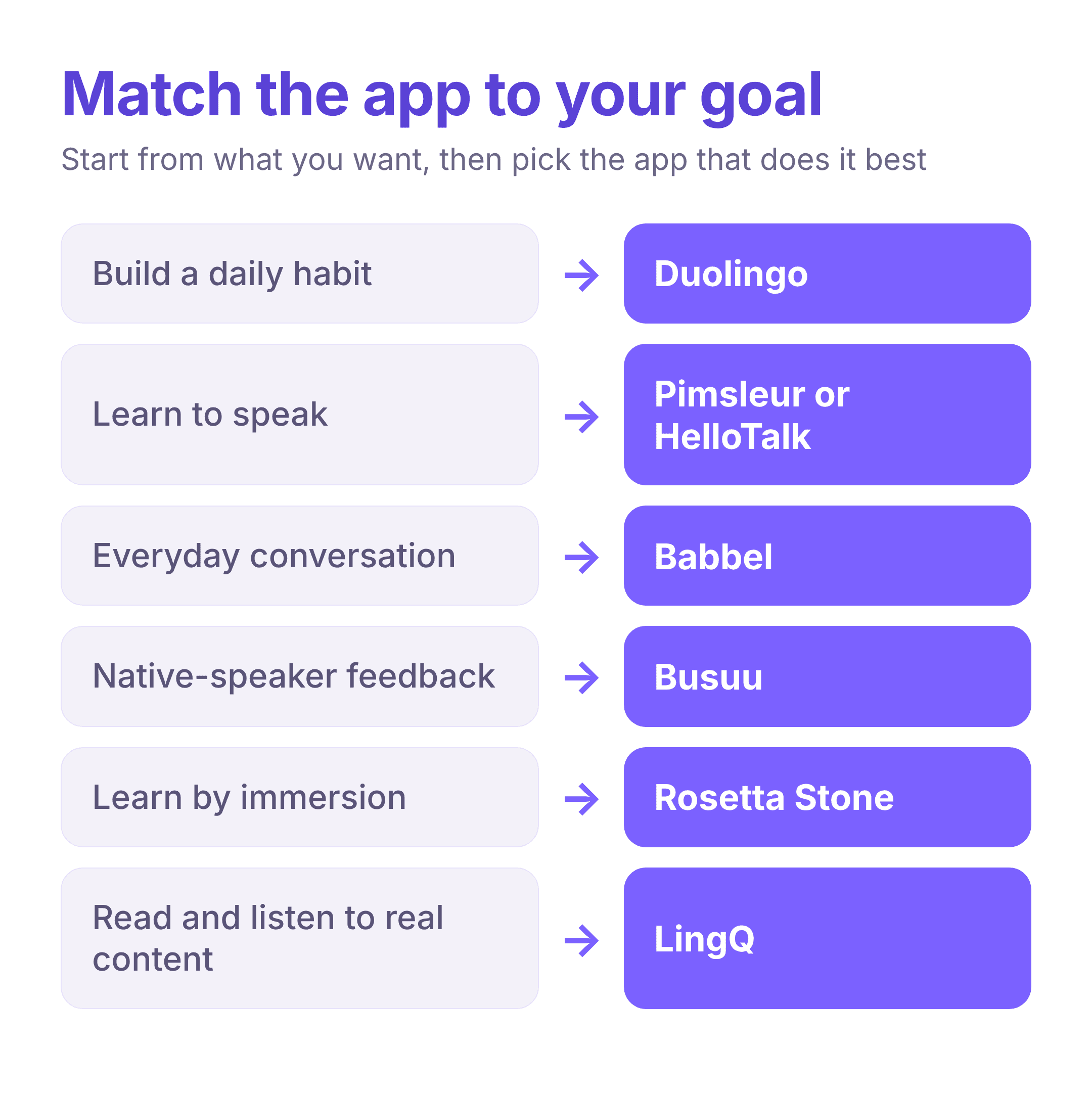
Budget matters too. If you want the best free language learning apps, Duolingo, Memrise, Drops, Mondly, and HelloTalk all give you a lot for free, while Babbel, Pimsleur, and Rosetta Stone are built around a full course you can usually try before committing. And if you are learning one specific language, the fit can change: for the best app to learn Spanish, for instance, almost all of these support it well, so you can safely choose on method rather than coverage.
Whichever you pick, the most reliable approach is to choose one app that matches your main goal and use it daily, then add a second only when you hit its limit, which for most people is speaking. Keeping the habit going is what moves the needle, so it helps to attach practice to something you already do, the way you would with any routine; our guide to the morning routine covers how to make a new habit stick. If staying consistent is your real challenge, a few of the tools in our roundup of the best productivity apps can help you protect the time.
There is no single best language learning app, only the one that fits how you want to learn and the time you can give it. Duolingo and Memrise make the daily habit easy, Babbel and Pimsleur build real speaking skill, Busuu and HelloTalk bring in other people, and tools like LingQ and Drops fill in reading and vocabulary. Pick the one that matches your goal, practice a little every day, and add a second app only when you need it. What matters most is choosing one and sticking with it.