RiseGuide Team
 FREE GUIDE with any plan: the First Impression FormulaClaim the offer

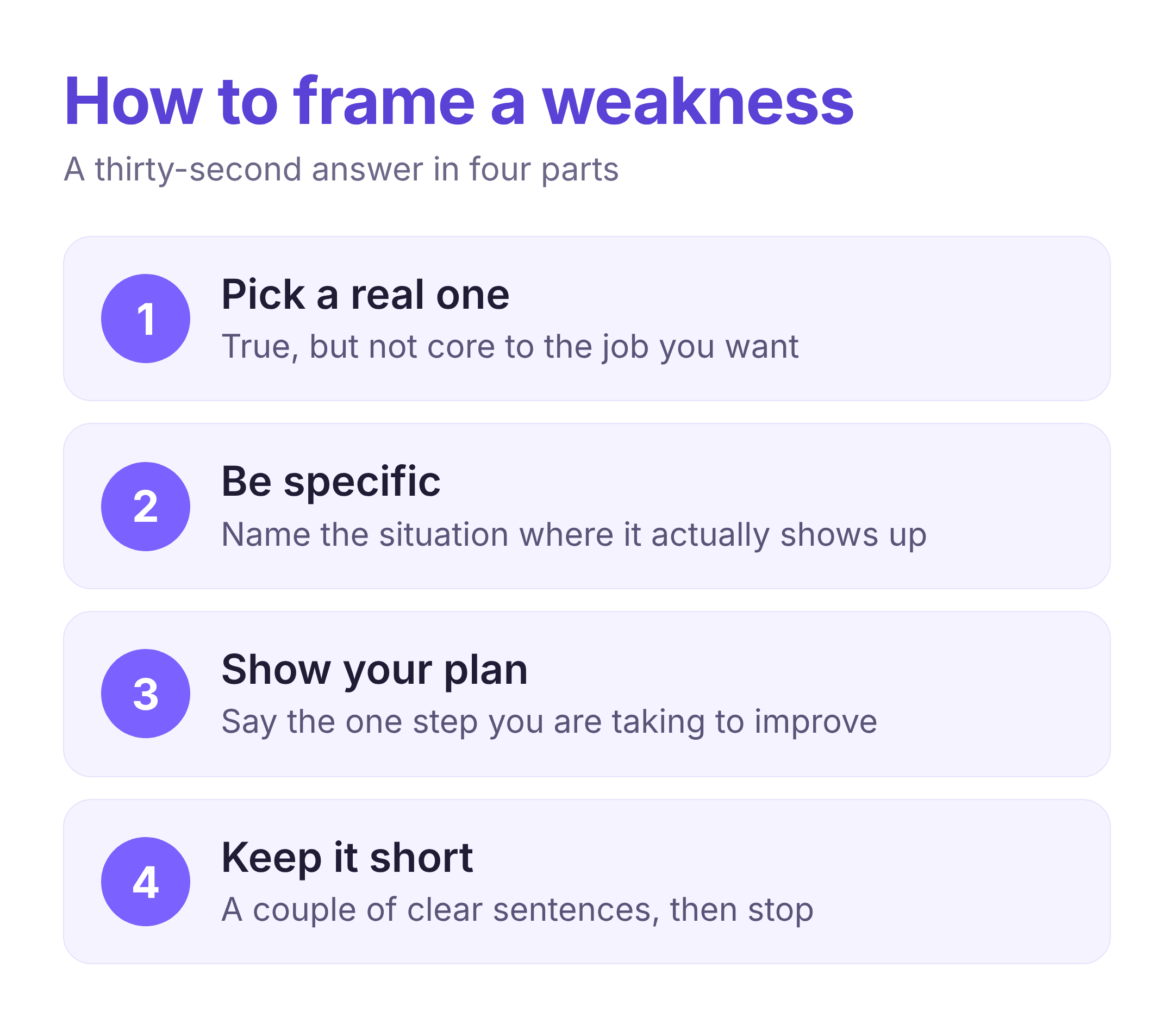
To answer the weaknesses question in a job interview, name a real weakness that will not stop you doing the job well, be specific about how it shows up, and say what you are doing to work on it. Keep it short and honest, skip the fake weakness dressed as a strength like "I just work too hard," and do not name anything that is core to the role. Good options to adapt include public speaking, delegating, saying no to extra work, being too self-critical, spending too long polishing details, and gaps in a specific tool you are already learning.
Most interview questions let you talk about what you are good at. The weaknesses question does the opposite, and that is exactly why it makes people nervous. The good news is that it is one of the most predictable questions you will face, so it rewards a little preparation. Interviewers are not trying to catch you out. They want to see that you know yourself and can talk about a shortcoming like an adult. Here is why they ask, a simple way to frame your answer, and a set of real weaknesses for a job interview with example answers you can make your own.
Interviewers ask about weaknesses to see three things: that you are self-aware, that you are honest, and that you are the kind of person who works on their gaps. A candidate who claims to have no weaknesses looks like they lack either self-knowledge or candor, and a candidate who names a real one and shows they are handling it looks mature and coachable. Career advisers who study interviews describe the question as a test of self-awareness more than a trap, as one guide from Science Careers puts it. The answer they are hoping for is simple: a genuine weakness, said plainly, with a clear sign that you are doing something about it.
A good answer has four parts, and it only takes about thirty seconds to deliver. Walk through these before your interview and you will have a reply ready.
Here are common, honest weaknesses that work in most interviews, each with an example answer. Pick one that is true for you and reword it in your own voice, since a memorized script is easy to spot.
Presenting to a room is a common fear, and admitting it reads as honest rather than damaging for most roles.
Example answer: "Speaking in front of a big group has never come naturally to me. I used to avoid it, but I decided that was holding me back, so I joined a local speaking group and now volunteer to present at our team meetings. I am still a little nervous, but I am much more comfortable than I was a year ago."
Wanting to do everything yourself is a real weakness, especially if you are moving into a role with more responsibility.
Example answer: "I tend to take on too much myself because I want things done a certain way. I have learned that does not scale, so I have been practicing handing work off clearly and trusting my teammates. Letting go of the small stuff has made the whole team faster."
Taking on too much is honest and relatable, and it shows you care about doing a good job.
Example answer: "I find it hard to say no when someone asks for help, and I have ended up overcommitted a few times. I have started being more realistic about what I can take on, and I now check my workload before agreeing to something new so I can actually deliver what I promise."
Many strong performers are hard on themselves, and naming it shows self-awareness.
Example answer: "I can be quite hard on myself, and I used to dwell on small mistakes longer than was useful. I have worked on this by focusing on what I would do differently next time instead of replaying the error, and by actually noting the things that went well, which I used to skip."
This is the honest version of "I am a perfectionist," with a real cost named instead of a humblebrag.
Example answer: "I sometimes spend longer polishing a piece of work than it needs, because I want it to be right. I have gotten better at asking what level of detail a task calls for, and setting a time limit so I do not over-invest in something that only needs to be good enough."
If the role does not depend on it, admitting you find hard conversations uncomfortable is honest and common.
Example answer: "Giving someone critical feedback has always been uncomfortable for me, because I do not want to upset people. I have been learning to be direct and kind at the same time, and I now prepare what I want to say in advance, which has made those conversations go much better."
A fixable, relatable weakness that shows you have reflected on how you work.
Example answer: "I used to try to solve everything on my own before asking for help, which sometimes cost me time. I have learned to flag when I am stuck much earlier, and setting a rule for myself, that if I am blocked for more than an hour I ask, has made a real difference."
If there is a tool the role uses that you are still learning, naming it honestly and showing progress works well.
Example answer: "I am still building my fluency with [the specific tool]. I have been using it on a side project and taking an online course to get up to speed, and I am comfortable I will be fully productive with it quickly."
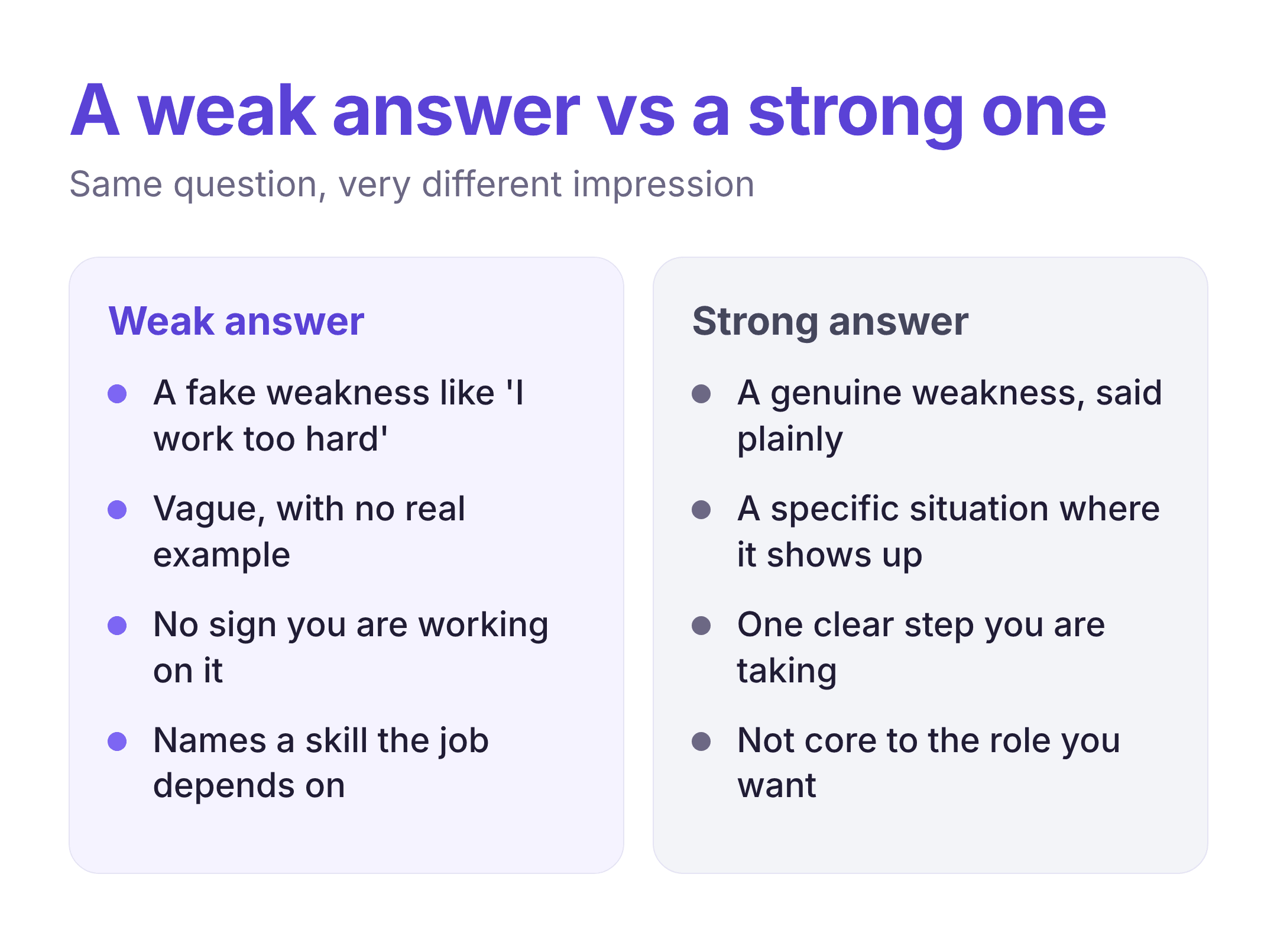
A few answers do more harm than good, so steer clear of these.
Skip the fake weakness that is really a brag, like "I work too hard" or "I care too much." Interviewers have heard them hundreds of times, and they read as avoiding the question. Skip anything that is central to the job you are applying for, since that raises a real doubt about whether you can do the work. And skip genuine dealbreakers, like being unreliable or struggling to get along with people, which are better worked on privately than raised in an interview. The goal is an answer that is honest but not self-sabotaging.
You will often be asked for a strength in the same breath, so it helps to prepare both together. For a strength, pick one that matters for the role and back it with a short, specific example of a time it made a difference, rather than a list of adjectives. The same honesty that makes a weakness answer land makes a strength answer land too: a real example beats a claim every time. Our team's guide to introducing yourself covers how to set up both early in the conversation, and the same calm, prepared approach helps with the work here question. If you want to turn the tables, our team's list of questions to ask at the end of the interview is worth a look.
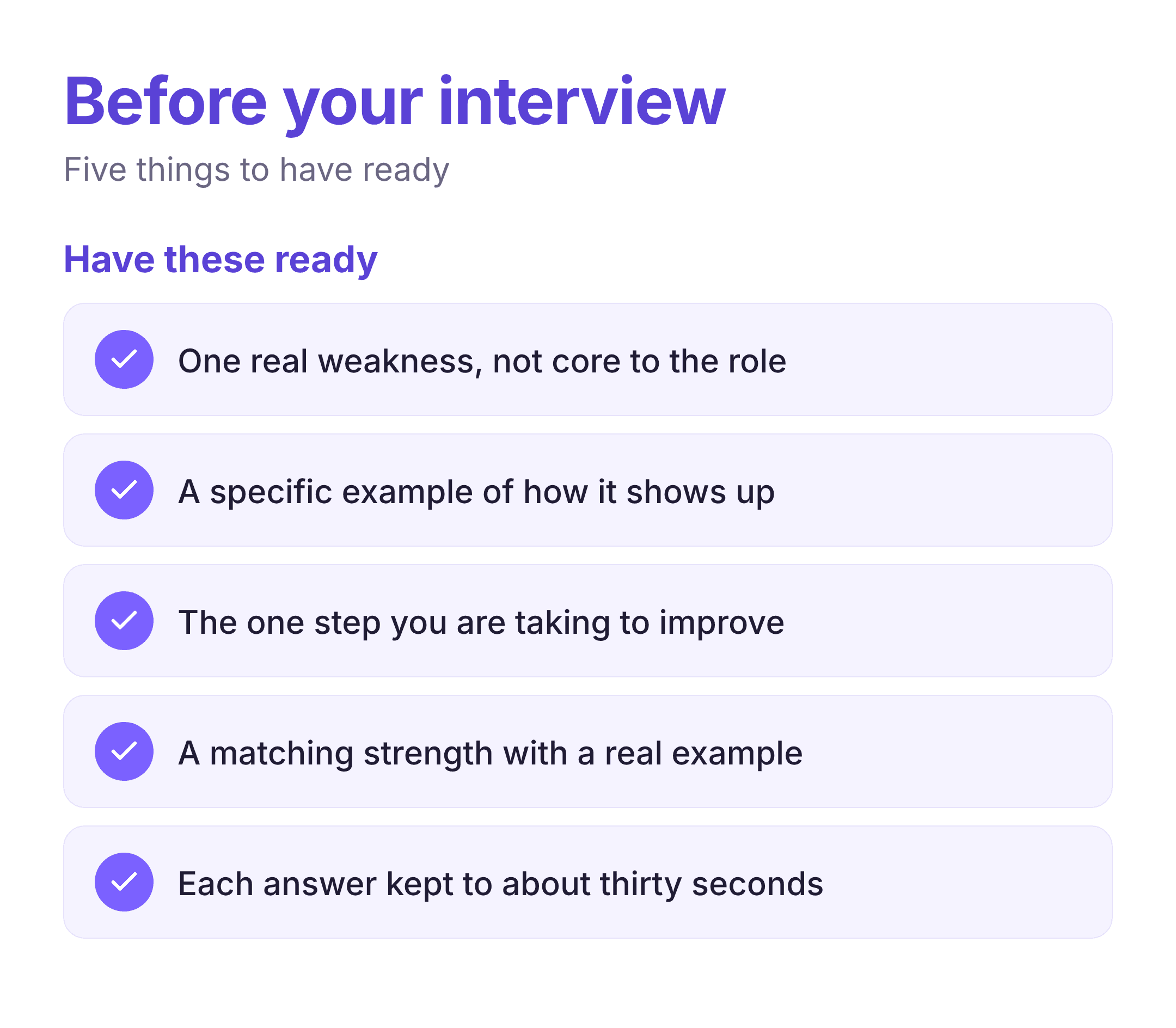
The weaknesses question is easier than it feels once you stop trying to hide. Pick something true that will not sink your candidacy, say how it shows up, and show that you are working on it. That answer tells an interviewer what they actually want to know, which is that you understand yourself and keep getting better. Prepare one honest weakness and one real strength before you walk in, and a question that used to make you sweat becomes one of the easiest to handle.
The best answer names a real weakness that will not stop you doing the job, explains briefly how it shows up, and shows one concrete step you are taking to improve. Honesty plus a plan beats any clever line.
Five that work for most roles are public speaking, delegating, saying no to extra work, being too self-critical, and spending too long polishing details. Pick one that is genuinely true for you and add what you are doing about it.
Treat it the same as any weakness question, but choose one clear example rather than listing several. Name the weakness, give a specific situation where it shows up, and describe the step you are taking to work on it, then stop.
No. Answers like "I work too hard" or "I am a perfectionist" with no real cost named come across as dodging the question. A genuine weakness with a plan attached makes a far better impression.
Avoid anything core to the job you are applying for, genuine dealbreakers like being unreliable or hard to work with, and the fake humblebrag weaknesses. These either raise real doubts or sound like you are avoiding the question.