RiseGuide Team
To stop self-sabotage, you first name the exact behavior that gets in your way, then look at what it is protecting you from, usually a fear of failing, being judged, or having your life change. From there you answer the harsh inner voice with a fairer read of the situation, shrink the next move until it is too small to talk yourself out of, and decide in advance how you will handle the moment the urge to bail shows up. Slips are part of the process, so you treat a setback as useful information and start again. Over time the pattern loosens because you stop fighting yourself and start giving the nervous part of you a safer way through.
Most people can point to a moment when they got in their own way. Maybe you kept polishing a project until the deadline slid past, or picked a fight in a relationship right as it turned serious, or set a goal on Monday and let it go by Thursday. A single slip like this is just being human. When it becomes a pattern, it has a name: self-sabotage, and the frustrating part is that the person standing between you and what you want is you. This guide covers what it is, the everyday behaviors it hides inside, the reasons behind it, and the steps that help you stop.
Self-sabotage is any behavior that gets in the way of something you say you want. You set a goal, and then you do something, or avoid doing something, that makes that goal harder to reach. The confusing part is that it almost never feels like sabotage while it is happening. It feels reasonable. You are being careful, you are waiting for a better time, you are protecting yourself from disappointment. Only later, looking back, does the pattern come into focus.
Most of it is not a conscious choice. You are not sitting down and deciding to fail. The behavior usually starts as a way to feel better right now, even when it costs you later. So understanding what is self sabotage in your own life means separating the surface action, like skipping the gym or not sending the email, from the quiet job it is doing, which is helping you avoid a feeling you would rather not sit with.
The most common forms of self sabotage look like ordinary habits, which is exactly why they are easy to miss. Naming them makes them easier to catch in the moment. Here is the self sabotaging behavior that shows up most often.
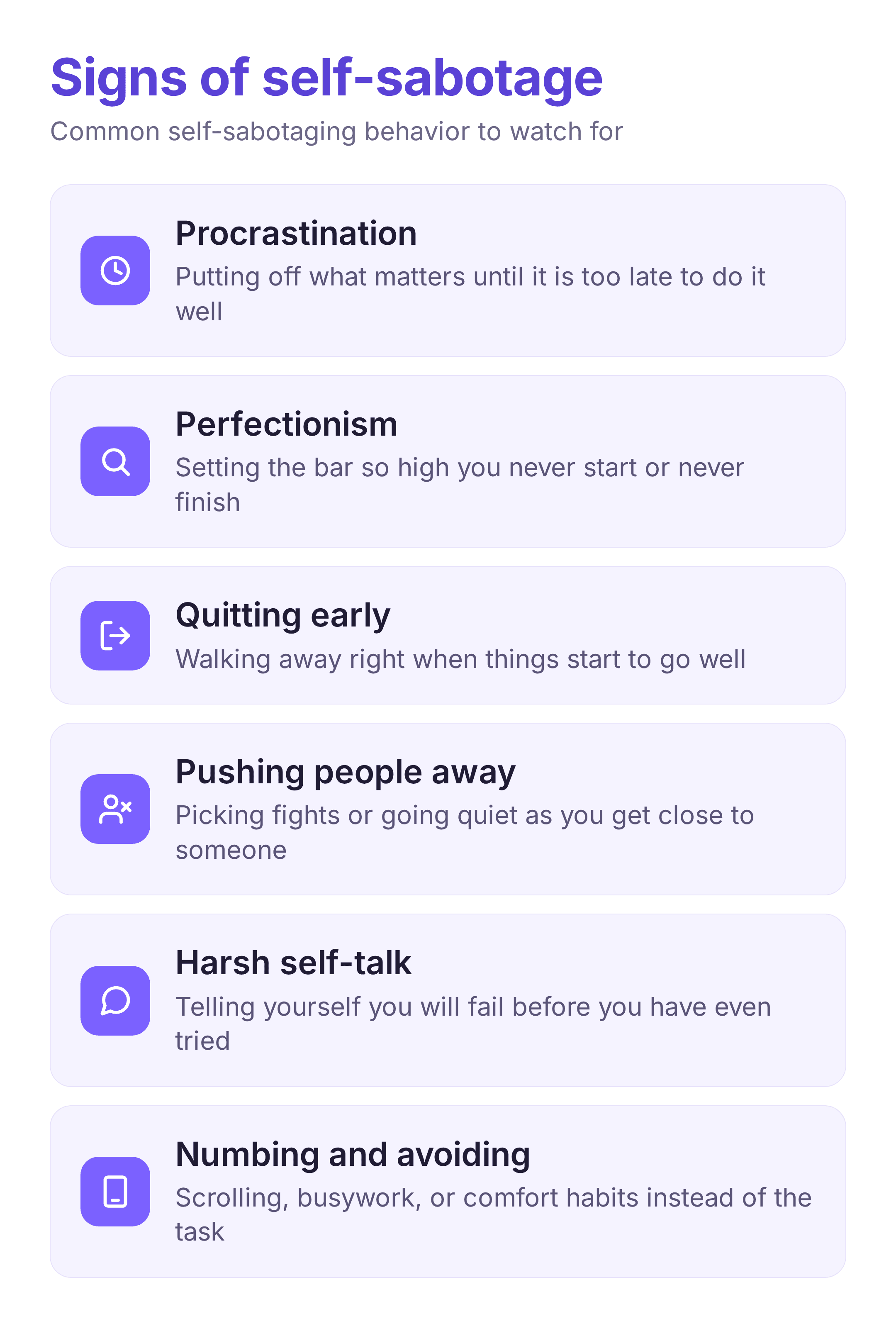
Procrastination is the most familiar one. Putting a task off feels harmless, but it often shields you from the risk of trying and falling short. It is also widespread. The psychologist Joseph Ferrari has found that about 20 percent of adults are chronic procrastinators, people who delay across work, home, and relationships as a settled habit rather than a one-time slip. If this is your main pattern, our team's guide on how to stop procrastinating goes deeper on it.
Perfectionism is the dressed-up version of the same move. When the standard is impossibly high, you get a respectable reason to never start or never finish. Quitting early works the other way: things start going well, the stakes rise, and you walk away before anyone can see you fail. Some people push people away instead, picking fights or going quiet just as a friendship or relationship gets close. Harsh self-talk keeps the whole thing running by telling you that you will fail before you have even tried. And when a task feels heavy, numbing and avoiding takes over, so you reach for scrolling, busywork, or a comfort habit instead of the thing in front of you. One or two of these will probably feel familiar.
If you can see the behavior clearly and still repeat it, you are not lazy or broken. This pattern runs on older logic, laid down before you had words for it, and it is usually doing a job. Asking why do I self sabotage is really asking what the behavior is protecting. A handful of reasons come up again and again: a fear of failing, a fear of succeeding and the pressure that comes with it, a pull toward whatever feels familiar, a low sense of your own worth, and a need to stay in control by choosing the disappointment yourself before life can hand it to you.
The fear of success surprises people, but it is real. The writer Gay Hendricks calls it the upper limit problem: each of us carries an internal setting for how much good we will let ourselves have, and we pull ourselves back down when we cross it. As he puts it in The Big Leap:
"Each of us has an inner thermostat setting that determines how much love, success, and creativity we allow ourselves to enjoy. When we exceed our inner thermostat setting, we will often do something to sabotage ourselves, causing us to drop back into the old, familiar zone where we feel secure."
The author Steven Pressfield gives the same force a different name. He calls it Resistance, the pull that shows up whenever you try to do work that matters to you. In The War of Art he opens with it:
"Most of us have two lives. The life we live, and the unlived life within us. Between the two stands Resistance."
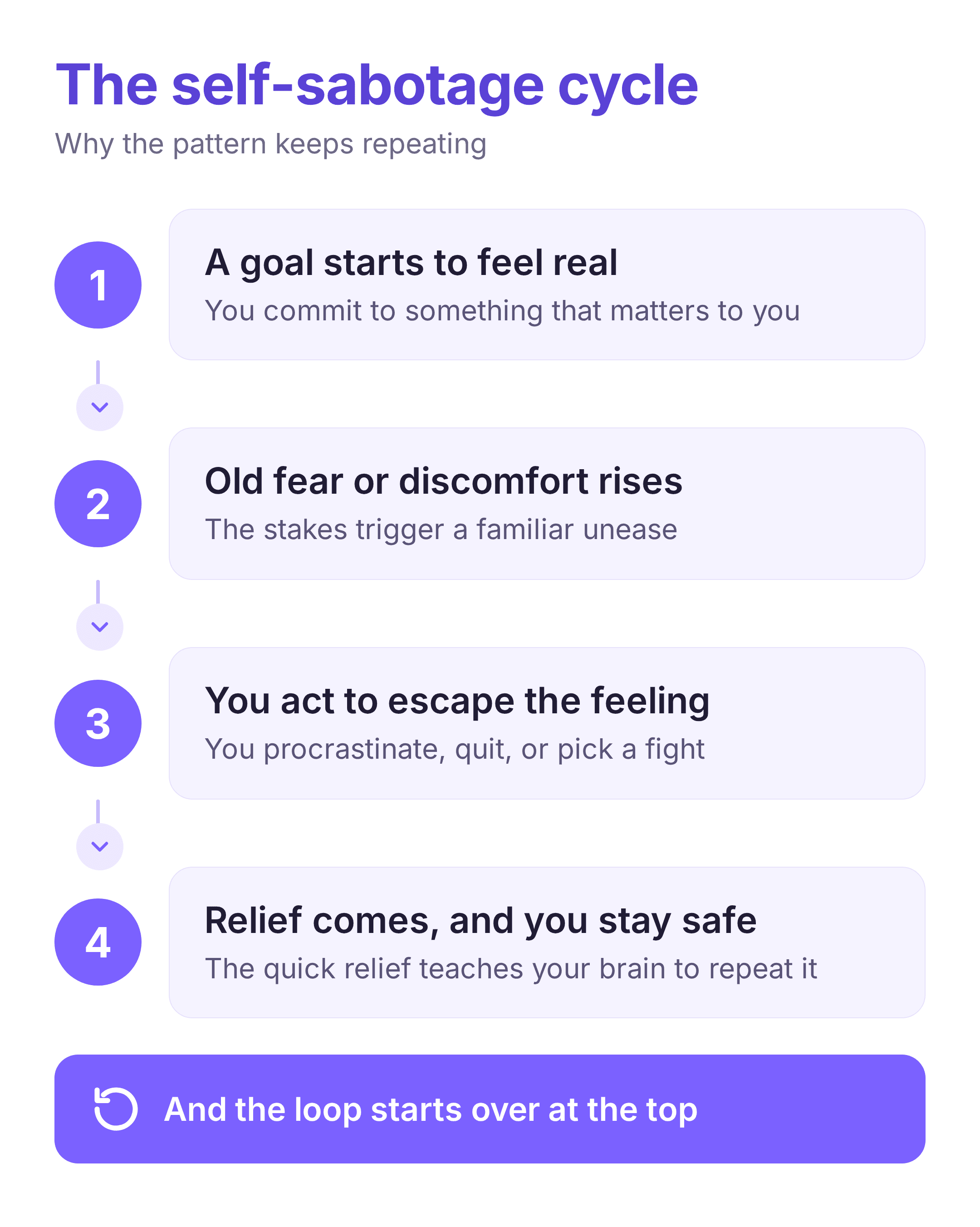
Whatever you call it, the mechanism is the same. A goal starts to feel real, an old fear or discomfort rises, you do something to escape that feeling, you get a wave of relief, and you settle back into the familiar zone. The relief is what teaches your brain to run the loop again next time.
Knowing why you do it is a real start, and it points to where the fix goes. The point is to give the nervous part of you a safer way through. These steps build on each other, so it helps to take them roughly in order. Here is how to stop self sabotaging in practice.
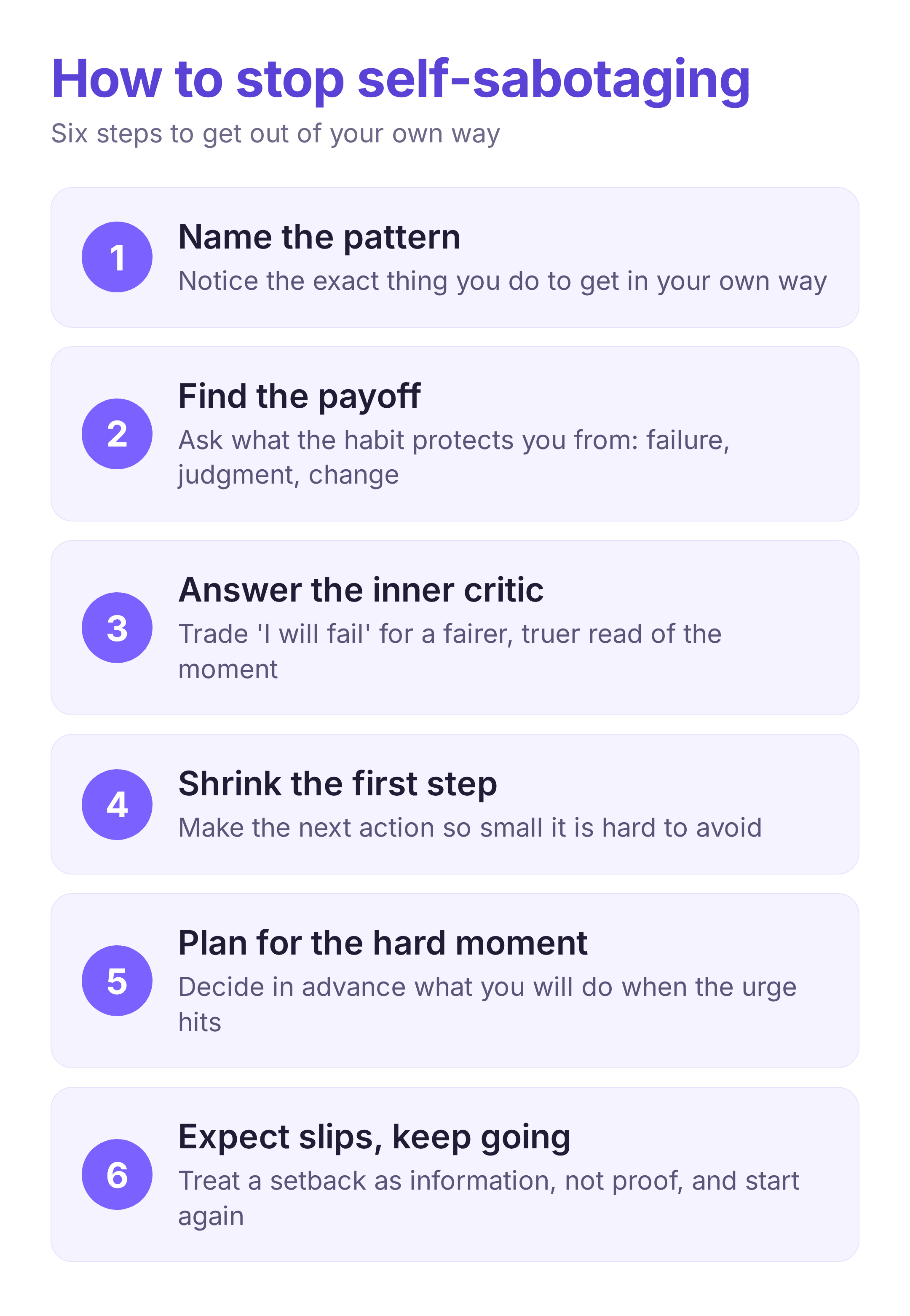
Start by naming the pattern. Pick one goal you keep undercutting and write down the exact thing you do to get in your way. Specifics matter more than labels here: "I reorganize my desk instead of writing" is more useful than "I procrastinate." Once you can see the move, look for the payoff. Ask what the behavior protects you from. Usually it is one of a few things: the chance of failing, the fear of being judged, or the discomfort of your life actually changing. The habit is doing a job: it is buying you a feeling, and naming that feeling takes away some of its power.
Next, answer the inner critic. When the voice in your head turns cruel after a slip, it feeds the whole cycle, so it helps to talk back with a fairer, truer read of the moment. Juliann Wiese, a Master Certified Coach and one of our experts, has a practical piece on working with your inner critic that pairs well with this step. Then shrink the first step until it is almost too small to avoid. If the goal is to write, the step is one sentence. If it is to exercise, it is putting on your shoes. Small, repeatable actions are also how lasting change is built, and our team's guide to forming good habits shows how to make the next move feel automatic.
The last two steps are about the moment things get hard. Plan for it in advance by deciding what you will do when the urge to bail shows up, so the choice is already made when your motivation dips. And expect slips. You will fall back into the pattern sometimes, and that is normal. A setback is information about what set you off, so learn what you can from it and start again. Progress looks like noticing faster and recovering sooner each time.
Getting in your own way is common, and it is not a character flaw. It is an old strategy for staying safe that has outlived its usefulness. Willpower alone rarely does it. The way through is noticing the pattern, understanding the fear underneath it, and giving yourself smaller, kinder ways to move forward. You will still slip sometimes, and that is part of it. What changes is how quickly you catch it, and how gently you begin again.
It is any repeated action, or avoidance, that gets in the way of a goal you care about. Common examples are procrastinating, holding yourself to impossible standards, quitting right before you succeed, and talking yourself down. The behavior usually feels reasonable in the moment and only looks like sabotage in hindsight.
Look for a gap between what you say you want and what you keep doing. If you set the same goal again and again and undercut it in similar ways each time, that pattern is the tell. It helps to track one goal for a couple of weeks and note the exact moments you pull back and what you were feeling right before.
There is rarely a single cause. It usually traces back to a fear the behavior is protecting you from, such as failing, being judged, or the pressure that comes with things going well. Past experiences and a low sense of self-worth feed it too. The behavior sticks because escaping the uncomfortable feeling brings quick relief.
No. Self-sabotage is a common pattern of behavior, not a diagnosis. It can show up alongside anxiety or low mood, and if the pattern is severe or tied to real distress, talking to a qualified professional is a sensible step. For most everyday cases, though, it is a habit you can understand and change with practice.