RiseGuide Team
 FREE GUIDE with any plan: the First Impression FormulaClaim the offer

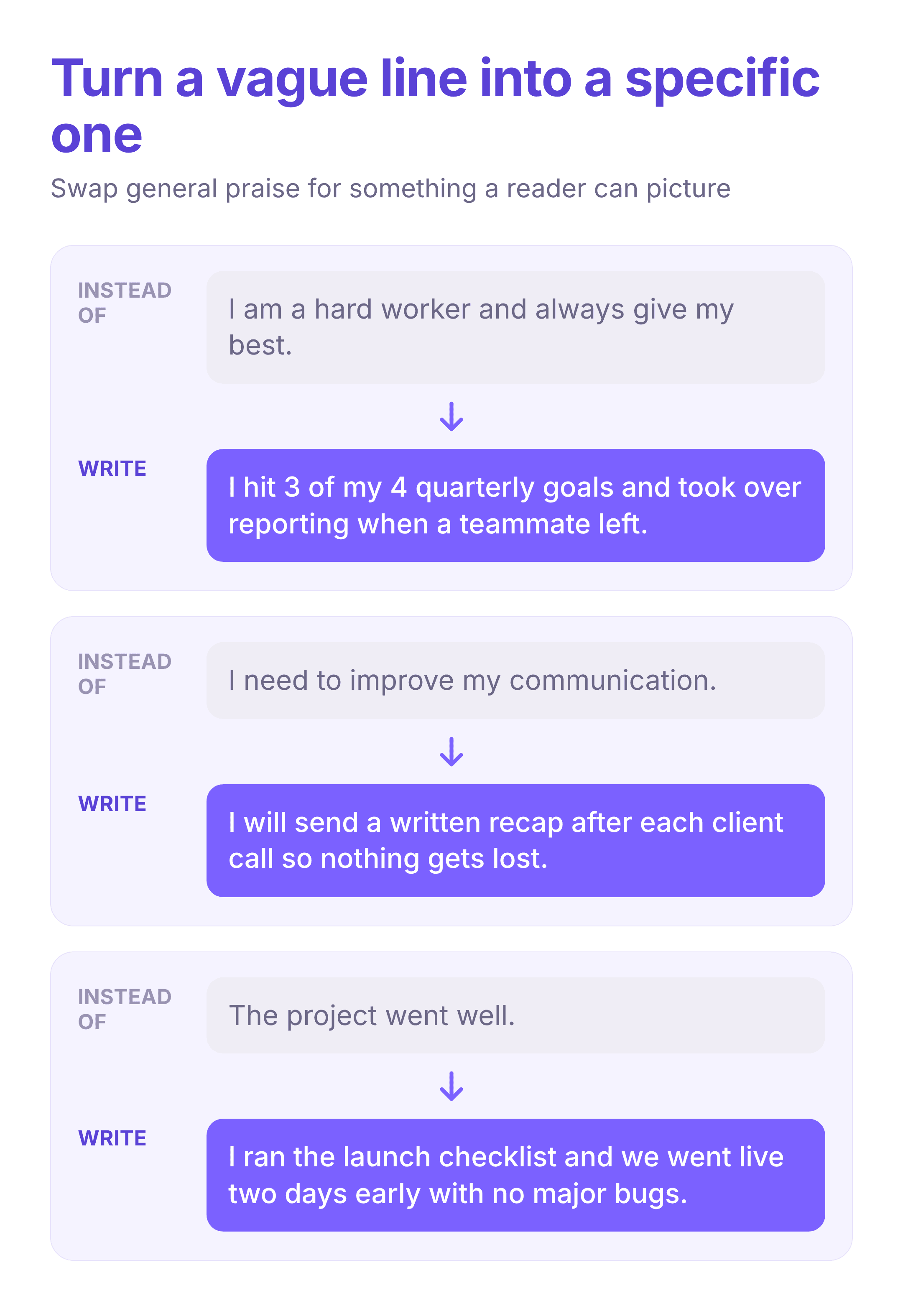
A self evaluation is the part of a review where you describe your own work: what you achieved, where you are strong, where you want to grow, and what you are aiming for next. Strong entries name a specific task and add a result, like "I trained three new hires and all three passed their 90-day review," instead of general lines like "I always work hard." The self evaluation examples here are grouped into achievements, strengths, areas to improve, and goals, so you can find one close to your situation and change the details. There is also a template you can copy that walks through each section with prompts, plus a quick way to turn vague lines into specific ones.
Review season has a way of turning a confident person into someone staring at a blank form. You know your work was solid, but writing it down about yourself feels awkward, and the box on the screen wants specifics you have not thought about in months. A self evaluation is your own account of how the period went, and it carries real weight, because managers often read it before they write the performance review of you. What follows are self evaluation examples grouped by theme, plus a template you can copy, so the next blank form is easier to fill.
A self evaluation, sometimes called a self appraisal or self assessment, is your written answer to a simple question: how did your work go this period? Most self evaluation performance review forms give you a few open boxes, usually covering your achievements, your strengths, the areas you want to improve, and your goals for next time. The managers reading it are looking for specifics they can point to, not a list of adjectives.
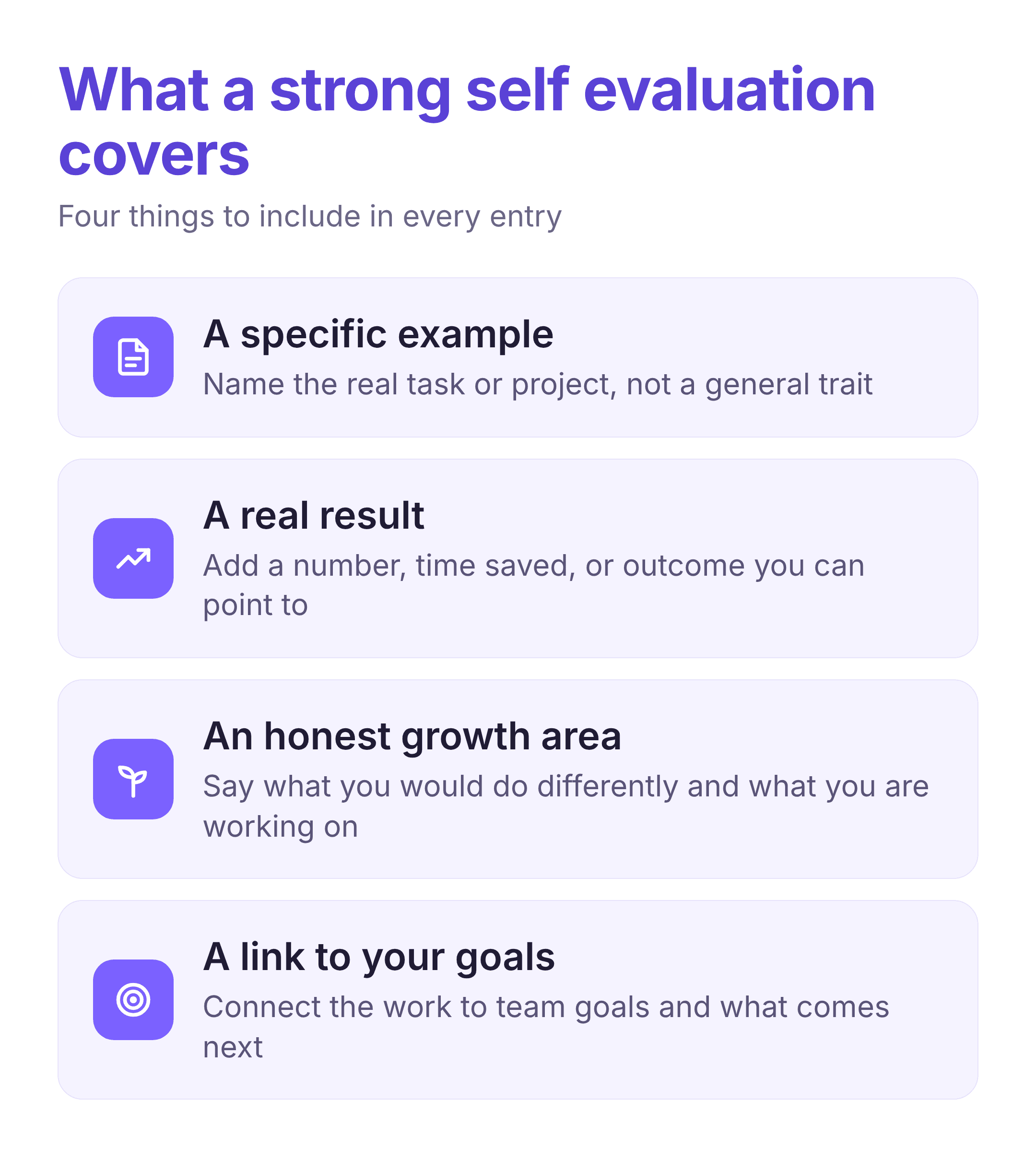
A strong entry usually has four things:
Here are self evaluation examples you can adapt, grouped into the four areas most forms ask about. Use them as sample answers: find one close to your situation, then swap in your own project, number, or result. They also work as self assessment examples if that is the term your company uses, and as self-appraisal comments for most roles, so change the wording to match how your team talks.
Lead with what you got done and the result it produced. Pick the few things you are proudest of rather than listing everything.
Name a strength, then back it with one moment that shows it. A strength with an example behind it is far more convincing than the word on its own. If you want more language for this, our guide to people skills lists strengths worth naming.
This is the section people dread, but it is also where a thoughtful answer stands out. Pick a real area, keep it honest, and pair it with the step you are already taking. That shows self-awareness without turning the form into a confession.
Close with where you are headed. Good goals are specific enough that you will know whether you hit them. If you are not sure what to aim for, our post on career goals can help you frame them.
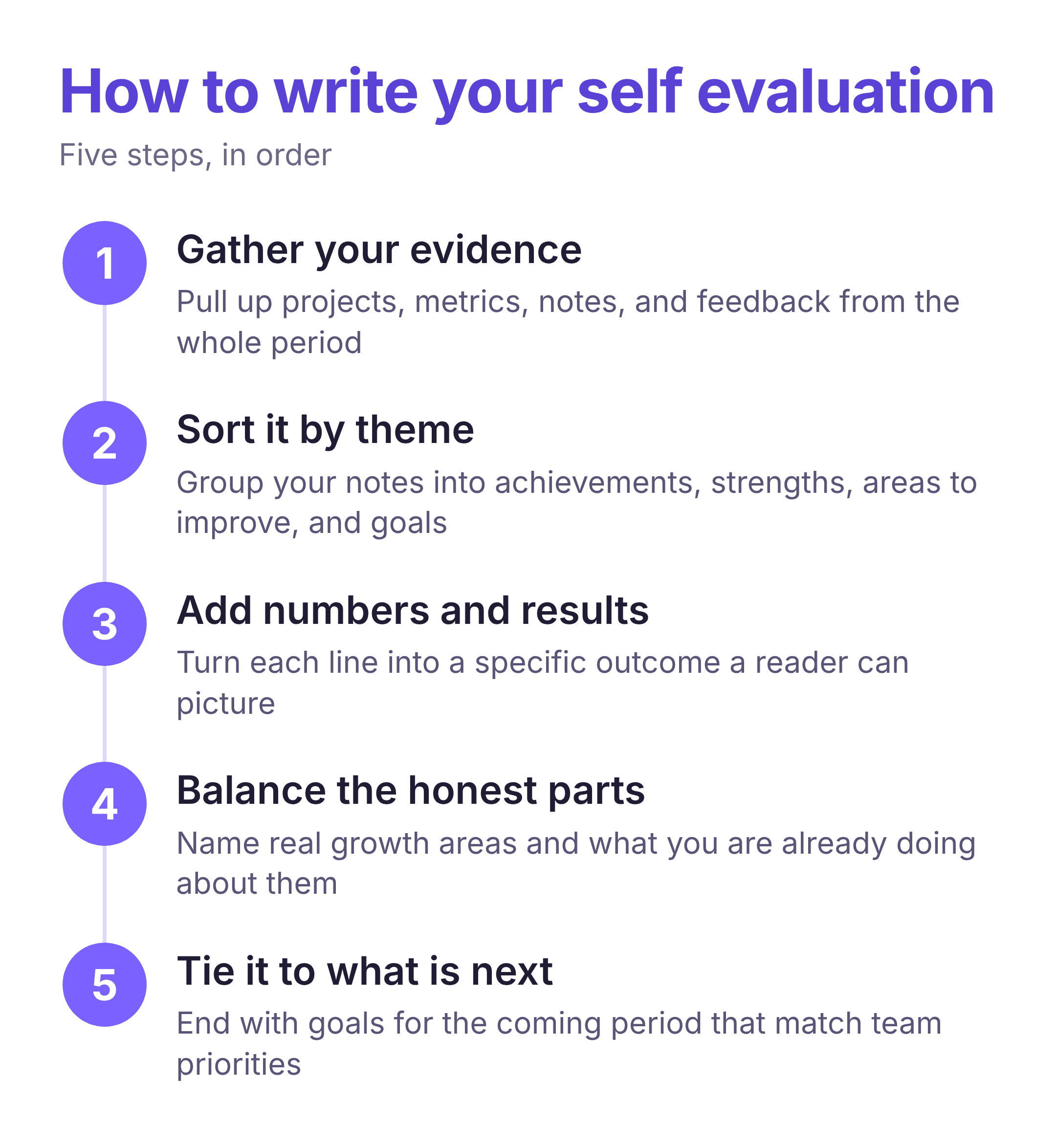
Here is how to write a self evaluation from a blank form, in an order that keeps it honest and specific. The steps matter, because gathering your evidence first stops the whole thing from drifting into vague praise.
A specific self evaluation also becomes evidence you can reuse later, when you make the case to get a promotion or ask for a raise.
The difference between a forgettable self evaluation and a strong one is usually specificity. A line like "I am a hard worker" could describe anyone, and a reviewer skims past it. Swap it for something a reader can picture: the task, the number, the outcome. The same move works for an area to improve, where "I need to communicate better" becomes a concrete habit you are building.
This self evaluation template follows the same order. Copy it, fill in the brackets with your own work, and cut any section your form does not ask for. Adjust the tone to your workplace, because a formal annual review reads differently from a quick quarterly check-in, so match how your team actually writes.
Summary: In [period], I focused on [main responsibility]. Overall, [one honest sentence on how it went].
Key achievements:
- [Project or task], which led to [specific result or number].
- [Project or task], which led to [specific result or number].
Strengths I relied on:
- [Strength], shown when [brief example].
Areas I want to improve:
- [Honest area], and I am already [action you are taking].
Goals for next [period]:
- [Goal], which I will measure by [how you will know it worked].
Support I need: [Anything useful from your manager: a tool, training, or regular feedback.]
Here is the same template filled in for a support specialist, so you can see the shape:
Summary: This quarter I focused on cutting our ticket backlog. Overall, it went well, with one process I still want to tighten.
Key achievements: I cleared a 200-ticket backlog in six weeks and wrote three help articles that now deflect about 40 tickets a month.
Strengths I relied on: Patience with frustrated customers, shown when I handled the billing outage without a single escalation.
Areas I want to improve: I hold onto hard tickets too long before escalating, and I am now flagging anything stuck for more than a day.
Goals for next quarter: Bring our average response time from 6 hours to 4, measured in the help-desk dashboard.
Support I need: A short SQL training so I can pull my own ticket reports.
If you also need a template for the job itself, our cover letter examples include one you can copy the same way.
A self evaluation is easier when you treat it as an ongoing record of your work rather than a one-time test. Keep a running note of your wins and your stumbles through the period, and the form becomes a matter of sorting and tightening rather than remembering. Use the examples and the template here as a starting point, and keep editing the details until each line sounds like your own work.
Start by collecting evidence, not by writing. Pull up your projects, numbers, and any feedback from the whole period, then sort them into achievements, strengths, areas to improve, and goals. Once the raw material is in front of you, writing each line is mostly a matter of adding the result.
Avoid vague praise with nothing behind it, like "I always do my best," and avoid blaming other people for what went wrong. Skip a long list of flaws too, since one or two honest growth areas with a plan read far better than five. Keep each point tied to real work.
Good self-appraisal comments name a specific task and the result it produced, such as "I cleared a 200-ticket backlog in six weeks." The examples in each section above are written this way, so you can adapt them to your own role. Use the same pattern for strengths, growth areas, and goals.
Most forms expect a few sentences per section, not an essay. Aim for enough detail to make each point specific, then stop. A tight, concrete answer is easier to read than a long one that repeats itself.
Pick a genuine area, phrase it as something you are improving, and pair it with the step you are already taking. For example, "I hold onto hard tasks too long, so I am now flagging anything stuck for more than a day." That shows self-awareness and action at the same time, which is what reviewers are looking for.