RiseGuide Team

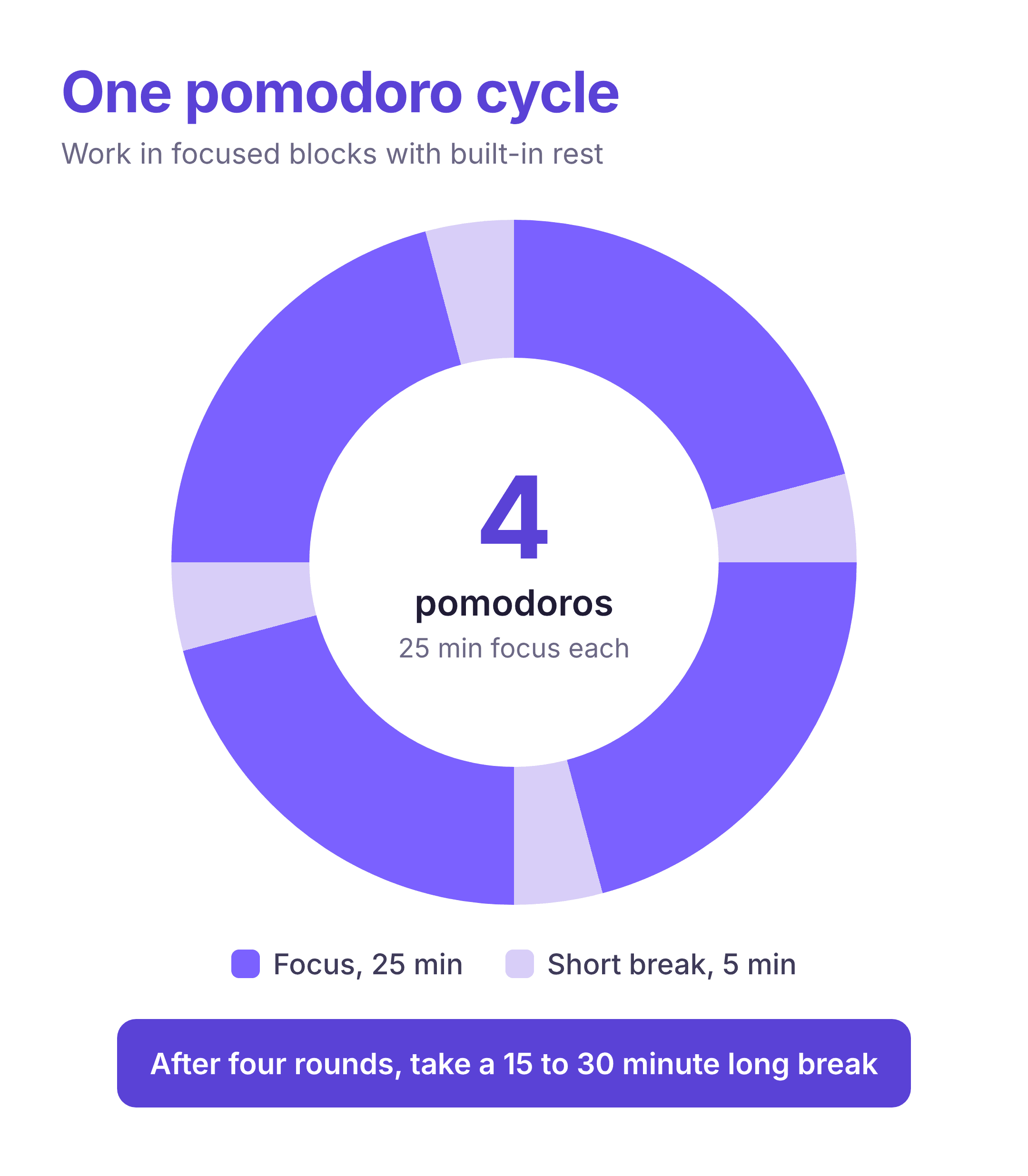
To use the Pomodoro technique, pick one task, set a timer for 25 minutes, and work on only that task until it rings. Take a 5-minute break, then start another 25-minute round. Each round is one "pomodoro." After four pomodoros, take a longer break of 15 to 30 minutes. The method works by turning a big, open-ended task into short timed sprints with built-in rest, which makes a task easier to start and harder to abandon for your phone. You can run it with any kitchen timer, a phone, or a dedicated Pomodoro timer, and you can stretch the blocks longer once 25 minutes feels too short.
Most of us don't lose a workday all at once. We lose it in small interruptions: a message here, a quick glance at the phone there, a tab that pulls us sideways. Each switch has a real price. Gloria Mark, a professor of informatics at the University of California, Irvine, found that it takes about 23 minutes to get back to a task after an interruption. The Pomodoro technique is one of the simplest ways to guard your attention against all of that, and it needs nothing more than a timer. Francesco Cirillo created it in the late 1980s, and this guide is about how to actually use it day to day.
This article mentions ADHD and focus difficulties for educational and informational purposes only. It is not medical or mental health advice, and it is not a diagnosis. If something is seriously affecting your ability to concentrate, a qualified professional can help you find what works for you.
The hardest part of most tasks is starting. A report with no deadline or a chapter you've been avoiding feels heavy, so you put it off. When you promise yourself only 25 minutes on one thing, starting feels small enough to say yes to, which is why the method is so good at getting past procrastination, something our post on why you procrastinate digs into. You're not committing to finishing. You're committing to 25 minutes.
The second reason is focus. A timer that's already running is a quiet commitment: you're less likely to open a new tab when you know a break is only a few minutes away. The work block gives your attention one job, and the break gives it a chance to recover before the next one. Barbara Oakley, an engineering professor who co-created the widely taken Learning How to Learn course, describes the Pomodoro technique as one of the easiest ways to get past the discomfort that makes us procrastinate: you focus fully for a short stretch, then give yourself a genuine reward.
Cirillo came up with the method as a struggling university student who couldn't concentrate. In the preface to his book The Pomodoro Technique, he describes the moment it began: "So I made a bet with myself, as helpful as it was humiliating: 'Can you study – really study – for 10 minutes?'" He grabbed a kitchen timer shaped like a tomato (pomodoro is Italian for tomato), and the name stuck. Here is the method he built from that bet. The order matters, so treat these as steps.
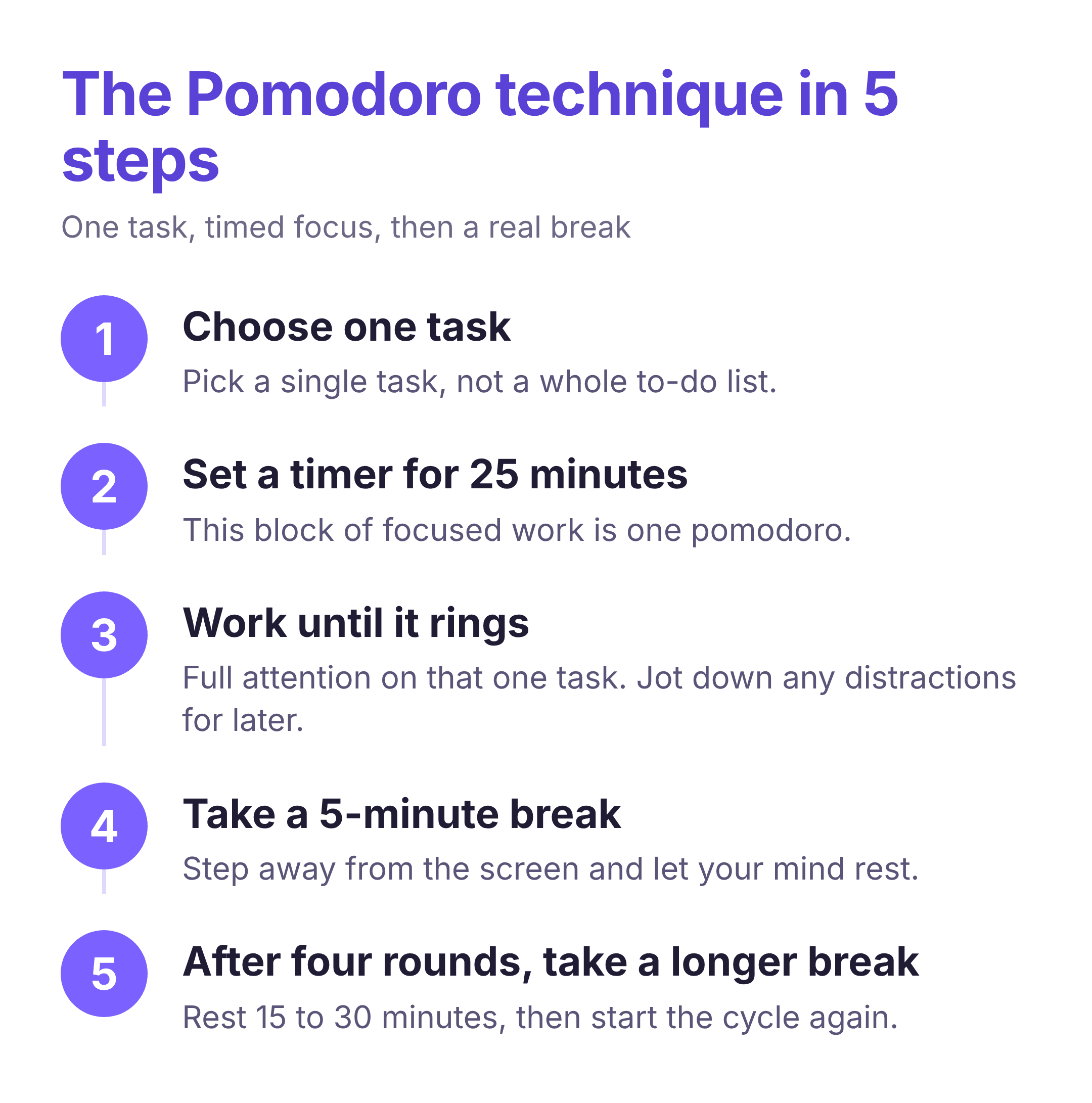
Pick a single task to work on, not a to-do list. If it's large, like "write the report," narrow it to the next concrete piece, like "draft the introduction." One clear target per pomodoro keeps your attention from splitting.
Twenty-five minutes of focused work is one pomodoro. Setting the timer is the signal to begin, and it turns a vague intention into a clear, short window.
Give the task your full attention until the timer goes off. When a distraction pops into your head, such as an email you need to send, write it on a notepad and return to it later instead of acting on it now. If you break focus completely, that pomodoro doesn't count; start a fresh one.
When the timer rings, stop, even mid-sentence. Stand up, stretch, get water, or look out a window. Step away from the task so your mind can rest, and skip anything that pulls you back onto a screen.
Once you've finished four pomodoros, take a longer break of 15 to 30 minutes. This longer rest is where your brain consolidates what you did and recharges for the next set.
The classic timing is 25 minutes of work and 5 minutes of rest, but the numbers aren't fixed. Cirillo chose 25 minutes because it was long enough to make progress and short enough to stay sharp. If 25 minutes leaves you cut off mid-flow, try 50 minutes of work with a 10-minute break. If even 25 feels like too much on a hard day, start with 15. The ratio of focused work to rest matters more than the exact minutes.
You can run the method with almost anything. A physical kitchen timer works well because winding it is a small ritual that tells your brain it's time to focus, and it keeps your phone out of your hand. A plain phone or computer timer is fine too. If you want something built for this, a dedicated Pomodoro technique timer or a Pomodoro technique app will count your work blocks and breaks for you, track how many pomodoros you've done, and often block distracting sites while the timer runs.
The method suits almost any focused work, but a few adjustments help for specific situations.
The Pomodoro technique for studying pairs well with active recall: spend a pomodoro testing yourself on material rather than rereading it. Our team's guide to studying effectively covers methods that fit neatly inside a 25-minute block, and our team's guide to building study habits helps turn focus sessions into a routine.
For work that needs a long runway, like writing or coding, shorter blocks can interrupt flow. Longer pomodoros of 50 minutes suit the kind of sustained concentration described in our post on deep work. Keep the core idea: one task, protected time, a real break.
On days when sitting still is hard, shrink the work block instead of dropping the method. A 10 or 15 minute pomodoro still counts, and finishing a short block builds momentum for the next one. Many people with shorter attention spans find the structure and the clear finish line easier to work with than an open-ended session.
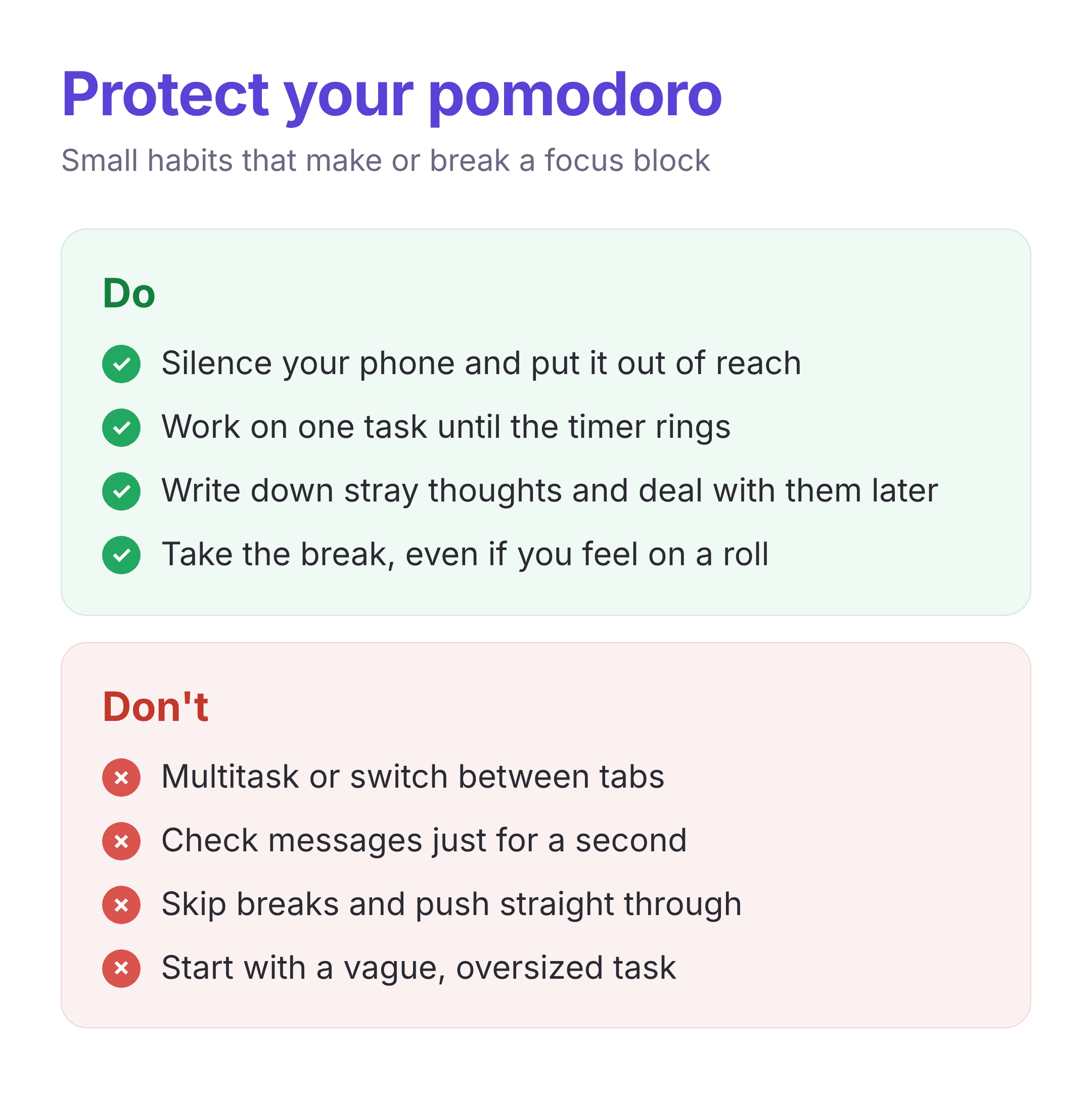
A few habits can undo the method. The first is choosing a task that's too big, so you spend the pomodoro deciding where to start; break it into a single next step before the timer begins. The second is treating the break as optional and working straight through, which leads to the burnout the breaks exist to prevent. The third is keeping your phone within reach, so a notification pulls you out two minutes in. Put it in another room while the timer runs.
The Pomodoro technique comes down to a simple agreement with yourself: one task, a set amount of time, then a rest. Start with a single 25-minute block today on the task you've been avoiding. If the timing doesn't fit, adjust it. The method bends to your work, your attention, and the kind of focus the task in front of you actually needs.
The Pomodoro technique is a time-management method where you work in focused 25-minute blocks, called pomodoros, separated by short breaks. After four blocks you take a longer break. It helps you start tasks, stay focused, and avoid burning out.
It's named after the tomato-shaped kitchen timer Francesco Cirillo used when he invented the method as a student. Pomodoro is the Italian word for tomato.
Choose one task, set a timer for 25 minutes, work until it rings, take a 5-minute break, and after four rounds take a longer 15 to 30 minute break.
Short breaks are about 5 minutes, taken after each 25-minute block. The longer break after four pomodoros is usually 15 to 30 minutes.
Yes. The timed blocks make long study sessions less daunting and give you regular breaks, which helps retention. It works best when you spend each block on active study, like testing yourself, rather than passively rereading.
Many people with ADHD find the clear time limit and the visible finish line helpful, and shortening the block can make it easier to start. This is general information, not medical advice, so it's worth checking with a qualified professional about what suits you.