RiseGuide Team
 FREE GUIDE with any plan: the First Impression FormulaClaim the offer

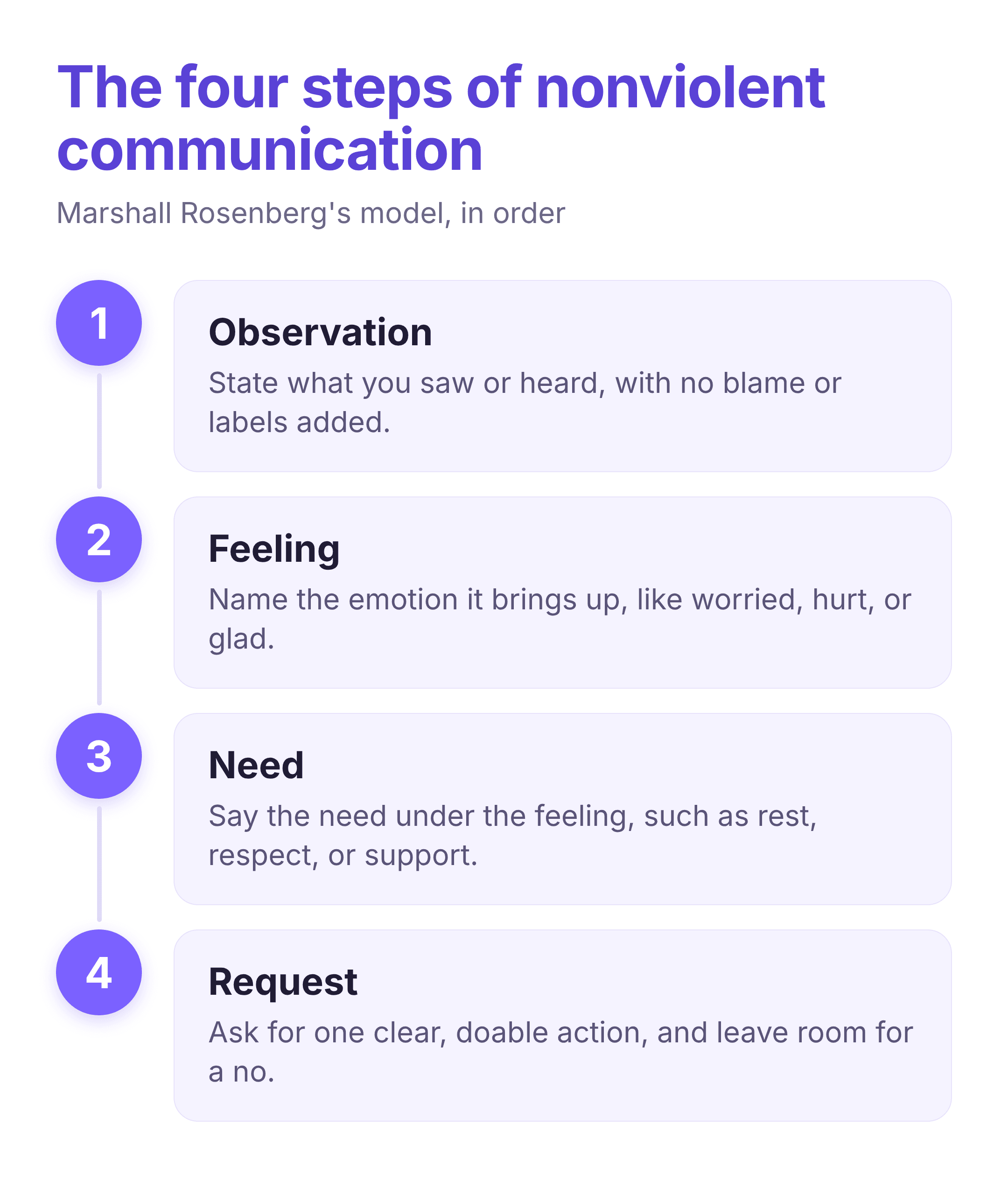
Nonviolent communication is a four-step way of speaking and listening that the clinical psychologist Marshall Rosenberg developed in the 1960s. The steps run in order: state an observation (what happened, with no judgment), name the feeling it brings up, say the need behind that feeling, then make one clear, doable request. You use the same four steps the other way to understand someone else, guessing at their observation, feeling, need, and request instead of reacting to their words. Taken together, the steps turn blame into a plain description of what you see, how you feel, what you need, and what would help.
Most arguments do not begin over the thing people end up shouting about. They begin when a plain event, a sink full of dishes, a late arrival, a two-word reply, gets turned into a verdict about the other person. Nonviolent communication is a way of keeping the event and the verdict separate, so a hard conversation has somewhere to go instead of hardening into attack and defense. Marshall Rosenberg, a clinical psychologist who spent decades mediating disputes in classrooms, prisons, and conflict zones, built the method and taught it around the world through the Center for Nonviolent Communication, which he founded in 1984. This guide walks through his four steps and shows what each one sounds like in an everyday conversation.
Nonviolent communication is a structured way of expressing yourself, and of hearing other people, that focuses on observations, feelings, needs, and requests rather than on blame, labels, and demands. Rosenberg also called it compassionate communication, and in his workshops he used a giraffe puppet to stand for it, since the giraffe is the land animal with the largest heart. The opposite, the judging and diagnosing most of us learned growing up, he called jackal language.
Most people first meet the Marshall Rosenberg nonviolent communication model through his 1999 book Nonviolent Communication: A Language of Life. The idea at its center is that behind every criticism or shutdown is an unmet need, and that people respond very differently when they hear the need instead of the attack. As Rosenberg put it:
"When we focus on clarifying what is being observed, felt, and needed rather than on diagnosing and judging, we discover the depth of our own compassion."
Rosenberg lays out the model himself in a recorded San Francisco workshop, where he walks a room through the same four steps and the common mistakes people make at each one.
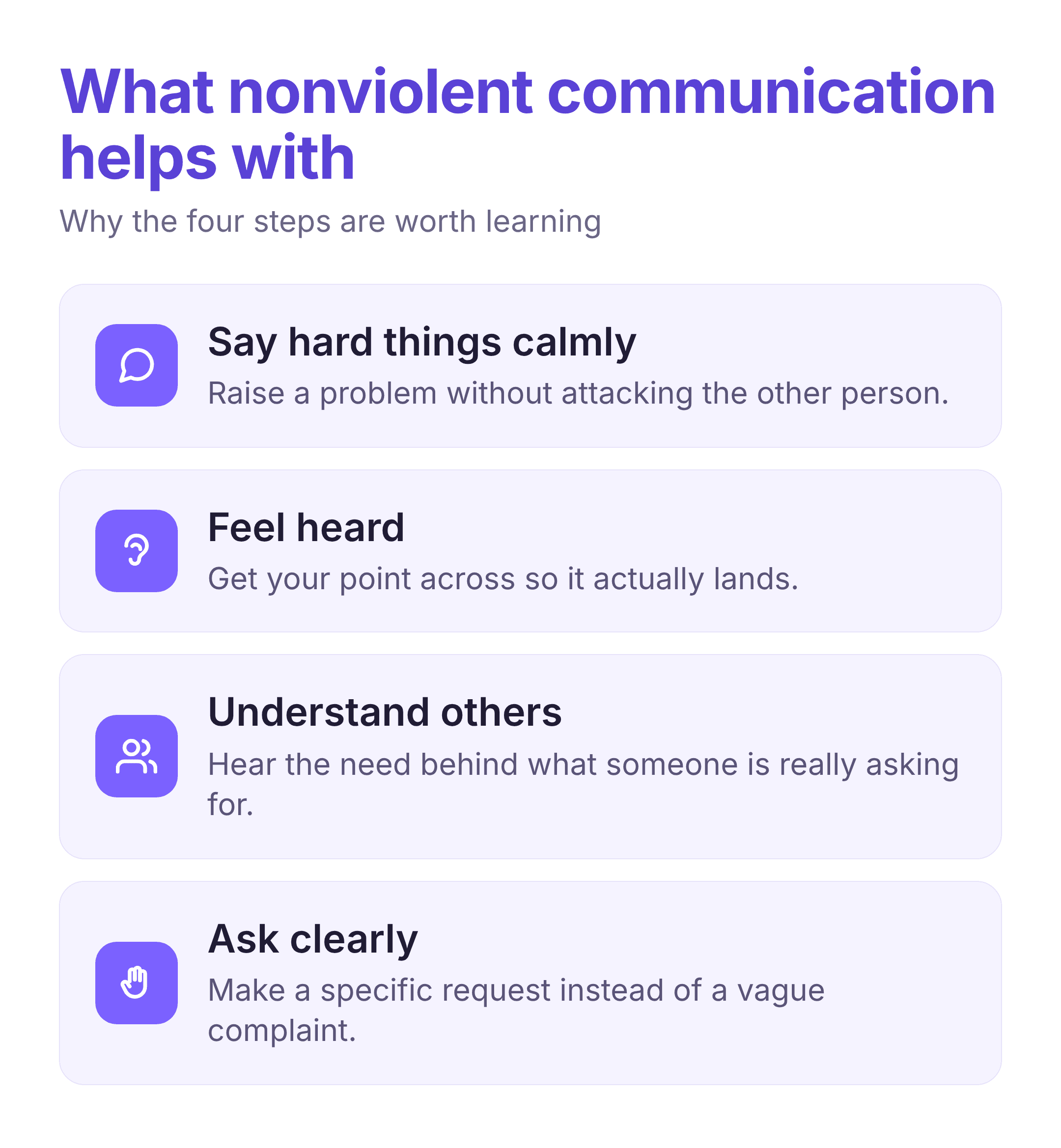
The four nonviolent communication steps run in a set order, because each one sets up the next. You start with a fact, add how you feel about it, trace that feeling to a need, and only then ask for something. Skip the first steps and a request lands as a demand; the other person hears what they did wrong before they hear what you want. The same four steps also work in reverse, as a way to listen: when someone comes at you with a complaint, you can quietly look for the observation, feeling, need, and request buried inside it.
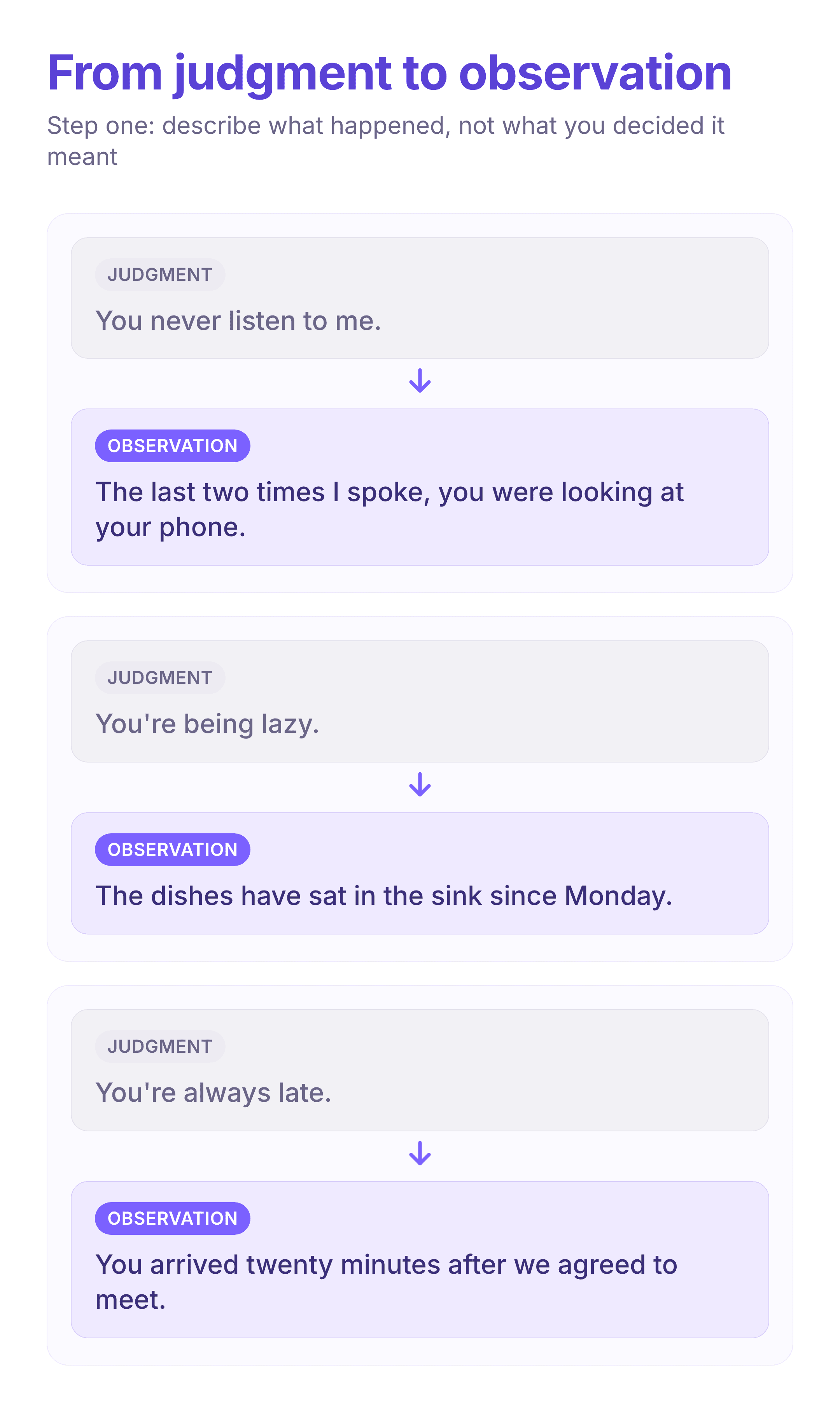
Describe only what a camera or a voice recorder would catch. "You left the dishes in the sink since Monday" is an observation. "You're lazy" is an evaluation, a conclusion you drew from what you saw. The trouble with evaluations is that they invite an argument about character instead of about the dishes, and the other person spends their energy defending themselves rather than hearing you.
Watch for words that sound factual but carry a judgment, like always, never, and again. "You're always late" is a verdict. "You arrived twenty minutes after we agreed to meet" is something both of you can actually look at. Observing well also means hearing what the other person actually said rather than what you assumed they meant, which our guide to listening skills breaks down in more detail.
Once you have stated the observation, say how it makes you feel. The catch is that many sentences that start with "I feel" are not feelings at all. "I feel like you don't care" and "I feel ignored" are thoughts and interpretations wearing a feeling's clothes, and they still point a finger at the other person. The actual feeling underneath is something like lonely, hurt, worried, or tired.
Naming a real emotion does two things. It tells the other person what is going on inside you, and it keeps the focus on your experience instead of on their faults. "When the dishes sit for days, I feel frustrated and a little worn out" is hard to argue with, because no one can tell you that you do not feel what you feel.
Every feeling is a signal about a need that is either met or unmet. Frustration about the dishes might point to a need for shared responsibility or rest. Loneliness at dinner might point to a need for connection. The third step is to name that need out loud, so the conversation moves from what the other person did to what matters to you.
Rosenberg drew a sharp line between needs and strategies. A need is universal and simple, like rest, respect, support, or honesty; a strategy is one particular way of meeting it. "I need you to do the dishes tonight" is a strategy. "I need to feel like we are sharing the load at home" is the need, and there may be several ways to meet it. Rosenberg kept a nonviolent communication needs list, an inventory of common human needs, to help people find the right word for what they were missing. Saying the need plainly is also the heart of our guide to communicating your needs in a relationship.
The last step is to ask for one specific, doable action in the present. Vague wishes like "I need you to care more" give the other person nothing to do. "Would you be willing to rinse your dishes before bed this week?" gives them a clear, concrete action they can say yes or no to.
What separates a request from a demand is how you handle a no. If a refusal leads to punishment, guilt, or the silent treatment, it was a demand all along, and people can feel the difference. A genuine request leaves room for the other person to decline or to offer a different way of meeting the need, which keeps the conversation open even when you disagree. Our guide on how to disagree respectfully covers that balance in more situations.
Putting the four steps together takes a sentence or two. Here is how the same structure sounds across a few common situations.
At home. "When the dishes have been in the sink since Monday [observation], I feel frustrated and tired [feeling], because I need to feel like we are sharing the housework [need]. Would you be willing to handle the dishes on the nights you cook [request]?"
At work. "When the report came in a day after the deadline [observation], I felt anxious [feeling], because I need enough time to review things before they go to the client [need]. Could we agree on an internal due date that is a day earlier next time [request]?"
With a friend. "When our plans got canceled by text an hour before [observation], I felt let down [feeling], because I was looking forward to catching up and I need a bit more notice to plan my day [need]. Next time, could you let me know in the morning if something feels shaky [request]?"
Notice that none of these sentences name a flaw in the other person. They describe an event, own a feeling, point to a need, and ask for one thing. When both people get stuck, naming the deeper conflict directly can help, and our guide to interpersonal conflict walks through how to do that.
The four steps feel stiff at first, and that is normal. Early on, it helps to write out a sentence before a hard conversation rather than improvise it, and to practice on small, low-stakes moments before you use it on a real dispute. A few things make the learning faster:
If communication is the skill you want to work on first, RiseGuide's Communication Mastery journey breaks nonviolent communication and related skills into short, interactive lessons built from the insights of experts, so you can practice the four steps on real scenarios rather than only read about them.
Nonviolent communication does not make hard conversations easy, and it will not win an argument on its own. What it does is slow down the moment where an event becomes an accusation, so you can say what you saw, how you feel, what you need, and what would help, in that order. The method takes practice, and it works in both directions, as a way to speak and as a way to listen. Start with one conversation, keep the observation plain, and ask for one clear thing.
The four steps are observation, feeling, need, and request. You state what happened without judgment, name the feeling it brings up, say the need behind that feeling, and then make one clear, doable request.
It is a way of talking and listening that separates facts from blame. Instead of telling someone what they did wrong, you describe the event, your feeling, your need, and a specific thing that would help, which makes it easier for the other person to actually hear you.
The clinical psychologist Marshall Rosenberg developed it starting in the 1960s and spread it through the Center for Nonviolent Communication, which he founded in 1984, and his book Nonviolent Communication: A Language of Life.
A request leaves room for a no. If the other person declines and you respond with punishment, guilt, or the cold shoulder, it was a demand. A real request lets them say no or offer another way to meet the need.
It can lower the heat, because naming an observation and a need gives the other person less to defend against than an accusation does. It works best when you have practiced the steps beforehand, since they are hard to reach for the first time in the middle of a tense moment.