
RiseGuide Team

To give constructive feedback that people actually use, pick a good moment and ask if the person is open to hearing it, describe the specific situation and the behavior you saw instead of judging their character, and explain the effect it had. Keep it to one or two points, make it a two-way conversation, and check that you have the full picture before you settle on what to say. End with one clear next step the person can act on, then follow up later so the feedback turns into a change instead of a one-time comment.

Most of us give feedback all the time. We tell a teammate their draft is confusing, we mention to a friend that they cut people off, we let someone we manage know a project slipped. A lot of it goes nowhere: the other person nods, agrees, and then does the same thing next week. Gallup found that just one in four employees strongly agree they get valuable feedback from the people they work with, so most of it either misses the point or stings enough that people tune it out.
The point of constructive feedback is to help the other person do something differently, so the real measure of it is whether they end up using it. Feedback that gets used is usually specific, aimed at behavior rather than the person, and clear about what to try next. Knowing how to give constructive feedback that way is much the same whether you are reviewing a colleague's work or telling a friend something they will not want to hear.
Before the how, it helps to see why feedback so often gets ignored. The problem is rarely that the person refused to listen; usually the feedback itself was put in a way that made it hard to act on.
"Be more professional" or "your report needs work" gives the other person nothing to hold. They cannot tell which moment you mean, what exactly to change, or what "better" would look like. Vague feedback feels like a judgment on the whole of them rather than a note on one thing they did, and a judgment is much harder to accept than an observation.
There is a difference between "you were dismissive" and "you interrupted twice while she was still explaining." The first labels the person's character, so the natural response is to defend themselves. The second points at a behavior, which is something they can picture and change without feeling like you are calling them a bad person.
Even accurate feedback stalls when the person walks away unsure what to do with it. If someone hears that their presentation ran long but leaves without knowing what to cut, the note goes nowhere. Feedback that gets used almost always ends with something concrete the person can try next time.
The table below sums up what usually separates feedback people act on from feedback they resist.
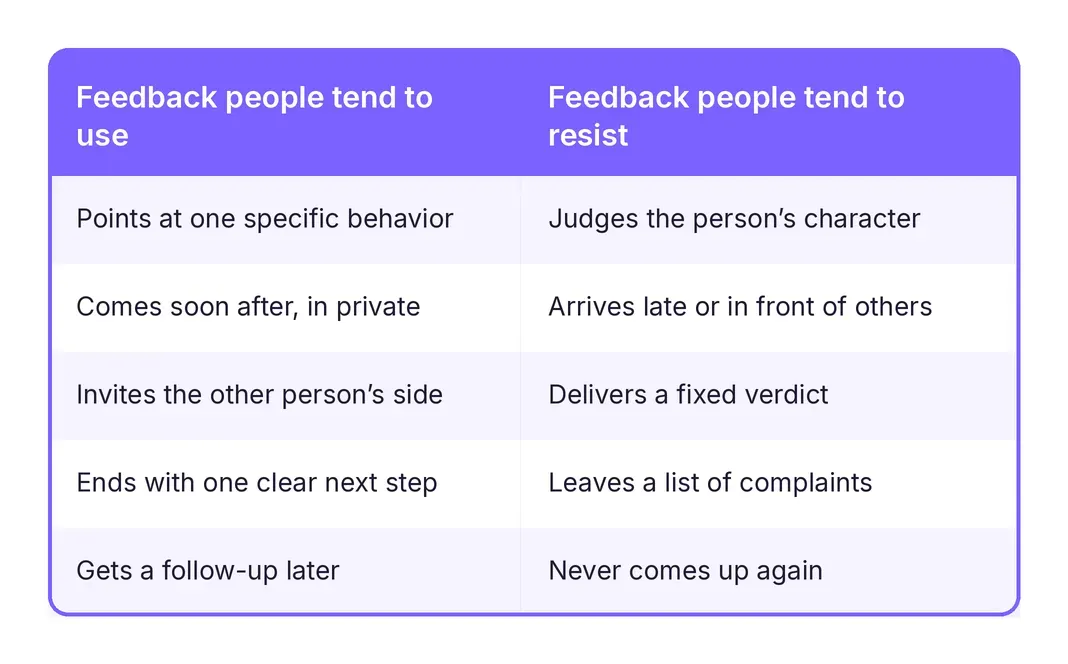
These moves roughly follow the order of a single feedback conversation, from picking the moment to following up afterward. You will not need all of them for a small note, but for anything that matters, working through them keeps the feedback clear and keeps the other person on your side. Most of knowing how to give feedback well comes down to these habits.
Timing changes how feedback lands. Giving it in front of others, when the person is stressed, or weeks after the fact all make it harder to hear. Aim for a private moment reasonably soon after what you noticed, while it is still fresh for both of you.
Then ask before you launch in. A short "can I share something I noticed about the meeting?" gives the person a second to get ready, and it turns the exchange into something they agreed to rather than something you dropped on them. If the answer is "not right now," you have learned that this is the wrong moment, which is useful on its own.
This step is what usually keeps feedback from feeling like a personal attack. Point at what the person actually did, in plain observable terms, and leave their character out of it. One clear way to do this is the SBI model, developed at CCL: you name the situation, the behavior you saw, and the impact it had.
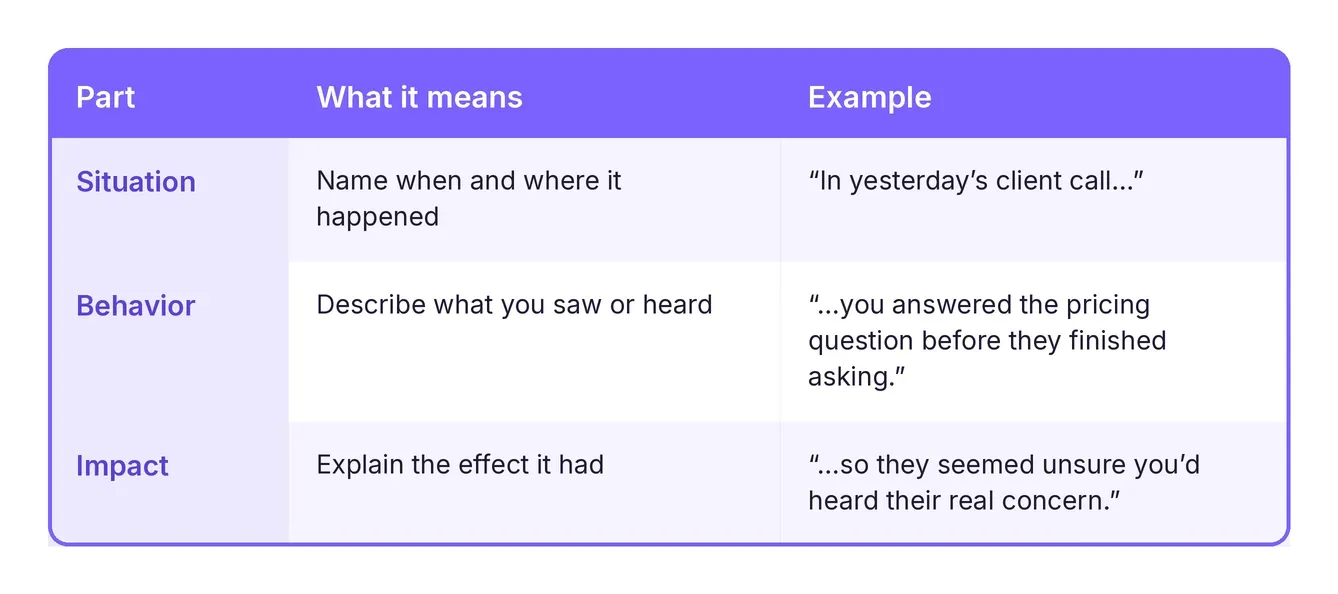
So instead of "you don't take deadlines seriously," you would say: "On the client report yesterday (situation), it came in a day after we agreed (behavior), and the team had to rush the review, so a couple of errors slipped through (impact)." The person may still be uncomfortable, but there is nothing there to argue with, because you described events rather than passed a verdict on their work ethic.
Specific feedback is easier to act on. The more clearly you name the exact moment and what you would want instead, the easier it is for the person to picture the change.
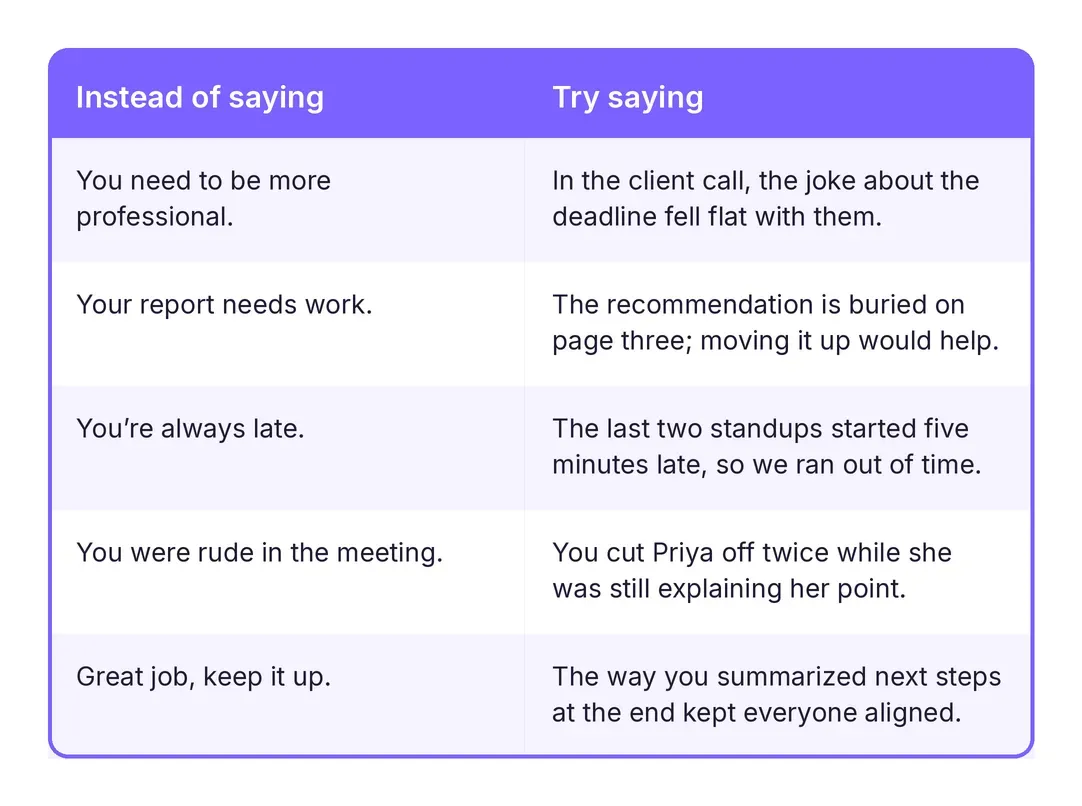
For instance, "your emails are hard to follow" becomes "when the ask is buried in the third paragraph, I sometimes miss it, so it helps when the request is in the first line." You have given them a picture of the behavior and a picture of the fix in one breath, which is more likely to change what they do than a general complaint. Being direct about what you need is a form of assertiveness, and if that is something you find hard, our post on how to stay assertive without coming across as pushy covers it in more depth.
Feedback based on half the story is easy to reject, because the person knows something you do not. Before you decide the behavior was a problem, leave room for their side. Something as simple as "that is how it looked to me, but I might be missing context" invites them to fill in what you could not see.
Sometimes their answer changes your read entirely, and the deadline you were about to raise turns out to have had a reason you did not know. Even when it does not change anything, the person is far more open to your point once they have been heard. Listening to their side is a real part of giving good feedback, and it is worth practicing on its own. If communication is the area you most want to strengthen, the Communication Mastery journey in RiseGuide breaks these habits into short lessons you can practice between real conversations.
Whether feedback leads to a change often comes down to whether the person leaves with a next step. Close the conversation by agreeing on one thing to try, in words concrete enough to act on. "Next time, send the draft by Thursday so we have a day to review" is usable. "Be more on top of deadlines" is not.
Focus on one next step. Handing someone a list of five things to fix spreads their attention so thin that nothing changes, so pick the one that matters most and let the rest wait.
A single piece of feedback usually starts a change rather than finishing it, so it helps to stay with it. When you notice the person doing the new thing, say so. A quick "the draft came in early, that made the review much smoother" tells them the effort was worth it and makes the next round of feedback easier to give.
Following up also keeps you honest: if nothing changed, a calm check-in is a chance to find out what got in the way, and often the thing that got in the way is something you can help with rather than a lack of effort. This matters as much at work as it does at home.
Good feedback comes down to a handful of habits: choose the moment, describe behavior instead of character, be specific, leave room for the other person's side, and end with one thing to try. None of this requires you to be harsh, and none of it requires you to water down what you mean. It works when you are clear about what you saw and specific about what the person can do next. The more you practice giving feedback this way, in small moments as well as big ones, the more natural it gets, and the more the people around you come to trust that your feedback is worth acting on. If you want to keep building the wider skill, our roundup of communication books is a good place to go next.
Strong constructive feedback examples name a specific behavior and its effect, then point to a change. For a colleague: "In today's standup, the update ran about ten minutes, and we lost time for the other items, so it would help to keep it to the top two blockers." For a friend: "When I was telling that story, you jumped in with the ending, and I felt a bit brushed off. I would love to finish next time." Both describe what happened rather than labeling the person, and both leave a clear next step.
A simple five-step version is: ask if the person is open to feedback, describe the situation and the behavior you saw, explain the impact it had, hear their side of it, and agree on one next step. Following up later is what turns those steps into a real change rather than a single conversation.
One common version is clear, caring, and constructive. Clear means the person knows exactly what you are referring to, caring means you deliver it in a way that shows you are on their side, and constructive means you leave them with something they can do rather than just a complaint. The labels matter less than the habits behind them.
Focus on the behavior rather than the person, keep it to one or two points, and frame it as your own observation ("here is how it looked to me") instead of a fixed judgment. Asking first and inviting their side also softens the exchange, because the person feels included in the conversation rather than judged by it.