RiseGuide Team
 FREE GUIDE with any plan: the First Impression FormulaClaim the offer

Figures of speech are words or phrases used in a non-literal way to make writing and speech clearer, stronger, or easier to remember. The main ones fall into four groups: comparison (simile, metaphor, personification, analogy), emphasis and contrast (hyperbole, understatement, litotes, oxymoron, paradox, antithesis, irony), sound (alliteration, assonance, consonance, onomatopoeia), and substitution or wordplay (metonymy, synecdoche, euphemism, idiom, pun). For example, a simile says someone is "as brave as a lion," a metaphor says "time is money," and hyperbole exaggerates with "I've told you a thousand times."
We use figures of speech constantly, often without noticing. When you say a meeting "dragged on forever" or that someone "lit up the room," you are already using them. They turn plain statements into something a listener can picture or feel, which is why they show up everywhere from poems and song lyrics to political speeches and everyday chat. Learning the main figures of speech, and seeing a clear example of each, makes it easier to spot them when you read and to use them on purpose when you write or speak. Below you will find figures of speech examples for every type on this list.
A simple figures of speech definition: a figure of speech is a word or phrase that departs from its literal meaning to create an effect. Instead of saying exactly what the words mean on the surface, you use them in an imaginative way, and the listener understands the real meaning from context. "You are the sunshine of my life" does not claim the person is a star millions of miles away; it says they bring warmth and happiness.
Figures of speech are one part of figurative language, the broader term for any language that works beyond the literal. People often ask how many figures of speech are there, and there is no single fixed number: reference books list anywhere from a handful to more than 200, because some figures are everyday tools and others are rare rhetorical terms. This guide covers 20 of the most useful types of figures of speech, grouped by what they do.
The first group links one thing to another so a reader sees what you mean. These are the figures most of us learn first in school, and they are the backbone of description in both writing and speech.
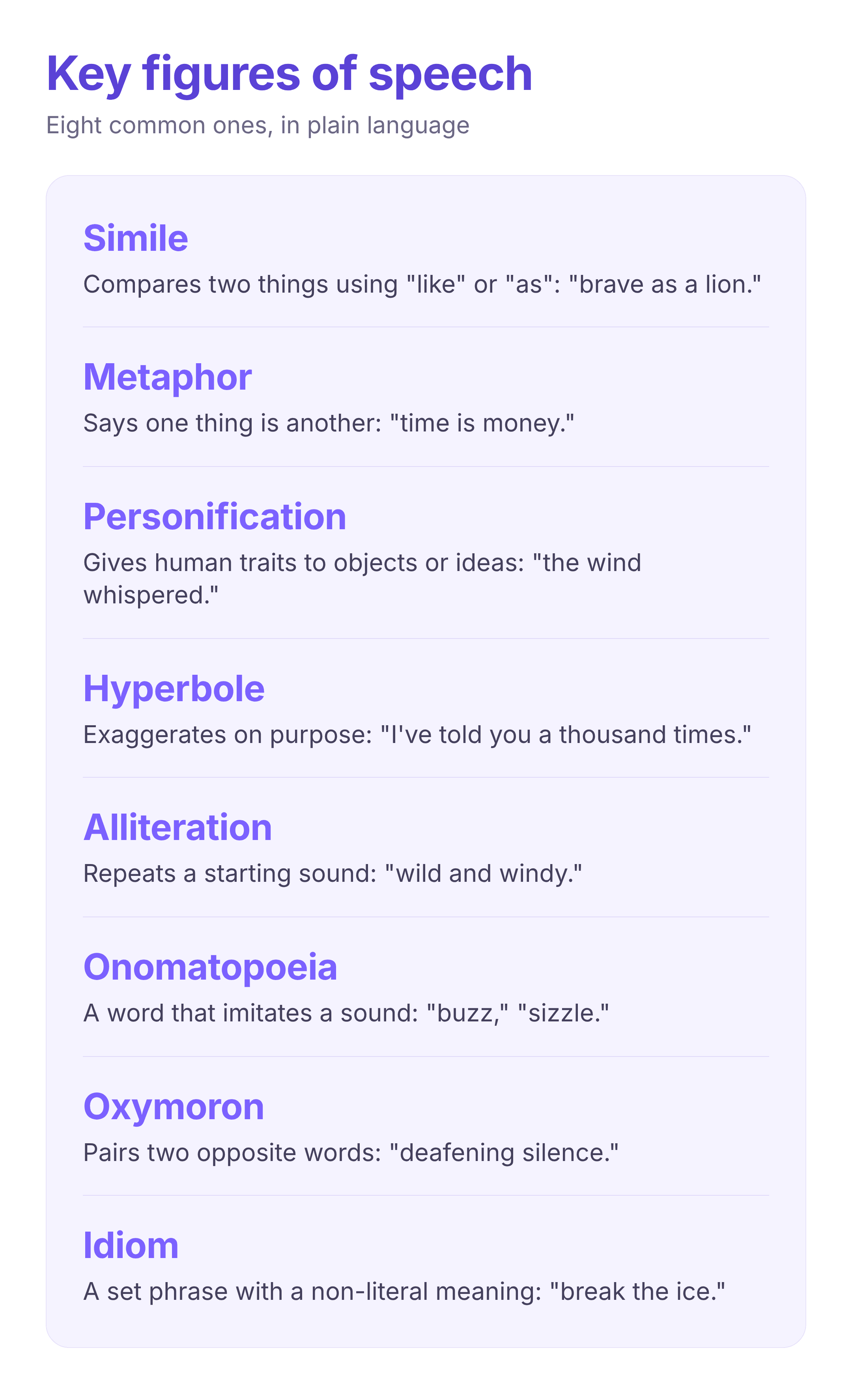
A simile compares two different things using "like" or "as." The comparison is open and direct, which makes a simile easy to spot. Examples: "She is as brave as a lion," "He ran like the wind," "The water was as smooth as glass."
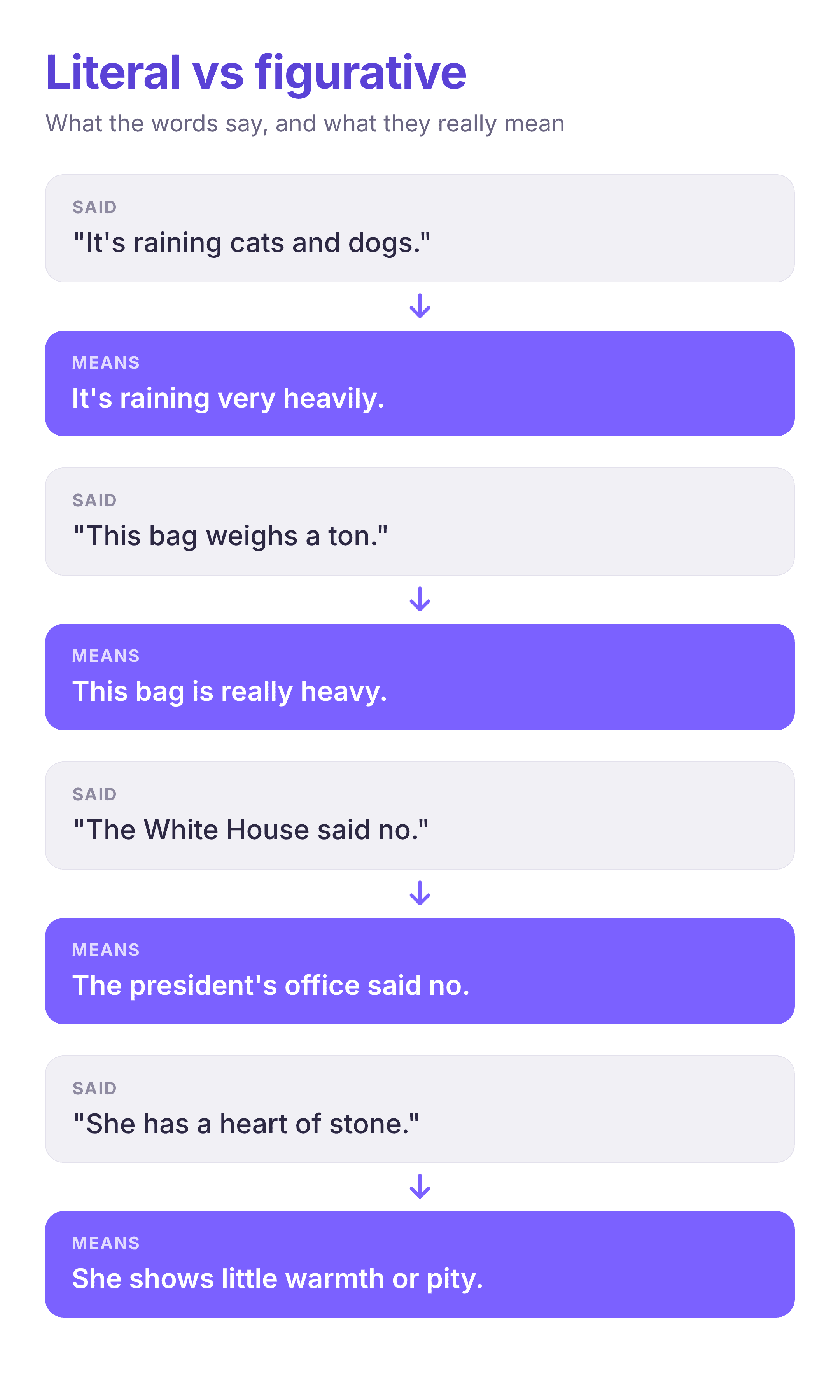
A metaphor also compares two things, but it says one thing is the other, with no "like" or "as." Examples: "Time is money," "The classroom was a zoo," "He has a heart of gold." A metaphor is often stronger than a simile because it states the comparison as a fact rather than a likeness.
Personification gives human qualities to something that is not human, such as an object, animal, or idea. Examples: "The wind whispered through the trees," "My alarm clock screams at me every morning," "Opportunity knocked." It is a quick way to make a scene feel alive.
An analogy explains something by comparing it to something more familiar, usually to make a point or teach an idea, and it often runs longer than a simile or metaphor. Example: "Learning to write is like learning to drive: the rules feel awkward at first, then they become automatic." Analogies are useful any time you want to make a hard idea click.
The next group changes the weight of what you say. Some exaggerate, some play things down, and some set opposite ideas against each other to make a point land.
Hyperbole is deliberate exaggeration that no one takes literally. Examples: "This bag weighs a ton," "I have told you a thousand times," "I am so hungry I could eat a horse." It signals strong feeling rather than fact.
Understatement makes something sound smaller or less serious than it really is, often for modesty or dry humor. Calling a deep cut "just a scratch," or describing a hurricane as "a bit of wind," are understatements.
Litotes is a specific kind of understatement that affirms something by denying its opposite. Examples: "She is not unkind" (meaning she is kind), "That is not a bad idea" (meaning it is quite good), "He is no fool." It is a softer, more modest way to make a positive point.
An oxymoron puts two words with opposite meanings right next to each other. Examples: "deafening silence," "bittersweet," "act naturally," "found missing." The clash is the point; it captures something that really is two things at once.
A paradox is a statement that seems to contradict itself but holds a real truth once you think about it. Examples: "Less is more," "The only constant is change," "You have to spend money to save money." Where an oxymoron is two words, a paradox is a whole idea.
Antithesis sets two opposite ideas against each other in a balanced sentence. Examples: "Give me liberty, or give me death," and Neil Armstrong's "That is one small step for man, one giant leap for mankind." The matching structure makes the contrast easy to feel and remember, which is why so many great public speakers reach for it.
Irony is a gap between what is said and what is meant, or between what you expect and what happens. Saying "Lovely weather" during a downpour is verbal irony. A fire station burning down is situational irony. Irony only works when both people share the context.
This group is less about meaning and more about music. These figures use repeated or imitative sounds to give a phrase rhythm, which is part of why they are so common as figures of speech in poetry, song lyrics, and brand names.
Alliteration repeats the same beginning consonant sound in nearby words. Examples: "Peter Piper picked a peck of pickled peppers," "wild and windy," "Coca-Cola." The repetition makes a phrase catchy and easy to say.
Assonance repeats vowel sounds inside nearby words. Example: "The rain in Spain falls mainly on the plain," where the long "ai" sound repeats. It creates a softer, internal rhyme.
Consonance repeats consonant sounds, usually in the middle or at the end of words rather than the start. Examples: "pitter-patter," "the lumpy, bumpy road," "first and last." It is the cousin of alliteration, just not anchored to the first letter.
Onomatopoeia is a word that imitates the sound it describes. Examples: "buzz," "hiss," "sizzle," "clang," "splash." Comics and children's books lean on it heavily because the word itself carries the sound.
The last group replaces one word with another related one, or plays with a word's double meaning. Several of these are everyday figures you already use without thinking of them as figures of speech.
Metonymy replaces the name of something with the name of something closely linked to it. Examples: "The White House said no" (the White House stands for the administration), "the crown" for the monarchy, "Hollywood" for the film industry.
Synecdoche is a close relative of metonymy where a part stands for the whole, or the whole for a part. Examples: "All hands on deck" (hands stand for sailors), "nice wheels" (wheels stand for the car), "give us this day our daily bread" (bread stands for food).
A euphemism swaps a blunt or uncomfortable word for a gentler one. Examples: "passed away" for died, "let go" for fired, "between jobs" for unemployed. Euphemisms soften news that might otherwise feel harsh.
An idiom is a fixed expression whose meaning cannot be worked out from the individual words. Examples: "break the ice," "under the weather," "cost an arm and a leg," "bite the bullet." Every language has hundreds of them, and they are a common source of confusion for new speakers.
A pun plays on a word that has two meanings, or on two words that sound alike, usually for humor. Examples: "I used to be a banker, but I lost interest," "A bicycle cannot stand on its own because it is two-tired." Puns are a staple of jokes, headlines, and anyone learning to be funny.
It is easy to think of figures of speech as a poetry-class topic, and poems really are full of them: similes, metaphor, personification, and sound devices like alliteration and assonance give verse much of its texture. But the same tools run through ordinary life. Advertising slogans use alliteration and puns, sports commentary runs on hyperbole and metonymy, and most of what we call slang is built from idioms and metaphor.
That overlap is good news if you want to use them better. You already have an ear for figures of speech from everyday talk, so the task is really about noticing what you already do and choosing it on purpose.
A figure of speech helps when it makes your meaning clearer or more memorable, and gets in the way when it is doing neither. A few simple habits keep them working for you.
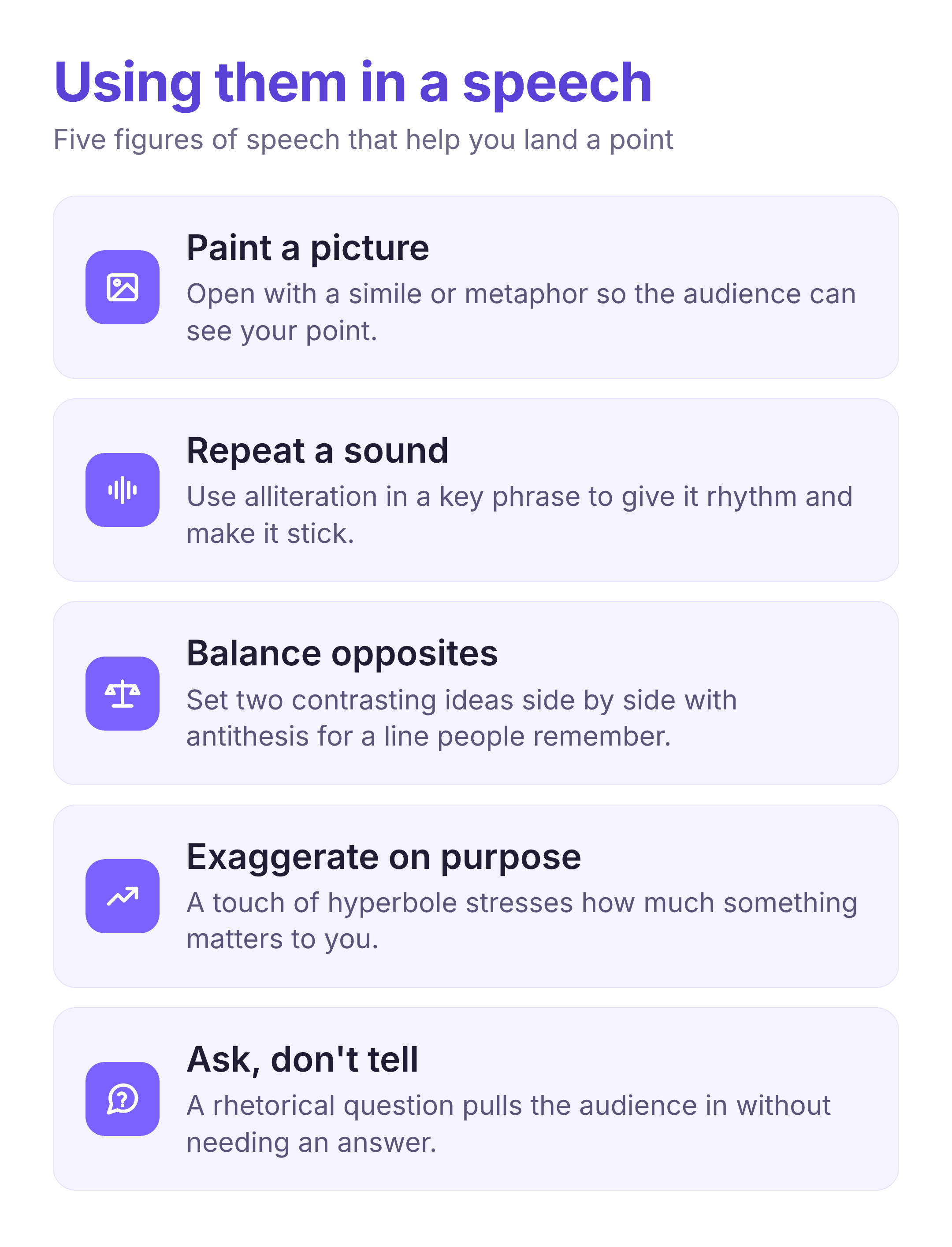
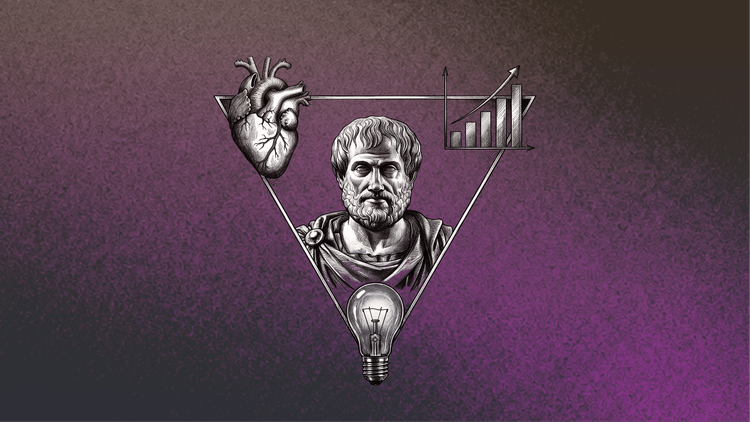
Figures of speech are some of the most useful tools for anyone who wants to write or speak with more color, whether you are drafting an elevator pitch, building a persuasive argument with ethos, pathos, logos, or just trying to tell a better story at dinner. Practicing public speaking gives you more chances to use them, and the more you notice them in others, the more naturally they will find their way into your own words.
You do not need all 20 of these at once. Most people already use similes, metaphors, idioms, and hyperbole every day, so the real gain comes from recognizing them and reaching for the right one on purpose. Keep this figures of speech list somewhere handy, notice them when you read or listen, and try one or two in your next email, post, or talk. They are simple to learn, and they make plain writing more interesting to read.
There is no fixed number. Everyday writing relies on a few dozen, while rhetoric textbooks catalog more than 200, including many rare terms. Most people only need the 20 common figures of speech in this guide to read and write with confidence.
Simile, metaphor, personification, hyperbole, idiom, and alliteration are among the most common figures of speech in English. You will find them in everyday conversation, advertising, song lyrics, and news headlines, not just in literature.
Literal language means exactly what it says: "the soup is hot." Figurative language uses words beyond their literal sense for effect: "the soup is molten lava." Figures of speech are the specific tools, like metaphor or hyperbole, that make language figurative.
Yes. An idiom is a figure of speech because its meaning is not literal: "spill the beans" has nothing to do with beans. The difference is that idioms are fixed, well-known phrases, while a metaphor or simile can be invented fresh each time.