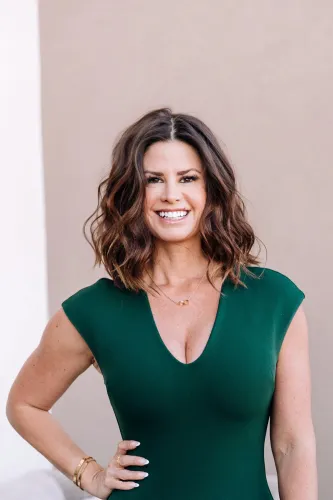
Katie Mares
Brand Experience Expert
I make decisions for a living. Speeches to give, businesses to build, teams to guide. You would think all that practice would make the hard calls easier, and sometimes it does. But the decisions that still make my stomach drop are not the professional ones. They are the personal ones, where it is not a spreadsheet on the line but my family, my health, my name, and the people I love most.
Those decisions live in a different part of us, and you cannot fully strategize your way through them, because they are less about logic than about who you are. So I want to share how I try to move through them, not as someone with a perfect formula, but as a woman who has had to make her share of hard calls and wants you to feel a little less alone in yours.
When the pressure is personal, our nervous system tends to do one of two things. It freezes, or it performs. Freezing looks like avoidance, endless research, and waiting for a sign that never quite comes. Performing looks like making a fast, loud decision so everyone believes you have it handled, whether or not the decision is right. Both are fear in disguise.
The response I keep coming back to is to get quiet enough to hear my own values. Before I weigh options, I ask myself what actually matters to me here. Not what will look good, and not what will please the loudest person in the room, but what I value and what honoring that value looks like in this exact situation. When you anchor a decision to your values, you stop chasing the answer that seems correct and start looking for the one that is true for you, and the true one is usually the one you can live with.
This is where my work and my life overlap. I spend my days talking about human connection and about how often we forget that the person in front of us wants to feel seen. When the stakes get personal, we tend to zoom in so tightly on the problem that we lose sight of the people wrapped up in it, ourselves included.
So I try to widen the lens. I ask who is affected, and I talk to them. I let them be part of it, not to hand off the decision, since it is still mine to make, but because the people involved usually carry information my anxious mind has skipped right over. A few things help me in the middle of it. The people around me are allies rather than obstacles. Asking for input is a strength, not an admission that I cannot cope. And the way I treat people during a hard decision matters as much as the decision itself, because the way you carry people through a difficult moment is often what they remember long after the outcome fades.
There is a particular voice that shows up when the stakes are high. It says you are going to get this wrong, that you are not qualified to decide something this big, and that you had better hand it to someone smarter or safer. I know that voice well, and most women I meet know it intimately.
I want to gently push back on it. You have made it through hard things before, and you have instincts built from real experience that are worth trusting. Deciding under pressure is less about silencing every doubt than about noticing the fear, thanking it for trying to protect you, and choosing to trust yourself anyway. That trust is a muscle, and every time you make a values-based call and stand behind it, the muscle gets stronger.
I have had to make peace with something that took me years to accept. There is often no perfect decision available. When it is your family, your health, or your name, the variables are too tangled and too tender for a clean, obvious winner. So I have changed the goal. Instead of a flawless decision, I aim for a human one, a decision I can look at in six months or ten years and say, "I made that from love and from my values, with the information I had." You can stand behind a decision like that even when the outcome surprises you, so give yourself that grace ahead of time.
Something I have learned from studying experience is that you can sometimes earn more loyalty through recovery than through the experience you originally designed. When a company gets something wrong and then makes it right with genuine care, customers often trust it more than if nothing had gone sideways at all. That truth carries over into life. If a personal decision does not unfold the way you hoped, you are not finished. How you recover, own it, adjust, and keep showing up for the people involved can build more trust and more closeness than getting it right the first time ever would have. So decide from your values, decide with your people close, and trust the woman who has already survived so much to survive this too.