RiseGuide Team

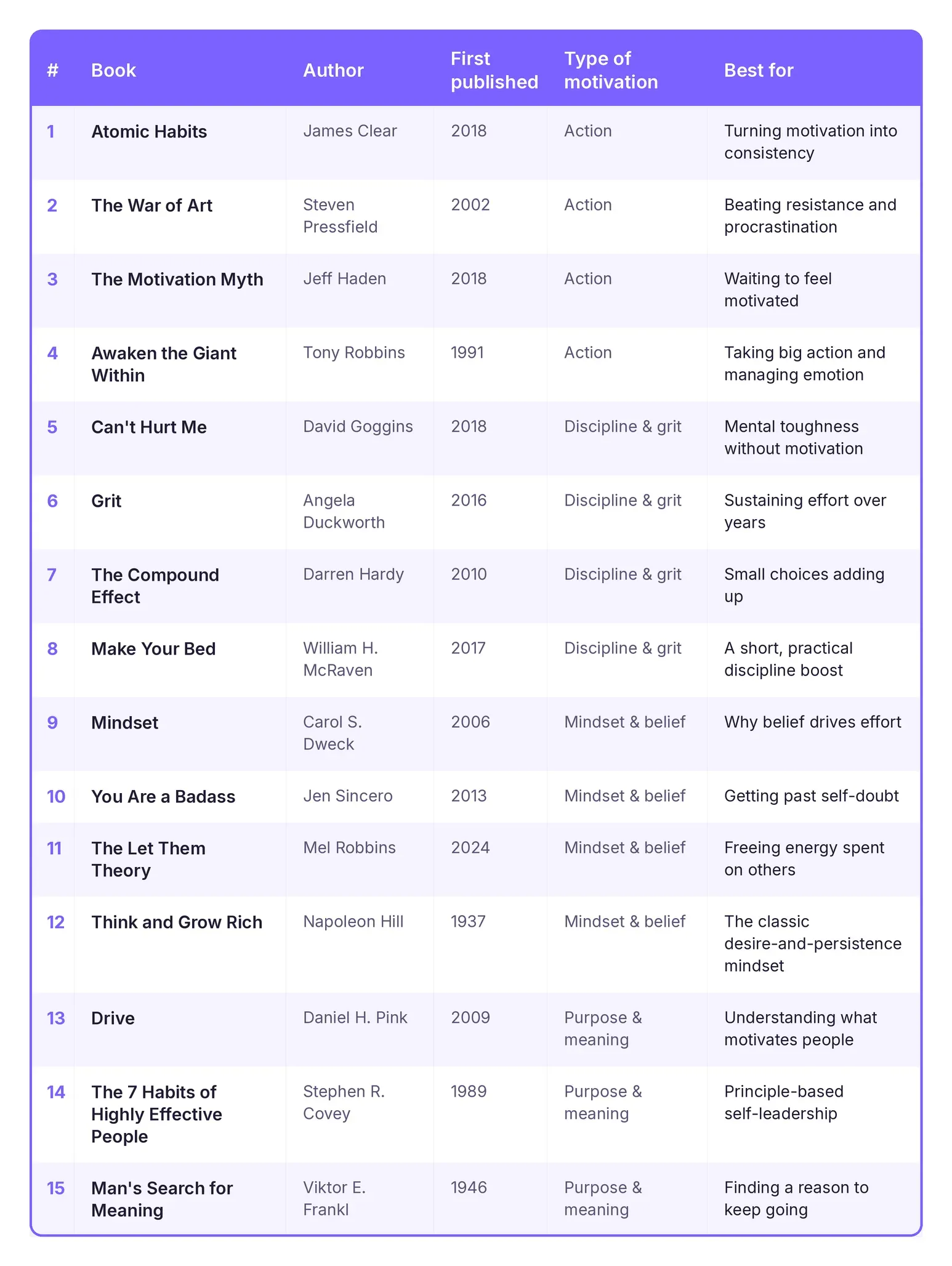
Fifteen motivation books, grouped by what you need help with:
If you want one place to start: read Atomic Habits if you know what you want to change and keep losing consistency, Can't Hurt Me if you need a push on the days you don't feel like it, and Man's Search for Meaning if what you're missing is a reason rather than a method.
People usually look for a motivation book when they're stuck on something: a project they've stopped working on, a goal that mattered a few months ago and doesn't now, or a task they keep putting off. The books on this list get grouped together in stores, but they deal with different problems. Some help you start when you don't feel like it. Some help you keep going after the first interest fades. Others deal with what you believe about yourself, or the reason you're doing the work at all.
First, work out what the problem really is. Is it starting, keeping going, believing you can do it, or knowing why you're doing it? These are different problems, and a book aimed at the wrong one won't help you much.
A few things are worth checking before you pick one. See whether the examples still feel relevant, because some of the older books use business stories from decades ago. Notice whether the advice is based on research or on the author's opinion. And think about length and tone, since a short, clear book you finish is more useful than a long one you give up on. You'll also find lists sorted into motivational books for men and motivational books for women, but it's more useful to choose by the type of motivation you need than by who the book was aimed at.
One more thing to keep in mind. Reading about motivation and building it are not the same, and only the second one changes anything. The ideas also fade quickly unless you use them, so getting them to stick is its own task, and our piece on how to learn anything faster covers habits that help a book stay with you after you finish it. This list is organized the same way as our best productivity books list: choose by the problem, not the ranking.
These four are for the gap between wanting to do something and doing it: procrastination, stalling, and waiting for a feeling that doesn't come.
Clear's main idea is that you can set motivation up instead of waiting to feel it. Rather than relying on willpower, you change your surroundings and how you see yourself, so the behavior takes less effort to do. Every small action, he says, is a vote for the kind of person you want to become, and change comes from repeating those small actions rather than from one big effort.
The practice most readers keep is habit stacking, where you attach a new habit to one you already do, along with the two-minute rule, which shrinks the start of a habit until it's easy to begin. We covered his systems-over-goals argument in more detail in our best productivity books roundup, where the book also appears.
"Every action you take is a vote for the type of person you wish to become." — James Clear, Atomic Habits
Best for: people who know what they want to change and keep losing consistency, and who want a method rather than encouragement.
Worth knowing: it says less about the emotional side of motivation. If your problem is that you've lost the reason to bother, this book assumes you already have one.
Pressfield gives one name to the thing that stops you: Resistance. It's what shows up as procrastination, self-doubt, and the sudden urge to do anything except the work in front of you. He argues that Resistance is strongest before the work that matters most, so the things you avoid the most are often the ones worth doing.
His answer is to stop waiting to feel ready and do the work on a regular schedule, whether or not you feel inspired. The book is short and written in brief sections you can read in one evening.
"The more important a call or action is to our soul's evolution, the more Resistance we will feel toward pursuing it." — Steven Pressfield, The War of Art
Best for: writers, artists, founders, and anyone whose work stalls at the start for reasons they can't explain.
Worth knowing: the last third moves into muses and spiritual ideas that not every reader will want. The first two-thirds are the most useful part.
Haden questions an assumption most of these books rely on. Motivation, he says, doesn't come first and cause action; it works the other way around. You do a small piece of the work, you finish it, and the satisfaction from that small win gives you the drive to do the next piece.
The takeaway is to stop waiting to feel motivated and build a process that includes an early, achievable win. Motivation comes from starting, not before it.
"Motivation is a result. Motivation is the pride you take in work you have already done—which fuels your willingness to do even more." — Jeff Haden, The Motivation Myth
Best for: people stuck waiting to feel motivated before they begin.
Worth knowing: it's mostly one strong idea with a lot of examples. Once you understand the main point, there's less to gain from reading on.
Robbins's book is about decisions and emotions as the tools for change. He argues that your life is shaped more by the decisions you make than by your circumstances, and that most people never decide with enough commitment for anything to change. He also covers how to manage your emotional state, since how you feel affects what you're willing to do.
It's the longest and most wide-ranging book on the list, covering beliefs, values, the questions you ask yourself, and the words you use in your head. You take from it what fits.
"It is in your moments of decision that your destiny is shaped." — Tony Robbins, Awaken the Giant Within
Best for: readers who want a big push and a wide set of tools, and don't mind a long book to get them.
Worth knowing: it's long, and the early-1990s references feel dated. Robbins's high-energy style works for some readers and not others.
When motivation isn't reliable, discipline is what's left. These four are about showing up on the days you don't want to, and about small actions repeated over time.
Goggins, a former Navy SEAL and ultramarathon runner, argues that motivation isn't reliable, so you shouldn't build anything on it. Instead you build on a mind you've trained through discomfort on purpose. His best-known idea is the 40% rule: when your mind says you're done, you've usually used about 40% of what you have.
The book mixes a difficult memoir with challenges at the end of each chapter, so it works as a workbook as much as a story. Its point about relying on discipline instead of motivation is what makes it useful here.
"Motivation is crap. Motivation comes and goes." — David Goggins, Can't Hurt Me
Best for: people who are tired of waiting to feel inspired and want a case for doing the hard thing anyway.
Worth knowing: the extreme endurance framing won't match everyone's goals. Take the mindset and adjust the intensity to your own life.
Duckworth, a psychologist, studied why some people keep working toward long-term goals while others with the same talent drift. Her answer is grit: passion and perseverance held steady over years. Her main point is that effort counts twice, because it builds skill and then turns that skill into results, so talent explains less than people assume.
She also looks at how interest and purpose grow over time, which matters because grit isn't about forcing yourself through something you don't care about.
"Enthusiasm is common. Endurance is rare." — Angela Duckworth, Grit
Best for: anyone working toward a goal that takes years, and parents or managers thinking about how perseverance develops.
Worth knowing: it relies heavily on studies, and some critics say the research has been pushed further than the evidence supports. Read it for the idea, not as the final word.
Hardy's point is that results come from small choices repeated over a long time, the same way small, regular savings add up. A big, dramatic change is hard to keep up, while a small, boring routine keeps working because it asks little of you on any given day.
The book is practical about tracking, since Hardy believes you can't change what you don't measure. It reads quickly and stays close to the one idea in its title.
"Your only path to success is through a continuum of mundane, unsexy, unexciting, and sometimes difficult daily disciplines compounded over time." — Darren Hardy, The Compound Effect
Best for: people waiting for a breakthrough who would do better with a simple routine kept up for months.
Worth knowing: it overlaps a lot with the habit books, and it has a promotional tone in places. If you've read Atomic Habits, some of it will feel familiar.
Based on a graduation speech that reached a wide audience, McRaven's short book argues that discipline starts with one small, finished task each morning. Make your bed, and you've started the day with something done and a bit of order to come back to at night. The ten lessons come from Navy SEAL training and apply to ordinary life.
It's the shortest book on the list and the easiest to give to someone who doesn't usually read this kind of book.
"If you want to change the world, start off by making your bed." — Admiral William H. McRaven, Make Your Bed
Best for: anyone who wants a quick, practical push toward daily discipline without a full theory of motivation.
Worth knowing: it's short and based on a speech, so it doesn't go deep. Read it for the push, not for a system.
Sometimes the problem isn't the plan but what you believe about yourself before you start. These four work on that.
Dweck's research separates a fixed mindset, where you see ability as set, from a growth mindset, where you see it as something you build through effort. This matters for motivation because it changes how you react to a setback. With a fixed mindset, difficulty feels like proof you've reached your limit; with a growth mindset, it's part of getting better, so you keep going.
The book follows the idea through school, sport, work, and relationships, and it's clear that a growth mindset means effort plus a good strategy, not just positive thinking.
"Becoming is better than being." — Carol S. Dweck, Mindset
Best for: people who give up as soon as they're not immediately good at something.
Worth knowing: it's academic and repetitive, and the idea has since been simplified into slogans that Dweck herself has pushed back on. The book is more careful than its reputation.
Sincero's book is the most casual on the list and focuses on the self-doubt that holds people back. She argues that a lot of what stops you is beliefs you picked up without noticing, and that the real work is spotting and changing them. The tone is light and funny on purpose, meant as a push rather than a study.
It's a good starting point for someone who doesn't get on with serious self-help, though it asks you to take a few of its claims on trust.
"If you're serious about changing your life, you'll find a way. If you're not, you'll find an excuse." — Jen Sincero, You Are a Badass
Best for: readers stuck in self-doubt who want energy and humor rather than frameworks and studies.
Worth knowing: the frequent swearing won't suit everyone, and parts lean on law-of-attraction ideas you can take or leave without losing the main message.
Robbins's recent book is about a specific waste of energy: trying to control what other people do and think. The tool is two words, "let them," followed by two more that do the real work, "let me." You let go of what other people do, and you put that freed-up attention on your own response and your own next step.
It's the newest book here, and its appeal is how little you have to remember. The whole method fits in four words.
"Saying 'let them' is just the first half of the equation. The second half, 'let me' — the source of your power is not in managing other people, it's in managing your response." — Mel Robbins, The Let Them Theory
Best for: people who lose drive through comparison, people-pleasing, and worrying about what others think.
Worth knowing: it's one idea stretched to a full book, and since it's recent, it's too early to say how well it lasts. You may find the main point in the first few chapters.
The oldest book on the list and one of the most influential, Hill's book argues that strong desire, a clear purpose, and persistence are what separate people who achieve from people who only wish. His idea of a "definite chief aim," one clear goal you keep in front of you, appears in nearly every motivation book written since.
Read it as the book that shaped the genre rather than as current advice. One caveat: Hill's own life story and several of his success claims are widely disputed, so treat the anecdotes with care and keep the lasting ideas about focus and persistence.
"Whatever the mind can conceive and believe, it can achieve." — Napoleon Hill, Think and Grow Rich
Best for: readers curious about where modern motivation writing came from who can filter out the dated parts.
Worth knowing: the language and examples are from the 1930s, and the questions about Hill's credibility are real. Useful as background, not as a manual.
When what's missing is a reason rather than a method, technique won't fix it. These three are about the reason behind the effort.
Pink gathers decades of research to argue that rewards and punishments are poor motivators for anything beyond simple tasks. What keeps effort going is three things: autonomy, the sense that you're directing your own work; mastery, getting better at something that matters to you; and purpose, the feeling that the work connects to something bigger than yourself.
It's the most research-based book here on what motivation is, which makes it a good starting point if you want to understand how it works before you try to change it.
"Control leads to compliance; autonomy leads to engagement." — Daniel H. Pink, Drive
Best for: managers, parents, and anyone trying to understand why rewards keep failing to produce lasting effort.
Worth knowing: it leans toward theory and workplace design, so it says less about daily practice. Some of the company examples have aged.
Covey argues that lasting motivation comes from character and principles rather than tricks, and that real change works from the inside out. The habits build on each other: being proactive, beginning with the end in mind, and putting first things first move you from reacting to your circumstances toward directing them. The habit most relevant to motivation is writing a personal mission statement, which gives you something to measure your daily choices against.
It's on our best productivity books list too, framed there around time and priorities. Here it fits as a book about self-leadership and the reasons behind your work.
"I am not a product of my circumstances. I am a product of my decisions." — Stephen R. Covey, The 7 Habits of Highly Effective People
Best for: readers who want a foundation of principles rather than tactics, and are willing to work through a dense framework.
Worth knowing: it's long, abstract, and heavy on its own terms, and the corporate examples are clearly from the late 1980s.
Frankl, a psychiatrist who survived the Nazi concentration camps, wrote the most serious book on this list. He noticed that the people who endured the worst conditions were often those who held onto a reason to live: a task left undone, or a person waiting for them. From this he developed logotherapy, the idea that the search for meaning, not pleasure or power, is the deepest human drive.
For a reader whose motivation has run out, Frankl's point is the one the other books assume: technique is useless without a reason, and even in the worst conditions, you still choose how you respond.
"When we are no longer able to change a situation, we are challenged to change ourselves." — Viktor E. Frankl, Man's Search for Meaning
Best for: anyone whose real problem is a lost sense of why, not a missing method.
Worth knowing: the first half is a hard account of the camps, and the second half is denser psychological theory. It asks more of the reader than the others do.
The best motivation book is the one aimed at the part that isn't working, so start by naming that instead of starting at the top of the list.
If the problem is starting, read The Motivation Myth to see why waiting to feel motivated keeps failing, or Atomic Habits if you'd rather have a method than a change in mindset. If you have plenty of ideas and no follow-through, The War of Art names what's stopping you.
If the problem is keeping going after the first interest fades, Can't Hurt Me and Make Your Bed make the case for discipline over feeling, and Grit and The Compound Effect explain why steady effort beats short bursts. If the problem is what you believe before you start, Mindset is the research-based version and You Are a Badass is the light one. And if what's missing is a reason rather than a method, Drive explains how motivation works and Man's Search for Meaning goes deeper into the question of why.
Whichever you pick, read one at a time and take one practice from it into your week. People who read four of these in a row often end up with new words for motivation but no change in what they do, because the reading was never the hard part. If you also want to work on how you communicate, our best books for communication skills list uses the same approach of choosing by problem.
There isn't one answer, because the books cover different problems. If you can't get started, read The Motivation Myth or Atomic Habits. If you can't keep going, Can't Hurt Me or Grit. If you've lost the reason behind the effort, Man's Search for Meaning. For a first motivation book that's quick and easy to use, Atomic Habits is the safest choice.
The ones readers most often call life-changing are Man's Search for Meaning, for its point that meaning is what carries people through hard times, and Atomic Habits, for making change feel manageable. Mindset changes how many people read their own setbacks. Which one helps most depends on what you needed to hear.
They work when you take one idea and use it, and they don't when you read them only for the feeling of progress. The most useful point in this whole category may be Jeff Haden's: motivation follows action rather than coming before it, which means the book matters less than what you do the morning after you finish it.
Popular lists of motivational books for men often include Can't Hurt Me and Think and Grow Rich, while lists of motivational books for women often include You Are a Badass and Mindset. All four work for anyone. It's more useful to choose by the type of motivation you need than by the audience a book was marketed to.
Among the best motivational books of all time, the ones that have lasted longest are Think and Grow Rich (1937), Man's Search for Meaning (1946), and The 7 Habits of Highly Effective People (1989). Of the newer books, Atomic Habits and Drive are the most likely to still be recommended ten years from now.