John Lentini
Leadership Coach
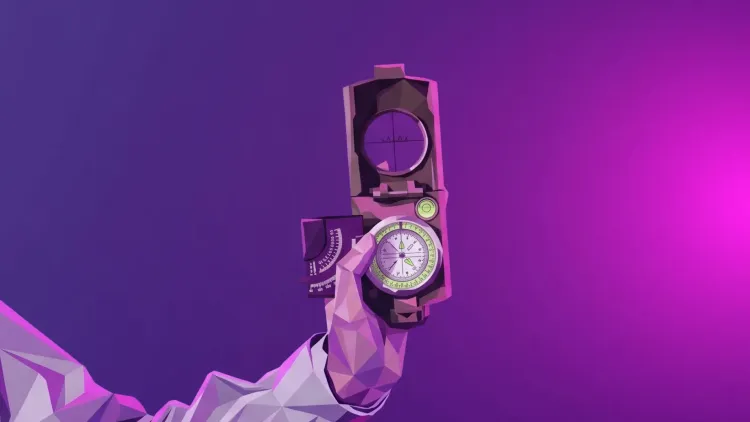
I'm John J. Lentini, The Leadership Engineer and creator of the Six Dials leadership framework. People hear "moral compass" and think of it as a private matter, something between you and your conscience. I want to reframe that. Your moral compass is not decoration. It is a working instrument you lead with, and like any instrument, it has to be calibrated before you need it.
Let's explore where it sits in the Six Dial system.
The framework I built runs on two sides that meet at the top.
Discipline plus Mindset plus Resilience equals Determination.
Integrity plus Empathy plus Influence equals Trust.
Determination plus Trust equals Character.
Integrity anchors the Trust side. And there is a reason Trust rests on it. People cannot trust what they cannot predict. Trust is not a feeling your team decides to grant you. It is a forecast. They are quietly guessing what you will do next, and Integrity is what makes their guess reliable. When your actions track your stated values day after day, you become predictable in the best sense of the word. That predictability is the raw material of Trust.
I learned what leadership means through real crisis, on September 11th at 2 World Trade Center and in Asia during the Fukushima disaster. In those moments, I experienced what both good and bad leadership looked like. The experience I carried with me from 9/11 informed my perspective on 3/11, as the Fukushima disaster is known in Japan. Sadly, this informed perspective was not shared by all of those with greater authority, and lesser related experience. Empathy was missing above me for people facing outsized trauma on the ground in Japan, and the Influence to push back from below was missing within me. I let my compass falter. Lesson learned.
Character gets tested in rough water, but it gets built somewhere else entirely: in the small, unwatched choices you make while the water is still calm.
Your moral compass gets calibrated in the moments no one is grading. The expense you could round up. The credit you could quietly take. The corner you could cut because the client would never know. Each of those is a calibration point. Turn the dial the right way when it costs you almost nothing, and the needle will hold when the pressure arrives and the cost is real.
So run the diagnostic on yourself before life runs it for you:
Where do your actions and your stated values already match?
Where do they quietly diverge?
Which small, private choices are you making that you would not want narrated out loud?
Find the gaps. Those gaps are where your Integrity dial is set too low. Focus there, and dial it up. This is self-diagnosis and an intentional feedback loop, the same way an engineer tunes a system before load-testing it.
Integrity does not just build Trust on its own. It makes the two dials beside it safe to use.
Look at what happens without it.
Influence without Integrity is manipulation. The same skill that moves people toward a shared goal will move them toward your private one, and they will not know the difference until it is too late.
Empathy without Integrity is telling people what they want to hear. You read the room, you feel what they feel, and then you use it to be liked instead of to be honest.
Integrity is the anchor that keeps those two powerful dials pointed at something legitimate. This is why the moral compass drives the actual engineering of leadership. It's not a soft skill at all. It is the hard foundation of Trust, in the same way that Discipline is the foundation of Determination. Weaken either, and the rest of the system doesn't just stop working. It turns against the people you were supposed to serve, including yourself.
There is a practical payoff here that has nothing to do with virtue for its own sake. A clear moral center makes your decisions faster and cleaner.
When you already know what you will and will not do, half the deliberation disappears. You are not relitigating your values in the middle of a hard call. You are not weighing whether this is the time to bend. The bending question was settled in the calm, so the crisis only asks you what, not whether. In the corporate world, in a genuine emergency, that speed is the difference between a decision made on principle and a decision made in panic.
An uncalibrated compass makes you slow, because every hard moment becomes a fresh negotiation with yourself. A calibrated one makes you decisive, because the negotiation is already over. As Roy E. Disney once put it, "When your values are clear to you, making decisions becomes easier."
Nobody handed me this framework. I extracted it from the worst days my teams and I ever faced, and the pattern was always the same. The leaders who held up had already decided who they were.
So do not wait for the test to find out where your needle points. Pull up your Six Dials control panel and look hard at the Trust side.
Read your Integrity dial honestly against the small choices, not the big speeches.
Check whether your Influence and Empathy are anchored to it or floating free.
Find one gap between your values and your actions this week, and close it.
Character is built with intent, the way an engineer builds a system, one calibrated dial at a time.
Engineer Character before life tests you.