RiseGuide Team

The transactional model of communication, developed by Dean Barnlund in 1970, describes conversation as a process where both people send and receive at the same time and build meaning together, instead of one person passing a finished message to another. It's made up of communicators (rather than fixed senders and receivers), simultaneous encoding and decoding, messages and cues, channels, noise, and feedback — all operating inside five contexts: physical, psychological, social, relational, and cultural. It improves on the older linear and interactive models, which treat communication as one-way or strictly turn-taking. In practice it means you're always communicating, saying something clearly isn't the same as being understood, and reading feedback and adjusting in the moment matters as much as your choice of words.
Most of us picture communication as a relay: I have a thought, I put it into words, I hand it over, and you receive it. That picture isn't wrong so much as incomplete, and the gap between it and reality is where a lot of everyday misunderstandings live. The transactional model is the attempt to describe what's really happening when two people talk — the glances, the pauses, the history between them, the noise in the room — all at once. Below is where the model came from, the parts it's made of, worked examples you can follow, and what actually changes once you take the idea seriously.
In this model, there are no fixed "senders" and "receivers." Everyone in a conversation is doing both jobs continuously. As the University of Minnesota's open communication textbook puts it, "the transaction model suggests that we are simultaneously senders and receivers." While you're talking, you're reading my face; while I'm listening, I'm nodding, frowning, or glancing at my phone, and you're adjusting to that in real time.
The second idea is more radical. In earlier models, communication carries meaning that already exists. In the transactional view, the conversation itself is where meaning gets made. The same textbook states it plainly: "we don't communicate about our realities; communication helps to construct our realities." A first "how are you?" between strangers and the thousandth between partners use identical words and mean completely different things, because the relationship and the history are part of the message.
The model is credited to communication scholar Dean Barnlund, who laid it out in a 1970 essay, "A Transactional Model of Communication," published in Sereno and Mortensen's Foundations of Communication Theory. Barnlund's contribution was insisting that communication is dynamic, continuous, circular, irreversible, complex, and unrepeatable - that you can never take a message back, and never have the exact same exchange twice.
It helps to see where it sits in a longer line of thinking. Claude Shannon's 1948 paper framed the "fundamental problem of communication" as reproducing a message from one point at another - a one-directional, engineering view. That transmission thinking ran through Shannon and Weaver's 1949 book and Harold Lasswell's work the year before. Wilbur Schramm added the loop of feedback in 1954, and David Berlo's 1960 model broke the parts down further. Barnlund's 1970 model was the step that made communication fully simultaneous and mutual. (A common mix-up: the model is sometimes wrongly traced to a 1977 paper by Baskin and Bruno - but that one is about transactional analysis, a separate idea we'll come back to.)
Communication models tend to be taught as a set, because each one fixes a limitation in the one before it. Seeing them side by side is the fastest way to understand what the transactional view adds.
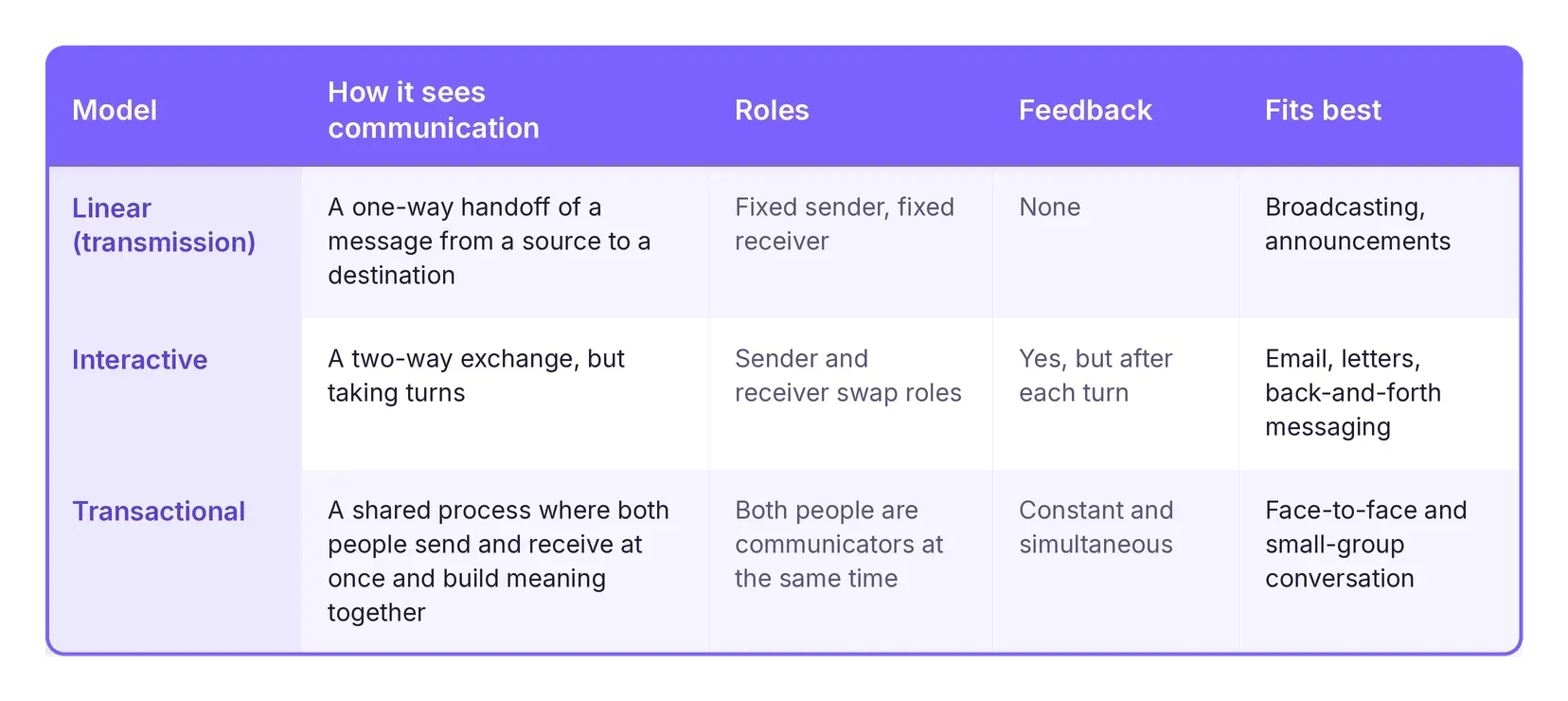
The jump from the interactive to the transactional model is the important one. The interactive model still has you waiting your turn. The transactional model says there is no turn-taking in a live conversation - your listener is responding the entire time you speak, and you're changing course based on what you see.
People often search for "the 5 parts" of the model, but there's no single official list, and different textbooks count the elements differently. What matters more is understanding the pieces and how they operate together. Here are the components the model is usually described through.
There's no "sender" and "receiver" here, only communicators - people doing both roles at once. The word choice is deliberate. Calling someone the "receiver" suggests they wait passively for a message. In a real conversation, the person listening is shaping the exchange through everything they do while you talk.
Encoding is turning a thought into words and signals; decoding is interpreting them. In older models these are separate steps that happen in sequence. Barnlund's point was that they are two simultaneous and interdependent aspects of the same process. You are packaging your own message and reading theirs in the same moment.
A message is more than the words. Barnlund distinguished three kinds of cues: public cues from the environment, private cues from your own senses and thoughts, and behavioral cues - the things you do and say, both on purpose and without meaning to. Tone, posture, and expression carry a large share of any face-to-face exchange, which is why they get a full treatment in our post on verbal versus nonverbal communication.
The channel is the route the message travels - the air between you in person, a phone line, a video feed, a text thread. The transactional model was built for rich, in-person channels where all the cues are available at once, which becomes important when we look at what happens on a laggy video call.
Noise is anything that interferes. It can be physical (a loud café), physiological (you're tired or unwell), psychological (you walked in already annoyed), or semantic (a word means something different to each of you). In the transactional model, noise isn't a rare glitch; some amount is present in every exchange.
Feedback is the response flowing back, and in this model it never stops. A slight frown, a pause before answering, a change in posture - you're getting this information continuously and adjusting to it, often without noticing.
Every exchange sits inside overlapping contexts that shape what things mean. The University of Minnesota text defines five: physical ("the environmental factors in a communication encounter"), psychological ("the mental and emotional factors"), social ("the stated rules or unstated norms that guide communication"), relational ("the previous interpersonal history and type of relationship we have with a person"), and cultural (aspects of identity such as nationality, ethnicity, gender, and class). The same words land differently depending on which contexts are in play.
The model is easier to hold onto when you trace it through real situations. In each of these transactional model of communication examples, notice how both people are communicating at once, how a context shapes the meaning, and how feedback keeps redirecting the exchange.
Your friend says "I'm fine, really." The words say one thing; their flat tone and the way they're turning the cup say another. You register both at once and soften your next question - and they register your softening and let their guard down a little. Neither of you took a turn. The relational context (years of friendship) tells you the words aren't the whole message, and your feedback and theirs are shaping the conversation moment to moment.
Six people are in a room and one says nothing the entire time. In a transmission view, that person isn't communicating - no message was sent. The transactional model says the opposite: their silence, folded arms, and fixed stare are behavioral cues everyone in the room is decoding. The meeting's meaning is being built partly by the person who never speaks. This is the clearest case of a truth the model insists on, which is that you're communicating whether you intend to or not.
You raise something that's been bothering you. Because of the relational and psychological contexts, your partner may hear criticism in a neutral sentence, and you may read defensiveness into a normal pause. Both of you are encoding and decoding at speed, and small pieces of feedback - a sigh, a softened voice - can tip the exchange toward repair or escalation. Many of the breakdowns here come down to assuming a clearly worded point was clearly received, one of the traps covered in our post on common communication mistakes.
This example is useful because it shows the model straining. On a laggy call, the channel starts dropping cues - you miss the micro-expressions, the audio clips the end of sentences, and the usual simultaneous feedback arrives half a second late. People start talking over each other and apologizing, not because they're bad communicators but because the conditions the transactional model assumes have partly broken down. It's a live demonstration of how much of an ordinary conversation runs on cues we never consciously notice.
The transactional model's strength is realism. It captures the mutual, in-the-moment nature of talking better than any model before it, it treats context and relationship as part of the message rather than background, and it makes room for the fact that meaning is negotiated rather than delivered.
Its limits are real too. As Barnlund's own summary notes, the model is effective for face-to-face and small-group communication but not for reading and writing or for mass communication - a novel or a billboard doesn't offer simultaneous feedback. And because it describes so much at once, it's harder to diagram cleanly; critics point out that it "fails to explain how meaning is created," only that it is.
The model isn't only for exams. If it's accurate, a few things follow for anyone who wants to communicate better.
The first is that you're always communicating. The psychotherapist Paul Watzlawick and his colleagues put this as an axiom back in 1967, and it fits the transactional model exactly:
"One cannot not communicate." - Paul Watzlawick, Janet Beavin, and Don Jackson, Pragmatics of Human Communication (1967)
Your silence in the meeting, your expression while someone else talks, the speed of your reply to a text - all of it is being read.
The second is that "I said it clearly" was never enough. In this model, a message isn't complete when it leaves you; it's complete when it's interpreted, and interpretation happens inside the other person's contexts, not yours. That reframes clarity as something you check for in their feedback, not something you declare about your own delivery.
The third is that the relationship is inside the message, so the same words genuinely mean different things to different people, and it's not a failure to account for that. Reading feedback and adjusting while you speak is a large part of what separates strong communicators from clear ones - a theme Ian Hawkins, a speaking and storytelling coach and one of our experts, gets at in three things every great communicator gets right.
No, and the two get confused constantly because the names are so close. Transactional analysis is a theory of personality and psychotherapy developed by psychiatrist Eric Berne in the late 1950s, built around "ego states" - the Parent, Adult, and Child modes people shift between in an exchange. It's a clinical framework for understanding the psychology of an interaction. The transactional model of communication is a general description of how any communication works. It's also separate from transactional leadership, a management style based on rewards and corrections. Same adjective, three unrelated ideas.
The transactional communication model is worth knowing because it corrects a picture most of us carry without realizing it. Communication isn't a package you hand over and hope arrives intact. It's a shared, continuous process where two people send and receive at once, build meaning together, and adjust to a stream of feedback the whole time. Once you can see the cues, the contexts, and the noise in your own conversations, you can start doing something about them.
There's no single official list of five, and textbooks vary. The model is usually described through its communicators, simultaneous encoding and decoding, messages and cues, channels, noise, and feedback — all operating inside five contexts (physical, psychological, social, relational, and cultural). If you need a short answer, the core elements are the communicators, the message, the channel, the noise, and the feedback.
Two friends talking over coffee is a clear one. Both are talking and reading each other at the same time — words, tone, and expression together — and each keeps adjusting based on the other's reaction, rather than waiting politely for a turn. A team meeting where one person sits in silence is another: their body language is a message everyone reads, even though they never speak.
The models most often taught are the linear (or transmission) model, the interactive model, and the transactional model, with Aristotle's early rhetorical model sometimes counted as the fourth. Each one addresses a limitation of the one before it, ending with the transactional model's fully simultaneous, two-way view.
Communication scholar Dean Barnlund, in a 1970 essay titled "A Transactional Model of Communication." It built on earlier work by Shannon, Schramm, and Berlo, but Barnlund was the one who made communication simultaneous and mutual rather than a turn-by-turn exchange.
The interactive model is two-way but takes turns: you send, I respond, you send again, with feedback arriving between turns. The transactional model removes the turns — both people send and receive at the same time, feedback is constant, and meaning is built together rather than passed back and forth.