RiseGuide Team

Imposter syndrome is the ongoing feeling that you're a fraud who has fooled everyone, even when there's clear evidence you're capable. It's very common, it isn't a diagnosis, and it tends to show up most when you're doing something new or hard. To overcome imposter syndrome, name the feeling and say it out loud to someone you trust, separate your feelings from the facts by keeping a record of your real wins and feedback, stop measuring yourself against a standard of perfection, accept help without seeing it as weakness, and expect a bit of self-doubt whenever you grow into a bigger role.
Almost everyone who has started a new job, given a talk, or been promoted knows the worry that they don't really belong there, and that sooner or later someone will notice. It's common enough that people with long track records and plenty of evidence behind them still feel like they've somehow fooled everyone around them. That experience is called imposter syndrome, and understanding what it is and why it happens takes some of its power away.
Imposter syndrome is the persistent belief that your success is undeserved and that you're not as capable as others think, so you live with a low-level fear of being exposed as a fraud. The tricky part is that it usually shows up in people who are doing well; the outside evidence says one thing, and the inside voice refuses to believe it.
The idea was first described in 1978 by psychologists Pauline Rose Clance and Suzanne Imes, who noticed a pattern of self-doubt among high-achieving women and named it the impostor phenomenon. It was never meant to be a medical diagnosis, and it isn't one today. It's a common experience rather than a disorder. Just how common is hard to pin down: one review of 62 studies covering more than 14,000 people found the rate ranged anywhere from 9% to 82%, depending on how it was measured and who was asked.
The signs of imposter syndrome are easy to miss because they often look like modesty or a strong work ethic from the outside. You might recognize a few of these:
Feeling one or two of these now and then is normal. Imposter syndrome is when the pattern sticks around and starts shaping the choices you make.
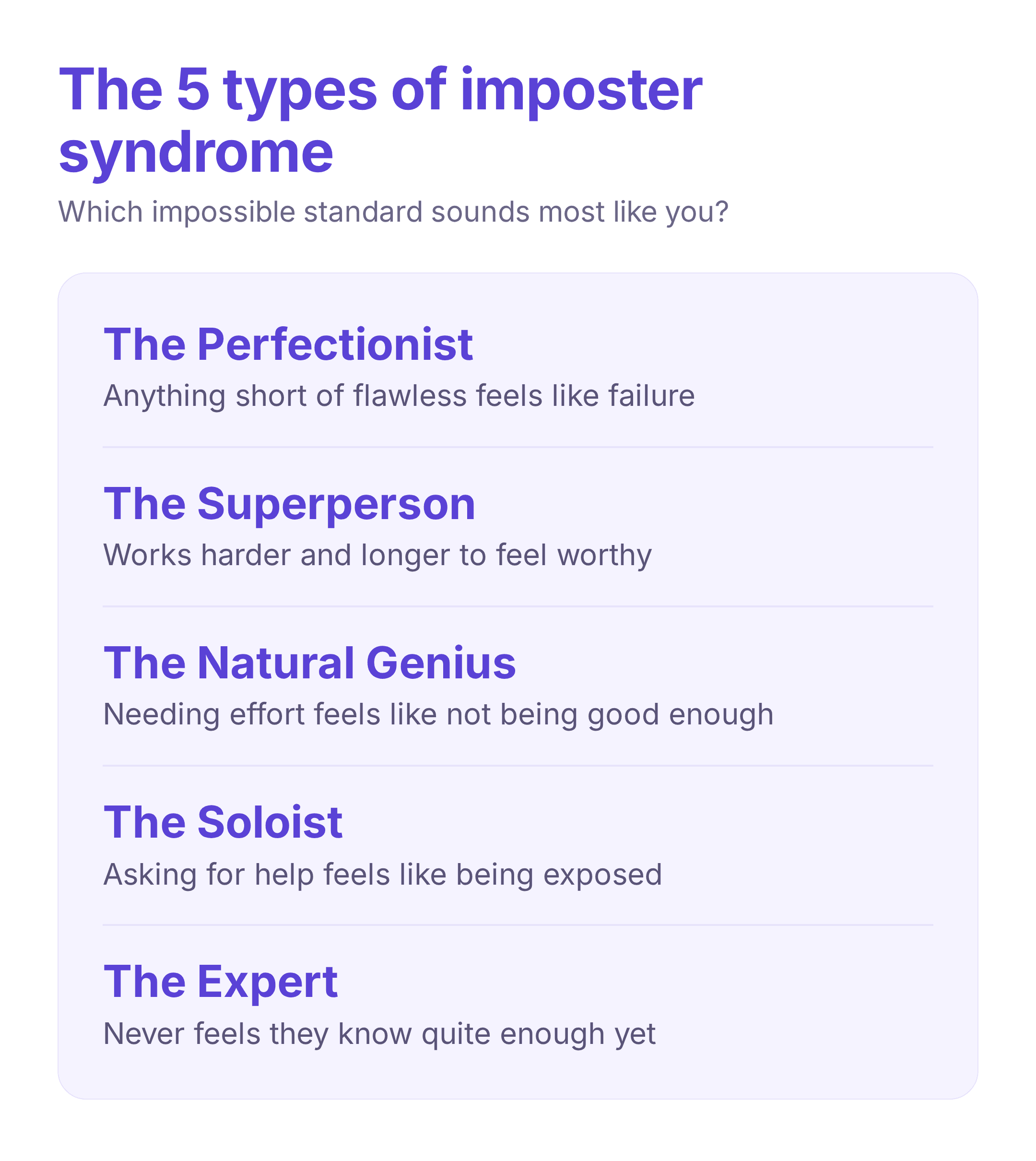
Not everyone experiences it the same way. Expert Valerie Young, who has spent years studying this, sorts it into five types. Seeing which one sounds like you makes it easier to catch. Here are common imposter syndrome examples, one per type:
Imposter syndrome usually isn't about a lack of skill. It tends to flare in specific situations: starting a new job or role, being promoted, or taking on something you've never done before, when you have less proof to reassure yourself. It's also more likely when you're the "first" or "only" of your background in the room, since there's no one who looks like you to normalize the experience. High-pressure, competitive environments feed it, and so do personal habits like perfectionism and constantly comparing yourself to people who seem to have it all figured out. Underneath a lot of it is a harsh inner voice, and Juliann Wiese, a Master Certified Coach and one of our experts, has a useful piece on working with that inner critic instead of taking it at its word.
You can't always argue yourself out of the feeling, but you can stop it from running the show. These approaches work whether the doubt is loud or quiet.
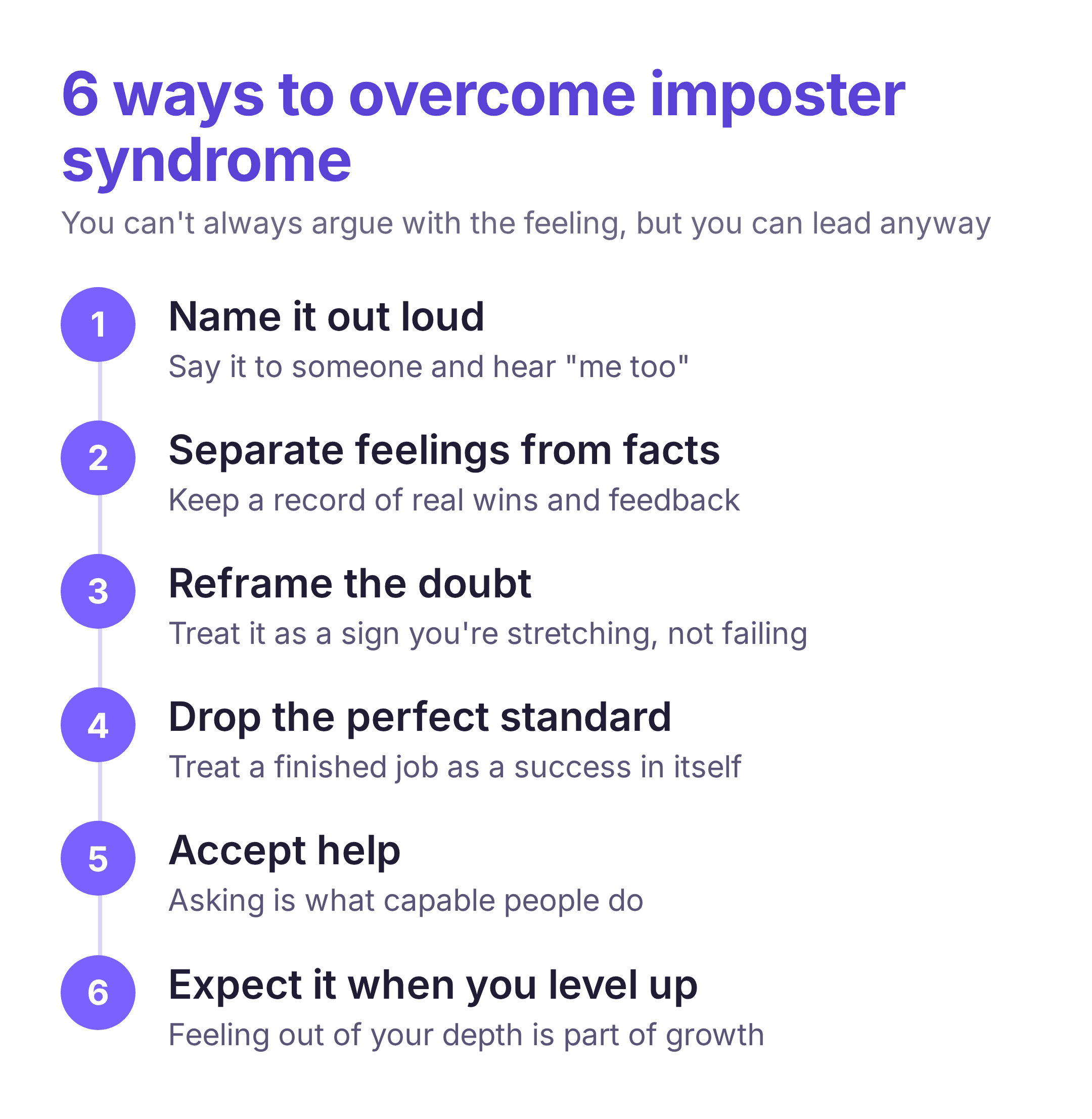
Imposter feelings shrink when you put words to them. Tell a friend, a mentor, or a colleague that you've been feeling like a fraud, and you'll almost always hear "me too." Realizing how common it is takes away a lot of its power, because the whole feeling runs on the belief that you're uniquely unqualified.
The feeling insists you're not good enough; the facts often disagree. Keep a running record of your wins, the positive feedback you get, and problems you've solved, and read it back when the doubt spikes. It's harder to believe you've fooled everyone when you're looking at a list of things you've done.
A bit of self-doubt can mean you care and you're stretching into something new. Mike Cannon-Brookes, the co-founder of the software company Atlassian, gave a widely watched talk about learning to treat that feeling as fuel rather than a stop sign. As he described it, "It's more a sensation of getting away with something, a fear of being discovered, that at any time, someone is going to figure this out." Naming it that plainly is part of how you loosen its grip.
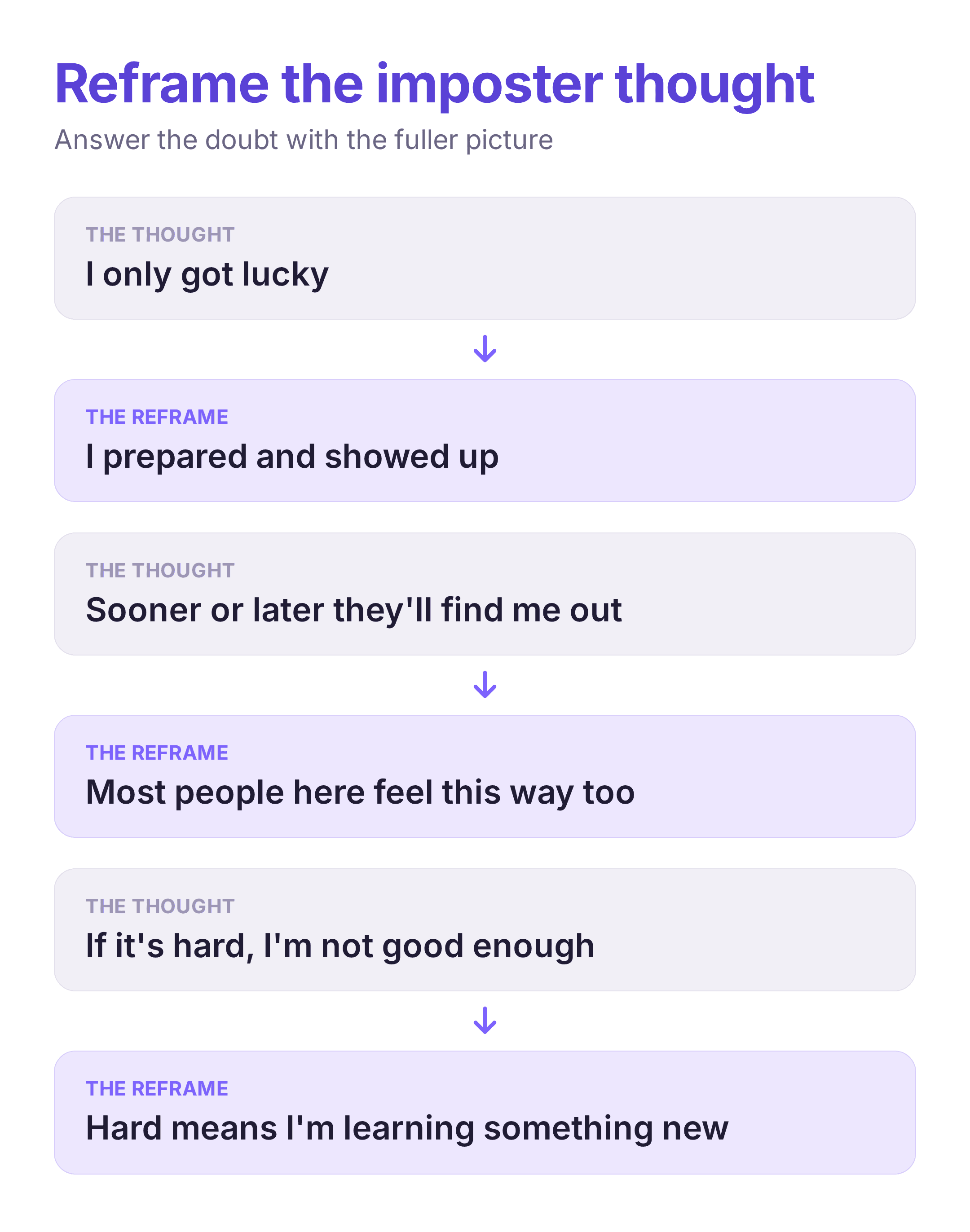
Much of imposter syndrome runs on an impossible bar. Decide what "good enough" looks like for a given task, aim for that, and treat a finished job as a success in itself. When competence means doing solid work instead of never making a mistake, most of the fear of being caught out falls away.
Asking for input is what capable people do. Let others help, and when something goes well, practice saying "thank you" instead of explaining why it wasn't really you. If confidence is the harder piece for you, our team's post on how to build confidence walks through habits that make it steadier over time.
Feeling out of your depth is a normal part of growth, not a sign you've made a mistake. The discomfort usually means you've stepped up to something bigger, and it tends to fade as you gather evidence in the new role. Knowing it's coming makes it far less alarming when it does.
Imposter syndrome is a habit of thought, and habits can change. You probably won't silence the doubt completely, and you don't need to. It helps to catch the feeling for what it is, check it against the facts, and take the next step anyway. Over time, as the evidence of your own competence piles up and you keep showing up despite the doubt, that inner voice gets quieter and easier to work with.
No. Imposter syndrome is a common pattern of self-doubt, and it isn't a clinical diagnosis. When it's severe, though, it can feed anxiety or low mood, and if it's affecting your wellbeing, talking to a mental health professional can help.
Psychologist Valerie Young describes five: the Perfectionist, the Superperson, the Natural Genius, the Soloist, and the Expert. Each one measures worth by a different impossible standard, from flawless results to never needing help.
Almost anyone can. It's especially common among high achievers, people starting new roles, and anyone who is the "first" or "only" of their background in a room. Feeling capable on paper doesn't protect you from it.
For most people it comes and goes rather than disappearing for good, often flaring up around new challenges. The goal isn't to erase it but to recognize it quickly and keep moving, so it has less say in your decisions.
If you regularly credit your success to luck, fear being "found out," and struggle to believe positive feedback despite real evidence you're doing well, those are the core signs of imposter syndrome. It's the gap between how capable you clearly are and how much of a fraud you feel.