RiseGuide Team
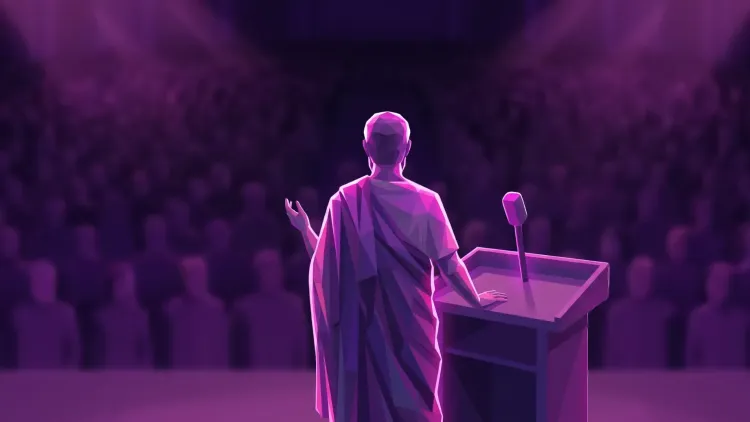
The greatest speeches of all time endure because each one rests on a single rhetorical move a listener can feel in the moment: Lincoln's tricolon at Gettysburg, Churchill's climactic list in 1940, Kennedy's reversal in his inaugural, King's repeated "I have a dream," Mandela's resolved final line at his trial, Earl Spencer's one-word turn at Diana's funeral, and Steve Jobs telling three stories at Stanford. Reduce any of them to its mechanics and you find a pattern of words, a deliberate silence, or a sentence built to pivot — a choice the speaker made on purpose and one you can borrow.
We keep returning to a small set of speeches. We quote them at graduations, play them in classrooms, and cue them up when we want to feel something. What we rarely do is ask why a particular speech still lands generations after the room emptied. Behind almost every one of the most famous speeches in history sits a specific, repeatable decision — a rhythm, a reversal, a pause held a beat longer than feels comfortable — and that decision is what does the work.
Great speaking looks like a gift when you watch it and turns out to be a craft when you look at it closely. The speeches people rank as the best speeches of all time rarely share a subject, a century, or a temperament. What they do share is a handful of structures that rhetoricians named a long time ago and that still move listeners for reasons researchers can now describe.
Repetition is the most visible of these. Repeating a word or an opening phrase gives an audience a rhythm to lean on and makes an idea easier to remember, an effect studied under the heading of repetition as a persuasive tool. Grouping ideas in threes has a pull of its own: a set of three feels complete, while a fourth item tips into overload, which is roughly what Suzanne Shu and Kurt Carlson found in their 2014 Journal of Marketing study, When Three Charms but Four Alarms (a landmark finding, now more than a decade old). And silence carries weight that words can't; a well-placed pause tells the audience that what came before, or what comes next, deserves attention, which is why guides on effective pauses treat them as part of delivery rather than gaps in it. The pause lives in the voice, so it improves with the same work as pitch and pace - the kind covered in our guide to improving your speaking voice.
Athens was a year into the Peloponnesian War when Pericles rose to honor the first soldiers who had died in it. Rather than open with grief or a call to arms, he spent much of the address praising the democratic values that made Athens worth defending, and only then turned to the dead and the living they left behind. No transcript survives; what we have is the version recorded by the historian Thucydides, so it is best read as his reconstruction of the speech rather than a verbatim record.
The technique is to establish common ground before making any request. An audience that has just been reminded of what it believes is far more receptive to being asked for something in the name of those beliefs. Try it before your next persuasive ask: write two sentences naming a value you and your listeners already share, and say those first.
Sojourner Truth spoke at the Women's Rights Convention in Akron, Ohio, and the version most people know - built around the repeated challenge "Ain't I a woman?" - is powerful and also unreliable. That wording comes from Frances Gage's account published twelve years later, in 1863. The earliest surviving transcript, taken down by Marius Robinson in 1851, doesn't contain the refrain at all, and you can compare the two versions side by side. It's a useful reminder that some of history's most quoted lines were shaped by later hands.
The technique the Gage version made famous is the rhetorical question used as a refrain: a question the speaker has no intention of having answered, returned to again and again until it becomes an accusation. Repetition turns a single question into a drumbeat. To practice, take the one objection you most want an audience to feel the weight of, phrase it as a short question, and repeat it verbatim after each piece of evidence.
Invited to speak on Independence Day, Douglass used the occasion to draw a line between his audience and himself. "This Fourth July is yours, not mine. You may rejoice, I must mourn," he told the assembled crowd, refusing the shared celebration the day assumed. The National Museum of African American History and Culture holds the fuller context of the address.
The move is strategic contrast: setting "yours" against "mine" and "rejoice" against "mourn" so the gap between two experiences becomes impossible to ignore. Contrast forces a listener to hold two things at once and feel the distance between them. To try it, take a claim you want to sharpen and write its opposite directly beside it in a matched sentence, so the two halves mirror each other.
Lincoln spoke for about two minutes, following an orator who had gone on for two hours. "Four score and seven years ago our fathers brought forth, upon this continent, a new nation, conceived in Liberty, and dedicated to the proposition that all men are created equal," he began (quoting here from the Bliss copy, the version Lincoln wrote out last and signed). He closed on a phrase built in three: government "of the people, by the people, for the people."
Two techniques carry the address. The first is brevity, which forces every word to earn its place. The second is the tricolon, that group of three whose completeness researchers have tied to how three items charm where four overload. To practice both, take your closing line and rewrite it as three parallel phrases, then cut the surrounding paragraph in half.
Three days into his premiership, with France collapsing, Churchill offered the House of Commons no comfort. "I have nothing to offer but blood, toil, tears and sweat," he said. The line is one of the most misquoted in the language: people routinely render it as "blood, sweat and tears," which changes both the words and their order and flattens the rhythm Churchill built.
The technique is the climactic list, a run of items arranged so the weight lands on the sequence itself. Four short, hard nouns in a row hit differently than any one of them alone, an effect close to the persuasive pull of repetition. To try it, find the single demand at the heart of what you're saying and stack three or four plain, concrete words in front of it, shortest to heaviest.
John Kennedy's inaugural gave the twentieth century one of its most repeated sentences: "And so, my fellow Americans: ask not what your country can do for you-ask what you can do for your country." The line works by turning back on itself, swapping the order of its own key terms in the second half.
Rhetoricians call this chiasmus, or antimetabole: reversing the structure of a phrase to flip its meaning. The symmetry makes the sentence feel discovered rather than written, as though the idea could only have been put this one way. It takes practice to build cleanly, so start small: take a sentence of the form "A does B," then write its mirror, "B does A," and keep only the version that says something true.
Standing at the Lincoln Memorial, King returned to four words until they became the spine of the speech: "I have a dream that my four little children will one day live in a nation where they will not be judged by the color of their skin but by the content of their character." He had planned to move on; he kept the phrase because the crowd responded to its return.
The device is anaphora, the repetition of the same words at the start of successive clauses, and it is among the most studied moves in rhetoric for good reason. Each repeat builds anticipation and welds separate images into one argument. To practice, pick a three-word opening - "I have," "We will," "No more" - and begin four consecutive sentences with it, letting the ending of each one change.
Facing a possible death sentence at the Rivonia Trial, Mandela spoke for hours and ended on a single controlled sentence: "It is an ideal which I hope to live for and to achieve. But if needs be, it is an ideal for which I am prepared to die." After a long, measured argument, the calm of that final line is what carries.
The technique is the resolved close: building through reasoned, even understated material toward one committed sentence that leaves no ambiguity about where you stand. To try it, take your next presentation and write the last line first - one sentence stating the position you'd hold even if it cost you - then build everything before it as the case for that line.
Speaking at his sister's funeral in Westminster Abbey, Earl Spencer built a sentence that pivoted on a single word: "a girl given the name of the ancient goddess of hunting was, in the end, the most hunted person of the modern age." The word "hunting" returns as "hunted," and the whole meaning turns with it.
This is antithesis sharpened to a point - what many speakers simply call the turn, where one repeated or inverted word carries the emotional weight of an entire idea. It rewards restraint, since the effect depends on the listener catching the flip themselves. To practice, look for a word in your draft that could return later in an altered form, and rebuild the sentence so the second use answers the first.
Jobs organized his entire commencement address around a simple promise: "Today I want to tell you three stories from my life. That's it. No big deal. Just three stories." He kept it, closing on the borrowed line "Stay hungry. Stay foolish," and along the way offered the observation that "you can't connect the dots looking forward; you can only connect them looking backwards."
Two techniques run underneath it. The first is the power of three again, this time as the scaffolding for the whole talk. The second is narrative itself: telling a story rather than listing points pulls listeners into a state researchers call narrative transportation, where they follow along as participants instead of judges. It's the same instinct behind the way modern communicators like Simon Sinek build an argument around a story rather than a slide of bullet points. To practice, take your next update and replace the opening summary with a thirty-second story of one specific moment, then let the point emerge from it.
Line up these speeches by date and something becomes clear: the same small set of techniques keeps reappearing. A Greek statesman, a nineteenth-century abolitionist, and a technology founder reach for repetition, contrast, threes, reversal, and the pause, separated by thousands of years and using them for entirely different ends. That recurrence is the encouraging part of studying the greatest speeches of all time, because a move that shows up again and again across centuries is a learnable pattern rather than a personal magic that a few people are born with. You don't need to master all of them. Pick the one that fits the next thing you have to say, run the drill a few times, and use it once for real.
A speech tends to be remembered when a clear idea meets a technique that makes it land and stick — repetition, contrast, a group of three, a reversal, or a pause used deliberately. Fame and occasion help, but the best speeches of all time almost always turn out to have a specific structural choice at their core.
There's no single answer, though Martin Luther King Jr.'s "I Have a Dream" tops many scholarly rankings of the most famous speeches of the modern era, including the well-known 1999 survey of communication scholars behind American Rhetoric's list. Lincoln's Gettysburg Address is its most common rival among the most famous speeches in history.
Probably not in those words. The refrain comes from Frances Gage's 1863 account, written twelve years after the 1851 speech. The earliest transcript, by Marius Robinson, doesn't include it.
Anaphora, the repeated opening phrase, is the most forgiving. It needs no special phrasing — only the discipline to begin several sentences the same way — and its effect is immediate for both speaker and audience.