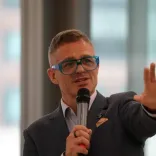
Ian Hawkins
Speaking and Storytelling Coach

The most common thing people say to me when they start coaching is some version of "I can't be a good speaker, I'm an introvert." They say it like a diagnosis, as though the matter is already settled and we should both just accept it. My honest view is that they have it backwards. Being an introvert isn't what holds you back on stage; it's one of the biggest advantages you can walk on with, and most people have simply never been told what it's for.
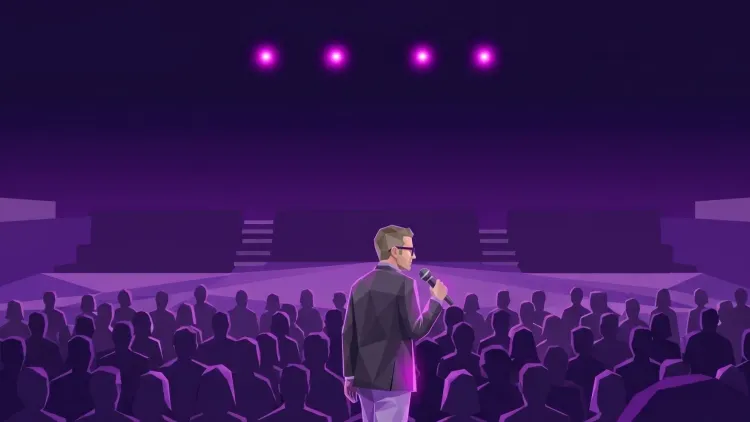
Most nervous speakers go wrong before they've said a single word, because they walk on thinking the event is about them. They're busy wondering how they look, whether they're good enough, and what the room makes of them. The more they turn the spotlight inward the heavier the whole thing becomes. The truth is that the most important person in the room is not the speaker, it's the audience. Your job is to work out what they want and then give it to them, and once you're doing that, the question of whether you personally feel impressive stops mattering, because you were never the point; you're there to serve the room.
An extrovert often assumes that whatever they bring will be enough, that their presence alone will carry the day, so they don't go looking for what the audience actually needs, and when it doesn't land they have a long way to fall. An introvert is already wired to watch a room, to read it, to notice what people are really responding to, which happens to be the entire job. The gift you thought you were missing has been there all along. You just filed it under shyness.
People tend to hear "introvert" and "performer" as opposites, and they really aren't. Freddy Mercury is the example I always come back to. On stage he was a rock god, a role that he kept playing offstage, throwing enormous, legendary parties. But when the party was in full swing, he often wasn't in the middle of it at all; he'd be upstairs somewhere with a cup of tea while it carried on downstairs. People would say what a rock star he was for throwing parties like that, not realizing he wasn't even at them.
There's a lot of freedom in that. Freddy Mercury wasn't literally a rock god, he just played one brilliantly, because he understood exactly what the audience had come for and gave it to them completely. You can work the same way. You step into the shoes of whoever the moment needs, you deliver, and then you step back out, go home, and put the kettle on. Nobody is asking you to become a different person, only to play a part well in service of the people in front of you.
That same reframe is the most useful thing I know for imposter syndrome, which tends to be the introvert speaker's constant companion. When you feel like a fraud, the instinct is to close the gap by trying to become whatever you imagine the audience expects, and that's a losing game, because you end up chasing a version of yourself that doesn't exist. The way out is to change the question entirely. Instead of asking how you become what they think you are, ask what this audience actually wants and what you can give them. If they want information, know your information cold. If they want a bit of pizzazz and showmanship, write yourself a fun introduction and deliver it with some panache. Either way you've taken an impossible problem about your identity and turned it into a practical one about your preparation, which is something you can actually solve.
It also helps to take yourself a little less seriously. I used to open my stand-up sets with the line, "Hello, it's nice to see you all, here are some jokes I've remembered," which undersells things, but it's honest, and it's roughly what the job is. When Jimmy Carr was asked the secret to being a good comedian, he said that in his case it was a good memory, since he tells five hundred jokes a night. Even the people who look completely effortless are usually just well prepared and pointed firmly at the audience rather than at themselves.
Being genuinely yourself on stage is worth more today than it was a few years ago, and there's a clear reason for it. We're all drowning in AI-generated everything, and for all the volume it produces, the one thing it reliably turns out is mediocrity, the kind of writing and speaking that's competent and smooth and instantly forgettable. That has actually moved the bar for standing out in your favor. If you bring the small, specific, slightly odd thing that only you would say, that quality is what rises to the top. There are no mediocre people, only people who haven't yet found the part of themselves they can put in front of an audience and feel justified in charging for.
I've coached people who spent years convinced their quietness ruled them out, and watched that same quietness become the reason a room leaned in. The watching, the noticing, even the discomfort with being the loudest voice were never the handicap they took them for; they were the talent, sitting unused and waiting for somewhere to point. The diagnosis those speakers walked in with had it upside down. Being an introvert was never the thing keeping them off the stage, it was the very thing that qualified them for it.