
RiseGuide Team
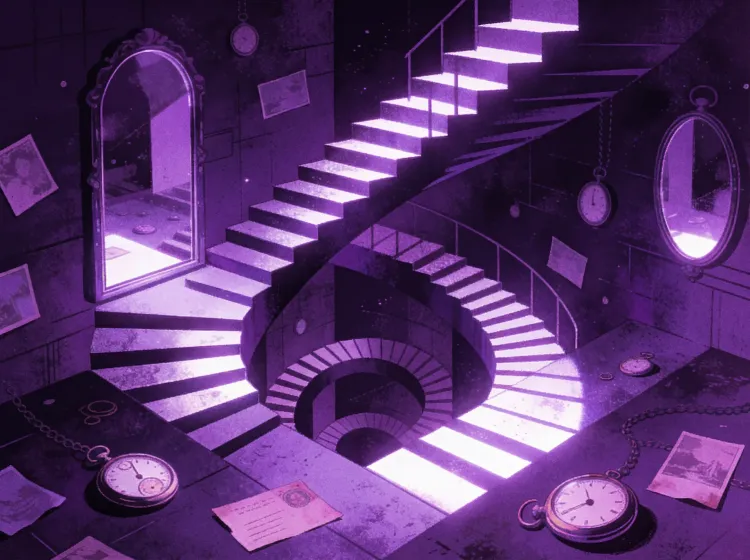
Unless you’ve been diagnosed with a condition, chances are you do not have a bad memory. Your memory is operating exactly as it was evolutionary designed to operate, and you might be trying to force it to do something that goes against its nature.
Most of us treat our brains like a junk drawer: we toss in names, dates, and to-do lists, shake the drawer, and then wonder why we can’t find anything when we need it. But your brain is not designed to memorize abstract data lists.
It is, however, exceptionally good at remembering locations and orientating in a new geographical area. This was encoded in our brains by evolutionary design: for survival, our ancestors needed to remember where food was, where danger was, and how to get home — skills that relied on spatial memory.
One of the most powerful tools for leveraging our tendency toward spatial memory is the Memory Palace technique, also known as the Method of Loci (Latin for “places”). It is not a new hack; it is an ancient spatial mnemonic system originated in Ancient Greece and also used by Roman orators to deliver hours-long speeches without notes.
It works because it stops treating information like abstract text and starts treating it like physical geography — working with your brain and not against it.
The Memory Palace technique, or the Method of Loci, is a visualisation strategy that pairs the things you want to remember (abstract data) with a place you already know perfectly (spatial reality).
This technique uses a familiar physical location (like your home or a route) as a mental “map” to store and recall information by associating items with specific spots (loci) within that space. You create vivid, imaginative links between the information and locations, then mentally “walk” through the palace to retrieve the data.
You don’t need to “study” the layout of your home to know where the bathroom is. You don’t need flashcards to remember your commute. That spatial data is hardcoded.
The Memory Palace technique hacks this hardware; it essentially creates a file folder system using the rooms and furniture of a familiar place.
The technique relies on two specific levers: Location and Vividness.
Jim Kwik, a brain performance expert, describes this as “pegging.” You need a secure hook (the location) to hang the coat (the memory) on. If the hook is weak, the coat falls.
But the coat itself matters, too. Derren Brown, the psychological illusionist, argues that we are programmed to ignore the mundane. If you place a normal item in a normal room in your mind, it blends in. To make it stick, the image must be highly emotional, bizarre, or grotesque.
Building a memory palace is, as Jim Kwik puts it: “Easy as PIE: 1. Place that will be your memory palace; 2. Image of what you want to remember; 3. Entwine — you put those two things together.”
You do not need to be a memory champion to use this! You just need five minutes and a room.
1. Select Your Blueprint. Choose a place you know intimately. Your current home is the best starter palace.
Derren Brown suggests: “It could be your street; it could be the walk from the subway station to your house. All you need along that area are a few set points that you can remember without having to think about it.”
2. Define Your “Loci” (Stations). Pick 5–10 distinct anchor points along that route. These act as the “files.”
3. Convert Data to Imagery. Let’s say you need to remember a grocery list: Eggs, Milk, Batteries, Spinach.
4. Place the Images. Walk the route mentally:
5. The Recall: To retrieve the list, you simply walk the path. You don’t ask, “What was item three?” You ask, “What is on the fridge?” The image of the batteries will appear instantly.
When people claim this technique doesn’t work for them, they are usually committing one of three errors:
The Memory Palace technique isn’t just about remembering groceries or impressing friends at parties but trusting your memory with confidence.
When you know you can store information at will, you stop feeling anxious about “going blank” in high-pressure situations. You stop outsourcing your recall to your phone.
At RiseGuide we believe that memory is not a talent you are born with. Memory is a skill you can develop.