
RiseGuide Team
There is no shortage of advice on how to improve yourself.
Type any question into a search engine — how to focus better, how to speak more confidently, how to make faster decisions — and you’ll get hundreds of thousands of results. Articles written for clicks. Lists optimized for rankings. AI-generated summaries of AI-generated summaries.
The volume isn’t the problem. The signal-to-noise ratio is.
Most of what surfaces is generic by design. Search algorithms reward content that appeals to the widest possible audience, which means advice tends toward the obvious: believe in yourself, stay consistent, build good habits. Not wrong, exactly. But not useful either.
General-purpose AI tools have the same limitation in a different form. Large language models are trained on the averaged-out content of the internet. When you ask them a specific question about personal development, they tend to produce responses that are plausible and coherent — but drawn from that same averaged-out pool. They don’t hallucinate in the dramatic sense people imagine. They just give you the middle of the distribution when what you actually need is the edge of it.
This is the problem SEEK was built to solve.
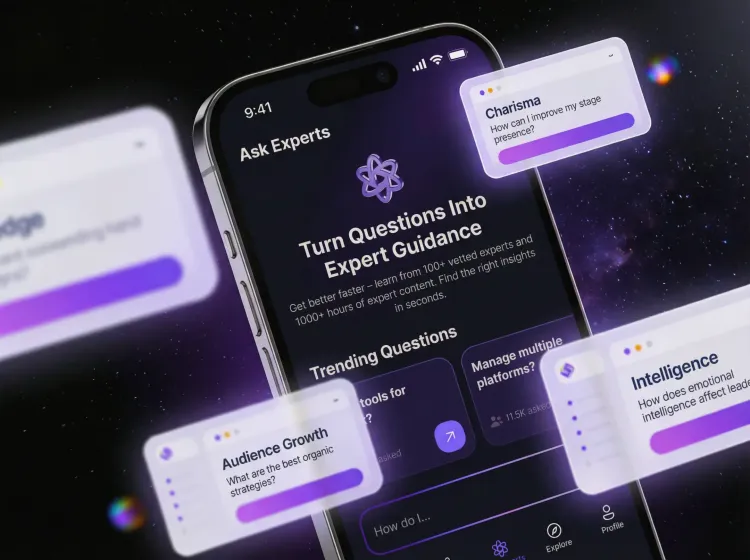
SEEK — Search Engine for Expert Knowledge — is a feature inside RiseGuide that works as a closed-loop knowledge engine. Rather than querying the open web or generating probabilistic responses, it draws exclusively from a curated library of publicly available work by over 300 verified experts: behavioral scientists, cognitive psychologists, Nobel laureates, leadership researchers, memory specialists, communication coaches, and habit formation researchers, among others.
Every source in the library has been hand-selected and vetted by RiseGuide’s team. If a topic isn’t covered by the library, SEEK says so rather than inventing an answer.
The result is a search experience that works differently from anything you’re used to. Not broader — narrower. Not more results — better ones.
When you ask SEEK a question, you receive a layered response built from verified sources within seconds.
The answer begins with video evidence — the exact clip and timestamp where a specific expert addresses your question directly. Not a paraphrase, not a summary of what someone once said. The source itself, so you can verify it.
From there, you get an executive summary: a concise synthesis of the key insight for when you need the answer quickly. If you want to go further, a deep dive provides the full sourced answer with links to every original piece of content referenced.
The final component is what SEEK calls the insight — a single, specific action you can take immediately to apply what you’ve just learned. Because information without application tends to stay information.
Once you have your answer, SEEK surfaces related questions designed to help you explore the nuance of the topic further. A single question can become a genuine thread of understanding rather than a one-off lookup.
The instinct when building a knowledge tool is to make it as broad as possible. More sources, more coverage, more flexibility.
SEEK deliberately goes the other way. The closed loop — drawing only from verified experts rather than the open web — is the feature, not a limitation.
It means responses are source-attributed by default. It means the framework behind any given answer can be traced back to a specific person whose methodology has produced documented results. And it means the system can acknowledge gaps honestly rather than filling them with something that sounds plausible.
As RiseGuide’s CEO Oleksandr Matsiuk put it at launch: “You type a question into Google and get a million results that contradict each other. You ask ChatGPT, and it gives you something that feels generic and vague. SEEK is different. Curated sources, trusted answers, content optimized for value rather than keywords, no ads or promotions.”
SEEK works best when you’re in the middle of something specific — a challenge you’re trying to think through, a skill you’re actively developing, a situation where you need a grounded answer rather than a general overview.
It integrates with RiseGuide’s structured learning tracks, which currently include communication and executive presence, and intelligence training covering memory, focus, and cognitive performance. Questions asked within those contexts tend to produce the most directly applicable responses.
It’s less suited to broad exploratory research or topics that fall outside its expert library. The scope is intentional: SEEK is built for depth in specific domains, not breadth across all of them.
The self-improvement industry is large and growing. It’s also, by most measures, not working particularly well — completion rates for personal development programs remain low, and generic advice rarely produces lasting change.
Part of the reason is that most available content is optimized for discovery rather than application. It’s designed to be found, not to be used.
SEEK is an attempt to close that gap — to make the kind of specific, expert-grounded, immediately applicable knowledge that used to require knowing the right people accessible on demand.
It’s available now to all RiseGuide premium subscribers on iOS and Android.