RiseGuide Team

If you’ve been searching for a self-improvement app, you’ve likely come across these three platforms: Mindvalley, Masterclass, and RiseGuide. Three very different methodologies and bets on how people learn and grow.
The question is not which platform has the biggest name attached to it, but which model produces real, measurable change for people with busy schedules, tangible goals, and a limited tolerance for content they will never finish. This comparison tries to answer that question and covers learning format, course depth, expert methodology, AI capabilities, and pricing — so you can make the right decision based on where you actually are.
MasterClass is a video-first learning platform offering 200+ courses taught by individually named celebrity instructors — think Gordon Ramsay on cooking, Chris Voss on negotiation, or Shonda Rhimes on storytelling. The experience is polished, cinematic, and largely passive.
Mindvalley is a personal transformation platform built around intensive guided programs it calls Quests. Each Quest is led by a named instructor and runs between 15 and 42 days, with daily sessions typically lasting 20 minutes or more. The platform places strong emphasis on community, live events, and what it describes as whole-life transformation — spanning mindset, relationships, health, and spirituality alongside professional skills.
RiseGuide is a mobile-first structured learning app designed around daily skill-building. Its content is synthesized from the publicly available work of over 300 experts — including behavioral scientists, Nobel laureates, memory researchers, leadership authors, habit formation specialists, and business strategists — hand-selected and vetted by RiseGuide's team. Rather than presenting a single instructor's perspective, each Journey distills multi-disciplinary expert knowledge into short, actionable daily lessons (7 to 10 min a day) built for application, not just comprehension.
MasterClass operates on a passive consumption model. Think Netflix for binge-watching education instead of the latest show. There is no structured progression between courses, no exercises tied to lessons, and no accountability/feedback mechanism built into the core product. You watch high-quality video content at your own pace. The platform has recently added AI-powered features (more on those below), but the core experience remains self-directed video watching. Completion rates for passive video courses are notoriously low across the industry — the content quality is high, but the behavioral transfer is limited without structure.
Mindvalley's Quest format improves on this meaningfully. Daily lessons are sequenced, sessions are intentionally short, and community accountability adds a social layer. However, sessions run 20–45 minutes, live events require up to a full weekend commitment, and the platform's emphasis on transformational depth makes it better suited to people who can invest significant daily time. It also revolves around spiritual concepts which for some people may be hard to grasp.
RiseGuide is built around a different assumption entirely: that consistent 7–15 minute daily sessions, tied to immediate application, compound faster than occasional deep immersion. Every lesson is followed by a framework, checklist, or an interactive exercise. Flashcards reinforce retention, and the repetition is built into the program curriculum. Quizzes and milestones make progress visible. The structure is designed so that ideas become habits rather than content that sits passively in memory.

The clearest way to understand what separates these three platforms is to look at how they handle the same skill areas. Communication and intelligence training are two of the most searched and most commercially relevant topics in self-improvement in 2026 – and the gap between platforms is significant.
MasterClass offers individual courses from notable instructors: Chris Voss on negotiation, Esther Perel on relationships, and various authors on writing. Each course reflects one person's approach in depth. The limitation is inherent in the model – you get one perspective, delivered as video, with no practice mechanism. There is no way to apply a negotiation framework during the lesson itself, and no structured path from one communication skill to the next. So whether or not the user will actually test the concept she just listened about becomes reliant entirely on her inherent motivation to improve and put things in practice.
Mindvalley's Speak & Inspire Quest (Lisa Nichols) is a 30-day structured program focused on public speaking, confidence, and communicating with presence. It is community-supported, sequenced daily, and includes live sessions. Mastering Authentic Networking (Keith Ferrazzi) is a 21-day program covering influence, charisma, and relationship-building. Both are well-regarded. The experience is richer than MasterClass but demands more time and works best for users motivated by instructor personality and community energy.
RiseGuide's Communication Mastery Journey synthesizes insights from across its expert library spanning communication researchers, executive coaches, and leadership authors — into a structured daily progression that takes away the guesswork around what to learn about next. Each session moves through a specific micro-skill: clarity of speech, negotiation frameworks, emotional intelligence, presence, confidence, public speaking. The lesson-to-exercise structure means users practice what they learn the same day they learn it — which research consistently identifies as the critical mechanism separating passive content consumption from genuine behavioral change. As Ericsson et al. established in their landmark work on deliberate practice (Psychological Review, 1993), structured effortful practice, not passive exposure, is what drives lasting skill acquisition.
MasterClass does not offer a dedicated cognitive skills track. Thinking, strategy, and decision-making appear as themes within broader business or leadership courses, but there is no structured path for building memory, critical thinking, or analytical reasoning as standalone skills.
Mindvalley's Superbrain Quest, led by Jim Kwik, is one of its most popular programs – a 30-day course covering memory techniques, speed reading, focus, and brain performance. It is single-instructor, well-structured, and benefits from Kwik's strong personal brand in the cognitive skills space. For users specifically interested in memory and learning, it is a credible option.
RiseGuide's Intelligence Training Journey covers memory, critical thinking, decision-making, and analytical reasoning as a connected progression rather than a single-instructor course. The content draws from neuroscience, behavioral economics, cognitive psychology, and productivity research synthesized across multiple expert sources and delivered as daily structured practice - including the frameworks by Jim Kwik. The goal is not to just teach about intelligence but to build it through repeated application.
MasterClass anchors its credibility in named celebrity instructors. The trust signal is recognition: you know who Gordon Ramsay or Malcolm Gladwell is, which makes it easy to commit. The limitation is that knowledge becomes single-source. Each course reflects one person's methodology, experience, and perspective — which can be brilliant, but also narrow.
Mindvalley uses its own roster of named instructors and thought leaders, many of whom are exclusive to the platform. Instructors like Jim Kwik, Lisa Nichols, and Vishen Lakhiani have built strong personal brands within the self-development space. The trust model is similar to MasterClass — you are buying into an individual's approach.
RiseGuide takes a structurally different position. Its content is synthesized from the publicly available work of over 300 experts, and each source is hand-selected and vetted by RiseGuide's team. This means no single point of failure, no ideological narrow-casting, no reliance on the fame of the author, and no dependency on any one instructor's continued involvement. What users get is the distilled, cross-disciplinary consensus of a wide expert field, structured for application rather than entertainment.
AI has become a competitive battleground for learning platforms. But not all AI integrations are built the same way, and the distinction matters for users trying to build real skills.
MasterClass has moved aggressively into AI features. MasterClass On Call (currently in beta) layers AI-powered roleplay, feedback, and real-time coaching on top of existing courses. MasterClass Executive is described as an AI-native experience for working professionals. The platform also recently launched a Certificate course with Microsoft on AI leadership. These are meaningful additions, but they are being layered onto a core product that remains a video catalog – the AI features enhance the experience rather than redefine it.
Mindvalley has incorporated AI primarily as a subject of study rather than a product feature. Its Amplify with AI program is a 21-day quest on using tools like ChatGPT and Midjourney for content creation and productivity. AI Mastery offers deeper certification-level training. The platform's learning delivery itself — live quests, community forums, live events — remains instructor and community-driven. AI is what Mindvalley teaches, not primarily how it teaches.
RiseGuide's AI layer is built into the core learning experience through SEEK – an expert knowledge search engine embedded in the app. Rather than generating responses from a general-purpose AI model, SEEK surfaces answers drawn directly from RiseGuide's vetted expert library. Users can ask questions within their learning domain and get responses grounded in trusted, curated source material rather than algorithmically produced text. SEEK integrates with the structured Journeys — so when a user hits a specific challenge during a communication or intelligence training module, they can query SEEK and get an expert-backed answer relevant to where they are in the program. The distinction is meaningful: RiseGuide uses AI to make expert knowledge accessible on demand, not to generate content or replace expert judgment.
Note: All prices listed below are indicative and may vary depending on region, current promotions, and platform updates. Always verify pricing directly on each platform's website before subscribing.
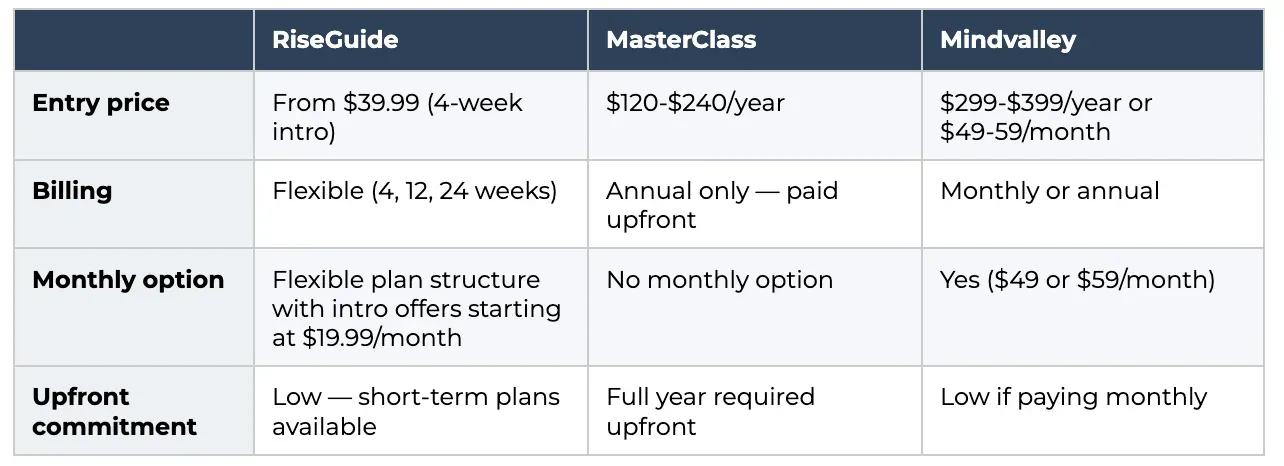
MasterClass requires a full annual payment upfront with no monthly option — the per-month figures on their site reflect the annual total divided by twelve. At $120/year for the Standard plan, it is affordable relative to its production quality, but the financial commitment is front-loaded regardless of how much you use it.
Mindvalley's monthly option ($49/month) really only makes sense if you use it continuously, meaning you enroll in a new 30-day course each month – otherwise the cost is quite hefty. Some flagship Mindvalley programs, including WildFit, Lifebook, and advanced certifications, are not included in the standard membership and require separate payment.
RiseGuide's shorter plan structure (4, 12, or 24 weeks) reduces financial commitment risk for users who want to test the format before extending. Introductory promo pricing for a 4-week plan starts around $19.99 (regular price $39.99), which gives access to a full structured Journey before any longer-term decision is required.
MasterClass is designed for longer viewing sessions. The platform is available across desktop, tablet, mobile, Apple TV, Android TV, and Roku — which reflects its positioning as a content experience you settle into rather than a daily mobile habit. Users who carve out 30–60 minutes regularly can get significant value. For those who cannot, the content tends to accumulate unwatched.
Mindvalley's daily quest sessions run 20–45 minutes. Add live events and community engagement and the time demand is real. The platform is rewarding for users who can treat personal development as a significant daily priority — but it is not built for the genuinely time-constrained.
RiseGuide was designed specifically for schedules where 10–15 minutes is the realistic window. Mobile-first, no desktop dependency, no live sessions to schedule around. The structured Journey format means every session builds on the last — so a short daily habit compounds meaningfully over weeks rather than requiring periodic intensive blocks.

Based on recent Reddit conversations, there’s a growing interest among potential users to understand how these apps compare and what works best.
MasterClass works best for users who want inspiration, craft-level insight, or deep exposure to a specific person's methodology — and who have the discipline to self-direct their own learning path. It is less suited to users who need structured behavioral change, daily accountability, or a clear progression from one skill to the next.
Mindvalley works best for users who want immersive, whole-life transformation and are energized by community, live interaction, and instructor personality. It is less suited to time-constrained learners, those who prefer mobile-first formats, or those looking for focused cognitive and communication skill-building without the broader spiritual and lifestyle framing.
RiseGuide works best for users who want structured, incremental skill-building — particularly in intelligence, communication, and habits — and whose schedules demand consistency over intensity. It is the right fit for people who have tried passive courses before and found that inspiration alone does not produce lasting change.
The most common mistake is choosing based on name recognition alone. A platform's ability to attract celebrity instructors or build community does not correlate directly with how much a user will improve. Format and structure determine outcomes more than brand. A second mistake is underestimating the time commitment before subscribing. Each of these platforms has a different implied daily investment — and the one that fits your actual schedule will deliver more value than the one with the most impressive catalog. The third mistake is treating any learning platform as passive entertainment and expecting active results. Content consumption and skill development are not the same thing. Platforms that build application into the learning experience close that gap; platforms that do not leave it entirely to the user.
These are three different bets on how people grow. MasterClass is a world-class content library built around recognizable names — strong on inspiration, limited on structure. Mindvalley is a transformational community platform — deep and immersive for users who can commit, demanding for those who cannot. RiseGuide is built on a different premise: that real skill development happens through short, structured, daily practice informed by the best available expert knowledge — not a single instructor's perspective, not passive video consumption, and not inspiration that fades before the next session.
For users whose goal is to measurably improve how they think, communicate, and make decisions – within the constraints of a real schedule – the format matters as much as the content. RiseGuide was built for that gap.
Learn more at https://riseguide.com/.